Complete guide
Focaccia: The Complete Guide
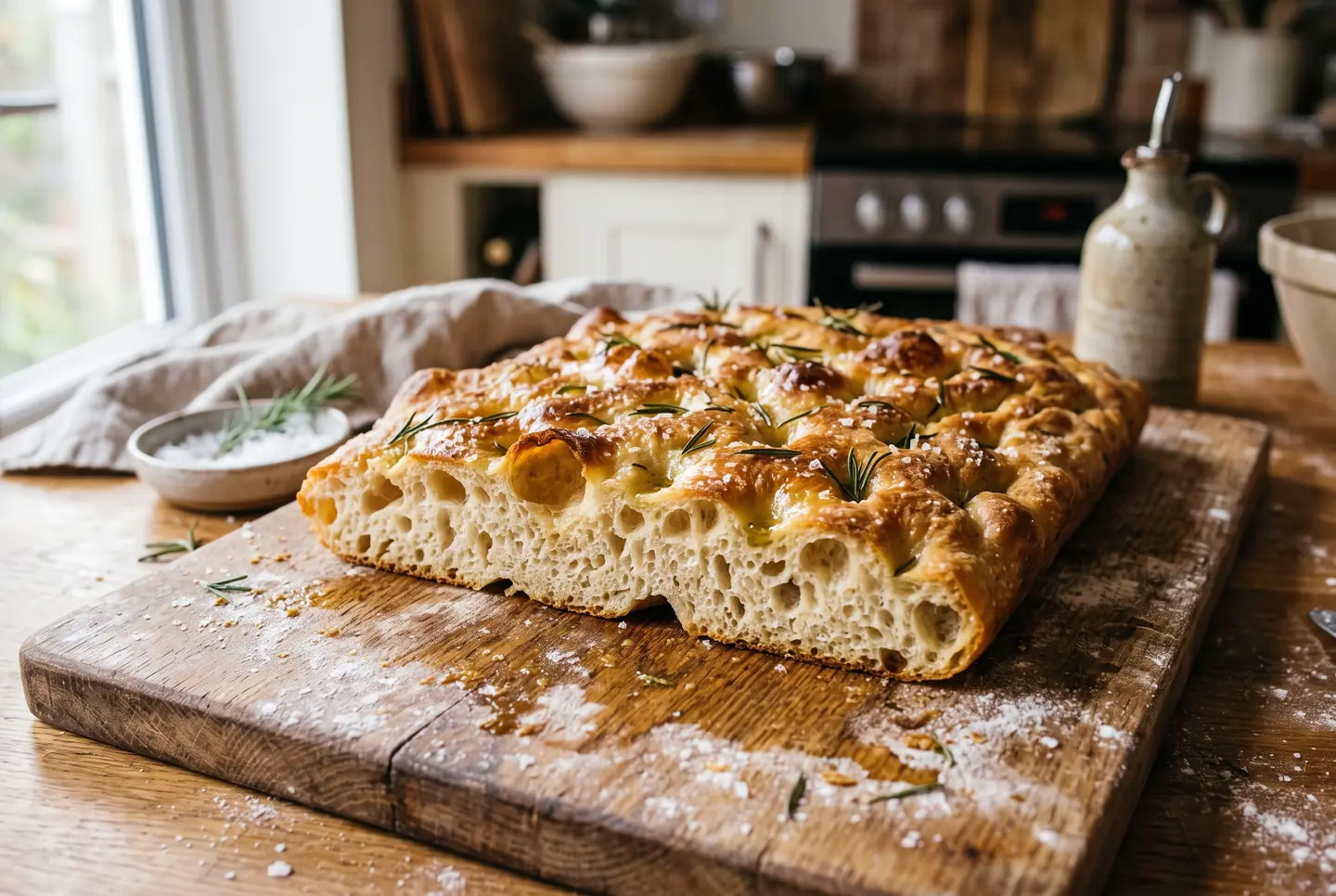
Focaccia is the friendliest bread in the Italian repertoire, and it is also the one most often ruined by good intentions. It is flour, water, salt, yeast and a lot of olive oil, and it asks for none of the shaping skill a boule or a baguette demands. You do not knead it hard, you do not slash it, you do not even really shape it: you pour it into a pan, dimple it with your fingers and bake it. And yet the two focaccias people bring home from a trip to Italy, the thin oily one from Genoa and the tall airy slab from a modern bakery, look almost nothing alike, and neither one comes out of most home ovens on the first try.
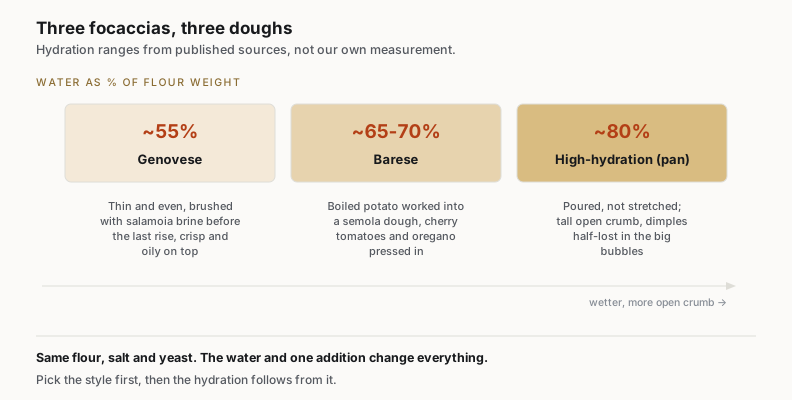
This guide is built around the small number of decisions that actually separate them. The first is how much water goes into the dough, because that single choice is what turns a thin, crisp genovese into a tall, open-crumbed pan focaccia. The second is the brine, the salamoia, that gets brushed on before baking and is the reason a real focaccia is golden and glossy instead of pale and dry. The third is the dimpling: when you press, how deep, and why those wells matter beyond looks.
Get those three right and everything else, the toppings, the sourdough version, the sandwich cut, is a variation on a dough you already control. By the end you will be able to look at a focaccia that came out hard, or greasy, or raw in the middle, and name the reason instead of guessing.
Focaccia: the recipe and the brine that makes the difference
The base is a lean dough with one thing most breads do not have: olive oil worked in, and much more of it brushed on. A dependable starting point is a strong bread flour, water at 70 to 80 percent of the flour weight, about 2 percent salt and a small dose of yeast, plus olive oil in the pan and on top. From there you adjust the water up or down depending on which style you are after, which is exactly what the full focaccia recipe with the salamoia brine, step by step lays out in weights you can scale.
Like most Italian breads, focaccia is written in baker's percentages, where the flour is always 100 percent and everything else is a share of the flour weight. That is what lets you scale from one pan to three without redoing the arithmetic, and it is how the styles in this guide are compared. Here is a dependable all-rounder formula, close to the widely used Baking Steel proportions of 700 g flour to 560 g water, 14 g salt and 2 g yeast, rounded to a single home pan.
| Ingredient | Baker's % | Example weight |
|---|---|---|
| Strong bread flour | 100% | 500 g |
| Water | 75% | 375 g |
| Salt | 2% | 10 g |
| Instant yeast | 0.6% | 3 g |
| Olive oil (in dough) | 4% | 20 g |
| Olive oil (pan + top) | to taste | generous |
Mix until there is no dry flour, rest, then give it three or four sets of stretch-and-folds in the bowl over the first couple of hours instead of kneading. Let it bulk ferment until nearly doubled, transfer to a well-oiled pan, proof again until puffy, dimple, brine and bake. That is the whole arc, and every style below is a deviation from it.
What almost nobody gets told is that the brine does most of the visible work. Salamoia is an emulsion of water, olive oil and salt, whisked together and poured over the dimpled dough just before the last rest or the oven. On a traditional genovese it is roughly equal parts water and oil with flaky salt (Italian Recipe Book), and it pools in the dimples, seasons the crust, and sets up the golden, crisp, faintly blistered top that a dry dough can never reach. Skip it and you have flatbread. Add it and you have focaccia.
| Element | What it is | What it does |
|---|---|---|
| Olive oil in the dough | 3 to 5% of flour weight | Tenderises the crumb, carries flavour |
| Olive oil in the pan | A generous film | Fries the base to a crisp shell |
| Salamoia (water + oil + salt) | Brushed on before baking | Golden glossy top, seasoned crust, soft interior |
The flour matters less than beginners fear and more than they hope. A strong bread flour, around 12 to 13 percent protein, gives the dough the strength to hold all that water and rise tall; a weak all-purpose flour can work at lower hydration but will struggle at 80 percent, going slack and tearing. If your focaccia keeps collapsing into a dense mat, the flour is one of the first things to check, right after the proof.
The high-hydration dough in a pan
The tall, open, bubbled focaccia everyone photographs is not a different recipe so much as a wetter one. Push the water to around 80 percent of the flour weight and the dough stops being something you handle and becomes something you pour. Baking Steel's well-known version runs 700 g flour to 560 g water, which is exactly 80 percent, with 14 g salt and just 2 g of yeast, left to bulk ferment slowly before it goes in the pan. GialloZafferano's high-hydration focaccia sits in the same territory.
That much water is what gives the crumb its big, glossy holes, and it is also why you never knead it: you stretch and fold it a few times in the bowl and let time build the structure. Instead of kneading, you wet one hand, reach under the dough, stretch it up and fold it over itself, turn the bowl a quarter and repeat, three or four times in the first two hours. Each set is gentler than the last as the gluten tightens. The dough goes from a shaggy soup to something smooth and elastic without your ever putting it on the counter.
The trade is that a wet dough is slack and sticky and needs a long, gentle fermentation to come together, so this is the style to make when you have a day, not an hour. Most reliable versions lean on a slow rise, whether a long room-temperature bulk or an overnight rest in the fridge, because time is what lets a barely-yeasted, very wet dough build flavour and strength on its own. The high-hydration focaccia method, from bowl to pan without a mess covers the folds and the timing that keep an 80 percent dough manageable.
The dimples: when and how to press
The dimples are not decoration. Pressing your fingers deep into a proofed focaccia does three things: it degasses the largest bubbles so the crumb bakes even, it creates wells for the oil and salamoia to pool and fry in, and it keeps the surface from doming into a loaf. Timing is the part people miss. You dimple after the dough has had its final proof in the pan, when it is puffy and jiggly, not before, and you oil your fingers first so they slide instead of tearing.
How deep? On a standard dough, press straight down until your fingertips reach the bottom of the pan. On a very high-hydration dough the dimples half-close and become less visible because the big air pockets swallow them, and that is normal, not a mistake. The one caution is to press with control rather than punching: on a delicate, well-risen dough you want to leave the wells without deflating the whole slab.
The reason the wells matter is what happens in them during the bake. Each dimple is a small reservoir that catches the oil and the salamoia, and because oil holds far more heat than air, those pockets fry the dough around them into little crisp golden craters while the raised ridges between stay soft. That contrast, crisp edge and tender crumb in the same bite, is a lot of what people love about focaccia and cannot get from a flat, undimpled slab. The full dimpling technique, timing and depth shows the moment to press and how to read the dough.
Focaccia genovese, the classic
The focaccia genovese, fugassa in the local dialect, is the original and in many ways the opposite of the Instagram slab. It is deliberately thin, around a centimetre and a half, and relatively low in hydration, about 55 percent, which gives it structure rather than a wild open crumb (Italian Recipe Book). Its signature is not the crumb at all: it is the salamoia flooding the dimples and the frank sweetness of good olive oil, baked until the top is crisp and the underside is fried golden by the oil in the pan. A malt or a spoon of honey often goes into the dough to help the colour.
It bakes hot and fast, around 230 C (450 F) for 15 to 20 minutes, because it is thin and you want the top to crisp before the whole thing dries out. This is the version to make when you want something to tear and dip in oil at a table, not a tall sandwich base. In Genoa it is an all-day food, eaten for breakfast dunked in a cappuccino, sold by weight from bakeries all morning, and it is meant to be greasy in the best sense, glossy with oil rather than dry. If your homemade genovese feels austere, it is probably too lean: more oil, in the dough and especially on top, is usually the answer. The step-by-step focaccia genovese, thin and salty walks through the salamoia ratio and the thinner roll.
Focaccia barese: potato in the dough
Travel south to Puglia and the focaccia changes character completely. Focaccia barese is built on a dough of durum semola blended with soft-wheat flour, and its defining move is a boiled, mashed potato worked into the dough. The potato holds moisture and starch that keep the crumb soft for days and give it a distinctive tender, almost springy bite that a straight wheat dough does not have. On top go halved cherry tomatoes pressed cut-side up, a scatter of dried oregano, coarse salt and olive oil, and it bakes until the tomatoes blister and the edges go lacy and crisp.
It is a useful style to know because it solves the single most common complaint about home focaccia, that it goes stale by the next morning: the potato is what buys it time. It is also a lesson in how much a single ingredient can redefine a bread. The genovese and the barese share the same four base ingredients, yet one is thin and brittle-crisp and the other is thick and pillowy, because of the water, the semola and that one boiled potato. The focaccia barese with potato in the dough covers the semola blend and how much potato to add without turning the dough gummy.
Focaccia with sourdough
If you keep a starter, focaccia is one of the best things to do with it, and it is the gateway many bakers use before attempting a proper loaf. Swapping commercial yeast for a lively sourdough starter gives the crumb a gentle tang and, crucially, buys the long, slow fermentation that a wet focaccia dough wants anyway. The high-hydration, no-knead, overnight-in-the-fridge rhythm of a good focaccia lines up almost perfectly with how a sourdough levain likes to work.
The one adjustment is time and dose: a starter leavens more slowly than a packet of yeast, so a sourdough focaccia is planned around an overnight bulk rather than an afternoon. The sourdough focaccia method and timing sets the starter percentage and the schedule so it is ready to bake when you are, not at three in the morning.
Gluten-free focaccia
Focaccia is one of the more forgiving breads to make without gluten, because it does not depend on the tall, elastic gluten structure that a sandwich loaf or a baguette needs. It is baked flat and supported by the pan, so a well-built gluten-free batter, wetter than a wheat dough and leaning on a binder like psyllium husk to hold gas, can give a genuinely good result rather than a sad crumbly square.
The pitfalls are specific: gluten-free doughs behave more like thick batters, they need that binder to trap the bubbles, and they are easy to overbake into something dry. The gluten-free focaccia that stays tender sets the flour blend, the psyllium ratio and the hydration that keep it soft.
Toppings: rosemary, tomato, grape and onion
The classic topping is the simplest: rosemary needles and flaky salt pressed into the oiled dimples, and for a lot of people that is the whole point of focaccia. But the surface is an invitation. Halved cherry tomatoes, thin-sliced onion softened so it does not burn, olives, and, in the autumn in parts of Italy, whole grapes for the sweet-savoury focaccia col'uva, all work beautifully.
The rule that keeps toppings from failing is about water and sugar. Wet toppings like fresh tomato release liquid that can steam the crust soft, so they go on cut-side up and sparingly; sugary ones like onion and grape burn if exposed, so they get pressed into the dough or added part-way through the bake. The guide to focaccia toppings that do not burn or go soggy sorts them by when to add each one.
Sandwich focaccia: the one that holds a filling
Focaccia makes a superb sandwich, but not every focaccia can. A very high-hydration, big-holed slab tears and leaks the moment you fill it; the sandwich focaccia you want is a touch lower in hydration and baked a little thicker and more evenly, so it has a close enough crumb to hold up to mortadella, or tomato and mozzarella, without falling apart or soaking through.
This matters because "focaccia sandwich" is a real and heavily searched thing, and the answer is not the same dough as the show-off pan focaccia. The focaccia built to be split and filled sets the hydration and the bake for a crumb that carries a filling.
Baking: oil, temperature and the crisp base
Focaccia lives or dies on two things in the oven: enough oil under it, and enough heat. The oil in the pan is not just non-stick, it shallow-fries the base into the crisp golden shell that defines a good focaccia, so be generous. Temperature runs hot, generally 220 to 250 C (about 425 to 480 F): the high-hydration versions bake around 230 C (450 F) for roughly 25 minutes (Baking Steel), the thin genovese around 230 C (450 F) for 15 to 20 minutes (Italian Recipe Book).
The base is where home ovens struggle, exactly as they do with pizza, because the crisp underside wants heat coming up from below. A metal pan conducts that heat far better than glass or ceramic, and setting it on a steel or heavy tray that has preheated with the oven gives the base a head start the moment the dough lands. Baking low in the oven, on that preheated surface, is the single most effective fix for a pale, soft bottom. The full baking guide: oil, oven position and getting a crisp base walks through temperature, rack height and the surface that browns the bottom.
| Style | Approx. hydration | Oven | Time |
|---|---|---|---|
| Genovese (thin) | ~55% | 230 C / 450 F | 15-20 min |
| High-hydration (pan) | ~80% | 230 C / 450 F | ~25 min |
| Barese (potato) | ~65-70% | 220-230 C / 425-450 F | 20-25 min |
Where it goes wrong: hard, oily or raw focaccia
Almost every failed focaccia is one of three things, and each has a clear cause. Hard and dense usually means the dough was under-proofed or too dry, so it never developed the airy crumb; give it more time and more water. Greasy and heavy is not too much oil so much as oil that never got hot enough to fry, which points back to the oven and the pan. Raw or gummy in the middle is under-baking, made worse by wet toppings steaming the surface soft before the inside sets.
| Symptom | Likely cause | Fix |
|---|---|---|
| Hard, dense, tight crumb | Under-proofed or dough too dry | Longer final proof; raise hydration |
| Greasy, heavy base | Oven or pan not hot enough to fry the oil | Preheat a steel; bake hotter and lower |
| Pale top, no colour | No salamoia brine, oven too cool | Brush the water-oil-salt emulsion; more heat |
| Raw, gummy middle | Under-baked; wet toppings steaming it | Bake longer; drier toppings, cut-side up |
The full troubleshooting guide for focaccia that comes out hard, oily or raw runs through every symptom in order.
How to store and reheat
Focaccia is best the day it is baked, but it keeps better than most lean breads because of all that oil, and the barese with its potato keeps best of all. For a day or two, store it at room temperature wrapped or in a bag rather than in the fridge, which stales bread faster. For longer, focaccia freezes very well: cool it fully, wrap it, and freeze, then reheat from frozen.
The reheat is where the crust comes back. A few minutes in a hot oven, not a microwave, revives the crisp top and base; the microwave makes it soft and leathery. The guide to storing and reheating focaccia so it crisps again covers the timing for room temperature, freezer and the oven refresh.
Frequently asked questions
Why is my focaccia hard instead of soft and airy? The two usual causes are too little water and too little proofing time. A focaccia dough should be wet, 70 percent hydration or more, and it should rise until it is visibly puffy and jiggly before it goes in the oven. A stiff, under-risen dough bakes into something dense and bread-roll-like rather than airy.
What is salamoia and do I need it? Salamoia is the brine brushed over focaccia before baking: an emulsion of water, olive oil and salt, roughly equal parts water and oil on a genovese (Italian Recipe Book). You do not strictly need it, but it is what gives real focaccia its golden, glossy, seasoned top. Without it the surface bakes pale and dry.
What hydration should focaccia dough be? It depends on the style. A thin genovese runs around 55 percent, which keeps it structured; the tall, open pan focaccia runs around 80 percent (Baking Steel), which gives the big holes. If you are starting out, 70 to 75 percent is a forgiving middle ground.
What temperature do you bake focaccia at? Hot: generally 220 to 250 C (425 to 480 F). Common published recipes bake around 230 C (450 F), for 15 to 20 minutes for a thin genovese and roughly 25 minutes for a high-hydration pan focaccia.
Can I make focaccia with sourdough instead of yeast? Yes, and it is one of the best uses for a starter. You swap the commercial yeast for an active sourdough starter and plan for a longer, usually overnight, fermentation, which suits a wet focaccia dough anyway. See the sourdough focaccia guide for the dose and timing.
Why does my focaccia turn out greasy? Greasiness is usually oil that never got hot enough to fry the base, not too much oil. Focaccia needs a generous film of oil in the pan and a genuinely hot oven, ideally with a preheated steel or heavy tray low down, so that oil crisps the bottom instead of soaking in.
How do I keep focaccia fresh? Store it at room temperature, wrapped, for a day or two rather than in the fridge, which stales it faster. It freezes well for longer storage. Reheat in a hot oven for a few minutes to bring the crust back, never in the microwave, which turns it soft and leathery.
Where I checked
Keep reading
 Guide
Guide
Bagel Dough: Why It Is So Firm, and How to Knead It
Bagel dough feels stiff and dry on purpose. Here is why it runs at 50 to 60% water and high protein flour, how to knead it, and the windowpane to aim for.
6 min read Guide
Guide
Bagel Recipe: New York Style, Step by Step
A weight-based New York bagel recipe, step by step: the firm 58% dough, an overnight cold retard, how long to boil, and the oven heat that sets a glossy crust.
6 min read Complete guide
Bagels: The Complete Guide
Make a real bagel at home: the firm 58% dough, why bagels are boiled before baking, New York vs Montreal, sourdough and gluten free, and how to fix flat ones.
18 min read