Guide
Bagel Dough: Why It Is So Firm, and How to Knead It
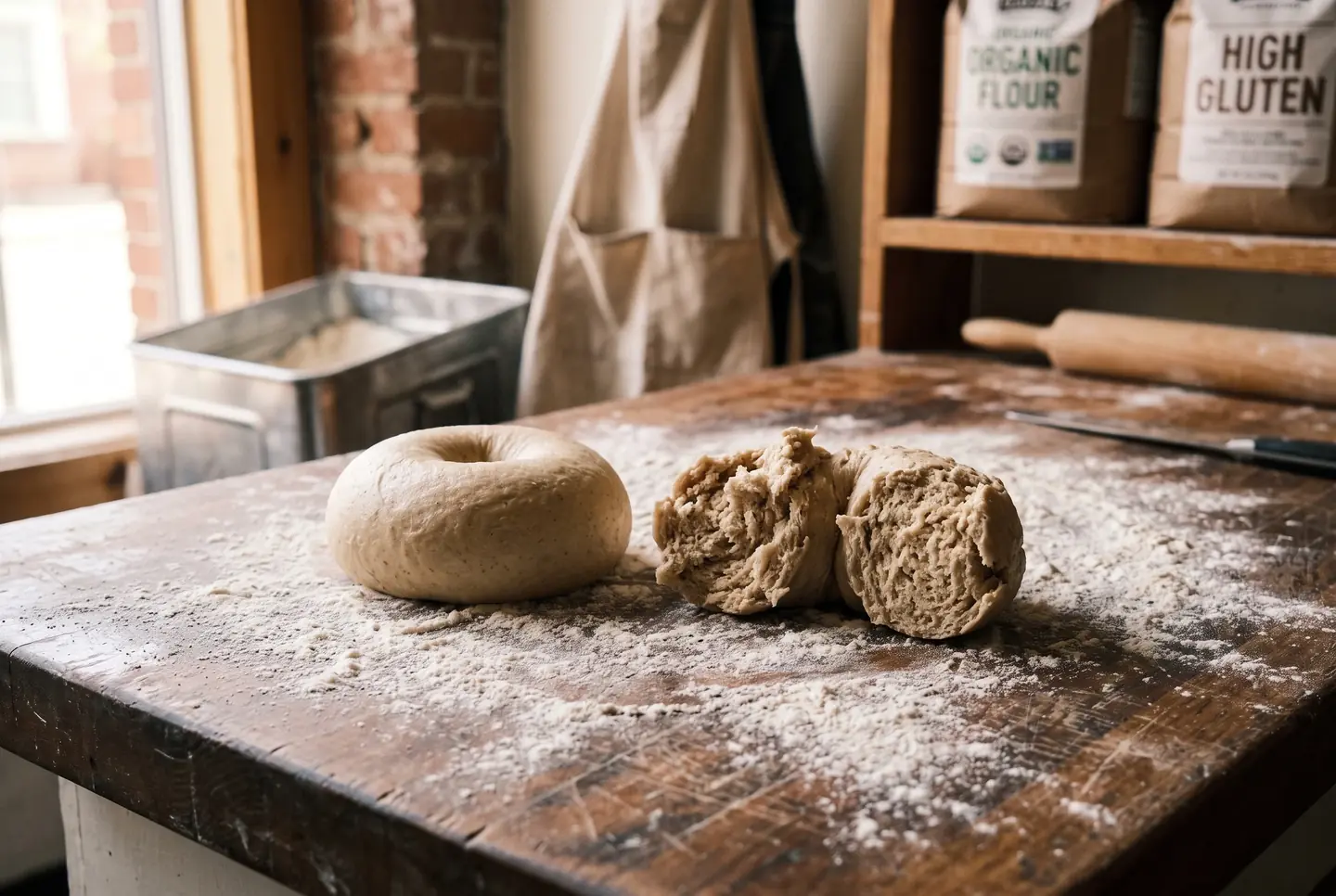
Bagel dough is supposed to feel wrong. It is stiff, almost dry, closer to firm modelling clay than to the soft, tacky dough most bread recipes give you. That is not a mixing mistake, it is the whole point: a firm, low water dough is the second thing, after the boil, that makes a bagel a bagel. If yours feels soft and slack, you have too much water, not too little.
This guide is the dough half of the story. For the full recipe with weights and times, see the complete bagel guide; here we stay on why the dough is firm and how to work it to the right point.
Why so dry: low water, high protein
The firmness comes from two choices, and they reinforce each other.
Low hydration. A bagel dough runs at roughly 50 to 60% water, against 60 to 65% for a sandwich loaf. With less liquid moving between the flour particles, the dough resists and holds a shape instead of flowing. That stiffness is what keeps the ring open and the hole from filling in.
High protein flour. Bread flour at around 12 to 14% protein builds a dense, elastic gluten network. A low water dough needs that strong network to survive being shaped into a ring and then boiled without slumping. All purpose flour, at about 10 to 11% protein, makes a softer, less chewy bagel.
| Dough | Hydration | Feel | Crumb you get |
|---|---|---|---|
| Ciabatta | 75% and up | slack, wet | large, irregular holes |
| Sandwich bread | 60 to 65% | soft, tacky | open, tender |
| Bagel | 50 to 60% | stiff, dry | tight, chewy |
Read that table top to bottom and the rule is plain: less water, tighter crumb. A bagel sits at the dry end on purpose.
Kneading a stiff dough
A dry dough asks more of your hands and your mixer than a wet one, because there is less water to help the gluten strands slide and align. Plan for real work.
- By machine. A stand mixer handles this best. One reliable rhythm is 3 minutes of kneading, a 5 minute rest, then 3 more minutes (The Curious Chickpea). The rest lets the flour hydrate fully so the second stint does more with less effort.
- By hand. Expect 10 to 15 minutes and a rest partway through if the gluten fights back. A stiff dough will not smear like a wet one, so lean into it with the heel of your hand and fold, rather than trying to stretch it thin.
- Autolyse to cut the work. Mixing flour and water first and resting 10 to 15 minutes before you knead lets gluten begin forming on its own, which shortens the kneading that follows.
The windowpane on a firm dough
The windowpane test is how you know the gluten is developed: pull off a small piece and stretch it gently between your fingers. If it thins to a translucent membrane without tearing, the dough is ready (King Arthur).
On a stiff bagel dough the membrane will be thicker and less see-through than on a soft, high water dough, and that is fine. You are looking for the point where it stretches smoothly and holds together, not for a gossamer film. A dough that tears immediately needs more kneading; a dough that is smooth, elastic and holds a stretch is done.
When the dough is too dry to come together
Sometimes low hydration tips into genuinely too dry: the dough will not clear the bowl, it cracks and crumbles instead of smoothing out. Flour absorbs different amounts depending on brand and humidity, so the recipe number is a starting point, not a law.
The fix is a teaspoon of water at a time, kneaded in fully before you add more. Go slowly: it is far easier to add water than to claw back a dough that has gone soft. A properly firm bagel dough should feel dense and only barely tacky, smooth on the surface, and it should hold a clean ridge when you press the side of your hand into it.
| Symptom | Cause | Fix |
|---|---|---|
| Cracks, crumbles, will not smooth | too dry, or under kneaded | add water a teaspoon at a time; knead longer |
| Soft, slack, sticks everywhere | too much water | it will spread in the oven; reduce water next batch |
| Tears at the windowpane | gluten under developed | keep kneading, rest, try again |
| Springs back and will not shape | gluten tight, needs rest | let it relax 10 minutes, then shape |
Salt and malt: what else the dough carries
Two ingredients beyond flour and water shape how the dough behaves, and both are easy to misread as optional.
Salt does more than season. It tightens the gluten network, so a salted dough feels firmer and holds its shape better than the same dough without it. That is welcome in a bagel, where firmness is the goal, but it also means salt slows the yeast slightly, which is part of why bagels take their time. Add it with the flour rather than straight onto the yeast.
Barley malt syrup goes into the dough as well as the boiling water. In the dough it feeds the yeast and lays the groundwork for the deep, even browning a bagel is known for (FoodCrumbles). It is a small amount, under 5% of the flour weight, so it does not soften the dough the way a sweeter enriched dough would. A bagel stays lean and firm even with the malt in it.
Neither changes the core rule. The dough is firm because it is dry and strong, and salt and malt only fine tune what the low hydration and the bread flour have already set up.
Frequently asked questions
Why is bagel dough so stiff? On purpose. Low hydration, around 50 to 60% water, plus high protein bread flour builds the dense, elastic gluten that holds the ring shape through boiling and gives the tight, chewy crumb. A soft dough spreads and bakes into a roll.
How long should I knead bagel dough? Until it passes a windowpane test, roughly 10 to 15 minutes by hand, or a couple of 3 minute stints with a rest between in a stand mixer. A stiff dough needs more work than a soft one.
What hydration should bagel dough be? Between 50 and 60% water to flour by weight. Around 58% is a common, well-behaved target for New York style bagels.
Can I use all purpose flour? You can, but the bagel will be softer and less chewy. Bread flour, at 12 to 14% protein, is what builds the gluten a firm ring needs. If all purpose is all you have, knead thoroughly and expect a gentler chew.
My bagel dough cracks and will not come together. What do I do? It is too dry. Add water a teaspoon at a time, kneading each addition in fully, until the dough is smooth and only barely tacky. Flour absorbs differently by brand and humidity, so adjust to feel.
The first time you make it, trust the stiffness. A dough that feels too dry to be right is usually exactly right, and the chew you get from it is the proof.
Where I checked
Keep reading
 Guide
Guide
Bagel Recipe: New York Style, Step by Step
A weight-based New York bagel recipe, step by step: the firm 58% dough, an overnight cold retard, how long to boil, and the oven heat that sets a glossy crust.
6 min read Complete guide
Bagels: The Complete Guide
Make a real bagel at home: the firm 58% dough, why bagels are boiled before baking, New York vs Montreal, sourdough and gluten free, and how to fix flat ones.
18 min read Guide
Guide
Boiling Bagels: How Long, and What Goes in the Water
How long to boil bagels and what changes with time: 30 vs 60 vs 90 seconds, plus what baking soda and malt do to the crust. The one step that makes a bagel.
6 min read