Complete guide
Bao Buns: The Complete Guide
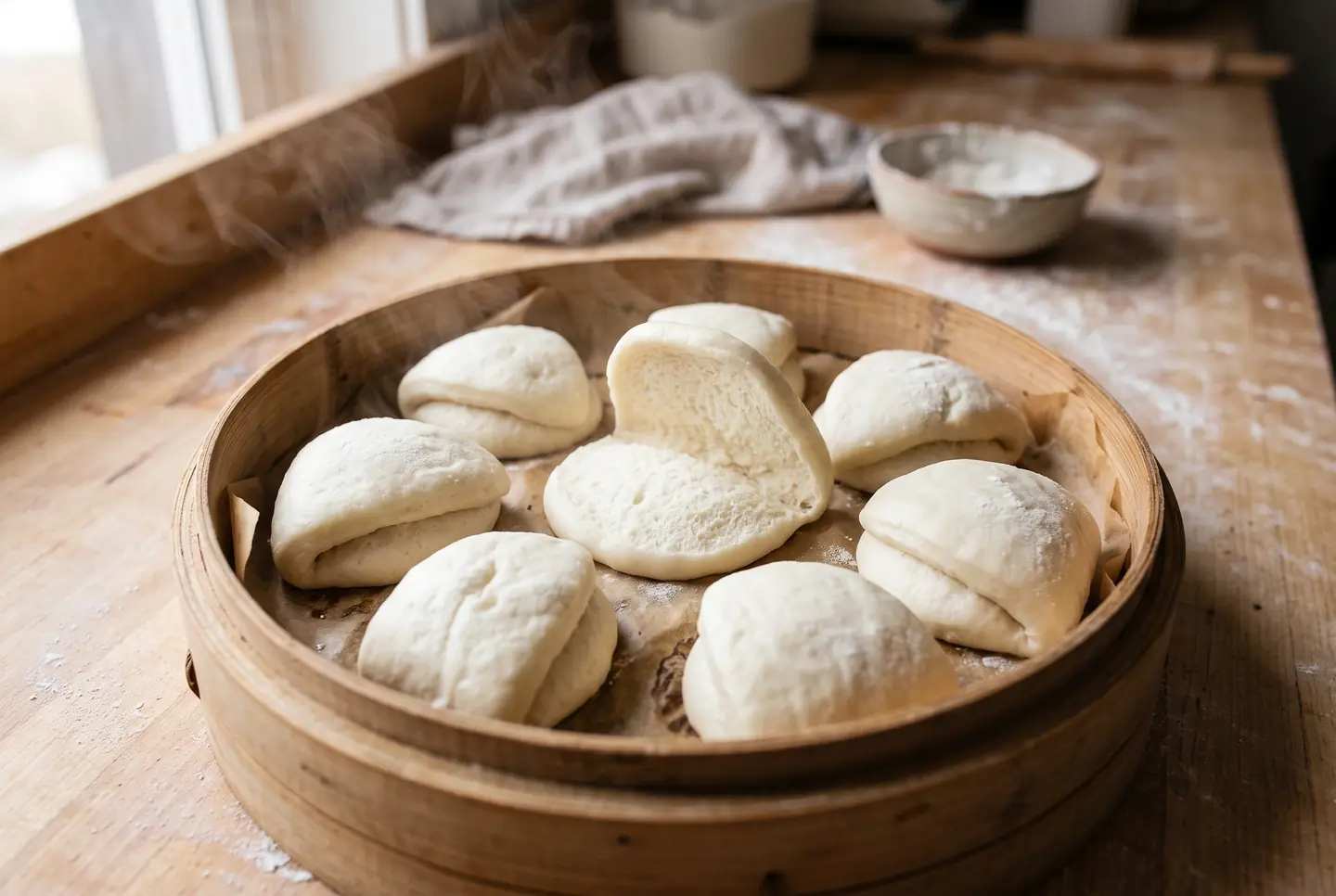
The first time most people meet a bao, it is holding something: a glossy slab of pork belly, a piece of fried chicken, a pile of mushrooms. The bun itself looks almost too perfect, snow-white and pillowy, folded like a little clam shell. It feels like the kind of thing that comes from a factory, or from years behind a dim sum trolley. It does not. A good bao is white, soft and open because of three plain decisions, and once you see them you can make them at home with a bowl, a rolling pin and a pot with a lid.
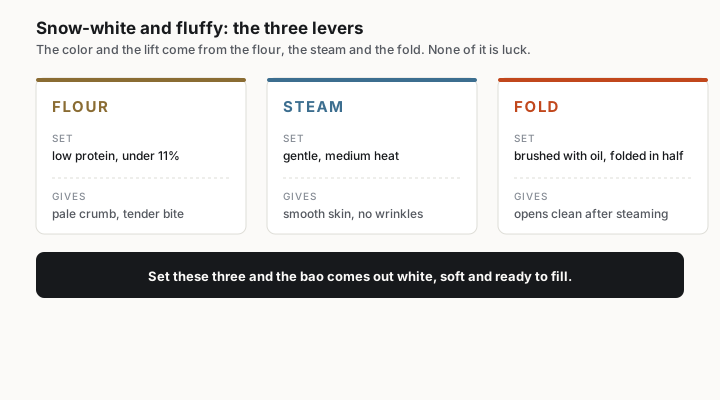
Those three decisions are the flour, the steam and the fold. The flour is why the bun is pale and tender instead of tan and chewy. The steam is why the skin stays smooth and the crumb stays cloud-soft instead of wrinkling or drying. The fold is why the open gua bao springs apart cleanly after cooking instead of gluing itself shut. Every bao you have admired got all three right, and every disappointing one missed at least one.
This guide walks the whole territory: the base dough and how it rises, the flour that turns it white, the two ways to shape it, the steam that finishes it, and then the fillings, from classic char siu pork to duck, mushroom and fully vegan versions. By the end you will know why a bao comes out dense, gummy or yellow, and none of those answers will be bad luck.
Bao buns: the steamed dough
A bao is a steamed yeasted bun, which sets it apart from almost everything else in this project. There is no oven and no crust. The heat is wet, gentle and never passes 100 °C (212 °F), the boiling point of water, so the outside never browns. That is the whole reason a bao can be white: nothing on the surface ever gets hot enough to color.
The dough is simple and forgiving. Here is a plain base that makes about ten open buns, the one to learn first before you push it toward any particular filling.
| Ingredient | Amount | What it does |
|---|---|---|
| Low protein flour | 300 g (about 2.5 cups) | The body of the bun, kept pale and tender |
| Sugar | 30 g (about 2.5 tbsp) | Feeds the yeast and softens the crumb |
| Instant yeast | 5 g (about 1.5 tsp) | The main rise |
| Baking powder | 3 g (about 0.75 tsp) | A second lift for extra fluff |
| Warm water or milk | 150 g (about 150 ml) | Milk gives a softer, slightly richer crumb |
| Neutral oil | 15 g (about 1 tbsp) | Tenderness and a smoother surface |
Two things in that list surprise people. The first is that many bao recipes use both yeast and baking powder, not one or the other. Omnivore's Cookbook, among others, adds baking powder on top of instant yeast precisely for a fluffier result: the yeast does the slow, flavor building rise, and the baking powder gives a final burst of lift in the first minutes of steam. The second is how little liquid there is. Bao dough is stiffer than most bread dough, closer to a firm playdough than a slack loaf, and that firmness is what lets a folded bun hold its shape in the steamer instead of slumping.
The method is short. Mix everything into a shaggy mass, then knead until smooth, around eight to ten minutes by hand or a few minutes in a stand mixer. Let it rise, covered, until doubled, which takes roughly one to two hours in a warm kitchen. Then you shape, give a short second rise, and steam. The full detail of shaping and steaming has a section of its own below, and so does each major filling.
Bao flour and the snow-white crumb
If you want to know the single biggest reason your homemade bao looks tan next to a shop one, it is the flour. Color and chew both come from protein, and bao wants very little of it.
Bread flour, at roughly 12 to 14 percent protein, builds a strong gluten network. That is exactly right for a chewy sourdough and exactly wrong for a bao, where it gives a dense, elastic, slightly gray bun. Red House Spice, one of the most careful Chinese cooking references online, puts the target plainly: for a fluffy, less chewy bun the flour should sit under 11 grams of protein per 100 grams. Cake flour, at around 8 to 9 percent protein, gives the softest, most tender result and the palest crumb.
| Flour | Protein (per 100 g) | Bao result |
|---|---|---|
| Cake flour | about 8 to 9% | Softest, palest, most tender |
| Bao or Hong Kong flour | low, often bleached | Whitest of all, the shop look |
| All purpose (lower end) | about 10 to 11% | Good, slightly more chew |
| All purpose (higher end) | 13% or more | Denser, needs the cornstarch fix below |
| Bread flour | 12 to 14% | Too chewy and grayish for bao |
The whitest buns of all use a dedicated bao flour, sometimes sold as Hong Kong flour, which is low in protein and often bleached. That bleaching is the shortcut to the snow-white color, and it is worth knowing that the color is partly cosmetic: an unbleached low protein flour makes a bun every bit as soft, just a shade creamier. If your only all purpose flour is on the strong side, at 13 percent protein or more, Red House Spice gives a clean trick: replace about one fifth of the flour by weight with cornstarch, sift the two together, and you drop the effective protein back into bao territory. That is the flour lever from the diagram, and it is the one that does the most visible work.
Choosing the right flour for bao is a small topic with a big payoff, and it has a full guide of its own.
Shaping: the open gua bao and the filled bun
There are two classic shapes, and they are genuinely different objects, not two names for the same thing. Knowing which you are making changes how you handle the dough.
The open gua bao is the folded, clam-shell bun you see holding pork belly. It is not sealed around a filling: you steam it empty and folded, then open it at the table and tuck the filling inside like a little taco. The trick that makes it work is almost too simple. You roll each piece of dough into an oval about 3 mm thick, brush the top with a thin film of neutral oil, then fold it in half. Omnivore's Cookbook is explicit about why: the oil keeps the two halves from fusing during steaming, so the bun puffs, sets, and then springs open cleanly instead of sealing itself shut. Fold without the oil and you get a solid lump you have to tear apart.
The filled baozi, such as char siu bao, is the pleated, sealed bun. Here you roll a round wrapper that is thick in the center and thin at the edge, spoon the filling into the middle, then pleat the edge by pinching small folds with your thumb and finger while rotating the bun, finishing with a twist to seal the top. The thick center supports the filling and the thin edge lets the many pleats close without a doughy knot.
| Shape | Sealed? | Steamed with filling? | Classic use |
|---|---|---|---|
| Open gua bao | No, folded over oil | No, filled after steaming | Pork belly, fried chicken, mushrooms |
| Pleated baozi | Yes, pinched and twisted | Yes, filling cooks inside | Char siu pork, vegetables |
Getting the fold and the pleat right is the difference between a bao that looks handmade in a good way and one that looks like it lost a fight. The step by step for both shapes is a guide of its own.
Steaming without collapsing
Steaming looks like the easy part and is where most home bao actually fail. Three things decide the outcome: the heat, the timing, and how you open the lid.
Heat first. For smooth, pale gua bao and mantou you want a gentle steam, medium or medium-low, not a violent rolling boil. Red House Spice warns that aggressive boiling makes the buns cook unevenly and come out wrinkled, with that shriveled, deflated skin. A steady medium heat keeps the surface smooth. Interestingly, the pleated char siu bao is the exception: it is often steamed on high on purpose, because the burst of heat splits the top open into the classic flowering crack, which for that bun is a feature, not a fault.
Timing is short. Small to medium buns need only about ten minutes of steam over medium heat. They are cooked long before they are dry, so the clock is more about not underdoing the center than about avoiding overcooking.
The lid is the part everyone learns the hard way. When the time is up, turn off the heat and leave the lid on for another five minutes before you open it. Both Red House Spice and Omnivore's Cookbook flag this rest as the fix for buns that suddenly shrivel: a bao pulled into cold air the instant it stops cooking can deflate from the temperature shock. Give it five quiet minutes to set, and it holds its puff. That is the steam lever from the diagram, and it costs nothing but patience.
The full method for steaming, including how to rig a steamer from a pot and a plate, is a guide of its own.
Char siu bao: the pork filling
Char siu bao is the pleated bun filled with Cantonese barbecue pork, the one that flowers open on top in a dim sum basket. The filling is what to get right, and it is two things, not one: chopped char siu and a thick, glossy sauce that holds it together.
The classic sauce is built on the sweet and savory Cantonese flavors, oyster sauce, hoisin, soy and a little sugar or honey, cooked with a starch slurry until it thickens into a jammy glaze that coats the chopped pork. The Woks of Life and China Sichuan Food both build the filling this way: you are not just stuffing roast pork into dough, you are making a sauced filling that clings and does not leak.
| Element | What it is | Why it matters |
|---|---|---|
| Char siu | Cantonese barbecue pork, chopped small | The flavor and body of the filling |
| Sauce base | Oyster sauce, hoisin, soy, sugar or honey | The sweet-savory Cantonese profile |
| Thickener | A cornstarch slurry, cooked in | Turns the sauce jammy so it does not run |
Two details separate a good char siu bao from a soggy one. Rest the pleated buns for 20 to 30 minutes before steaming, so the dough proofs and puffs, and steam them on high, which is what opens that signature crack on top. A cool, underproofed bun steamed gently will stay tight and pale, missing the whole point of this particular bao.
Char siu bao, from the pork to the pleats, is a guide of its own.
Duck, mushroom and vegetarian bao
The open gua bao is a blank canvas, and pork belly is only the most famous filling. Crispy duck with hoisin and cucumber, borrowed from the Peking duck pancake, sits beautifully in a folded bun. Fried chicken with a spicy mayo has become a modern classic. And there is a whole world of vegetarian and vegan bao that does not feel like a compromise.
The strongest meat-free fillings share one quality: they bring the same savory depth, the umami, that pork does. King oyster or shiitake mushrooms, torn and seared hard until their edges crisp and caramelize, carry a gua bao on their own. Braised jackfruit stands in for pulled pork. Crisp tofu or tempeh, glazed in the same sweet-savory sauce you would use on char siu, gives you a vegan bun with the familiar flavor and none of the meat.
The one thing to watch with vegetable fillings is water. Mushrooms and greens release a lot of liquid, and a wet filling makes a soggy bun, so cook them down hard and let them cool before they go anywhere near the dough. The full range of duck, mushroom and vegetarian bao is a guide of its own.
Gluten free bao
Gluten free bao is the hardest bun in this guide to pull off, and it is honest to say so up front. The soft, stretchy, cloud-like texture of a normal bao comes from a gluten network that is gentle but real, and that is exactly the thing a gluten free flour cannot make on its own.
The workable path is a gluten free flour blend combined with a binder that mimics gluten's stretch, usually xanthan gum or psyllium husk. Psyllium in particular forms a gel that gives gluten free doughs some of the elasticity they otherwise lack, which is why it shows up in most serious gluten free bread work. Expect a bun that is a little denser and less springy than the wheat version, and treat it as its own thing rather than a like-for-like copy. It can be very good; it will not be identical.
The practical build, blend, binder and the ratios, is a guide of its own.
Fillings and sauces that pair
A bao is a delivery system, and the filling lives or dies on balance: something rich, something fresh, something sharp. Miss one and the bun feels flat.
| Layer | Job | Examples |
|---|---|---|
| The protein | Rich, savory center | Pork belly, char siu, fried chicken, seared mushrooms, tofu |
| The crunch | Texture and freshness | Pickled carrot and daikon, cucumber, shredded lettuce |
| The sauce | Sweet, sharp or spicy lift | Hoisin, sriracha mayo, black vinegar, scallion oil |
| The herb | Aroma and a green note | Coriander, mint, sliced spring onion, crushed peanuts |
The template that almost never fails is rich plus pickle plus herb: fatty pork belly, sharp quick pickle to cut it, and a handful of coriander and crushed peanuts on top. Build your own fillings on that skeleton and you rarely go wrong. The full pantry of fillings and sauces, with quick-pickle ratios, is a guide of its own.
Whole wheat and the rustic bao
You can make a bao with whole wheat flour, and it is worth being clear about the trade. Whole wheat brings the bran and germ back into the flour, which means more fiber, a nuttier flavor and a browner, speckled crumb. It also means the bun will never be snow-white, and it will be a touch denser, because the sharp bits of bran cut through the gluten and the extra fiber soaks up water.
The way to keep it light is to not go all the way. A blend, say half whole wheat and half low protein white flour, keeps most of the fluff while adding the wholemeal flavor and color. Push the hydration up a little too, since the bran drinks more water than white flour does. The result is a rustic, honest bun that leans into its wholemeal character instead of pretending to be the pale version. The whole wheat and rustic bao is a guide of its own.
Where it goes wrong: dense, gummy or yellow bao
Almost every failed bao is one of three problems, and each has a clear main cause.
| Symptom | Main cause | The fix |
|---|---|---|
| Dense, heavy, no lift | Underproofed dough, or dead yeast | Give a full rise to doubled, check the yeast is alive |
| Gummy or wrinkled skin | Steam too aggressive, or lid opened too fast | Steam on medium, rest five minutes before opening |
| Yellowish, tan color | Flour too high in protein | Switch to a low protein or cake flour, or add cornstarch |
| Dough will not hold its shape | Too wet, too slack | Bao dough is stiff, add flour until firm |
| Halves fused shut (gua bao) | No oil between the fold | Brush the fold with a thin film of oil before folding |
The most common single complaint is a bun that steamed up beautifully and then shriveled the moment the lid came off, and that one is almost always the temperature shock, fixed by the five minute rest. The full symptom by symptom diagnosis is a guide of its own.
How to freeze and reheat bao
Bao freezes better than almost any other bread, which is why the frozen bags in the shop are so good: steamed buns are made to be reheated. You can make a big batch, freeze them, and have a warm bun in minutes.
Steam the buns fully first, let them cool, then freeze them in a sealed bag, where Omnivore's Cookbook notes they keep for up to three months. To reheat, the best route is to steam them again straight from frozen, no thawing needed, for a few minutes until hot and soft all the way through. The wet heat brings back exactly the texture they had fresh. Avoid the microwave for plain gua bao unless you wrap it in a damp paper towel, since dry microwaving turns the surface rubbery. The full storing, freezing and reheating method is a guide of its own.
The history of bao: from China to the world
The steamed bun is old, and the story that everyone tells is a good one even if it is more legend than record. It credits the filled bun to the strategist Zhuge Liang in the Three Kingdoms era, who is said to have made meat-filled buns shaped like heads to offer to a river in place of the human sacrifices a local custom demanded. Whether or not that is true, the plain steamed bun, mantou, and its filled cousin, baozi, have been staples across China for many centuries.
Gua bao, the open folded bun, is a Fujianese and Taiwanese specialty, long sold as street food holding braised pork belly. Its jump into Western food culture is recent and traceable: in the mid-2000s, chef David Chang put a version on the menu at Momofuku in New York, and the folded pork belly bun became one of the defining dishes of a decade of restaurant cooking. That is why so many people met the bao through a fusion filling before they ever met the traditional one. The full history of the bao is a guide of its own.
Frequently asked questions
What flour is best for bao buns? A low protein flour, under about 11 percent protein. Cake flour, at 8 to 9 percent, gives the softest and palest buns, and a dedicated bao or Hong Kong flour gives the whitest. If your all purpose flour is strong, replace about a fifth of it by weight with cornstarch to soften the crumb.
Why are my bao buns not white? The most common reason is flour with too much protein, which browns and grays the crumb. Switch to a low protein or cake flour. Shop buns are often made with a bleached bao flour, which is what gives that pure snow-white look, though an unbleached low protein flour makes a bun just as soft.
Do you steam gua bao with the filling inside? No. The open gua bao is steamed empty and folded, then opened and filled at the table. Only the sealed, pleated baozi like char siu bao is steamed with the filling cooking inside.
Why did my bao buns wrinkle or collapse? Usually the steam was too aggressive or you opened the lid too fast. Steam plain buns on medium heat, not a hard boil, and when the time is up turn off the heat and leave the lid on for five minutes before opening, so the buns do not deflate from the sudden temperature change.
Why do I use both yeast and baking powder? Many bao recipes use both. The yeast gives the slow rise and the flavor, and the baking powder adds a final burst of lift in the first minutes of steaming for an extra fluffy bun. You can make bao with yeast alone, but the two together are more foolproof.
How long do you steam bao buns? Small to medium buns need about ten minutes over medium heat. Then rest them with the lid on for five more minutes off the heat. Larger filled baozi may need a couple of minutes longer.
Can I freeze bao buns? Yes, and they freeze very well. Steam them fully, cool, and freeze in a sealed bag for up to three months. Reheat by steaming straight from frozen for a few minutes, which brings back the fresh texture better than a microwave.
What is the difference between bao and baozi? Baozi is the general Chinese word for a filled, pleated steamed bun. Bao, in most Western menus, usually means the open folded gua bao that you fill yourself. Both are steamed yeasted buns from the same family of doughs.
This guide keeps growing as new fillings and details turn up. Make the dough stiff, keep the steam gentle, and your first batch will already look the part.
Where I checked
Keep reading
 Guide
Guide
Bagel Dough: Why It Is So Firm, and How to Knead It
Bagel dough feels stiff and dry on purpose. Here is why it runs at 50 to 60% water and high protein flour, how to knead it, and the windowpane to aim for.
6 min read Guide
Guide
Bagel Recipe: New York Style, Step by Step
A weight-based New York bagel recipe, step by step: the firm 58% dough, an overnight cold retard, how long to boil, and the oven heat that sets a glossy crust.
6 min read Complete guide
Bagels: The Complete Guide
Make a real bagel at home: the firm 58% dough, why bagels are boiled before baking, New York vs Montreal, sourdough and gluten free, and how to fix flat ones.
18 min read