Complete guide
Detroit-Style Pizza: The Complete Guide
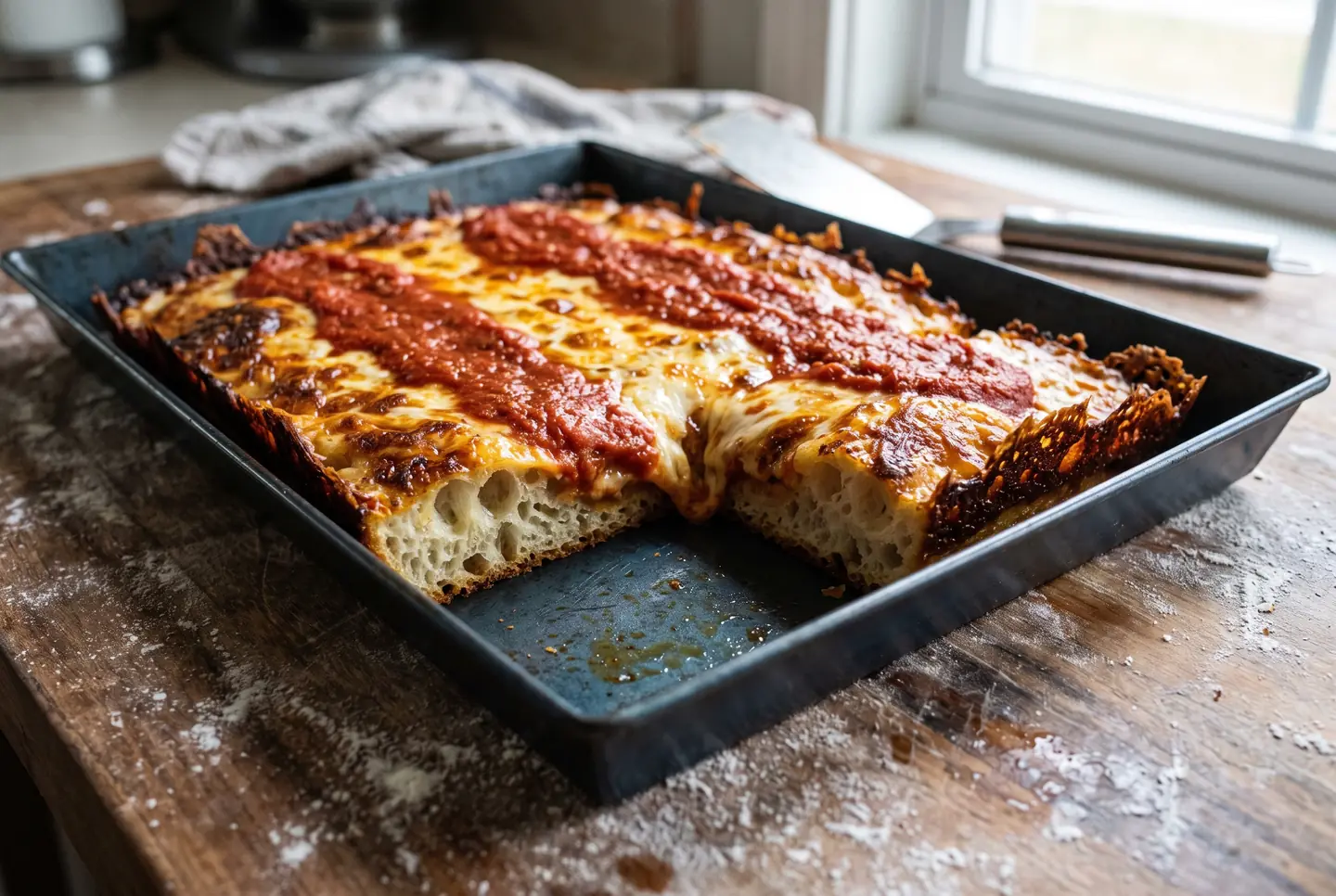
Most pizzas are round and thin, cooked fast and floppy. A Detroit is the opposite: a thick rectangle with a light, airy inside, a bottom that crunches like fried bread, and a border of cheese that has gone dark and lacy against the wall of the pan. That border has a name, the frico, and it is the reason people fall for this pizza and then spend a year trying to make it at home. The good news is that it comes down to three plain decisions, and none of them is luck.
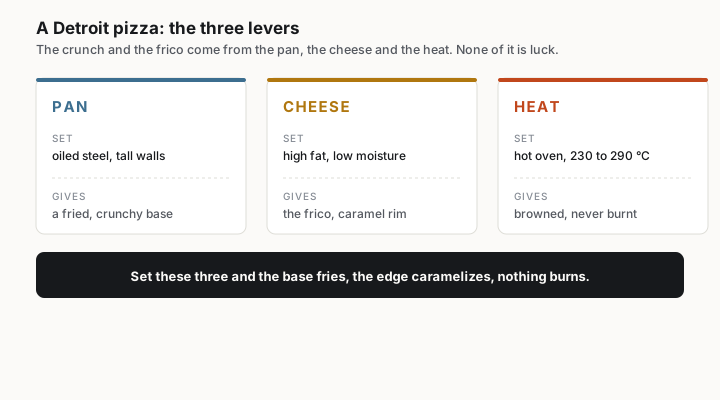
Those three decisions are the pan, the cheese and the heat. The pan is steel and it is oiled, so the bottom of the dough does not just bake, it fries. The cheese is pushed all the way to the edge, so it melts, pools against the hot metal and caramelizes into the frico. The heat is high enough to brown that cheese and crisp that base without burning either. Get those three right and a home oven turns out a pizza that a lot of pizzerias would be proud of.
This guide walks the whole thing: the high hydration dough and how it rises, the pan and why a plain steel one beats a fancy nonstick tray, the cheese that makes or breaks the frico, the backwards way you build it (cheese first, sauce last), and then how to bake it, fix it when it goes wrong, keep it and reheat it. By the end you will know why a Detroit comes out soggy, pale or burnt, and every one of those answers has a fix.
Detroit-style pizza: the recipe and the blue steel pan
A Detroit is a thick, rectangular pan pizza with a crisp fried base, a soft open crumb, cheese taken right to the edge, and the sauce ladled on top instead of underneath. That last part, the sauce on top, is why locals call it a "red top," and it is not just tradition: with the sauce sitting above the cheese, the crust never soaks and stays crisp all the way through.
Here is the shape of a home recipe for a single quarter-sheet pan, the one to learn before you start swapping toppings. The full method, with every rest and the pan-stretch, is a step-by-step Detroit-style pizza recipe of its own.
| Step | What you do | Why |
|---|---|---|
| Dough | Mix a wet dough (about 70% water), rest it | Water is what makes the crumb open and light |
| Proof in pan | Oil the pan, stretch the dough to the corners, let it puff | The oil fries the base, the puff gives the height |
| Cheese to the edge | Cover the top and push cheese against the walls | The cheese at the wall becomes the frico |
| Sauce on top | Ladle two or three stripes of sauce over the cheese | Sauce on top keeps the base from going soggy |
| Bake hot | High oven until the base is crisp and the frico is dark | Heat browns the cheese and fries the bottom |
The pan is the part people skip and then wonder why their pizza is pale on the bottom. The original Detroit pans were not baking trays at all. According to the history of the style, when Buddy's Rendezvous served the first one in 1946, the kitchen used blue steel utility trays made by Dover Parkersburg, pans built in the 1930s and 1940s to catch drips under machines or hold small parts in the auto factories of the city. Plain steel holds and throws heat in a way that browns the base, and that accident of using a factory tray is baked into the style to this day.
The dough: high hydration for an open, airy crumb
Detroit dough is wet. Most versions sit around 70% hydration, which means 70 grams of water for every 100 grams of flour, and some go higher. That much water is what gives the inside its open, almost focaccia-like holes and its light chew. A drier dough would bake up tight and bready, and the whole point of a Detroit is that contrast between the crisp fried bottom and the cloud on top of it. The full dough method, rest by rest, is a Detroit pizza dough guide of its own.
A wet dough is sticky and it scares people, so a few things make it easier. Use a strong bread flour, not all-purpose, because the extra protein holds all that water into a real gluten structure. Give it time: a slow, cold rise in the fridge over one or two days, as many recipes recommend, both deepens the flavor and firms the dough enough to handle. And do not fight it into the pan in one go. Stretch it as far as it wants, let it rest ten minutes so the gluten relaxes, then stretch again to the corners. Wet dough goes where you want if you give it a break.
| Ingredient | Amount (one small pan) | Baker's percentage |
|---|---|---|
| Bread flour | 250 g | 100% |
| Water | 175 g | 70% |
| Salt | 5 g | 2% |
| Instant yeast | 3 g | about 1.2% |
| Olive oil (in the pan) | 15 to 20 g | for frying the base |
The numbers above are a starting frame, not a sacred text. The one to hold onto is the water: keep it near 70% and the crumb stays open. Push the flour up or down for a bigger or smaller pan and keep the ratios the same.
The right pan and why it matters
The pan is the single most important tool in a Detroit, more than the oven and more than the cheese. It needs to do two jobs: conduct heat hard into the base so the oiled bottom fries, and have straight, tall walls for the cheese to climb and caramelize against. A true Detroit pan is heavy blue or anodized steel, rectangular, with sides about 6 cm (2.5 inches) tall. The classic sizes are 8 by 10 inches and 10 by 14 inches. A full Detroit pizza pan guide compares the options, but the short version is below.
| Pan | Base result | Frico edge | Notes |
|---|---|---|---|
| Blue or anodized steel Detroit pan | Excellent, fries crisp | Excellent, tall straight walls | The real thing, worth buying if you make these often |
| Heavy cake or brownie pan (metal) | Good | Good if the sides are straight | The best substitute most kitchens already own |
| Cast iron skillet | Very good base | Rounded edge, less frico | Great crunch, but the round wall gives less caramel rim |
| Glass or ceramic dish | Pale, slow | Weak | Glass insulates instead of conducting, the base stays soft |
If you buy nothing, a metal cake pan with straight sides gets you most of the way there. The thing to avoid is glass or ceramic, which insulate rather than conduct and leave you with a pale, soft bottom no matter how long you bake.
The frico: the caramelized cheese edge
The frico is the whole game, so it gets its own answer. It is the ribbon of cheese that you push against the wall of the pan, where it melts, pools, fries in its own fat and the pan oil, and turns into a dark, crisp, lacy edge. Done right it is the best bite of the pizza. The full Detroit pizza cheese guide goes deeper, but the key is which cheese you use.
The traditional choice is Wisconsin brick cheese. It works because it has a high butterfat content and relatively low moisture, so it can sit against very hot metal and caramelize instead of scorching or going watery and rubbery. That is the property to chase in any substitute: enough fat to brown, not so much water that it steams. Brick cheese is hard to find outside the American Midwest, so most home cooks build a blend.
| Cheese | Browns for frico? | Why |
|---|---|---|
| Wisconsin brick | Yes, the original | High fat, low moisture, made for this |
| Low-moisture mozzarella | Yes | Melts and browns, the backbone of most blends |
| Monterey Jack | Yes | Buttery, browns well, a common brick stand-in |
| Mild white cheddar | Yes | Adds fat and flavor to a blend |
| Fresh mozzarella (the wet ball) | No | Far too much water, it steams and pools, no frico |
The reliable home frico is low-moisture mozzarella as the base, cut with some Monterey Jack or a mild cheddar for the fat and color. Whatever you use, the move that matters is the same: take the cheese all the way to the pan wall, even piling it slightly up the sides. Cheese that stops short of the edge gives you no frico, and no frico is just a thick pizza.
Building it upside down: cheese, toppings, then sauce
A Detroit is built backwards from every other pizza, and the order is not fussiness, it is engineering. You go: dough in the pan, then pepperoni or other toppings straight on the dough, then cheese over everything and pressed to the edges, and finally the sauce, spooned on top in a few stripes. Because the sauce sits above the cheese instead of soaking into the dough, the base stays crisp and the cheese stays anchored to the rim. The full how to make Detroit pizza walkthrough covers the timing, but the logic is worth keeping.
There are two schools on when the sauce goes on. Some cooks add it before baking; others bake the pizza with just cheese and add warmed sauce in stripes the moment it comes out. Both are correct Detroit. Sauce before baking bakes into the cheese a little; sauce after keeps a brighter, fresher tomato taste and guarantees the crust never sees moisture until the last second. If your bases keep coming out soft, try saucing after the bake and see if it fixes it.
Detroit vs deep dish: what actually differs
People lump Detroit in with Chicago deep dish because both are thick and baked in a pan, but they are almost opposites in build. The clearest way to see it is side by side. There is a full Detroit vs deep dish comparison, and here is the heart of it.
| Detroit-style | Chicago deep dish | |
|---|---|---|
| Shape | Rectangular | Round |
| Crust | Light, airy, fried-crisp bottom | Dense, tall, pastry-like wall |
| Cheese | On top, pushed to the edge for frico | On the bottom, against the crust |
| Sauce | On top, in stripes ("red top") | On top, but as a thick ladled layer |
| Eating feel | Crisp and light for its height | Heavy, knife-and-fork rich |
The one-line version: a deep dish is a savory pie you eat with a fork, and a Detroit is an airy, crunchy pan pizza you pick up. They share a pan and a thickness and almost nothing else.
The sourdough version
If you keep a sourdough starter, a Detroit is one of the best homes for it. The long, wet ferment that Detroit dough already wants is exactly what natural leaven does well, and the mild tang plays beautifully against the rich frico. A sourdough Detroit pizza has its own full method, since the timing changes, but the shape of it is simple: replace the commercial yeast with an active starter, expect a longer and slower rise, and lean on the fridge to fit it around your day.
The trade you are making is time for flavor and keeping quality. A sourdough Detroit takes longer from mixing to baking, but the crumb keeps its softness a day longer and the flavor has more to it. Everything else, the oiled pan, the cheese to the edge, the sauce on top, stays exactly the same.
The gluten free version
A Detroit is a friendlier target for gluten free baking than a thin, tossed pizza, because you never have to stretch and toss a delicate dough in the air: you press it into a pan. A gluten free Detroit pizza is a guide of its own, but the principle is that the pan does the structural work that gluten normally would.
Use a gluten free bread flour blend that already contains a binder such as xanthan gum, keep the dough on the wet side so it presses out easily, and give it a little longer in the oiled pan to firm up before baking. The frico is the gift here: because the caramelized cheese edge is pure cheese and pan, it comes out exactly as good on a gluten free base as on a wheat one, so the most distinctive part of the pizza is never the part you have to compromise.
Baking: the temperature and the crisp base
Heat is the third lever, and Detroit wants a lot of it. A home oven set high, in the range of 230 to 290 °C (450 to 550 °F), is what browns the frico and fries the base in the time before the inside dries out. The exact number is less important than the principle: hot enough to color the cheese edge deeply while the crumb is still moist. A full how to bake Detroit pizza guide covers rack position and timing, and the table below gives the range that real kitchens use.
| Setup | Temperature | Time | Notes |
|---|---|---|---|
| Standard home oven | 230 to 260 °C (450 to 500 °F) | 12 to 18 min | The common home range, safe and reliable |
| Hot home oven with a steel or stone | 260 to 290 °C (500 to 550 °F) | 10 to 14 min | A preheated steel under the pan boosts the base |
| Pizzeria oven | up to 370 °C (700 °F) | shorter | Not a home setup, shown for reference |
Steel is the reason a Detroit browns so well: it soaks up heat and drives it into the dough, as the thermal write-ups on the style explain. You can borrow that at home by preheating a baking steel or stone on a low rack and setting the pizza pan straight onto it, which gives the base an extra push of heat right where it needs it. Pull the pizza when the frico is deeply browned, not just golden, because that dark edge is where the flavor lives.
Where it goes wrong: soggy base, burnt cheese
Almost every failed Detroit is one of a handful of problems, and each has a clear cause. The full Detroit pizza troubleshooting guide walks through each one, but this table catches the common ones.
| Symptom | Main cause | The fix |
|---|---|---|
| Soggy, soft bottom | Not enough heat, or a glass pan, or sauce under the cheese | Use a steel pan, bake hotter, put the sauce on top |
| No frico, plain edges | Cheese did not reach the pan wall | Push cheese all the way to the edge, even up the sides |
| Burnt cheese, bitter edge | Oven too hot for too long, or a low-fat cheese | Watch the edge, pull at deep brown, use a higher-fat cheese |
| Dense, bready inside | Dough too dry, or underproofed | Raise the water toward 70%, give a full rise in the pan |
| Dough will not reach the corners | Gluten too tight, stretched in one go | Stretch, rest ten minutes, stretch again |
| Greasy pizza | Too much oil in the pan, or very fatty cheese | Use enough oil to coat, not pool, and blot if needed |
The most common single complaint is a base that looks done but is soft under the cheese, and that is nearly always heat: a pan that does not conduct, or an oven that was not hot enough. Move to a steel pan and turn the oven up before you change anything else.
How to store and reheat without going soft
A Detroit keeps and reheats better than a thin pizza, because there is real crumb there to hold its texture. Cooled leftovers go in the fridge in a sealed container for three to four days, the standard safe window for cooked food. The one thing to avoid is the microwave, which steams the crust soft and rubbery. The full how to reheat Detroit pizza guide has the details, and the short answer is: use dry heat.
The best reheat is a hot skillet on the stove: set the slice in a dry or lightly oiled pan over medium heat, cover it for a couple of minutes, and the base crisps back up while the cheese warms through. A hot oven or a toaster oven does the same job. Both bring back the fried-bottom crunch that made the pizza worth making, which a microwave never will.
The history: from the car factory to the pizzeria
The Detroit is one of the few great pizzas with a birthday. It was first served in 1946 at Buddy's Rendezvous, a former speakeasy at Six Mile Road and Conant Street in Detroit, run by Gus and Anna Guerra. The recipe is said to trace to a Sicilian sfincione, the thick focaccia-like pizza of the island, brought either from Anna's family or from a cook named Connie Piccinato. The full Detroit pizza history is a guide of its own.
The detail everyone remembers is the pan. There were no good deep pizza trays to be had, so the kitchen used blue steel utility pans from the local automotive suppliers, trays built to catch drips or hold parts on the factory floor. That is why the pizza is rectangular, why it has those sharp square corners, and why the base fries the way it does. A pizza shaped by the car industry that built the city is a good enough story on its own, and it happens to be true.
Frequently asked questions
What makes Detroit-style pizza different? Three things: it is baked in an oiled steel pan so the bottom fries crisp, the cheese is pushed to the edge where it caramelizes into the frico, and the sauce goes on top of the cheese instead of under it, so the crust never sogs. It is thick and rectangular but light and crunchy, not dense like deep dish.
What cheese is used for Detroit pizza? Traditionally Wisconsin brick cheese, which has a high fat and low moisture content so it browns against the pan without scorching. Outside the American Midwest, most cooks use low-moisture mozzarella blended with Monterey Jack or a mild cheddar for the fat and color.
What is the frico on a Detroit pizza? The frico is the crisp, dark, lacy edge of caramelized cheese around the border of the pizza. It forms when cheese pushed against the hot pan wall melts, fries in its own fat and browns. It is the signature of the style and the best bite.
Why does the sauce go on top of a Detroit pizza? Sauce on top, the "red top," keeps moisture off the crust so the base stays crisp, and it keeps the cheese anchored to the rim to build the frico. Many cooks add the sauce in stripes after baking for the freshest tomato flavor.
What pan do I need for Detroit-style pizza? Ideally a heavy blue or anodized steel Detroit pan with straight walls about 6 cm (2.5 inches) tall. If you do not have one, a metal cake or brownie pan with straight sides is the best substitute. Avoid glass or ceramic, which insulate and leave the base pale and soft.
What temperature do you bake Detroit pizza at? High: most home ovens work in the 230 to 290 °C (450 to 550 °F) range. The goal is enough heat to brown the frico deeply and fry the base before the inside dries out. A preheated baking steel under the pan helps the base crisp.
How is Detroit different from Chicago deep dish? Detroit is rectangular, light and airy with a fried-crisp bottom and cheese on top pushed to the edge. Deep dish is round, dense and tall with a pastry-like wall and cheese on the bottom. They share a pan and a thickness and little else.
Can I make Detroit pizza with a sourdough starter? Yes, and it suits the style well. Swap the commercial yeast for an active starter, expect a longer, slower rise, and use the fridge to manage the timing. The wet dough Detroit already wants is exactly what a natural leaven does well.
This guide keeps growing as new toppings and pans turn up. Oil the pan well, take the cheese to the edge, and bake it hotter than feels sensible: that is the whole secret.
Where I checked
Keep reading
 Guide
Guide
Bagel Dough: Why It Is So Firm, and How to Knead It
Bagel dough feels stiff and dry on purpose. Here is why it runs at 50 to 60% water and high protein flour, how to knead it, and the windowpane to aim for.
6 min read Guide
Guide
Bagel Recipe: New York Style, Step by Step
A weight-based New York bagel recipe, step by step: the firm 58% dough, an overnight cold retard, how long to boil, and the oven heat that sets a glossy crust.
6 min read Complete guide
Bagels: The Complete Guide
Make a real bagel at home: the firm 58% dough, why bagels are boiled before baking, New York vs Montreal, sourdough and gluten free, and how to fix flat ones.
18 min read