Guide
Detroit Pizza History: From Car Factory to Pizzeria
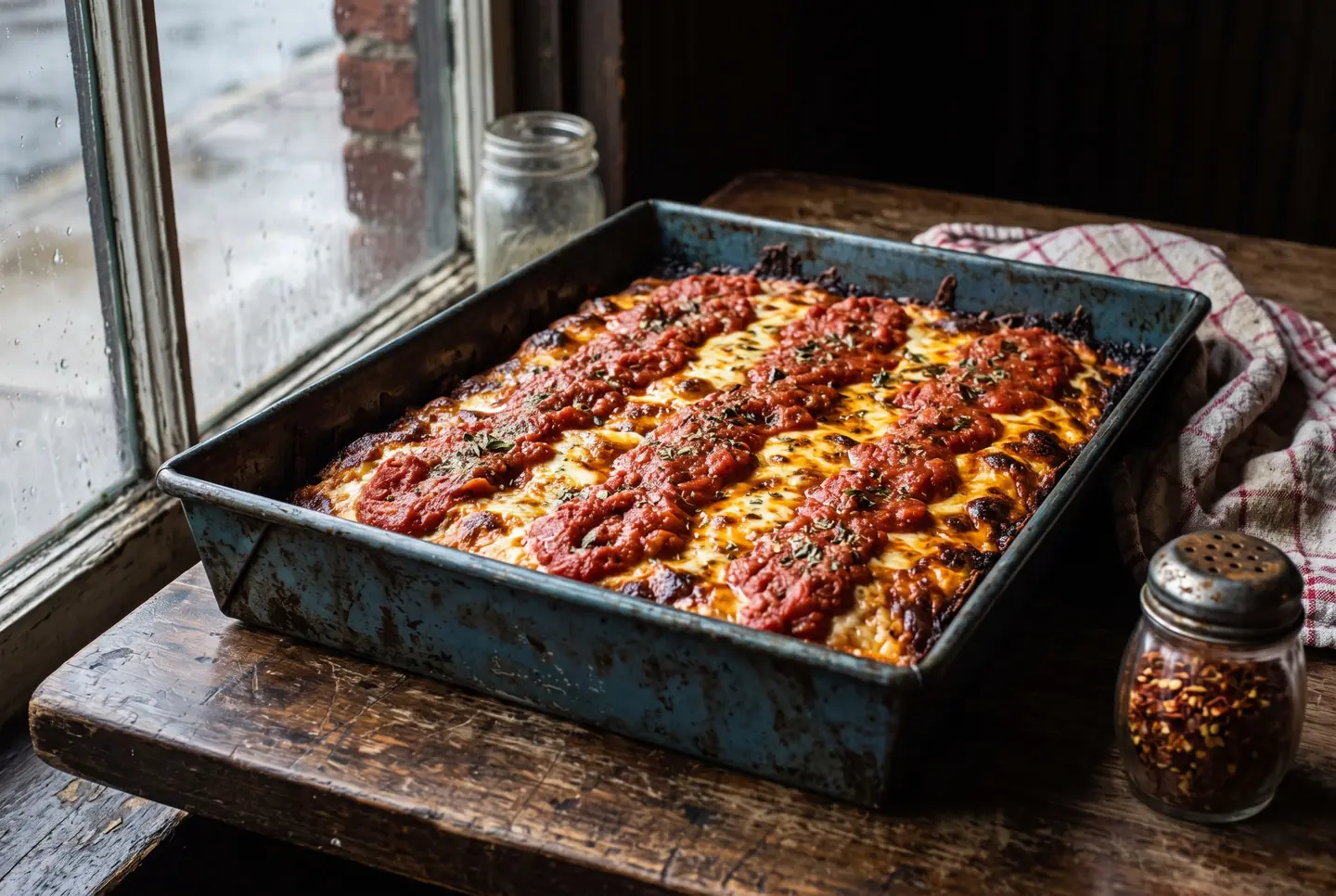
Detroit-style pizza is one of the few great pizzas with an actual birthday. It was first served in 1946 at Buddy's Rendezvous, a bar at Six Mile Road and Conant Street on Detroit's east side, and the recipe traces back to a Sicilian sfincione by way of the owners' family (Wikipedia). The detail everyone remembers is the pan: the kitchen used blue steel utility trays from the local car industry, and those trays gave the pizza its rectangular shape, its sharp corners and its fried base.
This is the deep version of the history note in the complete Detroit-style pizza guide. It is a short story, but a good one, and unusually well documented for a food origin.
From speakeasy to pizzeria
The building came first. Buddy's Rendezvous opened on Conant Street back in 1936 as a speakeasy-style bar, and for its first decade it was a drinking spot, not a pizzeria (Buddy's Pizza). The pizza that made it famous did not arrive until 1946, when owner Gus Guerra put a square, pan-baked pizza on the menu and turned a neighborhood bar into the birthplace of a style (Wikipedia).
That 1946 pizza is generally credited as the first of its kind in the United States, and eighty years later the style has spread nationwide from that single east-side address.
The Sicilian recipe behind it
The pizza did not come from nowhere. It was built on a Sicilian sfincione, the thick, focaccia-like pizza of the island, adapted from the family recipe of Gus Guerra's wife, Anna, and refined in the kitchen by a long-time employee named Connie Piccinato (Wikipedia). The sfincione lineage is why a Detroit is soft and airy inside rather than thin and crisp all the way through: it started life as a bready, pan-baked pizza, not a Neapolitan round.
Sfincione itself is a Sicilian street food, a thick, spongy, rectangular pizza traditionally topped with tomato, onion, herbs and often breadcrumbs rather than a heavy layer of mozzarella. You can see the family resemblance immediately: the pan shape, the airy crumb, the idea of a pizza that eats more like seasoned bread than a thin slice. What Detroit added was the American twist, a generous cheese load pushed to the edge of a steel pan, and that is where the frico was born.
| Element | Origin |
|---|---|
| Year and place | 1946, Buddy's Rendezvous, Detroit |
| The people | Gus and Anna Guerra, with cook Connie Piccinato |
| The recipe roots | Sicilian sfincione, a thick focaccia-like pizza |
| The pan | Blue steel utility trays from the auto industry |
| The claim | Widely credited as the first square pizza in the US |
The pan that made the pizza
Here is the part that turns a good story into a great one. In 1940s Detroit there were no purpose-built deep pizza trays to be had, so the kitchen used what the city had plenty of: blue steel utility pans from the local automotive suppliers, trays built to hold small parts or catch drips on the factory floor (Wikipedia).
That borrowed pan is not a footnote, it is the whole design. Its rectangular shape is why the pizza is rectangular. Its sharp corners are why a Detroit has those prized crunchy corner pieces. And the way seasoned steel conducts heat is why the oiled base fries crisp instead of steaming soft. A pizza literally shaped by the industry that built the city is a story you would not believe if it were not true.
How it spread beyond Detroit
For decades, Detroit-style pizza stayed a Detroit thing. The Guerra family carried it forward directly: after Buddy's, Gus and Anna Guerra were also tied to the founding of Cloverleaf, another early Detroit pizzeria that helped cement the style locally (Wikipedia). Generations of Detroiters grew up on it while much of the country had never heard of it.
The national wave came much later. Detroit-based and other chains put square, pan-baked pizza on menus far from Michigan, and independent pizzerias across the country picked up the style, until "Detroit-style" became a category you can find nationwide rather than a regional curiosity. A pizza that spent half a century as a local secret is now one of the most sought-after styles in the country.
A note on the "red top"
One small piece of Detroit vocabulary comes straight from the build. Because the sauce goes on last, in stripes over the baked cheese, a classic Detroit shows bands of red across the top, which earned it the nickname "red top." It is a plain description that stuck, and it captures the one visual cue that tells a Detroit apart at a glance: cheese first, sauce on top, not the other way around.
Why the shape still matters
Everything that defines a Detroit today still comes straight from that origin. The rectangular pan, the airy sfincione-style crumb, the cheese pushed to the metal edge to caramelize into frico against the hot steel wall: none of it is decoration, all of it is inherited. When you press a wet dough into an oiled rectangular pan at home, you are repeating a choice a Detroit bar kitchen made out of necessity in 1946.
If the story makes you want to bake one, the step-by-step recipe is the place to start, and the complete guide covers every part in depth.
Frequently asked questions
Where did Detroit-style pizza come from? It was created in 1946 at Buddy's Rendezvous, a bar at Six Mile and Conant in Detroit. Owner Gus Guerra put a square, pan-baked pizza on the menu, built on his wife Anna's Sicilian sfincione recipe and refined by cook Connie Piccinato.
Why is Detroit pizza baked in a rectangular pan? Because the original kitchen used blue steel utility trays borrowed from the local automotive industry, which happened to be rectangular. Those pans shaped the pizza, gave it its sharp corners, and, being steel, fried the base crisp.
What is Detroit pizza's connection to Sicily? The recipe is adapted from Sicilian sfincione, a thick, focaccia-like pizza. That heritage is why a Detroit has a soft, airy crumb rather than a thin, crisp Neapolitan base. It came to Detroit through the Guerra family.
Who invented Detroit-style pizza? It is credited to Gus Guerra at Buddy's Rendezvous in 1946, working from his wife Anna's family recipe, with long-time cook Connie Piccinato helping refine it in the kitchen.
When was Detroit-style pizza invented? In 1946. The bar itself, Buddy's Rendezvous, had opened earlier, in 1936, as a speakeasy-style spot, but the pizza that made it famous first appeared in 1946.
Is Detroit-style pizza really the first square pizza in the US? It is widely credited as the first square, pan-baked pizza of its kind in the United States, born at Buddy's Rendezvous in 1946 and spread nationwide from there.
A pizza shaped by a car factory, built on a Sicilian recipe, in a bar that started as a speakeasy. Few dishes carry their history this plainly, and you can taste all of it in the corners.
Where I checked
Keep reading
 Guide
Bagel Dough: Why It Is So Firm, and How to Knead It
Bagel dough feels stiff and dry on purpose. Here is why it runs at 50 to 60% water and high protein flour, how to knead it, and the windowpane to aim for.
6 min read Guide
Bagel Recipe: New York Style, Step by Step
A weight-based New York bagel recipe, step by step: the firm 58% dough, an overnight cold retard, how long to boil, and the oven heat that sets a glossy crust.
6 min read Complete guide
Bagels: The Complete Guide
Make a real bagel at home: the firm 58% dough, why bagels are boiled before baking, New York vs Montreal, sourdough and gluten free, and how to fix flat ones.
18 min read