Complete guide
Bagels: The Complete Guide
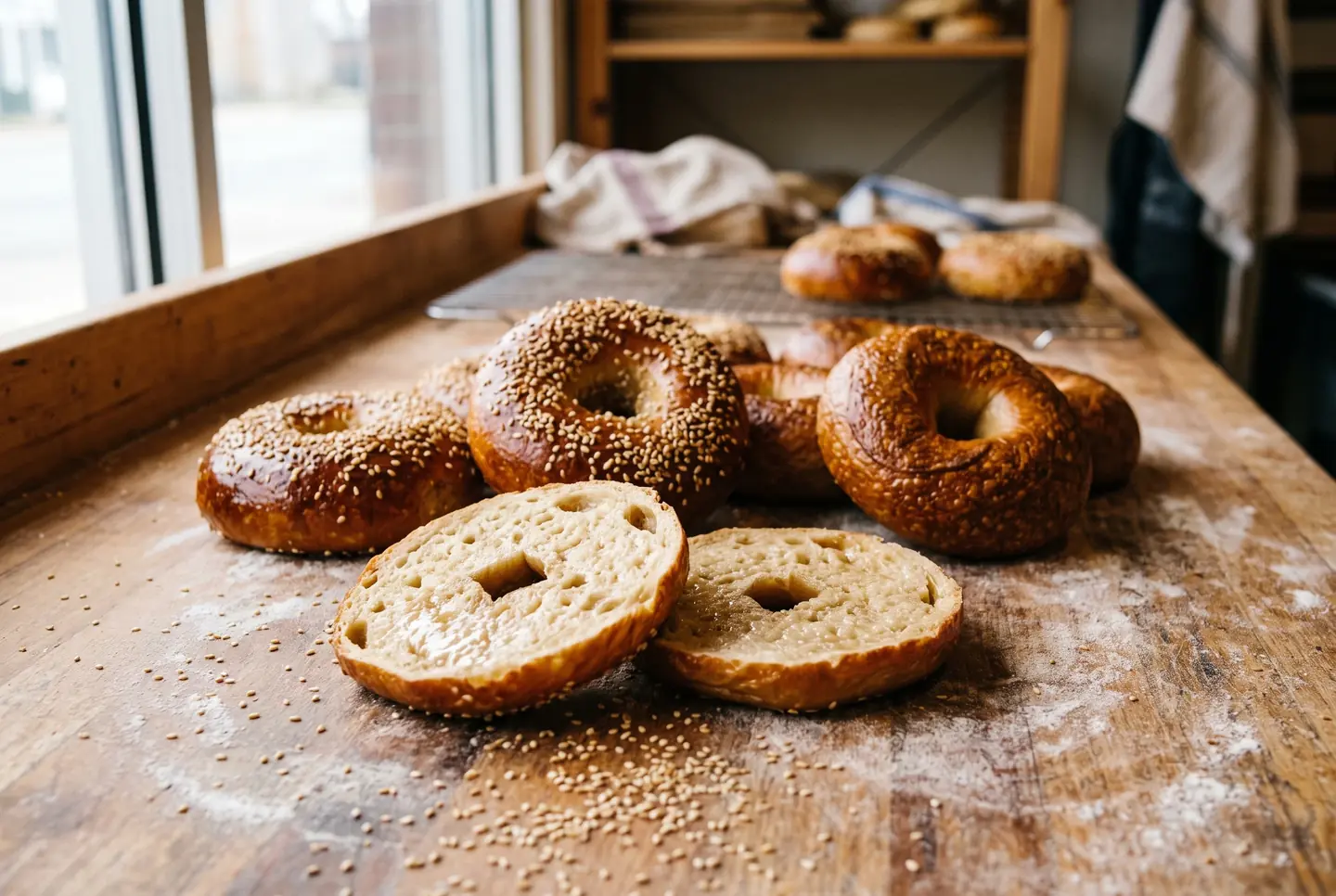
A bagel is the only bread most people eat that is cooked twice, once in water and once in the oven, and that single detour through a boiling pot is the whole reason it tastes like a bagel and not like a round roll with a hole. Skip the boil and you have not made a lazy bagel. You have made a different bread.
That is where most home recipes lose you. They treat the boil as a quaint ritual and rush past it, when it is the one step doing the heavy lifting. This guide is built the other way around: it starts from what the water actually does to the dough, then works outward to the firm dough, the shaping, the toppings and the bake. Get the boil right and everything else is detail.
One promise before we start. By the end you will know exactly why your bagels came out flat, pale or hard, because those three failures each have one main cause and none of them is bad luck.
The bagel recipe, and why bagels are boiled before baking
A bagel is a lean dough, high in gluten and low in water, that is shaped into a ring, briefly boiled, and then baked hot. Here is the base formula in baker's percentages, which is the only way to write a recipe that scales.
| Ingredient | Baker's % | For 600 g flour |
|---|---|---|
| Bread flour (about 12.7% protein) | 100% | 600 g |
| Water | 58% | 350 g |
| Salt | 2.4% | 14.5 g |
| Barley malt syrup | 4.6% | 28 g |
| Instant yeast | 0.75% | 4.5 g |
Those numbers are one well tested New York style formula, scaled to eight bagels of about 120 g each (The Curious Chickpea). The two that define the bagel are the low water and the malt: 58% hydration is dry for bread, and the malt feeds browning and flavour rather than sweetness.
Now the boil, which is the point of this whole guide. When a raw ring hits boiling water, the starch on its outer surface gelatinizes almost instantly. Wheat starch sets in roughly the 60 to 75 °C range, so a few seconds in water well above that is enough to cook a thin skin over the dough (FoodCrumbles). That skin does three things at once:
- It seals the surface, so the water barely penetrates and the inside stays raw and flexible.
- It sets the shape, so the bagel cannot balloon in the oven the way an unboiled roll would.
- It builds the crust, giving the baked bagel its shine and its dense, chewy bite (The Kitchn).
That is the difference in one sentence: an unboiled ring bakes into an airy roll, and a boiled one bakes into a bagel. The full step by step, from mixing to the cooling rack, is its own recipe guide.
The full recipe, step by step with times and oven settings, is a guide of its own.
Bagel dough: why it is so firm
Pick up a bagel dough and it feels wrong the first time. It is stiff, almost dry, closer to a firm modelling clay than to the soft, tacky doughs most bread recipes give you. That is correct, and it is the second thing that makes a bagel a bagel.
The firmness comes from two choices. First, low hydration: at 50 to 60% water, there is simply less liquid moving between the flour particles, so the dough resists. Second, high protein flour: bread flour at around 12 to 14% protein builds a dense, elastic gluten network that a low hydration dough needs to hold its ring shape through boiling.
| Dough | Hydration | Feel | What you get |
|---|---|---|---|
| Sandwich bread | 60 to 65% | soft, tacky | open, tender crumb |
| Bagel | 50 to 60% | stiff, dry | tight, chewy crumb |
| Ciabatta | 75%+ | slack, wet | large, irregular holes |
A stiff dough asks more of your hands and your mixer. Knead it well past the point where a softer dough would be done, until it is smooth and passes a windowpane test without tearing. If you are working it by hand, expect real effort and a rest partway through if the gluten fights you. A dough that is properly developed is what keeps the hole open and the crumb tight. How to mix and knead it to the right point is covered in its own guide.
Why the dough runs this firm, and how to knead it, is a guide of its own.
How to shape bagels: the hole that refuses to stay open
There are two ways to shape a bagel, and the argument between them is older than most bakeries.
The rope method. Roll a piece of dough into a rope about 20 cm long, wrap it around four fingers so the ends overlap in your palm, then roll the seam against the counter to weld it shut. This is the traditional hand method, and it gives the sturdiest join.
The poke method. Roll the dough into a tight ball, press your thumb through the centre, and stretch the hole open with two fingers. It is faster and beginner friendly, but the hole tends to close.
That closing hole is the single most common shaping complaint, and it has a simple cause: the hole shrinks in the boil and again in the oven, so whatever you make has to start much bigger than you think. Aim for a hole two to three times wider than you want in the finished bagel, roughly the size that looks almost comically large. It will close to about right. A shy hole bakes into a solid disc with a dimple.
Rest the shaped rings a few minutes before boiling so the gluten relaxes and they do not snap back. The full shaping walkthrough, rope versus poke with the fixes for each, is a guide of its own.
Boiling bagels: water, malt and baking soda
This is the section the rest of the guide has been pointing at. The boil is where a bagel is made or lost, and two variables control it: how long you boil and what is in the water.
Start with time, because it is the one that decides the texture. The longer a ring sits in the water, the deeper the starch gelatinizes, and the more of the dough is set before it ever reaches the oven. FoodCrumbles put the two extremes side by side: about 30 seconds a side leaves a thin cooked layer over a still raw, still expandable interior, while pushing toward three minutes a side sets far more of the dough and gives a markedly firmer, denser result with much less puff (FoodCrumbles). Everything useful lives between those two poles.
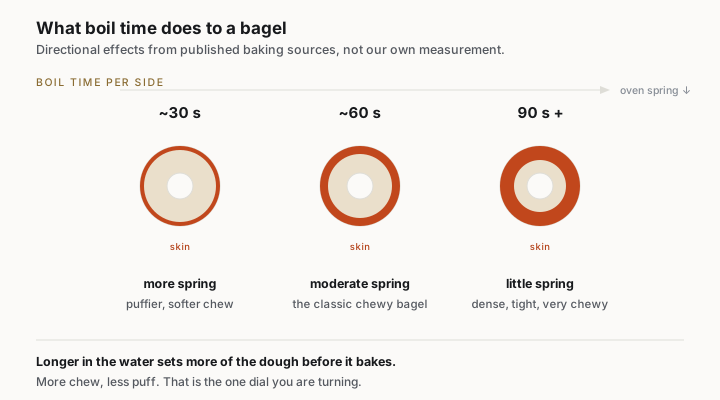
Directional effects from published baking sources, not our own measurement. The window most recipes aim for is 60 to 90 seconds a side.
| Boil time per side | The surface | Oven spring | The bagel you get |
|---|---|---|---|
| About 30 s | thin gelled skin | more | puffier, lighter, softer chew |
| About 60 s | firm set skin | moderate | the classic chewy, shiny bagel |
| 90 s and beyond | thick, deeply set skin | little | dense, tight, very chewy |
A widely used New York method boils 60 seconds, flips, then boils another 45 to 60 seconds, which lands squarely in that middle band (The Curious Chickpea). If your bagels come out cakey and soft, boil longer. If they come out tough and tight, boil less. You are not changing the recipe, you are changing one clock.
Now what goes in the water. Plain water works, but two additions earn their place:
- Barley malt syrup feeds the Maillard browning and adds a faint malty depth, and unlike table sugar or honey it colours evenly without scorching.
- Baking soda raises the water's pH, and a more alkaline bath browns darker and shinier, edging toward a pretzel like crust. Around a tablespoon per litre is plenty; much more and the bagel starts to taste of it (FoodCrumbles).
Keep the water at a strong simmer to a gentle rolling boil, not a violent one that batters the rings, and do not crowd the pot: a ring that sticks to its neighbour tears its skin. The full boil playbook, malt versus honey versus lye and how long for which texture, is its own deep dive.
New York bagel vs Montreal bagel
These are the two great schools, and they are genuinely different breads, not regional accents of one recipe.
| New York | Montreal | |
|---|---|---|
| Size and crumb | larger, softer, thicker | smaller, denser, bigger hole |
| Salt | yes | traditionally none |
| Enrichment | none | often egg yolk and oil |
| Boiling water | barley malt | honey |
| Oven | gas or electric | wood fired |
| Sweetness | savoury | sweeter |
The New York bagel is usually boiled in malted water and baked in a conventional gas oven, and it usually gets a cool overnight fermentation that deepens flavour. The Montreal bagel is boiled in honey sweetened water, enriched with egg yolk and oil, carries no salt, and is baked in a wood fired oven that gives it a blistered, toasty crust (Tasting Table, Mashed).
Neither is the correct bagel. If you want a chewy, savoury, substantial roll, make New York. If you want a sweeter, thinner, more charred one built around that big open hole, make Montreal. The one thing they share is the boil. A side by side of both schools, from the salt and egg in the dough to the malt and honey in the pot, is a guide of its own.
Everything bagel: the seasoning and how to make it stick
The everything bagel is a topping, not a dough, and the topping is easy: equal parts white and black sesame seeds, dried garlic and dried onion, poppy seeds, and flaky salt. The proportions are yours. The only rule is that the onion and garlic should be dried, because fresh ones burn to bitter black flecks in a hot oven.
The real question is how to make it stay on, because a topping that falls off in the toaster is a waste of good seed. The answer is timing: top the bagel wet, straight out of the boil, before the surface skins over. The gelatinized surface is tacky for a minute or two, and seeds pressed on in that window bond as the crust sets around them.
| Method | How well it sticks |
|---|---|
| Onto the boiled, still wet bagel | Best, the surface glues them |
| Dipped face down into a plate of seasoning | Excellent and even coverage |
| Onto a dry, cooled bagel | Poorly, they shed |
| With an egg wash first | Very well, but adds shine and a softer crust |
Dipping the wet top face down into a shallow plate of the mix gives the most even, generous coat. The full seasoning blend in real proportions and the trick that makes it stay on is a guide of its own.
Sourdough bagels
A sourdough bagel swaps the commercial yeast for a stiff levain, and it is one of the best uses of a starter, because the bagel's dense, slow structure suits a long ferment.
The changes from the base recipe are small but they matter. Build a levain and let the dough take its time: a cold overnight retard in the fridge, common in bagel making anyway, doubles as the sourdough fermentation and deepens the flavour. Keep the dough firm, the same low hydration as any bagel, because a wet sourdough will not hold the ring.
The trade you are making is time for flavour and keeping quality. A sourdough bagel takes a day of planning against a few hours for a yeasted one, and in return it tastes more complex and stales more slowly. If you already keep a starter, this is where to point it. The full levain build and schedule is covered in the sourdough bagel guide, and it leans on the starter guide for the culture itself.
Gluten free bagels
This is the hardest bagel to make well, and it helps to know why before you start. Gluten is exactly what a bagel leans on hardest: the chew, the ring that holds, the skin that survives the boil all come from a strong gluten network, and that is the one thing a gluten free flour cannot provide.
So a gluten free bagel is a rebuild, not a substitution. It needs a binder, usually psyllium husk, to mimic the structure gluten would give, and often xanthan gum in the flour blend. Psyllium is what lets a gluten free dough survive boiling at all: without it the ring disintegrates in the water.
Expect a different bagel, and judge it on its own terms. It will be a little softer and less elastically chewy than a wheat bagel, and that is the ceiling of the format, not a failure of your technique. The boil still matters, and the topping trick still works. The full binder ratios and a blend that holds together are covered in the gluten free bagel guide.
Whole wheat and whole grain bagels
Whole wheat bagels are the easiest variation to attempt and the easiest to get wrong, because bran does two unhelpful things: it drinks water and it cuts gluten strands like tiny blades, weakening the network the bagel depends on.
Two adjustments fix most of it. Add water, because whole grain flour absorbs more, so a dough that would be 58% with white flour often wants a few points more to feel the same. Do not go fully whole grain on your first try: a blend of roughly half and half whole wheat and bread flour gives most of the flavour and colour while keeping enough clean gluten to hold the ring and the chew.
A 100% whole wheat bagel is possible, but it is a denser, more assertive thing, and it wants a long soak or autolyse to soften the bran before you fight it into shape. Start with the blend and work up. The full whole wheat method, hydration and blend ratios included, is a guide of its own.
How to bake bagels: steam, seeds and the shiny crust
The bake is short and hot, and three things decide whether the crust comes out glossy and crisp or pale and dull.
Heat. Bagels want a hot oven. A common approach preheats to 500 °F (260 °C), then drops to 450 °F (230 °C) when the bagels go in, baking about 18 to 20 minutes with a rotation partway (The Curious Chickpea). The initial blast sets the crust fast.
Steam. A burst of steam in the first minutes keeps the surface moist just long enough for the crust to stay thin and shine rather than thickening into armour. A shallow tray of hot water on the oven floor, or a few ice cubes thrown in as you close the door, is enough at home. The boil has already done most of the surface work, so you need less steam than a lean hearth loaf.
Contact. Bake on a preheated stone or steel if you have one, or a heavy sheet, so the bottom gets direct heat and browns instead of steaming pale. Many bakers boil, top, then bake directly on the hot surface for the deepest bottom crust.
The shine you are chasing is the gelatinized surface plus the malt browning, not an egg wash, though an egg wash will add extra gloss if you want a glossier, softer top. Seeds go on before baking, pressed into the wet surface as covered above. The full bake, temperature and steam included, is a guide of its own.
Where it goes wrong: flat, wrinkled or hard bagels
Almost every failed bagel is one of three, and each has a main cause. Read this section and you will diagnose your own batch faster than any comment thread.
| Symptom | Most likely cause | The fix |
|---|---|---|
| Flat, spread out, no height | over proofed, or dough too wet or too weak | proof less, lower the hydration, use stronger flour |
| Wrinkled, shrivelled skin | over proofed then shocked by the boil | boil sooner after shaping, or retard cold and boil straight from the fridge |
| Dense, hard, tough | boiled too long, or dough underdeveloped | boil less, knead more |
| Pale, dull crust | oven too cool, or no malt and no baking soda in the boil | bake hotter, add malt and a little soda to the water |
| Hole closed up | shaped too small, or under rested | make the hole much bigger, rest before boiling |
Flat bagels are the headline complaint, and the usual culprit is proofing. A bagel that has fermented too long has spent its structure before it is boiled, so it collapses instead of holding. Bagels want a restrained proof, less than you would give a sandwich loaf, and many recipes retard them cold overnight and boil them straight from the fridge, which keeps them tight. If yours spread into pale flying saucers, proof less and boil sooner. Each of these failures, diagnosed in full by symptom with the fix for each, is a guide of its own.
How to store and freeze bagels
A fresh bagel is a same day food, and it goes stale fast because it is lean and low in fat. Plan around that rather than fighting it.
For the day: keep them at room temperature in a paper bag or loosely covered. Do not refrigerate them, because the fridge is the single fastest way to stale bread: starch retrogrades quickest at fridge temperature, so a bagel goes stale faster in the fridge than on the counter.
To keep them longer, freeze them, and freeze them fresh. Slice each bagel before freezing, because a frozen whole bagel is hard to cut and you can toast the halves straight from frozen. Bag them airtight to keep freezer burn off.
| Storage | How long | Notes |
|---|---|---|
| Counter, paper bag | 1 to 2 days | best texture, stales fast after |
| Fridge | avoid | stales faster than the counter |
| Freezer, pre sliced | 2 to 3 months | the right way to keep bagels |
To bring a frozen bagel back, toast it directly from the freezer, or thaw and then refresh it in a hot oven for a few minutes to wake the crust. A day old bagel that has gone a little firm is also, not by accident, the best possible bagel for toasting. The full storage and reheating method, counter versus freezer and why never the fridge, is a guide of its own.
Frequently asked questions
Why do you have to boil bagels? Boiling gelatinizes the starch on the surface into a skin that seals the dough, sets the shape so it cannot balloon, and builds the chewy, shiny crust. Skip it and you bake a soft round roll, not a bagel.
How long should I boil bagels? Between 30 and 90 seconds a side. Around 30 seconds gives a puffier, softer bagel, around 60 to 90 gives the classic chewy one, and much past 90 seconds gives a dense, tight result. Boil longer for more chew, less for a lighter bagel.
Why are my bagels flat? Almost always over proofing, sometimes a dough that is too wet or too weak. A bagel wants a restrained proof and a firm, well kneaded, low hydration dough. Proofing them cold overnight and boiling straight from the fridge keeps them tight.
What does baking soda in the water do? It raises the pH of the boiling water, which browns the crust darker and shinier and pushes it toward a pretzel like character. A tablespoon per litre is plenty. Too much and you can taste it.
What is the difference between a New York and a Montreal bagel? New York bagels are larger, savoury, salted, usually boiled in malt water and baked in a gas oven. Montreal bagels are smaller, sweeter, unsalted, enriched with egg and oil, boiled in honey water and baked in a wood fired oven with a bigger hole.
Can I make bagels without a stand mixer? Yes, but expect real work. Bagel dough is stiff and low in water, so kneading it by hand takes effort and often a rest partway through. A firm, fully developed dough is what holds the ring, so do not shortcut the kneading.
What flour is best for bagels? High protein bread flour, around 12 to 14% protein. The strong gluten it builds is what gives the chew and holds the ring through boiling. All purpose flour makes a softer, less chewy bagel.
Do bagels need malt? Not strictly, but malt is what gives a bagel its characteristic flavour and even browning, in the dough and in the boiling water. Without it a bagel browns paler and tastes plainer. Barley malt syrup is the traditional choice.
This guide keeps getting updated as new details turn up. Good baking, and make that hole bigger than feels sensible.
Where I checked
Keep reading
 Guide
Guide
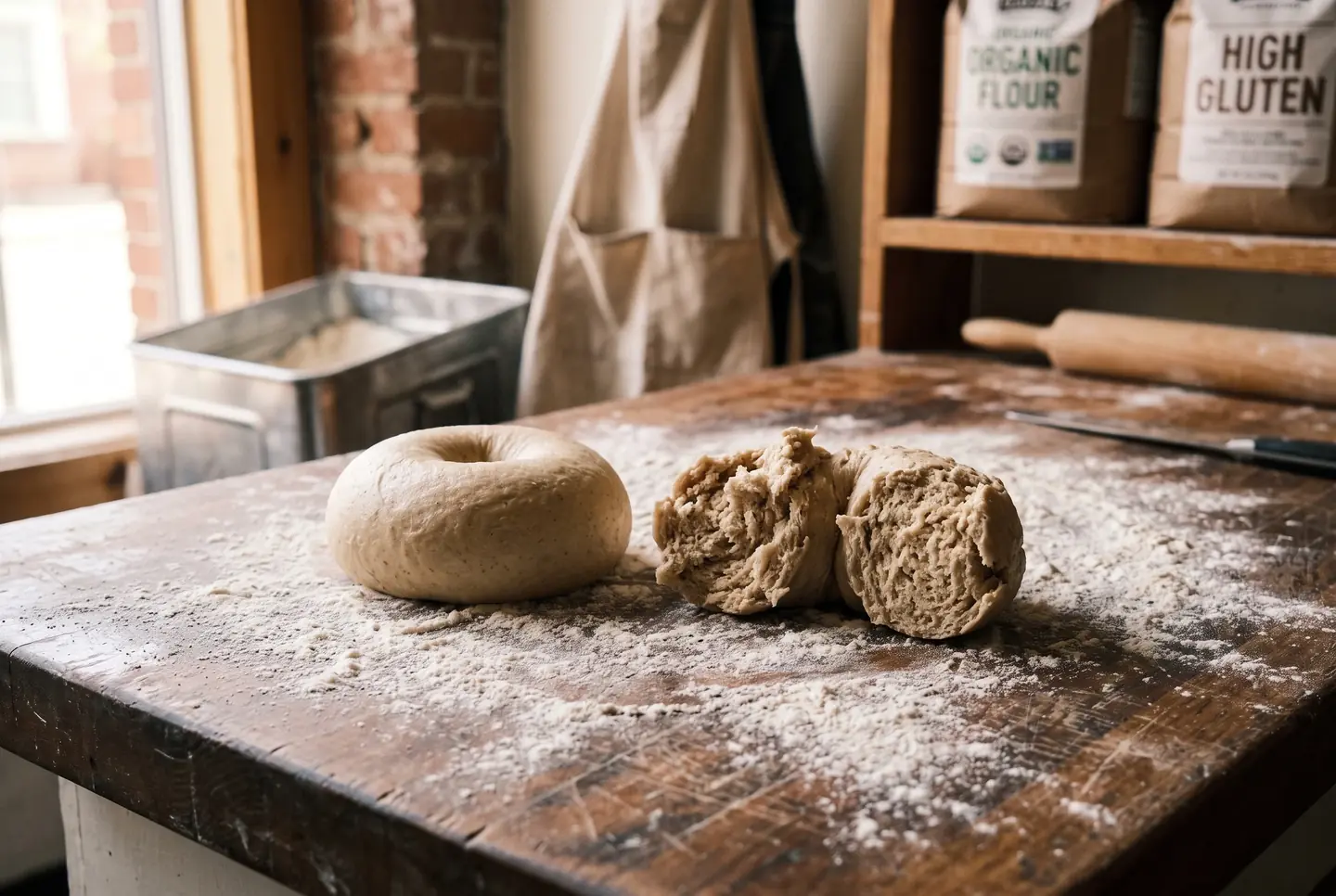
Bagel Dough: Why It Is So Firm, and How to Knead It
Bagel dough feels stiff and dry on purpose. Here is why it runs at 50 to 60% water and high protein flour, how to knead it, and the windowpane to aim for.
6 min read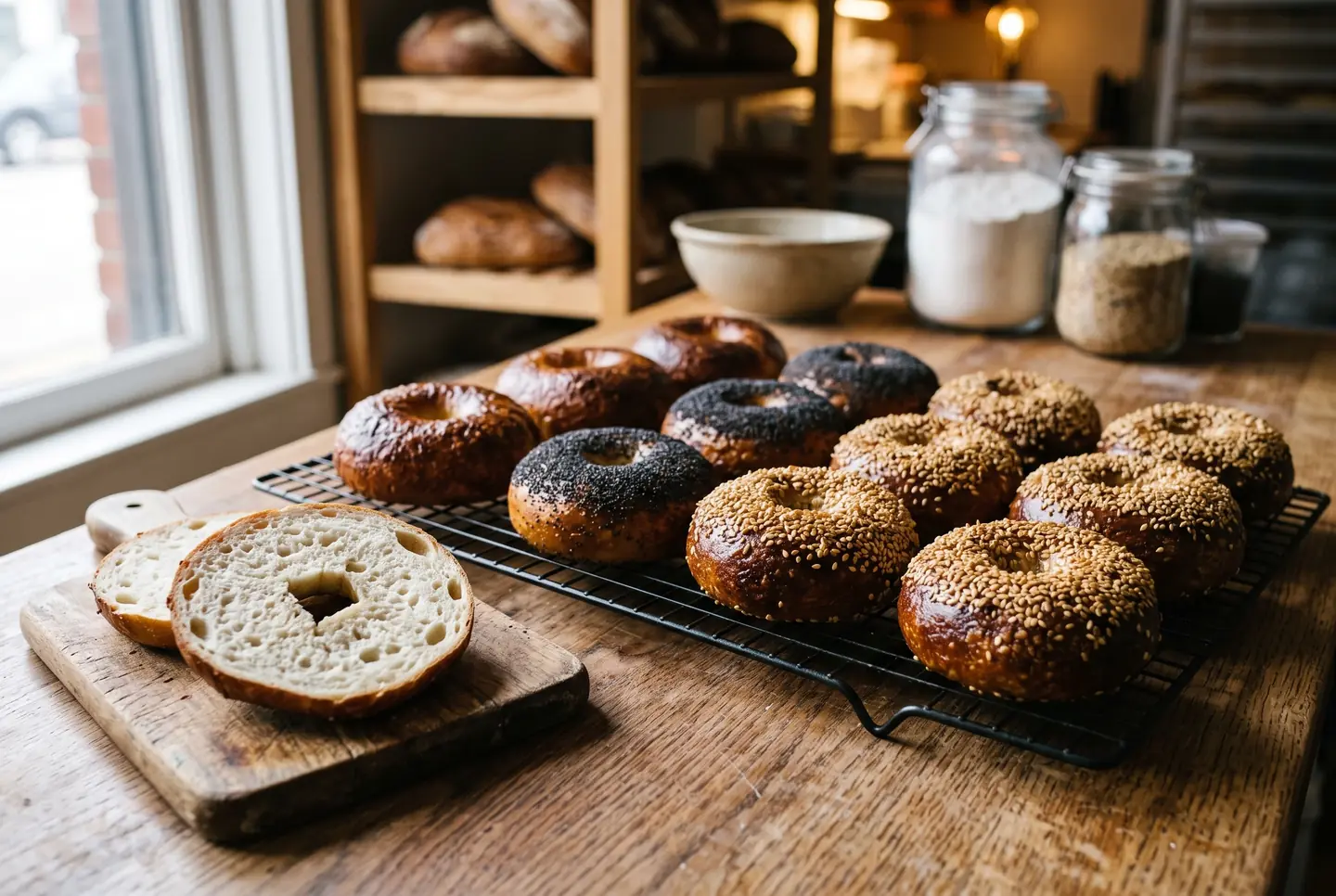 Guide
Guide
Bagel Recipe: New York Style, Step by Step
A weight-based New York bagel recipe, step by step: the firm 58% dough, an overnight cold retard, how long to boil, and the oven heat that sets a glossy crust.
6 min read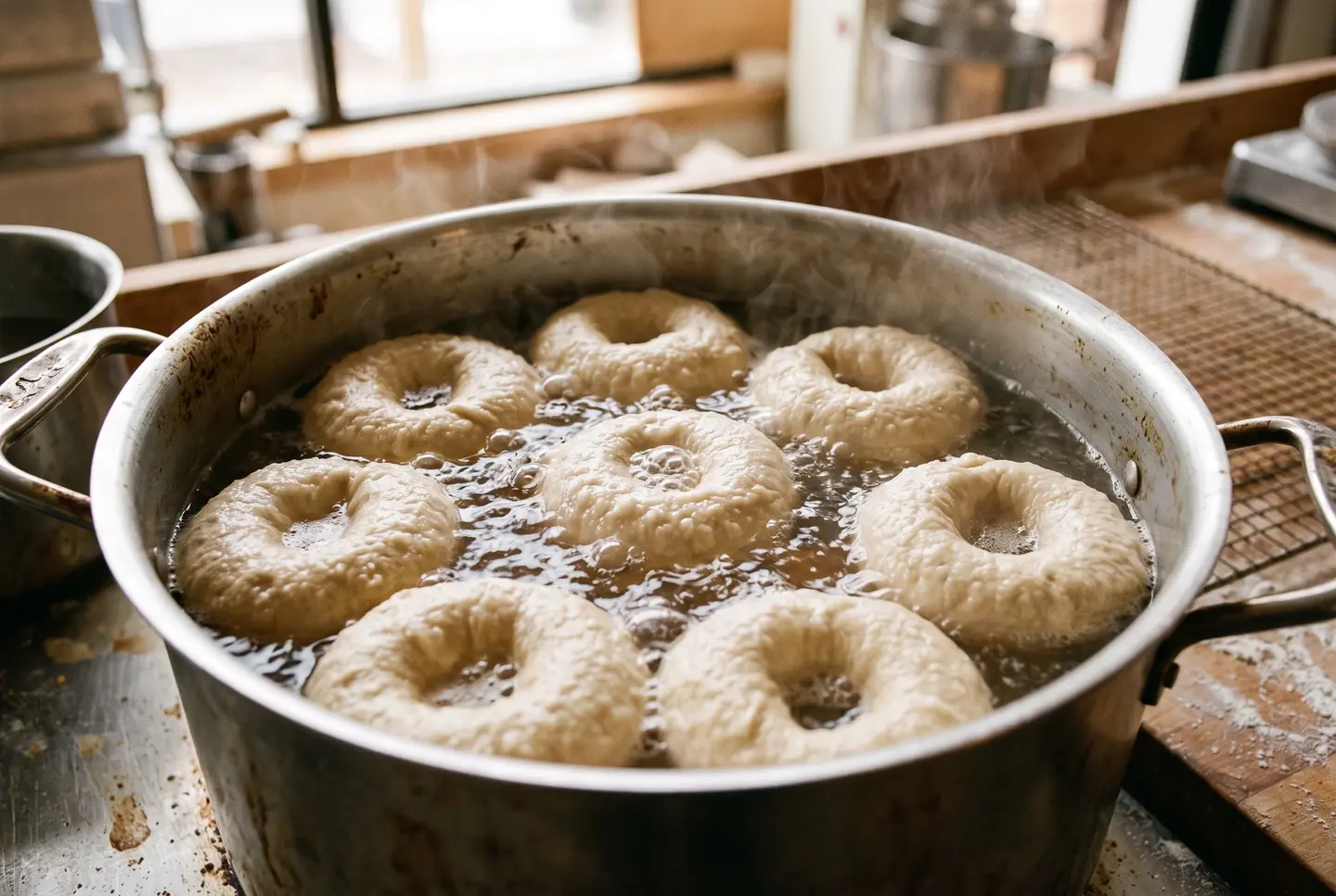 Guide
Guide
Boiling Bagels: How Long, and What Goes in the Water
How long to boil bagels and what changes with time: 30 vs 60 vs 90 seconds, plus what baking soda and malt do to the crust. The one step that makes a bagel.
6 min read