Guide
Boiling Bagels: How Long, and What Goes in the Water
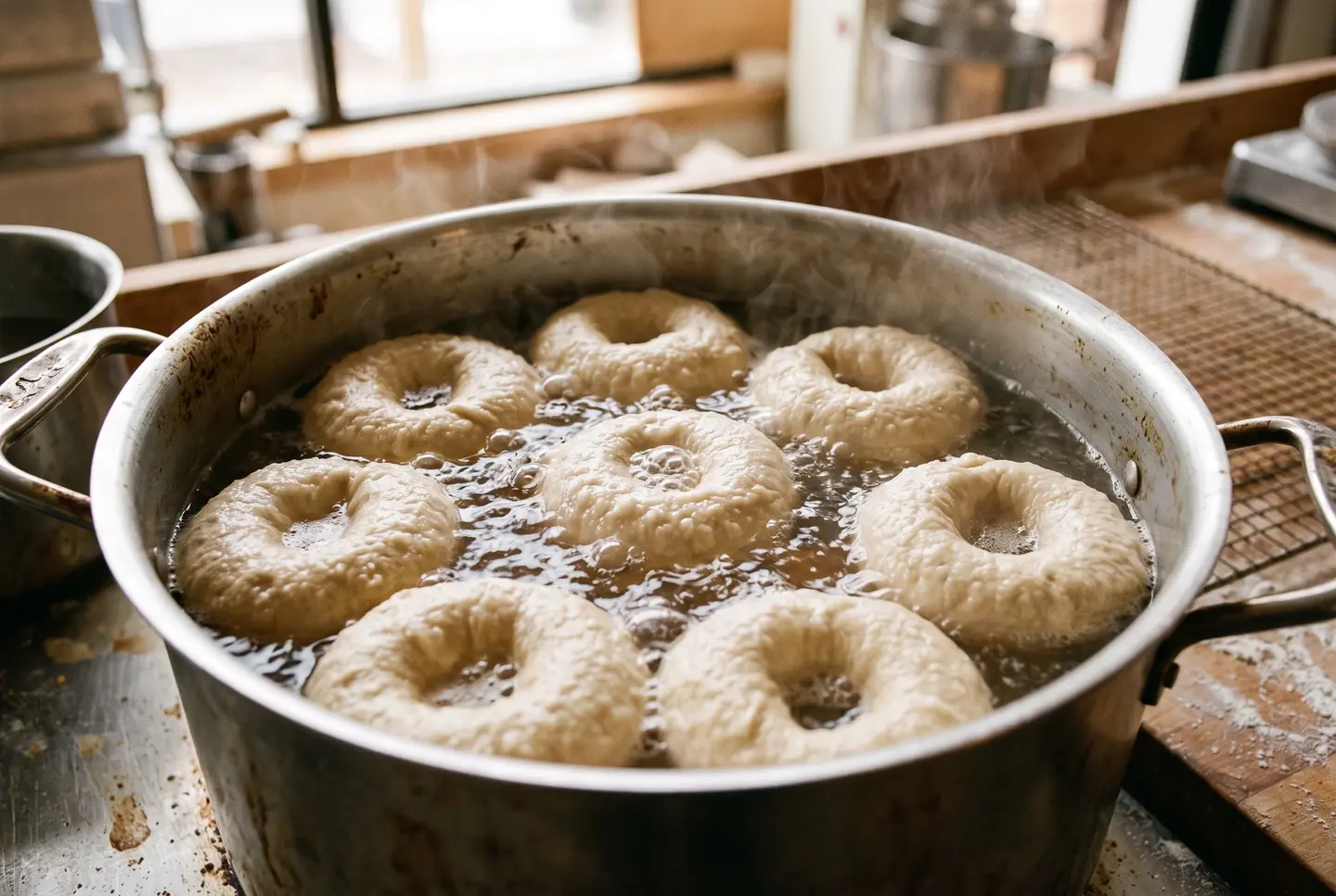
Boil each side 60 to 90 seconds in water with a spoon of malt and, if you want a darker crust, a spoon of baking soda. That single band covers most good bagels. Boil less and they puff soft and cakey; boil more and they turn dense and tight. The boil is the one step that separates a bagel from a round roll with a hole, so it is worth understanding rather than rushing.
This is the boiling half of the complete bagel guide: how boil time changes the texture, and what each addition to the water actually does.
Why bagels are boiled at all
When a raw ring hits boiling water, the starch on its surface gelatinizes almost instantly. Wheat starch sets somewhere around the 60 to 75 °C range, so a few seconds in water well above that cooks a thin skin over the dough (FoodCrumbles). That skin does three jobs at once: it seals the surface so the inside stays raw and flexible, it sets the shape so the ring cannot balloon in the oven, and it builds the crust that gives a bagel its shine and chew (The Kitchn).
Skip the boil and none of that happens: the ring bakes into an airy roll. That is the line between the two breads, and it is drawn in a pot of water.
How long to boil: the one clock that sets texture
Time is the variable that decides the texture, because the longer a ring sits in the water, the deeper the starch gelatinizes and the more of the dough is set before it ever reaches the oven.
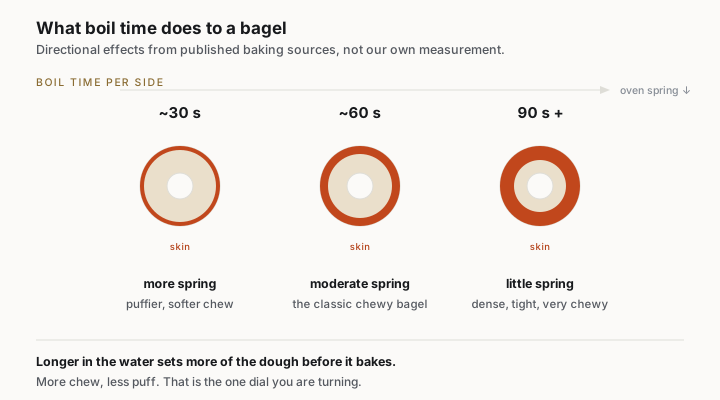
Directional effects from published baking sources, not our own measurement. The window most recipes aim for is 60 to 90 seconds a side.
FoodCrumbles put the two extremes side by side: about 30 seconds a side leaves a thin cooked layer over a still raw, still expandable interior, while pushing toward three minutes a side sets far more of the dough and gives a markedly firmer, denser result with much less puff (FoodCrumbles). Everything useful lives between those poles.
| Boil time per side | The surface | Oven spring | The bagel you get |
|---|---|---|---|
| About 30 s | thin gelled skin | more | puffier, lighter, softer chew |
| About 60 s | firm set skin | moderate | the classic chewy, shiny bagel |
| 90 s and beyond | thick, deeply set skin | little | dense, tight, very chewy |
A widely used New York method boils 60 seconds, flips, then boils another 45 to 60 seconds, which lands squarely in that middle band (The Curious Chickpea). Boil both sides for the same time so the ring sets evenly; a bagel cooked longer on one face sets a thicker skin there and can bake lopsided, curling toward the firmer side.
The rule to keep is simple: if your bagels come out cakey and soft, boil longer; if they come out tough and tight, boil less. You are not changing the recipe, you are changing one clock. And time is the lever precisely because it decides how much of the interior sets in the water versus in the oven: a short boil leaves most of the crumb to expand under heat, a long one has already fixed it before the tray goes in.
What goes in the water
Plain water works. Two additions earn their place, and each does a different job.
Barley malt syrup feeds the Maillard browning and adds a faint malty depth. Unlike table sugar or honey it colours evenly without scorching, which is why it is the traditional choice for the bath as well as the dough.
Baking soda raises the water's pH, and a more alkaline bath browns darker and shinier, edging toward a pretzel like crust. The alkalinity speeds the Maillard reaction, so the bagel colours faster in the oven (FoodCrumbles). Around a tablespoon per litre is plenty. Much more and the bagel starts to taste of it.
| Addition | What it does | How much |
|---|---|---|
| Nothing | seals and sets the crust, pale finish | plain water |
| Barley malt syrup | even browning, malty depth | about 1 tbsp per litre |
| Baking soda | darker, shinier, pretzel leaning crust | about 1 tbsp per litre |
| Honey or sugar | browning, sweeter note, browns less evenly | 1 to 2 tbsp per litre |
Malt and baking soda are not rivals; many recipes use both, malt for flavour and soda for colour and shine. Honey is a common stand in for malt if that is what you have, with a slightly sweeter result.
Running the pot
A few habits keep the boil from undoing the shaping you just did.
- Keep the water at a strong simmer to a gentle rolling boil, not a violent one. A churning pot batters the soft rings and can tear the skin you are trying to build.
- Do not crowd the pot. A ring that sticks to its neighbour tears when you separate them. Boil in batches with room to move.
- Have the tray ready. Straight from the water the skin is wet and delicate; lift each ring with a slotted spoon, let it drain a moment, then set it down and top it before the surface dries and the seeds will not stick.
Get the time into the 60 to 90 second band, put malt in the water for flavour and soda for colour, and keep the pot calm, and the boil does exactly what the rest of the recipe is counting on: it makes the ring a bagel before the oven ever sees it.
Frequently asked questions
How long should I boil bagels? Between 60 and 90 seconds a side for the classic chewy bagel. About 30 seconds a side gives a softer, puffier result; 90 seconds and beyond gives a dense, very chewy one. Adjust the time, not the recipe.
Do you have to boil bagels? Yes, if you want a bagel. The boil gelatinizes the starch on the surface, seals the ring so it cannot puff into a roll, and builds the shiny, chewy crust. An unboiled ring bakes into an airy roll instead.
What do you put in the water to boil bagels? Barley malt syrup for even browning and malty flavour, and baking soda for a darker, shinier crust. About a tablespoon of each per litre. Honey or sugar can stand in for the malt.
Why do you add baking soda to bagel water? It makes the water alkaline, which speeds the Maillard browning so the crust turns darker and shinier, closer to a pretzel. Keep it to about a tablespoon per litre, or the bagel picks up a soapy taste.
My bagels came out soft and cakey. What went wrong? You boiled too briefly. A short boil leaves the interior raw and expandable, so it puffs in the oven. Boil each side longer, toward 90 seconds, to set more of the dough and get the dense chew.
The boil is fast, and it is tempting to treat it as a formality. Give it the 90 seconds and the calm pot it wants, and it pays you back with the one thing a roll can never have.
Where I checked
Keep reading
 Guide
Guide
Bagel Dough: Why It Is So Firm, and How to Knead It
Bagel dough feels stiff and dry on purpose. Here is why it runs at 50 to 60% water and high protein flour, how to knead it, and the windowpane to aim for.
6 min read Guide
Guide
Bagel Recipe: New York Style, Step by Step
A weight-based New York bagel recipe, step by step: the firm 58% dough, an overnight cold retard, how long to boil, and the oven heat that sets a glossy crust.
6 min read Complete guide
Bagels: The Complete Guide
Make a real bagel at home: the firm 58% dough, why bagels are boiled before baking, New York vs Montreal, sourdough and gluten free, and how to fix flat ones.
18 min read