Guide
Gluten Free Bagels: Why Psyllium Is the Whole Recipe
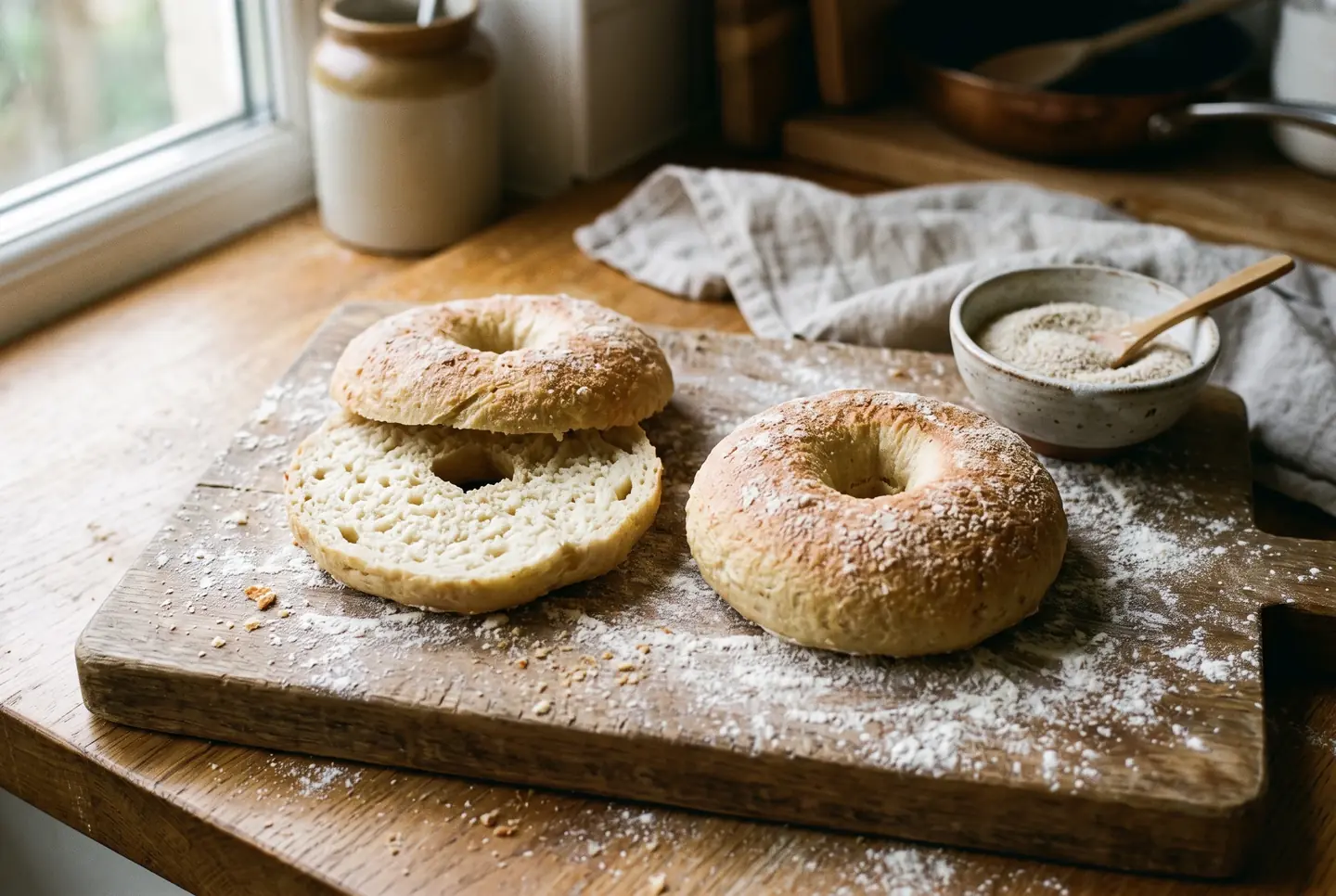
The direct answer first, because it saves a lot of failed batches: a gluten free bagel is a rebuild, not a substitution, and the ingredient that makes it work is not the flour. It is psyllium husk, usually around 4 to 5% of the flour weight, and it is the one thing standing between you and a ring that dissolves in the boiling pot.
Gluten is exactly what a bagel leans on hardest. The chew, the ring that holds its shape, the skin that survives a minute in boiling water: all of it comes from a strong gluten network, and that is the single thing a gluten free flour cannot give you. So you cannot swap the flour in the standard bagel recipe and expect a bagel. You have to rebuild the structure from a different material, and psyllium is that material.
Why gluten free bagels are the hard case
Of all the breads to make without gluten, a bagel is close to the hardest, and it helps to know why before you start so you judge the result fairly.
A soft sandwich loaf can hide a weak structure inside a tin. A bagel cannot hide anything. It has to be shaped into a free standing ring, hold that ring through a proof, then survive being dropped into boiling water, and only then does it bake. Every one of those steps is a demand on structure, and structure is the job gluten normally does. Take gluten away and the bagel does not get a little worse, it falls apart, unless something else is holding it together.
That something is a binder. In a wheat bagel the binder is free: the gluten builds itself as you mix. In a gluten free bagel you add the binder on purpose, and get the amount right, or there is no bagel to boil.
Psyllium husk: the ingredient that survives the boil
Psyllium seed husk is what makes a gluten free bagel possible at all. It absorbs water and forms a gel that binds the flours together and mimics the elasticity of gluten, which is why recipe developers reach for it specifically for boil and bake breads.
The amounts are consistent across good recipes. Snixy Kitchen uses 20g of psyllium husk to roughly 460g of flour blend, a little over 4%. Mama Knows Gluten Free uses 3 tablespoons of psyllium husk powder to 420g of flour, in the same range. Call it 4 to 5% of the flour weight and you are in safe territory.
| Ingredient | Typical amount | What it does |
|---|---|---|
| Psyllium husk | 4 to 5% of flour weight | binds the flours, mimics gluten, survives the boil |
| Xanthan gum | small, or none | extra softness; some recipes skip it when psyllium is present |
| Gluten free flour blend | the bulk | the body, usually a mix of rice, starch and a whole grain flour |
Without psyllium, the ring disintegrates the moment it hits the water. With it, the dough holds together through the boil the way a wheat dough would. That is not a minor upgrade, it is the difference between a bagel and a pot of cloudy water.
Xanthan gum is a secondary player. Some blends already contain it, and some recipes add a little for extra softness, but where psyllium is doing the structural work, xanthan is optional. Snixy Kitchen, for example, leaves xanthan out entirely and relies on psyllium alone.
The flour blend
No single gluten free flour makes a good bagel. The blends that work combine a base flour for body, a starch or two for structure and browning, and often a whole grain flour for flavour. A representative example from Snixy Kitchen is brown rice flour, tapioca flour, potato starch and sorghum flour together, with the psyllium added on top as the binder.
You do not have to grind your own blend. A good all purpose gluten free flour, ideally one that already includes xanthan, gets you to the same place, and then you add the psyllium separately. The point is that the flour is the body and the psyllium is the skeleton. If you are curious about the individual flours, sorghum and rice flour both have their own entries.
Method: what stays, what changes
The good news is that most of the bagel method survives intact. You still shape rings, you still boil before baking, and the topping trick from the base guide still works.
| Step | Wheat bagel | Gluten free bagel |
|---|---|---|
| Binder | gluten, builds itself | psyllium husk, added at 4 to 5% |
| Kneading | develops the gluten | mostly mixing; there is no gluten to develop |
| Shaping | roll and join a rope | often a wetter dough, shaped more gently |
| Boil | yes | yes, and psyllium is what lets it hold |
| Bake | hot oven | hot oven, around 425°F |
The boil is not optional here either. It gelatinises the surface and sets the skin, and the psyllium is precisely what allows a gluten free ring to take that treatment. Boil one minute per side as you would a wheat bagel, then bake hot. The topping goes on wet straight out of the water, same as always.
Set your expectations correctly
Judge a gluten free bagel on its own terms, not against a wheat one, or you will always be disappointed. It will be a little softer and less springily chewy than a gluten bagel, because that intense elastic chew is a gluten property and psyllium only approximates it. That softer result is the ceiling of the format, not a failure of your technique.
What you can absolutely get is a proper bagel shape, a real boiled skin, a good crust and a satisfying eat. What you cannot get is the exact bite of a New York bagel, and chasing it will only frustrate you. Aim for a very good gluten free bagel, which is an achievable and worthwhile thing, and leave the wheat comparison at the door.
Frequently asked questions
Can you make bagels without gluten? Yes, but it is a rebuild rather than a flour swap. You replace the structure gluten would provide with a binder, almost always psyllium husk at around 4 to 5% of the flour weight, which is what lets the ring survive the boil.
Why do gluten free bagels need psyllium husk? Because gluten is what normally holds a bagel together through shaping and boiling, and a gluten free flour cannot do that. Psyllium absorbs water and forms a gel that binds the flours and mimics gluten's elasticity, so the ring holds instead of dissolving in the water.
How much psyllium husk goes in gluten free bagels? Around 4 to 5% of the flour weight. Snixy Kitchen uses about 20g to 460g of flour and Mama Knows Gluten Free uses 3 tablespoons to 420g, both in that range.
Do I need xanthan gum as well as psyllium? Not necessarily. Psyllium does the structural work, and some recipes use it alone with no xanthan at all. A little xanthan, or a blend that already contains it, can add softness, but it is optional where psyllium is present.
Do gluten free bagels still get boiled? Yes. The boil sets the skin and is part of what makes a bagel a bagel, and the psyllium is exactly what lets a gluten free ring survive it. Boil about one minute per side, then bake hot.
Why is my gluten free bagel softer than a normal one? Because the springy, elastic chew of a wheat bagel is a gluten property, and psyllium only approximates it. A slightly softer, less chewy result is the natural ceiling of a gluten free bagel, not a mistake on your part.
Get the psyllium right and the rest of the bagel follows. It will not be a wheat bagel, and it was never trying to be. It is a good bagel that happens to be gluten free.
Where I checked
Keep reading
 Guide
Guide
Bagel Dough: Why It Is So Firm, and How to Knead It
Bagel dough feels stiff and dry on purpose. Here is why it runs at 50 to 60% water and high protein flour, how to knead it, and the windowpane to aim for.
6 min read Guide
Guide
Bagel Recipe: New York Style, Step by Step
A weight-based New York bagel recipe, step by step: the firm 58% dough, an overnight cold retard, how long to boil, and the oven heat that sets a glossy crust.
6 min read Complete guide
Bagels: The Complete Guide
Make a real bagel at home: the firm 58% dough, why bagels are boiled before baking, New York vs Montreal, sourdough and gluten free, and how to fix flat ones.
18 min read