Flour
Sorghum flour: the gluten-free grain that became a baking staple
Sorghum flour is milled from the whole grain of Sorghum bicolor, a naturally gluten-free cereal. Its mild flavor and pale color make it the go-to base for a lot of gluten-free home baking.
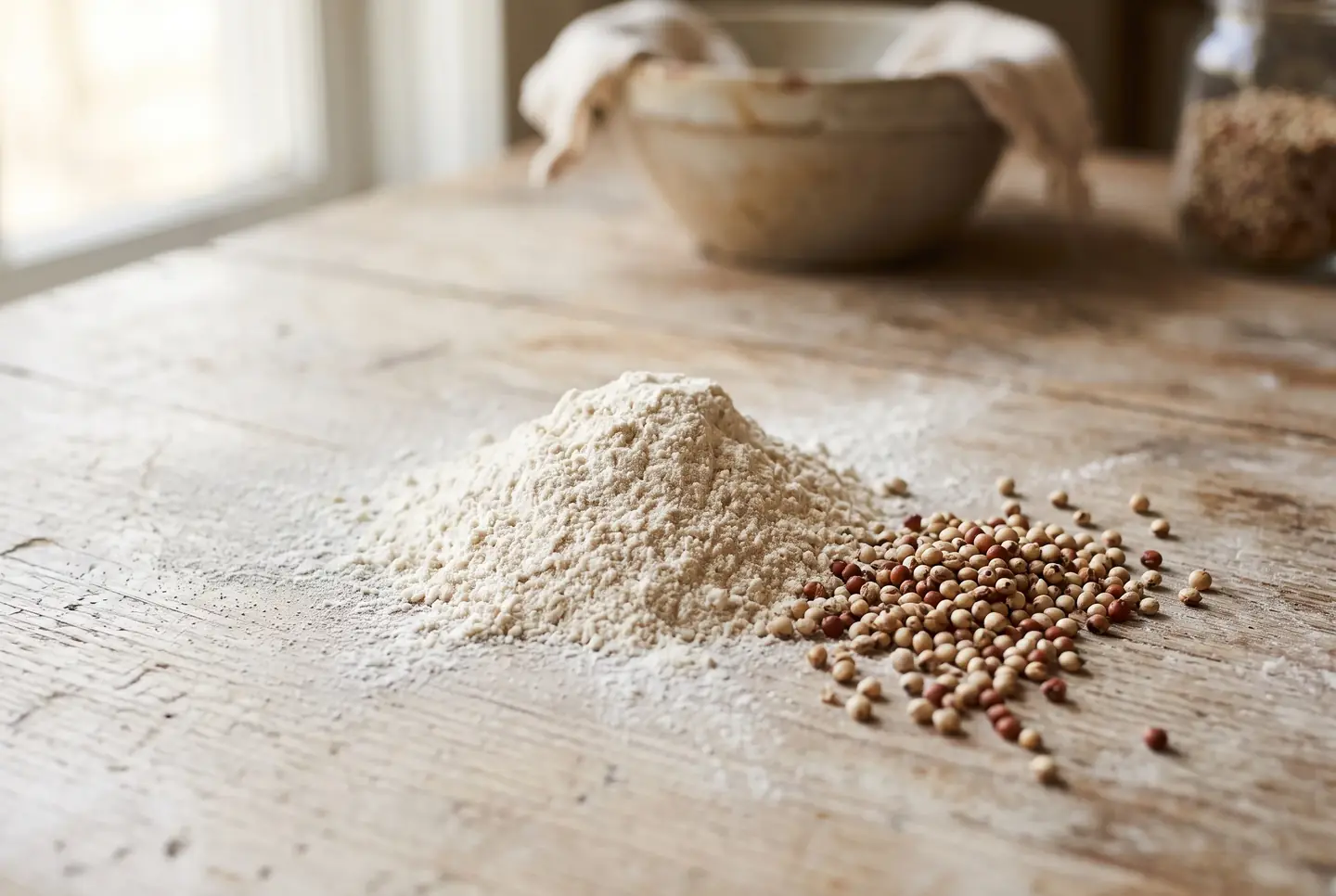
At a glance
- Strength (W)
- not measured
- Protein
- 8.4%
- Water absorption
- not measured
- Stability
- not measured
- Ash
- 1.3%
- Origin
- África (domesticado no nordeste africano, entre o Sudão e a Etiópia); hoje EUA, Índia, Nigéria e México
- Grain
- Sorghum bicolor, cereal naturalmente sem glúten
What it is called in each country
| Country | Called |
|---|---|
| English | 'Sorghum flour' nos EUA, base de muitas misturas sem glúten; 'white sorghum flour' na embalagem, e 'jowar flour' no comércio indiano do Reino Unido. |
| Português | No Brasil o sorgo é plantado em larga escala, mas quase todo para ração; a farinha alimentar é item de loja de produtos naturais e linha sem glúten, vendida como 'farinha de sorgo'. |
| Italiano | Vendida como 'farina di sorgo', quase sempre integrale, em loja bio ou setor senza glutine; ainda pouco comum fora do circuito celíaco. |
| Français | 'Farine de sorgho' em loja bio e magasin sans gluten; costuma vir do sorgho branco, às vezes chamada de 'gros mil' em textos antigos. |
| Español | 'Harina de sorgo' na Espanha (herbolario e sem glúten); na Índia e em parte da América Latina o grão é o 'jowar', e a farinha aparece com esse nome. |
What it is for
It is for anyone baking without gluten who still wants something that tastes like real food. The flavor is neutral and faintly sweet, without the bitterness some alternative flours carry, and the light color keeps doughs from turning gray. It shines as the backbone of a gluten-free bread blend, and in cakes, pancakes, muffins and cookies. It is usually paired with a light starch (tapioca, potato or corn starch) and a binder, because on its own it cannot hold structure the way gluten would.
How to substitute it
To swap part of the wheat in an ordinary recipe for sorghum, start around 30 percent and watch how it behaves: the dough turns more crumbly and drinks more liquid, so the crumb dries out if you do not adjust. In a recipe designed to be gluten-free, sorghum usually makes up 30 to 40 percent of the flour side, with the rest split between a starch and some rice or chickpea flour. What changes in the result: with no gluten, there is no elastic web to trap gas, so the rise comes from xanthan gum or psyllium plus the leavening, not from the dough network. Expect a tighter crumb and a thinner crust than a wheat loaf.
When not to use it
It is not the flour for a stretchy, hand-shaped dough like Neapolitan pizza or a long-fermented rustic loaf: without gluten, that elasticity simply is not there. It also makes little sense as the star of a thin, crisp coating, where a pure starch does more. And if you only want to add a hint of flavor to a wheat dough, there are more assertive flours; sorghum earns its place precisely by being discreet.
How to use it
In practice sorghum asks for three adjustments. First, hydration: it takes up more water than wheat, so a batter that looks right at the start can dry out in the oven; leave it a touch wetter than instinct says. Second, binding: without gluten you need something to hold structure, and psyllium husk gives a moister, less crumbly crumb than xanthan gum alone. Third, resting: giving the batter 20 to 30 minutes before baking lets the flour hydrate fully, which cuts the gritty feel that under-rested gluten-free flours tend to have.
How to choose one when buying
On the label, look for 'whole grain sorghum flour' and check whether it is white sorghum (more neutral) or a colored, bran-on type (more tannic and astringent). Good flour is fine and pale, with no rancid smell; because the whole grain carries oil, it goes off faster than a starch. Keep it sealed, away from heat, and in a warm climate the fridge is worth it. Gluten-free brands usually carry a certified gluten-free seal, which matters if there is a celiac at home, since it guarantees the mill avoided cross-contamination.
The story
Sorghum is one of the oldest cereals we still eat. It was domesticated in northeast Africa, in the belt running from today's Sudan to Ethiopia, more than four thousand years ago, and from there it spread across Africa and reached India, where it became everyday jowar. It has always been food for people across much of the world, even when in the West it turned mostly into animal feed. The gluten-free wave of recent decades brought the grain back to the table: cheap, drought-hardy and gentle in flavor, it reappeared as exactly the neutral base gluten-free bakers were missing.
Frequently asked
- Does sorghum flour contain gluten?
- No. Sorghum (Sorghum bicolor) is a naturally gluten-free cereal. Even so, if you are celiac, choose packages with a certified gluten-free seal, which guarantees milling without cross-contamination from wheat.
- Can you make bread with only sorghum flour?
- You can, but it comes out dense and crumbly. With no gluten, it works far better blended with a light starch and a binder such as psyllium or xanthan gum, which play the role of the elastic network sorghum lacks.
- What is the difference between sorghum flour and rice flour?
- Both are gluten-free, but sorghum has more protein and a faintly sweet flavor, while rice flour is more neutral and can leave a gritty texture. Many recipes use the two together to balance body and lightness.
- Is sorghum flour the same as jowar?
- Yes. Jowar is the name for sorghum in India, and jowar flour is the flour of the same grain, widely used for flatbreads like bhakri. If you find jowar flour, it is sorghum flour.