Complete guide
Sourdough Starter: The Complete Guide
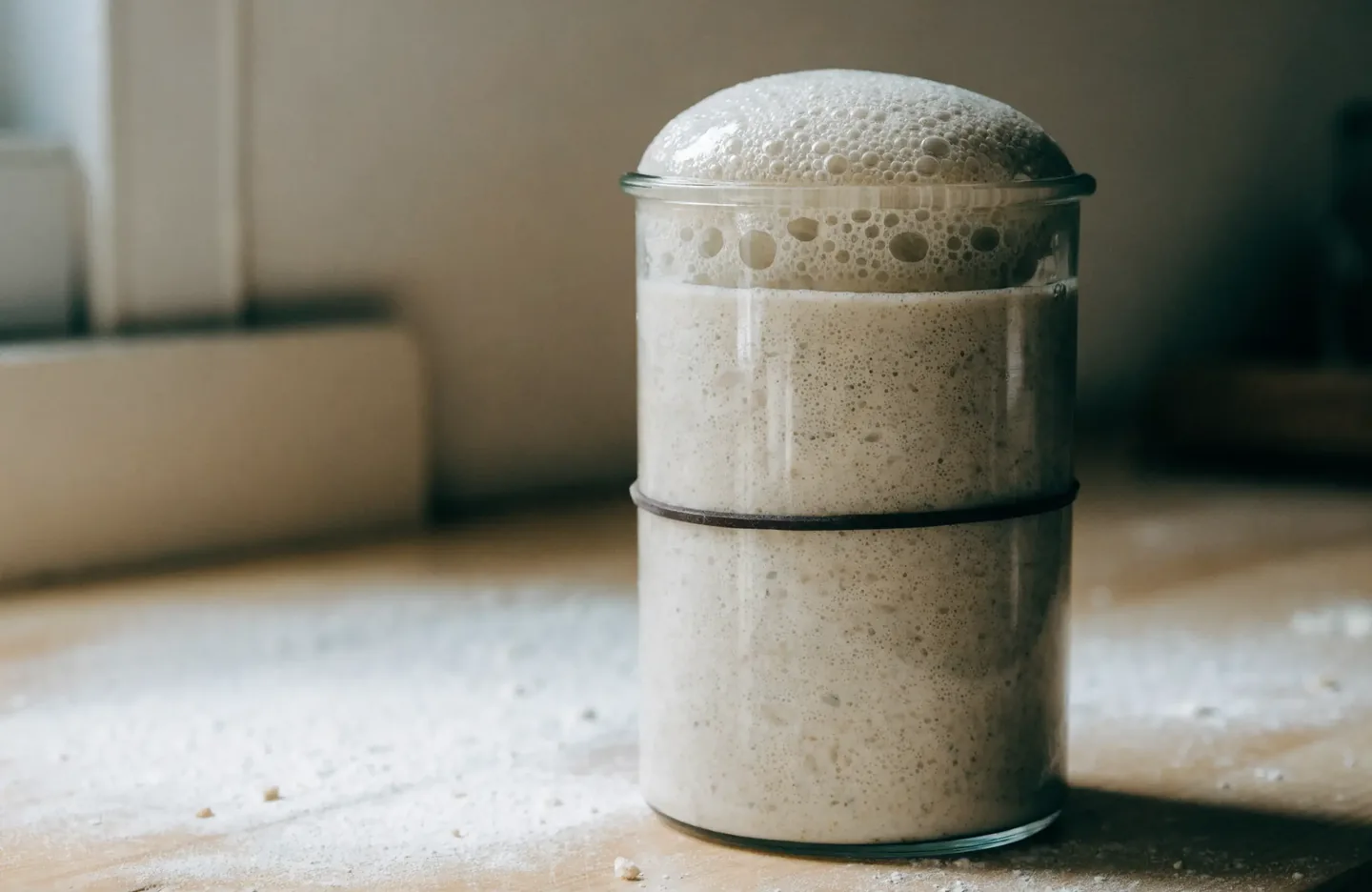
A sourdough starter is the only ingredient in bread that is alive, and it is the only one that behaves differently in your kitchen than it does in mine. That is why most starter guides fail you: they hand you one schedule, one ratio and one photo of a jar, as if fermentation did not care about the temperature of the room it happens in. It cares more about that than about almost anything else.
This guide is built the other way around. Every instruction here is tied to the two variables that actually control your starter: how much you feed it and how warm it is. Get those two right and the starter becomes predictable. Get them wrong and you will spend months believing your flour is cursed.
One warning before we start, because it will save you the most common frustration in sourdough: the float test does not work reliably, and section 7 explains what to do instead.
What a sourdough starter actually is, and what lives in it
A starter is a stable culture of wild yeasts and lactic acid bacteria living in a paste of flour and water. It is not "wild yeast" alone. That distinction matters, because the bacteria are the majority partner and they are the ones setting the flavour.
In a mature sourdough, lactic acid bacteria outnumber yeasts by roughly 10:1 to 100:1, and in some cultures the gap is far wider. Bacterial counts sit above 10⁸ CFU per gram, with yeasts at least an order of magnitude below (Frontiers in Microbiology).
The division of labour is clean:
| Partner | What it produces | What you notice |
|---|---|---|
| Yeasts (mostly Saccharomyces and related genera) | Carbon dioxide, ethanol | The rise, the domed jar, oven spring |
| Lactic acid bacteria | Lactic acid, acetic acid | The sourness, the keeping quality, the lowered pH |
More than 50 species of lactic acid bacteria and more than 20 species of yeast have been identified across sourdoughs worldwide (ASM). When 19 traditional Italian sourdoughs were characterised, Lactobacillus sanfranciscensis accounted for about 28% of bacterial isolates, L. plantarum about 16%, and L. paralimentarius about 14% (Applied and Environmental Microbiology).
Two practical consequences follow, and they contradict things you have probably read:
- Your starter is not "the flour's yeast" alone. It is a community, and communities shift with what you feed them and how warm you keep them. That is why the same jar tastes different in winter and summer.
- You are not going to lose it easily. A mature culture is acidic, and with 10⁸ bacteria per gram it is a hostile place for newcomers. Starters are far more robust than the internet suggests. The exceptions are in section 11, and they are about safety, not fragility.
How to create a sourdough starter from scratch in 7 days
You need flour, water, a jar and a scale. Nothing else. Not pineapple juice, not grapes, not commercial yeast.
| Day | What you do | What you should see |
|---|---|---|
| 1 | Mix 50 g wholemeal flour + 50 g water at 25 to 28 °C. Cover loosely. | Nothing. Correct. |
| 2 | Leave it alone. | Maybe a few bubbles, maybe none. Both are normal. |
| 3 | Discard all but 50 g. Add 50 g flour + 50 g water. | Often a false rise with a sharp, cheesy smell. This is not your starter yet. |
| 4 | Same feed. | Frequently the quietest day. Activity drops. Do not panic and do not throw it out. |
| 5 | Same feed. | Real bubbling begins, smell turns from cheesy to yoghurt-like. |
| 6 | Feed twice, 12 hours apart. | A visible rise and fall within the day. |
| 7 | Feed 1:1:1 and watch. | If it doubles in 4 to 8 hours, it is working. |
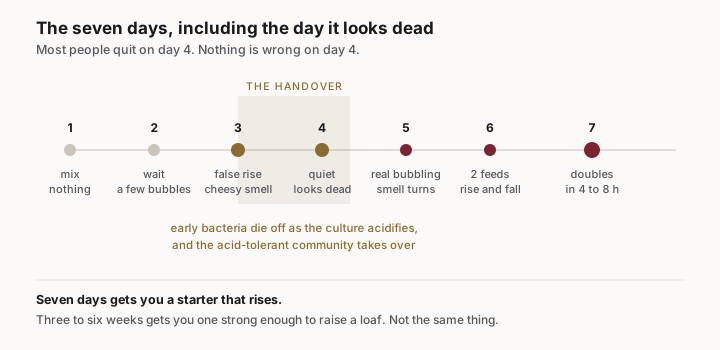
The day 3 to day 4 sequence is where most people quit. What happens is well documented: early activity is often driven by bacteria that do not survive the acidifying environment, and the culture goes quiet while the acid-tolerant community establishes itself. The apparent death on day 4 is a handover, not a failure.
Seven days gets you a starter that rises. It does not get you a starter that is strong. Strength is a separate thing and section 5 covers it.
Full walkthrough with what to do when it stalls: how to make a sourdough starter from scratch in 7 days.
Which flour to use to start a starter
Start with wholemeal, then decide what to maintain on. Wholegrain flours carry more microbial load, more minerals and more enzyme activity, which is exactly what you want in the first week.
| Flour | To create | To maintain | Notes |
|---|---|---|---|
| Wholemeal wheat | Excellent | Good | The reliable default for week 1 |
| Wholegrain rye | Excellent | Good | Fastest to get going, distinctly tangy, holds a lot of water |
| White bread flour | Slow | Excellent | Clean flavour, easy to read the rise, slower to establish |
| Type 00 / very refined | Poor | Fair | Too little bran and mineral content to start well |
| Bleached flour | Avoid | Avoid | The treatment works against you |
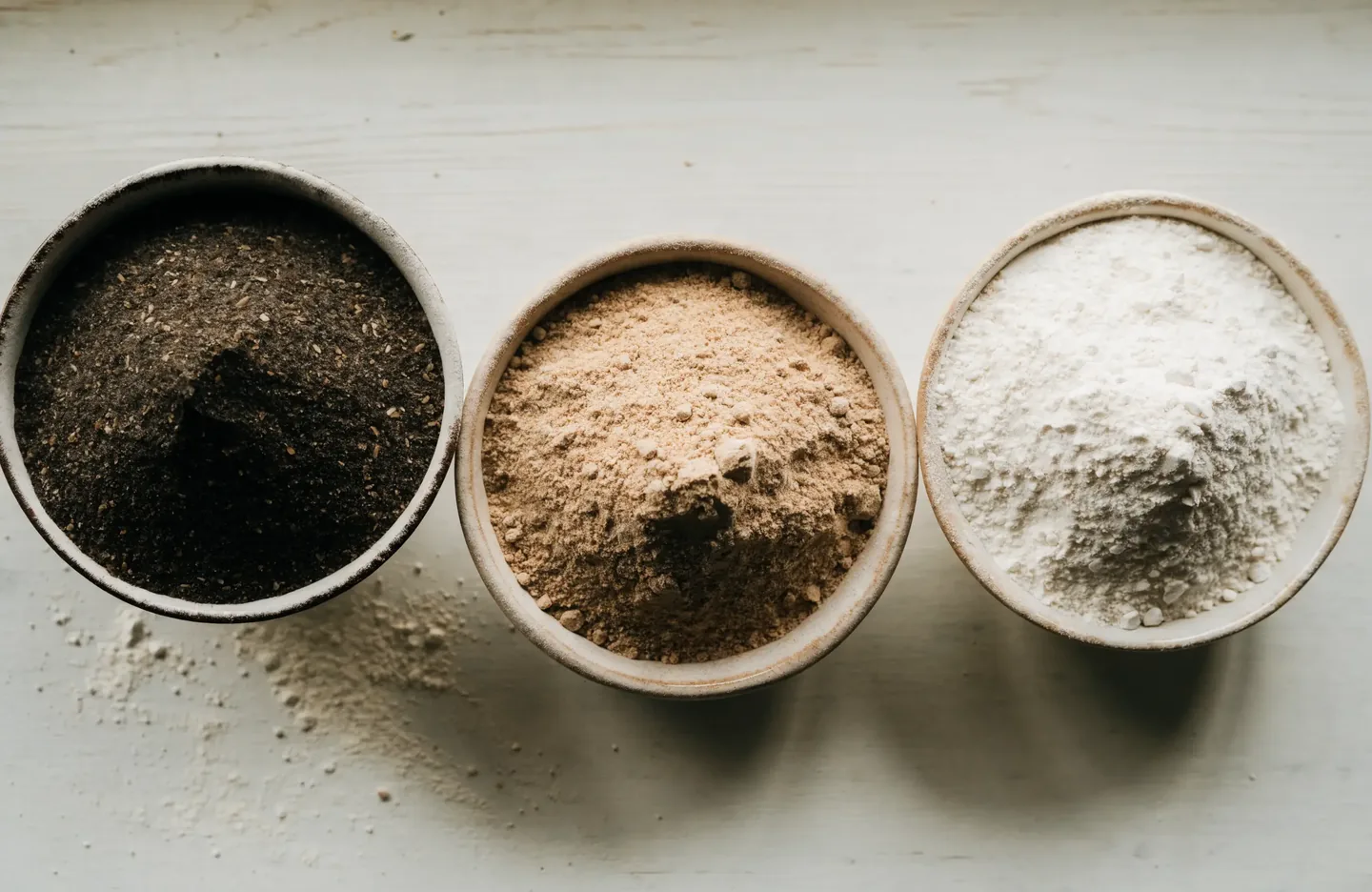
Left to right: wholegrain rye, wholemeal wheat, white bread flour. The darker the flour, the more microbial load and mineral content it brings to a young culture.
A practical compromise that works in most kitchens: create on 100% wholemeal, then move to a maintenance blend of roughly 80% white bread flour and 20% wholemeal. You keep the readability of a white starter and the vigour of a wholegrain one.
Detail worth knowing: rye and wholemeal starters are heavier and hold more water, which is precisely why they often fail the float test while being perfectly active. See section 7.
Which flour to create on and which to feed with, compared in detail: the best flour for a sourdough starter, from rye to wholemeal.
Does the water matter? Chlorine, hardness and temperature
Three properties, and only one of them matters much.
Chlorine. Municipal water is chlorinated to suppress microbes, which is not what you want in a jar whose entire purpose is microbes. In practice, established starters usually shrug it off, but a starter being created is more vulnerable. If your water smells of chlorine, leave it uncovered for a few hours or use filtered water. Chloramine, used by many utilities, does not off-gas the way chlorine does, so filtering is the safer route.
Hardness. Minerals help. Very soft or distilled water gives the culture less to work with. This is a small effect and not worth engineering around.
Temperature. This is the one that actually controls your outcome, and it is the one almost nobody measures. Water temperature is how you steer the final temperature of the starter, and the final temperature is how you steer the clock. Section 6 turns this into numbers.
How long until a starter is ready to bake with
There are two different questions hiding in this one, and conflating them is why people bake disappointing first loaves.
Is it alive? Usually 5 to 10 days. Is it strong enough to raise a loaf on its own? Often 3 to 6 weeks.
The test is not a single event, it is a pattern. Your starter is ready to bake when it doubles reliably, in a predictable window, three feedings in a row. Reliability is the whole point: a starter that doubles once and then sulks will not carry a dough through bulk fermentation.
| Signal | Means | Ready to bake? |
|---|---|---|
| Bubbles, no real rise | Alive, weak | No |
| Doubles once, then irregular | Establishing | Not yet |
| Doubles in 4 to 8 h, three feeds running | Stable and strong | Yes |
| Doubles in under 3 h consistently | Very vigorous, watch it closely | Yes, and use it earlier |
If you are impatient, the honest workaround is to bake a dough that uses commercial yeast alongside your young starter for flavour. That is not cheating, it is a normal bakery technique, and it beats a brick.
How long each stage really takes, from first bubbles to bake-strong: how long it takes to make a sourdough starter.
How to feed a starter: 1:1:1, 1:2:2 and 1:5:5
The ratio is written as starter : flour : water, by weight. A 1:5:5 feed means 10 g of old starter, 50 g flour, 50 g water.
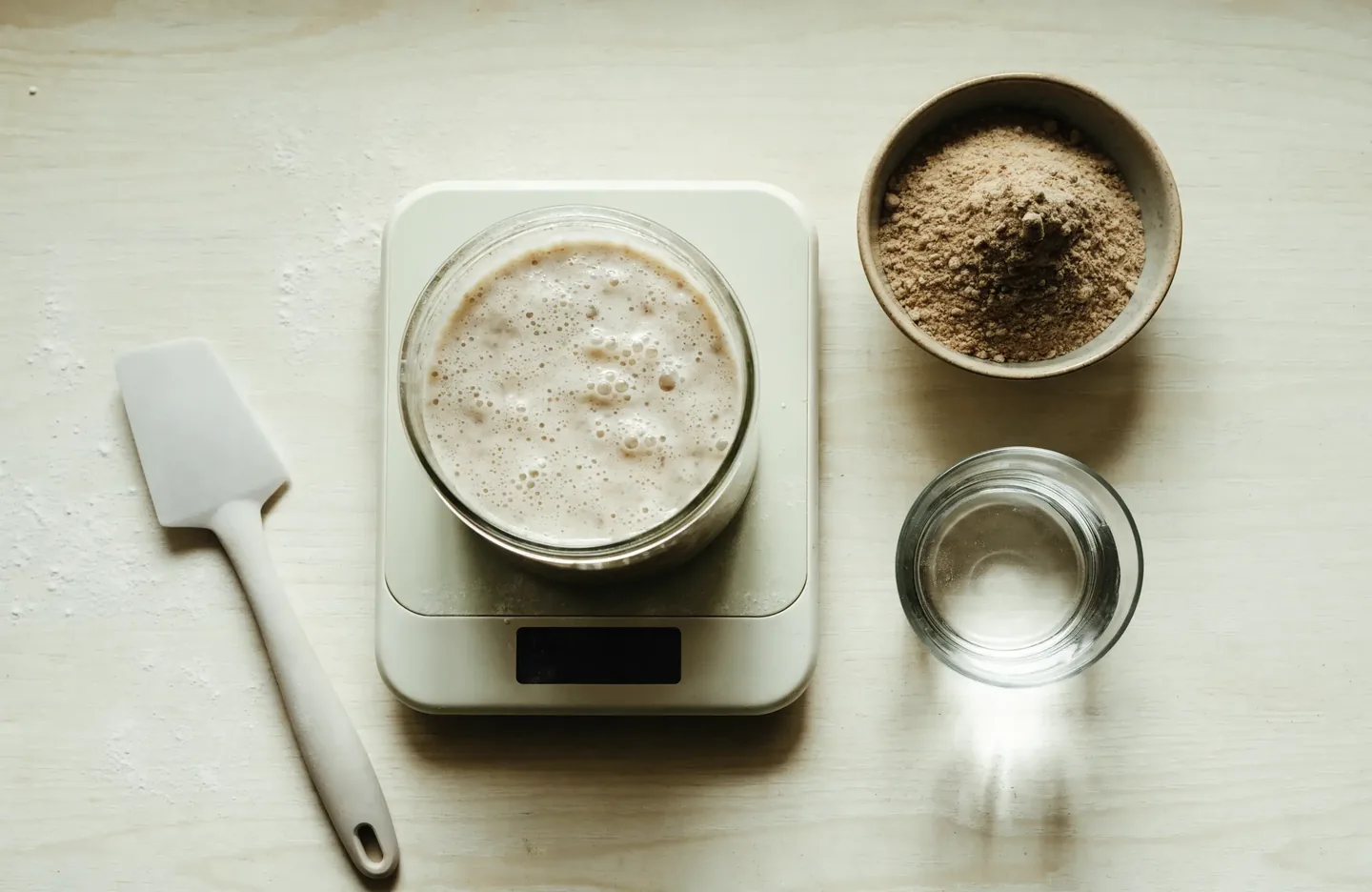
Ratios are by weight, never by volume. A cup of flour and a cup of water are not the same amount of anything.
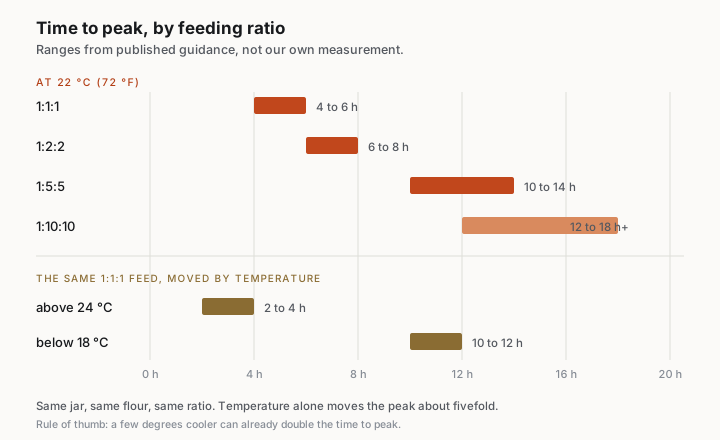
The rule underneath is simple and it is the single most useful thing in this guide: less old starter relative to fresh flour means a longer, slower climb to peak. You are not feeding it more or less food in total, you are changing how diluted the culture is.
| Ratio | Meaning | Peak at ~22 °C | Use it for |
|---|---|---|---|
| 1:1:1 | Equal weights | 4 to 6 h | Same-day baking, reviving a sluggish jar |
| 1:2:2 | Double the feed | 6 to 8 h | A relaxed daytime schedule |
| 1:5:5 | Five times the feed | 10 to 14 h | Overnight levains, milder flavour |
| 1:10:10 | Ten times the feed | 12 to 18 h+ | Long holds, very mild flavour |
Those windows are what bakers typically see in a kitchen around 20 to 22 °C (68 to 72 °F). They are ranges to plan around, not measurements: your flour, your jar and your kitchen will shift them.
Now the part that most guides leave out: temperature moves every number in that table. Fermentation is a biological rate, so it speeds up as the culture gets warmer and slows down as it cools, and the effect is much larger than most people expect: a few degrees can halve or double the time to peak. That is the reality bakers keep running into:
- In a warm kitchen above 24 °C, a 1:1:1 feed can peak in 2 to 4 hours, which is why summer starters seem to collapse the moment you look away.
- Below 18 °C, that same 1:1:1 feed can take 10 to 12 hours, which is why winter starters seem dead.
Same jar. Same flour. Same ratio. Completely different clock.
Practical rule: pick the ratio to fit the time you want, not the other way around. Want to bake after work? Feed 1:5:5 in the morning. Want a levain ready at 7 a.m.? Feed 1:5:5 the night before. Room running hot? Go up a ratio, not down.
The full feeding playbook, ratio by ratio and by temperature: how to feed a sourdough starter, from 1:1:1 to 1:5:5.
How to know your starter is at peak
Here is where this guide breaks with almost every beginner article on the internet.
The float test is not reliable. Dropping a spoonful of starter in water and seeing whether it floats fails in both directions:
- False positives. King Arthur tested a starter that was hours away from being usable, with only a few small bubbles, and it floated anyway. Their conclusion is worth quoting: something that sinks is definitely not ready, but something that floats is not necessarily ready either (King Arthur Baking). A starter already past peak and collapsing can also still float, because it holds surface gas.
- False negatives. A high hydration starter, or a wholegrain or rye one, can sink while it is at its strongest, because bran and germ weigh it down and the paste is loose. This one is baker's experience rather than a measured result, but it is the reason a sinking rye starter alarms people who have nothing wrong with their jar.
If you feed a rye starter and it never floats, nothing is wrong with your starter. The test is wrong.
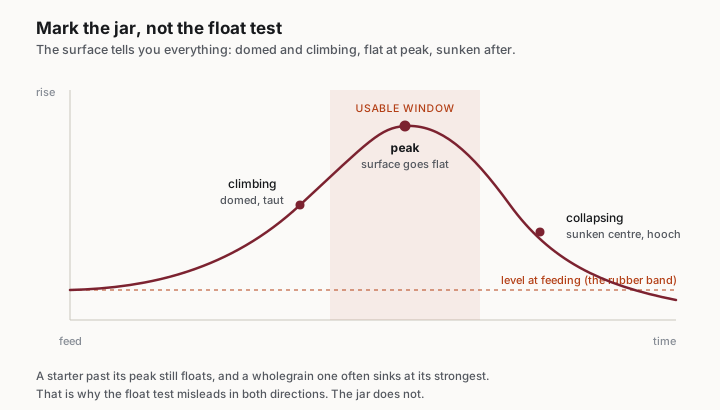
Use these instead, in order of reliability:
- Mark the jar. A rubber band or a marker line at the level right after feeding. Peak is the moment the rise stops and the surface goes from domed to flat. This is the single most useful habit in sourdough.
- Read the surface. Domed and taut means still climbing. Flat means at peak. Sunken in the centre means past it.
- Read the bubbles. Many small bubbles throughout means active. A few large bubbles and a wet, slack texture means past peak.
- Time it. Once you know your jar peaks at 6 hours at 1:2:2 in your kitchen, the clock is more reliable than any test.
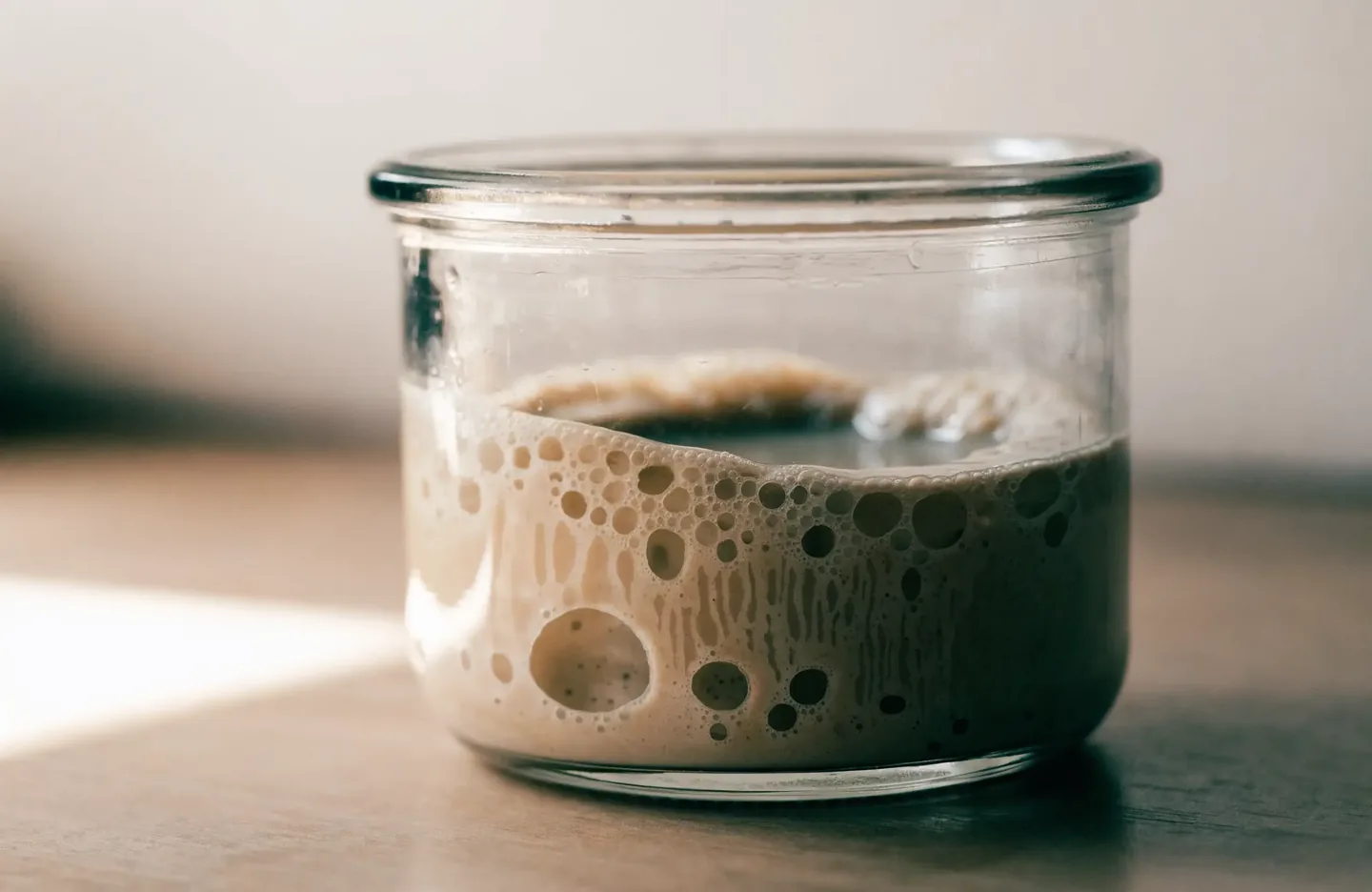
Past peak: sunken centre, large irregular bubbles, and hooch on top. Still usable, just more acid and less lift.
Past peak is not a disaster. A starter slightly past peak still raises bread, it just brings more acid and slightly less lift. Section 15 turns that into a flavour control.
How to read every signal that the culture is ready to bake: how to tell your sourdough starter is active and at peak.
Liquid starter versus stiff starter
Hydration here means water as a percentage of flour weight.
| Type | Hydration | Behaviour | Best for |
|---|---|---|---|
| Liquid (the common 1:1 by weight) | 100% | Faster, more lactic, milder and yoghurt-like | Everyday baking, easy to stir and read |
| Stiff (often called lievito madre or pasta madre) | 45 to 55% | Slower, more acetic, sweeter and more aromatic | Enriched doughs, panettone, long-keeping breads |
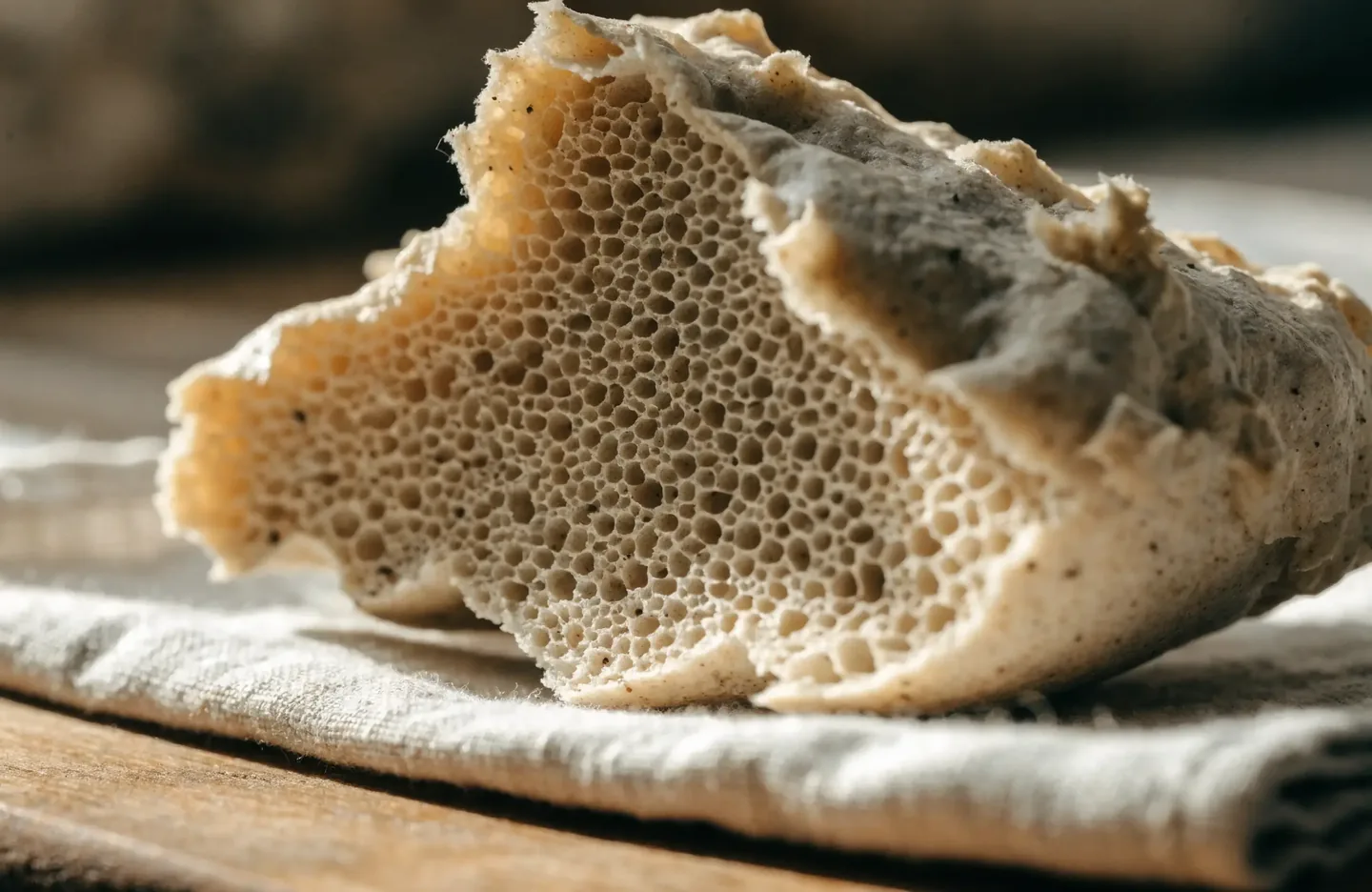
A stiff starter torn open. The structure is closer to a dough than a batter, which is exactly why it holds strength between feedings.
A stiff starter resists over-acidification and holds strength better between feedings, which is exactly why the Italian enriched-dough tradition is built on it. It is also more work: it needs kneading rather than stirring, and it is harder to read at a glance.
If you are choosing, start liquid. Move to stiff when you have a reason.
Storing in the fridge and bringing it back
You do not need to feed a starter daily unless you bake daily.
To put it away: feed it, let it rise for 1 to 2 hours at room temperature so fermentation is under way, then refrigerate. Storing it straight after feeding gives the culture nothing to work with while it cools; storing it at full peak means it is already spent.
How long it keeps: a week is routine. Two to three weeks is fine. Longer works, but the revival takes proportionally more feeds.
To bring it back: discard down to a small amount and feed 1:5:5 at room temperature. Expect the first cycle to be sluggish. Give it two to three consecutive feeds before judging it, and never judge a fridge starter by its first feed. This is the most common false alarm in sourdough.
The full cold-storage method, from the one-hour wait to the wake-up feeds: storing a sourdough starter in the fridge.
How to dry a starter and revive it
Drying is your insurance policy, and it takes ten minutes.
- Feed the starter and wait until it is at peak.
- Spread it as thinly as you can on baking paper, ideally under 1 mm.
- Leave it at room temperature until it is brittle and snaps rather than bends. Usually 12 to 48 hours depending on humidity. Do not use heat.
- Break it into flakes and store in an airtight jar, away from light.
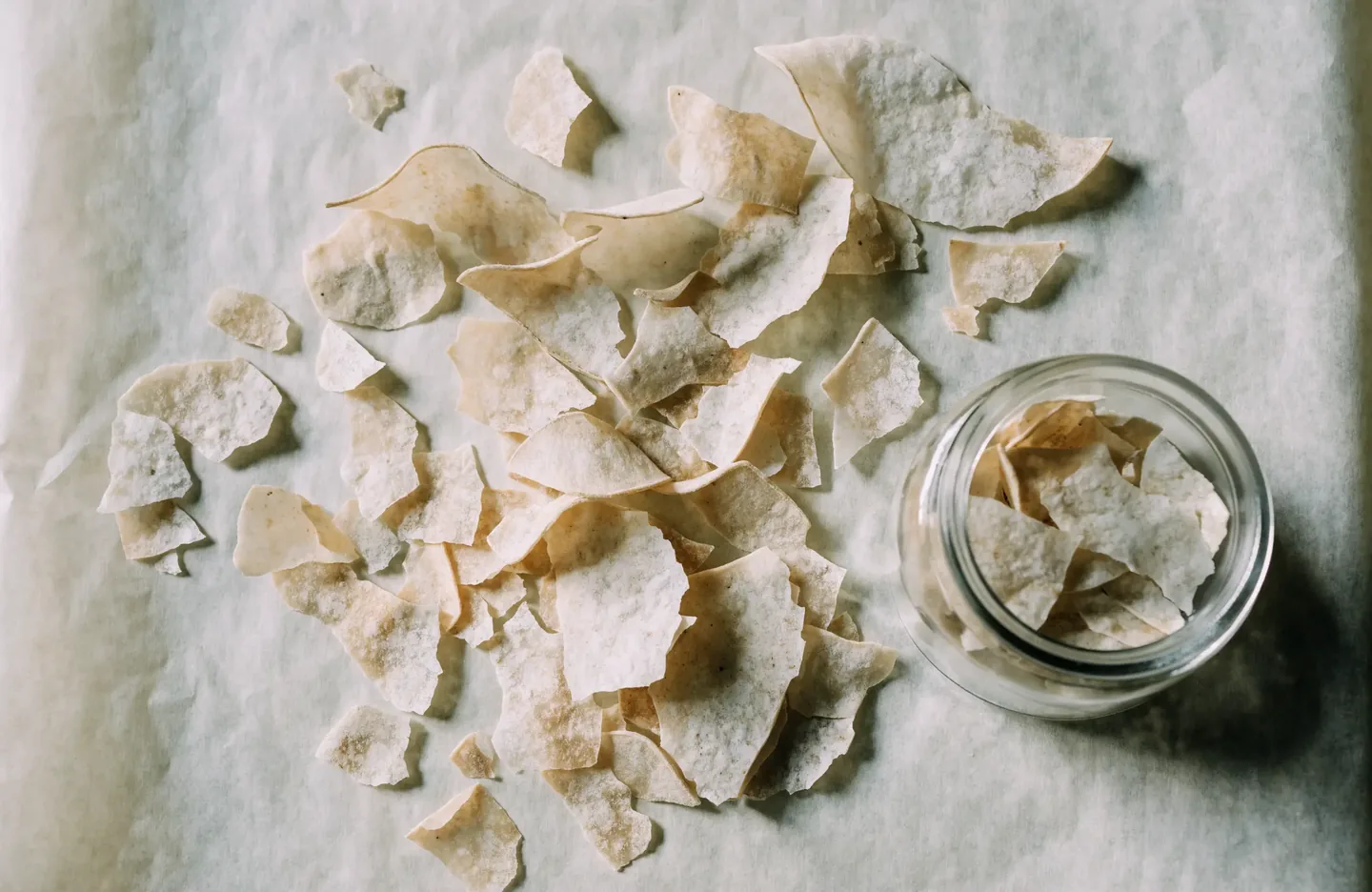
Dried to brittle flakes. This is the cheapest insurance in baking, and it takes ten minutes.
Dried starter keeps for years at room temperature. Keep a jar at a friend's house and you have an offsite backup.
To revive: cover the flakes with an equal weight of warm water, let them dissolve for a few hours, then add flour and feed as a normal starter. Expect 3 to 5 feeds before it is back to full strength. It will look hopeless on the first two. That is expected.
The full drying and reviving method, step by step: how to dehydrate a sourdough starter and bring it back to life.
Mold on a starter: when to save it and when to throw it out
This is the one section in this guide where the advice is deliberately conservative, because it is the one where being wrong has a health cost rather than a baking cost.
| What you see | What it is | What to do |
|---|---|---|
| Fuzzy spots, green, black, blue or pink | Mold | Discard the whole jar. Do not scrape and continue |
| Pink or orange streaks or film | Bacterial contamination, associated with Serratia marcescens | Discard the whole jar |
| Flat, white, powdery or wrinkled film | Kahm yeast, not mold | Salvageable, see below |
| Dark liquid on top | Hooch, normal | Stir in or pour off, see section 13 |
| Grey or brown discolouration of the paste | Usually oxidation and hunger | Feed it |
Why we do not tell you to scrape mold off. Mold is a network, and what you see on the surface is the fruiting body, not the extent of the organism. Some molds produce mycotoxins that spread beyond the visible growth. A starter costs seven days to rebuild. Rebuild it.
Kahm yeast is the one you can rescue. It presents as a flat white film rather than fuzz, and it is a surface yeast, not a mold. Skim the film off, take a small amount of clean starter from the bottom of the jar, move it to a clean jar and give it a large feed. Recurring kahm usually points to a jar that is too warm, too wet or left open too long.
The rule when you are unsure: throw it out. Uncertainty is not a reason to take the risk.
Every spot and film explained, with when to save the jar and when to bin it: what to do about mold on a sourdough starter.
My starter isn't rising: the eight real causes
In order of how often each one is actually to blame.
- It is too cold. Overwhelmingly the most common cause, and the most misdiagnosed. Below 18 °C everything slows to a crawl. Measure the paste, not the room.
- You are looking at the wrong moment. It rose and fell while you were at work. Mark the jar and you will see it.
- It is too young. Days 3 to 5 are the quiet handover described in section 2.
- It just came out of the fridge. Give it two to three feeds before judging.
- The ratio is too generous. A 1:10:10 feed in a cold kitchen may take 24 hours.
- The flour changed. New bag, new brand, bleached by accident. Whole grain fixes most sluggishness.
- The jar is wrong. Too wide and the rise is invisible. A straight-sided, tall jar is worth more than any gadget.
- It is genuinely weak. The last resort, not the first assumption. Fix it with two feeds a day at 1:1:1 on wholemeal, at 24 to 26 °C, for three days.
Notice that seven of the eight are about conditions and reading, not about the culture being broken. That ratio matches what actually turns up in practice.
Each cause diagnosed in order of likelihood, with the fix for each: why your sourdough starter is not rising.
Hooch: the dark liquid on top
Hooch is a layer of liquid, usually grey to dark brown, that forms on a hungry starter. It is alcohol and water, a by-product of fermentation that has run out of food.
It is not dangerous and it is not mold. It is a message: you are underfeeding, or feeding too infrequently for the temperature.
- Stir it in for a more sour, more assertive starter.
- Pour it off for a milder one.
Either is fine. The real fix is to feed more often, feed at a bigger ratio, or keep the jar cooler. Hooch on a fridge starter is completely normal and not a cause for concern.
What your starter's smell is telling you
Smell is the fastest diagnostic you have, and it is free.
| Smell | What it means | Action |
|---|---|---|
| Yoghurt, mild dairy, slightly sweet | Healthy, near peak | Use it |
| Sharp vinegar | Acetic dominant, hungry or cool | Feed more often or warm it |
| Nail polish remover, acetone | Very hungry, alcohol accumulating | Feed now, larger ratio |
| Cheesy or gym socks in week 1 | Normal early transition | Keep going |
| Cheesy in an established starter | Something is off, usually neglect | Two feeds a day for three days |
| Bready, faintly alcoholic | Healthy, just past peak | Fine to use |
Acetone smell alarms people the most and is the least serious of the alarming ones. It means hungry, not dead.
How to make your starter more sour, or less
Sourness is not one thing. It is a balance between two acids, and you can steer it.
| You want | Do this | Why |
|---|---|---|
| More sour, sharper | Keep it cooler, feed less often, use a stiff starter, add wholegrain or rye | Favours acetic acid |
| More sour, rounder | Keep it warmer, longer bulk, higher hydration | Favours lactic acid |
| Less sour | Feed more often, larger ratio, use at peak rather than after, keep it warm | Less acid accumulates |
The most common mistake is trying to get sourness by neglecting the starter. That gets you acid, but it also gets you a weak culture that struggles to raise the loaf. Sourness comes from the dough fermentation schedule, not from an abused jar.
How to steer the tang up or down on purpose, without weakening the culture: how to make sourdough less sour, or more.
Levain versus starter: the difference almost everyone gets wrong
They are the same organism at different points in its life.
- Starter (also chef, mother) is the culture you keep and maintain indefinitely.
- Levain is a build made from the starter, specifically for one bake, and used up in it.
Why it matters practically: a levain lets you change flour, hydration and quantity for a single loaf without ever touching your mother culture. Want a rye levain for one bread? Build it from your white starter. The mother stays exactly as it was.
If a recipe says "100 g levain", it means a fresh build at peak, not a scoop from your fridge jar. Using the fridge jar directly is the most common reason a recipe underperforms.
The full distinction and how to build a levain for a single bake: levain versus starter, the difference explained.
How much starter to use: the inoculation percentage
Inoculation is the weight of starter as a percentage of the flour in the dough. It is the control most home bakers never touch, and it is powerful.
| Inoculation | Bulk at ~24 °C | Character |
|---|---|---|
| 5% | Long, 8 to 12 h | Mild, complex, good for overnight |
| 10 to 15% | Moderate, 4 to 6 h | The common default |
| 20%+ | Fast, 2 to 4 h | Quicker, more acidic, less nuanced |
Inoculation and temperature are the two dials for the same outcome. Cold kitchen? Raise the inoculation. Hot kitchen? Lower it, and lower it more than feels sensible. This single adjustment removes most of the seasonal chaos people blame on their starter.
What to do with the discard
Discard is not waste, it is unfermented flour and water plus a lot of acid. It has no leavening power worth relying on, so use it where acid and flavour help and rise does not matter.
Works well: crackers, pancakes and waffles, flatbreads, crumpets, batters for frying, pizza dough where commercial yeast does the lifting, banana bread and other chemically leavened bakes where the acid reacts with bicarbonate.
Does not work: anything that needs the discard alone to rise.
Or stop producing it. Keep a smaller starter. Thirty grams maintained at 1:5:5 gives you plenty for a levain build and produces almost no discard. Most people keep two or three times more starter than they will ever use.
Refrigerated discard keeps about a week. It gets more sour the longer it sits, which is sometimes exactly what a cracker wants.
Recipes and habits that put every gram to use rather than the bin: what to do with sourdough discard.
Sourdough starter versus commercial yeast
Not a moral question. A question of what each one does.
| Sourdough starter | Commercial yeast | |
|---|---|---|
| Organisms | Wild yeasts plus lactic acid bacteria | One selected strain of S. cerevisiae |
| Timing | Hours, temperature dependent | Predictable and fast |
| Flavour | Acid, depth, complexity | Clean, neutral |
| Keeping quality | Better, the acidity slows staling | Shorter |
| Effort | Ongoing maintenance | None |
You can use both in the same dough, and plenty of professional bakeries do. A small amount of commercial yeast alongside a levain gives you sourdough flavour with a schedule you can plan around. Nothing is lost except purism.
How to travel without killing your starter
Ranked by how long you will be away.
| Away for | Do this |
|---|---|
| Up to 2 weeks | Feed, wait 1 to 2 h, refrigerate. Nothing else needed |
| 2 to 6 weeks | Feed at 1:10:10, refrigerate. The large feed buys time |
| Over 6 weeks | Dry a portion (section 10) and refrigerate the rest as backup |
| Moving house or flying | Dry it. Flakes travel at room temperature, but check the rules first (see below) |
Crossing a border is a separate question, and do not assume dried starter counts as flour. A starter is a live culture, and several countries treat it accordingly. Australia restricts bringing in sourdough starter whether wet or dried, New Zealand and Canada apply strict biosecurity rules to homemade food, and what is allowed as a commercially packaged product is often not allowed in a home ziplock bag. Declare it if the form asks, and check the destination country's rules before you fly rather than at the counter.
Two habits that cost nothing and have saved a lot of cultures: keep a dried backup in a cupboard permanently, and give a jar to a friend. Redundancy is free.
Frequently asked questions
How do I know my starter is finally ready to bake with? When it doubles in a predictable window across three consecutive feeds. One good rise is not enough. Reliability is the signal, not peak height.
Why does my starter never float? Probably because it is a wholegrain or high hydration starter, both of which routinely sink while perfectly active. The float test is unreliable in both directions. Mark the jar and watch for the rise to stop instead.
Can I save a starter with mold on it? No. Discard it and start again. Mold extends beyond what you can see, and rebuilding costs seven days. The exception is kahm yeast, a flat white film rather than fuzz, which can be skimmed and rescued.
My starter smells like acetone. Is it dead? No, it is hungry. Acetone means alcohol has accumulated because the culture ran out of food. Feed it at a larger ratio and it will recover within a day or two.
How often do I really have to feed it? If it lives in the fridge and you bake weekly, once a week. If it lives on the counter, once or twice a day depending on temperature. The colder it is, the less often it needs feeding.
Does the brand of flour matter? Less than temperature, more than water. Wholegrain flour makes a starter more vigorous regardless of brand. If your starter is sluggish, adding 20% wholemeal will do more than switching brands.
Is older starter better? No. There is no evidence that an old culture bakes better than a well maintained young one. A hundred year old starter is a good story, not a better loaf. What matters is the last two weeks of maintenance.
Can I use tap water? Usually yes, once the starter is established. While creating one, filter it or leave it standing if your water smells strongly of chlorine. Chloramine does not off-gas, so filtering is the safer choice.
This guide keeps getting updated as new details turn up. Good baking, and be patient on day four.
Where I checked
Keep reading
 Guide
Guide
Bagel Dough: Why It Is So Firm, and How to Knead It
Bagel dough feels stiff and dry on purpose. Here is why it runs at 50 to 60% water and high protein flour, how to knead it, and the windowpane to aim for.
6 min read Guide
Guide
Bagel Recipe: New York Style, Step by Step
A weight-based New York bagel recipe, step by step: the firm 58% dough, an overnight cold retard, how long to boil, and the oven heat that sets a glossy crust.
6 min read Complete guide
Bagels: The Complete Guide
Make a real bagel at home: the firm 58% dough, why bagels are boiled before baking, New York vs Montreal, sourdough and gluten free, and how to fix flat ones.
18 min read