Guide
Active Sourdough Starter: How to Know It Is at Peak
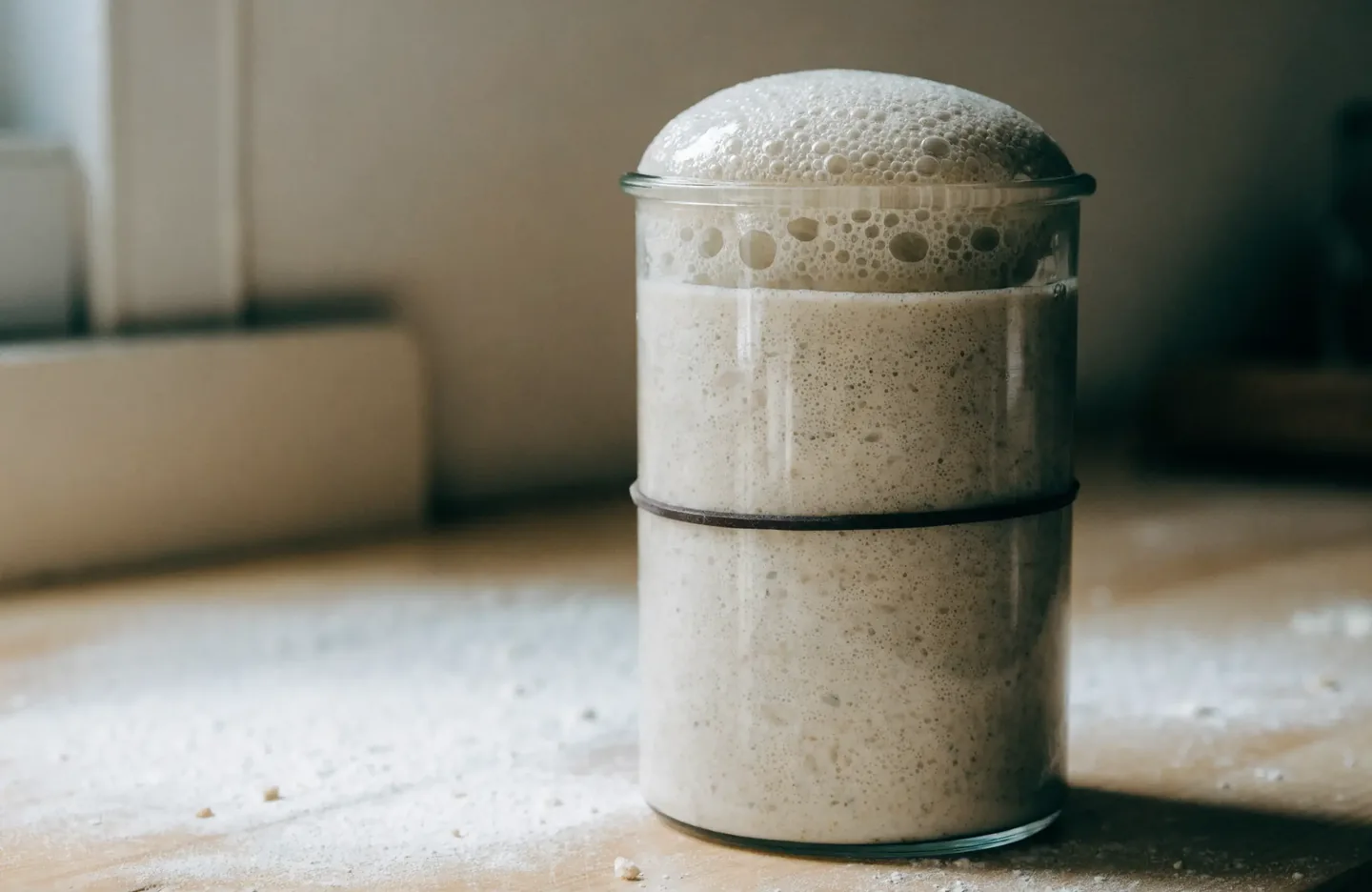
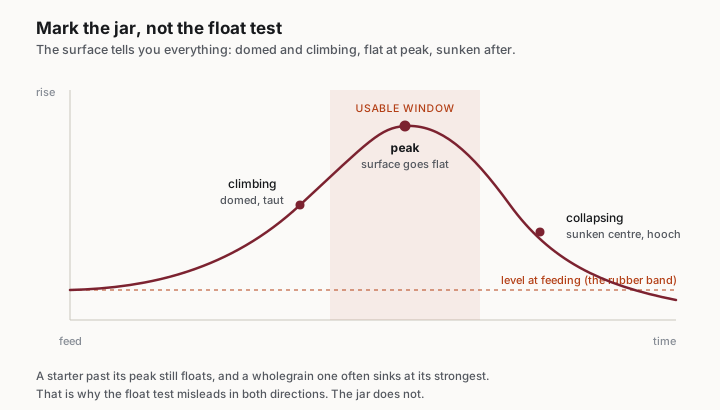
Peak is the moment the rise stops and the domed surface goes flat. That is the whole definition. It is not the moment the jar doubles, and it is not a smell, and it is certainly not whether a spoonful floats.
If you want one habit that fixes this permanently: put a rubber band around the jar at the level right after you feed it, and note the time. Everything below is a refinement of that.
| State | Surface | Bubbles | In bread |
|---|---|---|---|
| Still climbing | Domed, taut, pulling up the sides | Many, small, even | Underpowered. Slow, tight loaf |
| At peak | Flat, level, just stopped moving | Dense web throughout | Best lift, mildest flavour |
| Just past peak | Beginning to sink in the centre | Larger, irregular | Still good. More acid, slightly less lift |
| Well past peak | Sunken, wet, hooch on top | Few large ones, slack texture | Works, but sour and sluggish |
This is one section of the complete guide to sourdough starters, which covers feeding, storage and what to do when the jar misbehaves.
Why "did it double?" is the wrong question
Doubling is the advice everyone repeats, and it quietly assumes you fed at 1:1:1. Change the ratio and you change how far the jar climbs, because you changed how diluted the culture is.
Feed a healthy starter 1:1:1 and it will usually more than double. Feed the same jar 1:5:5 and it has five times as much flour to work through, so it climbs higher and takes far longer to get there. King Arthur's own description of a starter held around 72 °F (22 °C) is that it will "double or triple in volume in about eight hours" (King Arthur Baking). Double or triple. Even the people writing the rule do not treat it as a fixed number.
A stiff starter, one at 50% hydration, is the clearest case. It rises noticeably less than a liquid one because the paste is tight, and a baker judging it by the doubling rule will conclude it is weak when it is doing exactly what a stiff starter does.
So: doubling is a symptom, not the definition. The flat top is the definition.
Find your own jar's peak time, once
This takes one evening and it replaces every rule of thumb on the internet with a number that is actually about your kitchen.
- Feed at a ratio you will use often. 1:2:2 is a good default: 20 g starter, 40 g flour, 40 g water.
- Stir until smooth, scrape the sides down, and mark the level with a rubber band.
- Write down the time and the room temperature. The temperature is not optional, it is the variable that will explain everything later.
- Check every hour. You are watching for one thing only: the moment the dome stops being domed.
- Write down that number of hours.
That is your jar's peak time at that ratio and that temperature. From then on you feed by the clock and glance at the jar to confirm, rather than staring at it all afternoon.
| Ratio | My peak time | Room temp | Notes |
|---|---|---|---|
| 1:1:1 | Fastest, for same day baking | ||
| 1:2:2 | The everyday default | ||
| 1:5:5 | Overnight levain |
Fill that in over a couple of weeks and you own the most useful piece of information in your whole sourdough practice. It is also the reason experienced bakers seem to know when their starter is ready without looking: they measured it once and now they read a clock.
Temperature moves the number more than anything else
Fermentation is a biological rate. Warmer means faster, and the effect is far larger than most people expect, which is why the same jar seems like a different organism in January and July.
King Arthur's bakers describe the practical version of this. Martin Philip holds his starter around 72 °F (22 °C) in warm months and raises it to 75 °F (24 °C) when the house cools; when he needs an active starter within 8 to 12 hours, he sets 78 °F (26 °C). To slow a starter down over several days he drops it to 45 °F or 50 °F (7 to 10 °C). Andrew Janjigian goes the other way and holds his at 65 °F (18 °C) specifically so he can feed it once a day instead of twice (King Arthur Baking).
Read that again, because it contains the whole trick: temperature is a scheduling tool. Nobody there is chasing a "correct" temperature. They are each picking one that makes the peak land when they want it to.
Two practical consequences:
- Your starter did not get weaker in winter. It got slower. Same jar, colder room.
- If your jar keeps peaking at 2 a.m., you do not have a problem with your starter. You have a problem with your ratio and your room, and both are adjustable.
When you cannot be there at peak
This is the real-world question, and the honest answer is that you have three levers.
Change the ratio. More flour relative to old starter means a longer climb. Going from 1:1:1 to 1:5:5 can turn a four hour peak into an overnight one. This is the cleanest lever and the one to reach for first.
Change the temperature. A cooler spot stretches the timeline, a warmer one compresses it. The oven with the light on, a cupboard, the top of the fridge: these are all different rooms.
Use the fridge as a pause button. A starter at peak that goes into the fridge holds roughly that state for a while, cold slowing the culture down rather than stopping it. It will keep acidifying slowly, so this buys you hours and days, not weeks.
What you should not do is feed it and then bake with it whenever you happen to be free. That is how people end up convinced their starter is unreliable, when what is unreliable is the timing.

Using it early, on time, or late
None of the three ruins bread. They make different bread.
| When you use it | What you get | When you would want this |
|---|---|---|
| An hour or two before peak | Most lift, mildest flavour | Sandwich loaves, enriched doughs, brioche |
| At peak | Best balance of lift and flavour | The default for almost everything |
| An hour or two past peak | More acid, a little less lift | When you want a tangier crumb |
| Well past peak, sunken | Noticeably sour, sluggish rise | Rarely on purpose. Feed it first |
The one case that genuinely costs you is the last row. A starter that collapsed hours ago has spent its sugar and built up acid, and acid weakens gluten. You can still bake with it, and the loaf will be denser and sharper than you wanted. Feeding it and waiting is almost always faster than fighting that dough.
What an active starter is not
It is not a starter that passes the float test. That test says yes too early, because trapped gas floats whether or not the culture is ready, and King Arthur's own testing found a jar hours from usable floating happily (King Arthur Baking). It also says no too often for rye and high hydration starters, which sink at their strongest. The seven day guide covers why in more detail.
It is not a starter that smells strongly sour. Sharp, vinegary or acetone smells usually mean hungry, which is the opposite of peak. At peak the smell is mild: yoghurt, green apple, bread dough.
It is not a starter that is full of enormous bubbles. Those come after the collapse, when the structure has gone slack and gas is coalescing.
Frequently asked questions
How long should an active sourdough starter take to peak? Four to eight hours at 1:1:1 in a room around 22 °C is typical, but the number that matters is yours, measured once in your own kitchen. Below 18 °C or above 26 °C, expect that window to shift substantially in either direction.
My starter doubles but never triples. Is it weak? No. How far it climbs depends on the feeding ratio and the hydration, not just on strength. A consistent, predictable rise and fall matters far more than the height it reaches.
Can I use my starter straight from the fridge? For flavour, yes, in things like pancakes or crackers. For a loaf that needs to rise, no. Take it out, feed it, and use it at its next peak.
How do I know if I missed peak? Look at the surface. A centre that has sunken below the edges means the collapse has started. If there is a layer of dark liquid on top, you missed it by a good margin.
Does the jar shape change what I see? Yes, and more than people expect. A straight-sided jar shows the rise honestly. In a curved or tapered jar the same volume of gas reads as a much bigger climb near the narrow part.
Should I stir my starter to check it? Not while you are waiting on peak. Stirring knocks the gas out and destroys the one signal you are trying to read. Check it with your eyes.
My starter peaks in two hours in summer. Is that normal? Normal and inconvenient. It means your kitchen is warm and your ratio is small. Move to 1:5:5 or find a cooler shelf, and the timing comes back to something you can plan around.
Once you can call peak reliably, the next thing worth learning is how ratio and temperature let you schedule that peak on purpose, because a starter that peaks when you are ready to bake is the whole game.
Where I checked
Keep reading
 Guide
Guide
Bagel Dough: Why It Is So Firm, and How to Knead It
Bagel dough feels stiff and dry on purpose. Here is why it runs at 50 to 60% water and high protein flour, how to knead it, and the windowpane to aim for.
6 min read Guide
Guide
Bagel Recipe: New York Style, Step by Step
A weight-based New York bagel recipe, step by step: the firm 58% dough, an overnight cold retard, how long to boil, and the oven heat that sets a glossy crust.
6 min read Complete guide
Bagels: The Complete Guide
Make a real bagel at home: the firm 58% dough, why bagels are boiled before baking, New York vs Montreal, sourdough and gluten free, and how to fix flat ones.
18 min read