Guide
How to Feed a Sourdough Starter: 1:1:1, 1:2:2 and 1:5:5
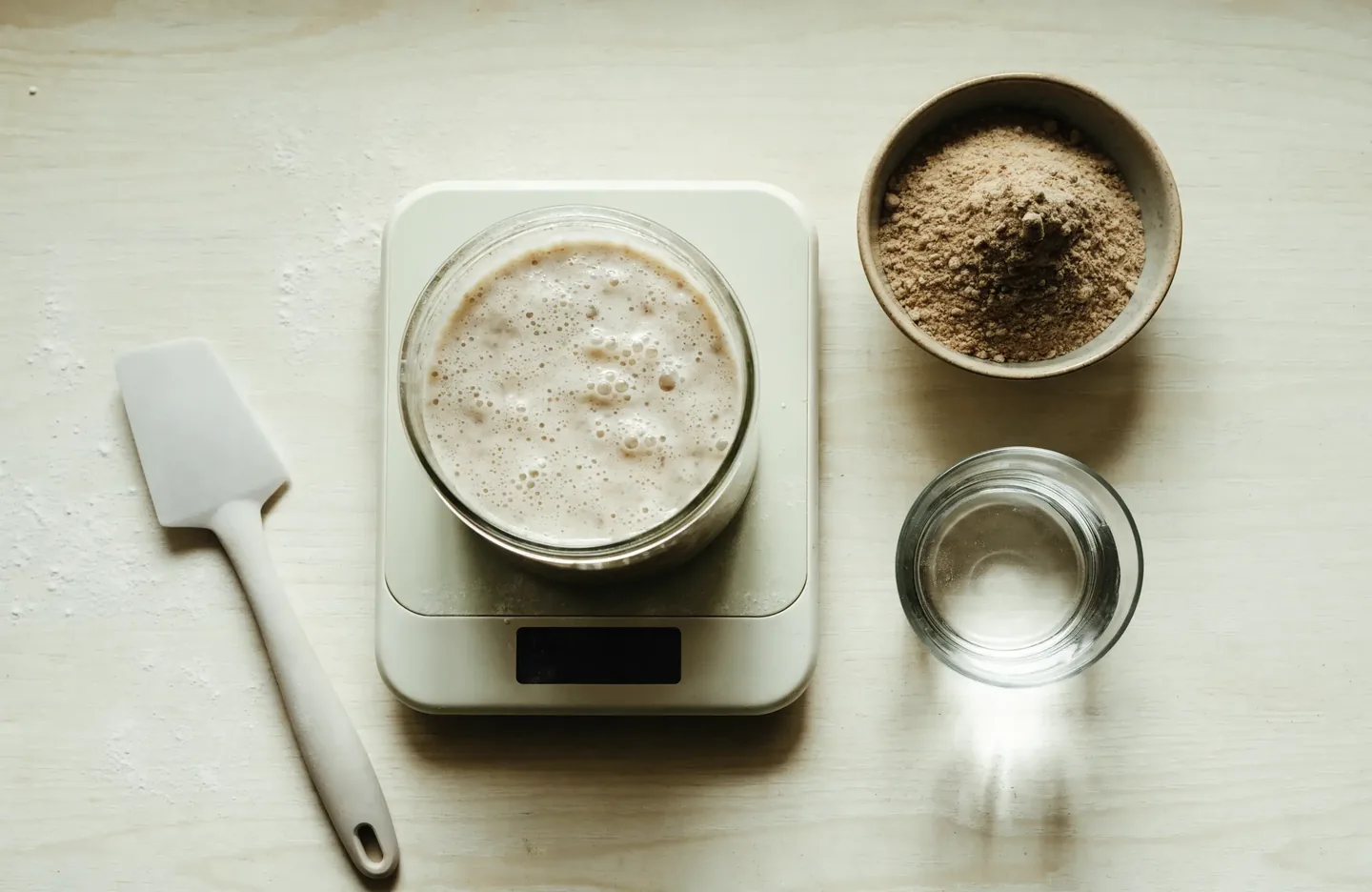
To feed a sourdough starter, throw most of it away, then stir the small remainder into fresh flour and water by weight. A common everyday feed is 1:2:2: 20 g of old starter, 40 g flour, 40 g water. That is the entire mechanic. Everything that feels complicated about feeding is really a question about which ratio to use and when.
Here is the idea that makes the rest click: feeding is not about giving the culture more food, it is about setting a timer. The less old starter you keep relative to the fresh flour, the longer the jar takes to climb to its peak. You are choosing when it will be ready, not how strong it will be. This page is one section of the complete guide to sourdough starters; here we go deep on the feed itself.
Read the ratio: starter, then flour, then water
A feed is written as three numbers, always in the order starter : flour : water, and always by weight.
- 1:1:1 means equal weights of each. Take 20 g of starter, add 20 g flour and 20 g water.
- 1:5:5 means five times as much fresh flour and water as old starter. Take 10 g starter, add 50 g flour and 50 g water.
The two ends of that range behave like different tools. A 1:1:1 feed keeps a lot of active culture in the jar, so it wakes up fast and peaks soon. A 1:5:5 feed dilutes that culture into a much larger volume of fresh flour, so it takes far longer to work through and peaks much later. Same organism, same food, different clock.
Ratios are by weight, never by volume. A cup of flour and a cup of water are not the same amount of anything, and eyeballing scoops is the single most common reason a starter behaves differently every day.
The ratio table: pick the number, get the time
This is the table to keep on the fridge. The peak times assume a kitchen around 20 to 22 °C (68 to 72 °F), which is where most homes sit.
| Ratio | You mix | Peak at ~22 °C | Reach for it when |
|---|---|---|---|
| 1:1:1 | 20 g + 20 g + 20 g | 4 to 8 h | Baking today, or reviving a sluggish jar |
| 1:2:2 | 20 g + 40 g + 40 g | 6 to 8 h | A relaxed daytime schedule |
| 1:5:5 | 10 g + 50 g + 50 g | 10 to 14 h | An overnight levain, milder flavour |
| 1:10:10 | 5 g + 50 g + 50 g | 12 to 18 h+ | Long holds, a very mild loaf |
Those windows are ranges to plan around, not stopwatch readings. Your flour, your jar and your kitchen will each nudge them. The pattern is what matters: more fresh flour relative to old starter buys you more hours. When King Arthur ran one starter at 1:1:1, 1:2:2 and 1:4:4 side by side, that is exactly what showed up: the jar with the most fresh flour was the last to peak (King Arthur Baking).
King Arthur's maintenance guidance sits right inside this range: a room-temperature starter fed about every 12 hours, and used at its peak, is their default (King Arthur Baking). The ratio is how you decide where in the day that peak lands.
Temperature moves every number in that table
The ratio sets the timer, and temperature changes how fast the timer runs. Fermentation is a biological rate, so it speeds up as the culture warms and slows as it cools, and the effect is larger than most people expect: a few degrees can halve or double the time to peak.
- In a warm kitchen above 24 °C, a 1:1:1 feed can peak in 2 to 4 hours, which is why summer starters seem to collapse the moment you look away.
- Below 18 °C, that same 1:1:1 feed can stretch to 10 to 12 hours, which is why winter starters seem dead when nothing is wrong with them.
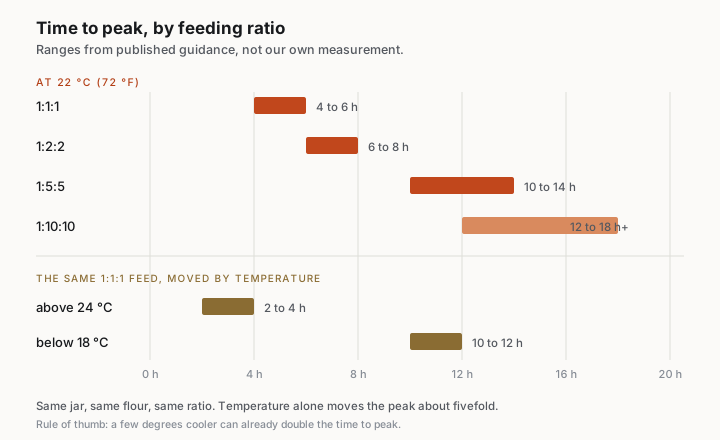
Martin Philip of King Arthur treats this as a scheduling dial rather than a problem to fix: he holds his starter around 72 °F (22 °C) in warm months, raises it toward 78 °F (26 °C) when he needs it active within 8 to 12 hours, and drops it to 45 to 50 °F (7 to 10 °C) to slow it down over several days (King Arthur Baking).
The practical rule falls out of this: pick the ratio and the spot together to make the peak land when you want it. Want to bake after work? Feed 1:5:5 in the morning. Kitchen running hot in July? Go up a ratio, not down, and use a cooler shelf.
How much to feed, and why you throw most of it away
The part that unsettles new bakers is the discard. Why toss good starter every day?
Because feeding is dilution. If you never removed any, the jar would double in size at every feed and you would need kilos of flour to keep the same ratio. Keeping a small amount and building it back up is how you hold the culture strong on a spoonful of flour instead of a sack.
For a jar you bake from once or twice a week, you rarely need to maintain more than 20 to 40 g of starter between bakes. Feed that small amount, and the day before you bake, do a larger build to get the quantity your recipe needs. The removed portion is not rubbish: it goes into pancakes, crackers and discard recipes, not the bin.
| Jar you keep | Everyday feed | Flour per week (roughly) |
|---|---|---|
| 20 g | 1:2:2, once a day | About 280 g |
| 10 g | 1:5:5, once a day | About 350 g |
| 10 g in the fridge | 1:5:5, once a week | Well under 100 g |
The smaller the jar you maintain, the less flour you spend and the less you discard. Most people keep far more starter than they will ever bake with.
Little and often, or big and rare
There are two honest maintenance rhythms, and both work.
Little and often means a small ratio like 1:1:1 or 1:2:2 fed once or twice a day at room temperature. The starter stays lively and mild, ready to bake on short notice. It costs more flour and more attention.
Big and rare means a large ratio like 1:5:5 and then straight into the fridge, fed maybe once a week. Cold slows the culture to a crawl, so a single generous feed carries it for days. It costs almost no flour and almost no attention, at the price of needing a wake-up feed or two before it is bake-ready.
Neither is more correct. A daily baker leans on the first, a weekend baker on the second. Andrew Janjigian's trick of holding a starter cool, around 65 °F (18 °C), so it only needs feeding once a day is simply a point between the two (King Arthur Baking).
When and how, step by step
- Weigh the jar empty once and remember the number, or use a scale with a tare button. Everything downstream is weight, so this saves you fishing starter out with a spoon.
- Keep the small amount you want and remove the rest. For a 1:5:5 feed on a 60 g jar, keep 10 g and take out 50 g.
- Add the flour and water for your ratio and stir until there are no dry pockets. Scrape the sides down so you can read the rise cleanly.
- Mark the level with a rubber band or a dry-erase line, and note the time and room temperature. The temperature is not optional: it is the number that explains everything later.
- Use it at peak, the moment the domed top goes flat. Learning to read that moment is its own skill, covered in how to tell your starter is active.
Feed at a ratio you will actually repeat, and within a couple of weeks you will know your jar's peak time by heart. From then on you feed by the clock and glance at the jar only to confirm.
Signs you are feeding wrong
Most feeding problems are timing problems in disguise.
| What you see | What it usually means | The fix |
|---|---|---|
| Peaks and collapses before you get to it | Ratio too small for a warm room | Go to 1:5:5, or a cooler shelf |
| Barely rises in a whole day | Room too cold, or the jar is hungry | Warmer spot, or feed 1:1:1 to revive |
| Sharp, acetone or nail-polish smell | Overdue for a feed, acid has built up | Feed now, it is not ruined |
| Thin liquid on top (hooch) | Went long past peak | Stir it in or pour it off, then feed |
| Rises the same tiny amount every time | Usually a stiff or wholegrain jar behaving normally | Judge by the flat top, not the height |
A jar that keeps peaking at 2 a.m. does not have a health problem. It has a ratio and a room that do not match the clock you keep, and both of those are yours to change.
Frequently asked questions
How often should I feed my sourdough starter? At room temperature, once or twice a day depending on the ratio and how warm your kitchen is. In the fridge, roughly once a week. The honest signal is the jar: feed it when it has peaked and started to fall, not on a rigid schedule that ignores the temperature.
Do I have to discard before feeding? To keep the same ratio without the jar growing endlessly, yes. If you want to keep everything, you have to scale the flour and water up to match, which quickly becomes impractical. Removing most and feeding the remainder is the whole point of a ratio.
What is the best ratio to feed a starter? There is no single best one. 1:2:2 is a sensible everyday default at room temperature. Use 1:1:1 to revive or bake same day, and 1:5:5 when you want an overnight or all-day climb. Pick the ratio to fit the time you have.
Can I feed my starter straight from the fridge? Yes. Take it out, discard down to your small amount, and feed at your usual ratio. It will take longer to peak than a room-temperature jar because it starts cold, so give it time or use a warm spot for the first feed.
Should I feed by weight or by cups? By weight. Volume measures are wildly inconsistent for flour, so a cup-based feed changes the real ratio every time and takes away your only reliable variable. A cheap kitchen scale is the best sourdough tool you can buy.
My starter did not rise after feeding. Did I kill it? Almost certainly not. Cold rooms and hungry jars both look like death and are neither. Move it somewhere warmer, feed it 1:1:1 for a day or two, and watch for any climb at all. Genuine death is rare and usually smells of rot, not of vinegar. The one thing you do not revive is visible spoilage: fuzzy mould, or a pink or orange streak, or a truly putrid smell means the jar has been invaded and belongs in the bin, not back on the counter (King Arthur Baking).
Can I change the ratio every day? You can, and experienced bakers do it constantly to steer the timing. Just remember that when you change the ratio you change the peak time, so a jar you fed 1:5:5 today will not be ready on the same clock as one you fed 1:1:1 yesterday.
Once feeding by weight is second nature, the next thing worth owning is reading the jar itself, so you can tell exactly when it is at peak instead of guessing, because a starter used at the right moment is most of what separates a good loaf from a flat one.
Where I checked
Keep reading
 Guide
Guide
Bagel Dough: Why It Is So Firm, and How to Knead It
Bagel dough feels stiff and dry on purpose. Here is why it runs at 50 to 60% water and high protein flour, how to knead it, and the windowpane to aim for.
6 min read Guide
Guide
Bagel Recipe: New York Style, Step by Step
A weight-based New York bagel recipe, step by step: the firm 58% dough, an overnight cold retard, how long to boil, and the oven heat that sets a glossy crust.
6 min read Complete guide
Bagels: The Complete Guide
Make a real bagel at home: the firm 58% dough, why bagels are boiled before baking, New York vs Montreal, sourdough and gluten free, and how to fix flat ones.
18 min read