Guide
Best Flour for a Sourdough Starter: Rye, Wholemeal or White
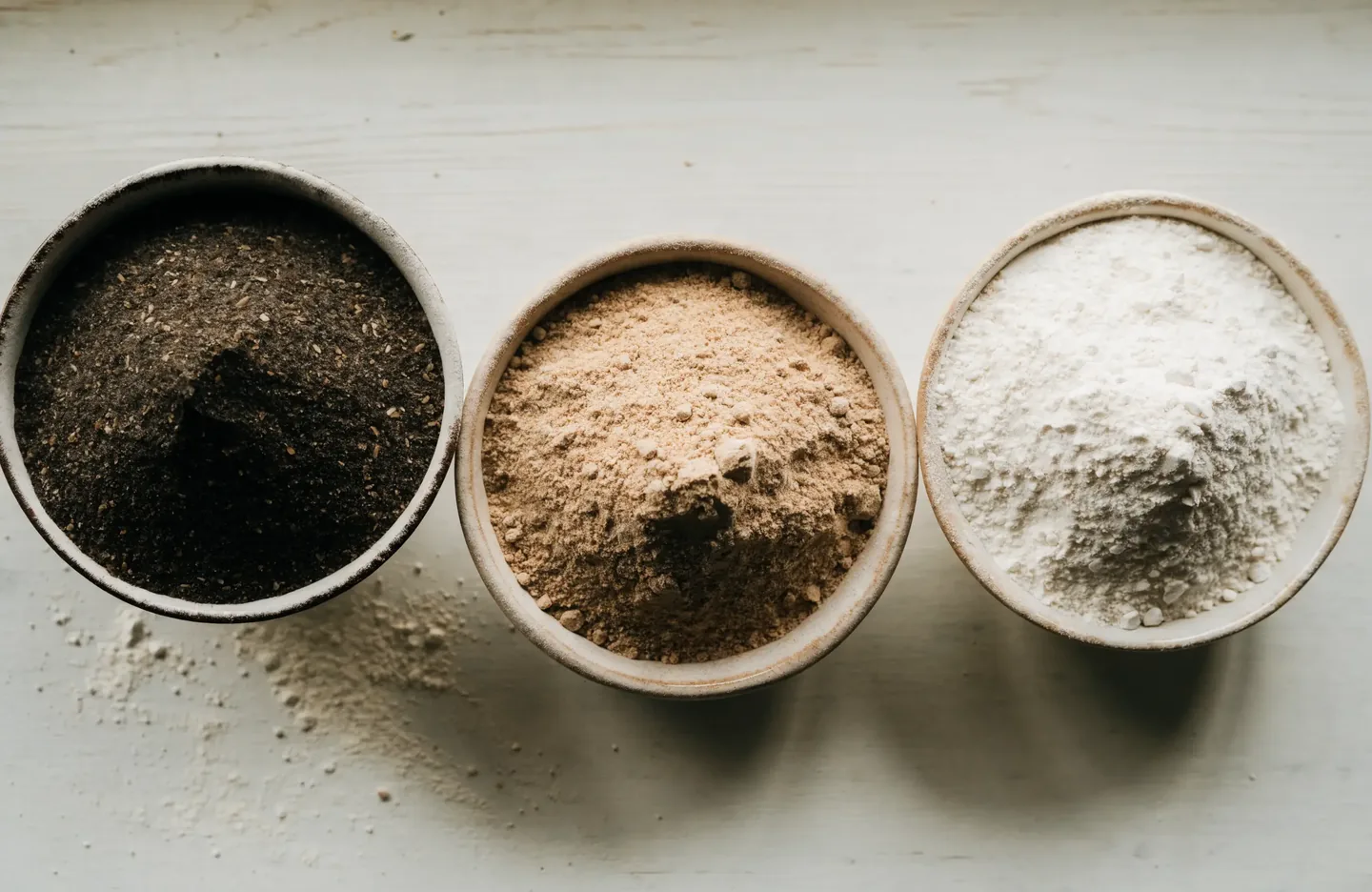
Start with wholegrain rye, or wholemeal wheat if rye is hard to find. Once the starter is alive and doubling on schedule, feed it whatever flour you actually bake with, including plain white. The flour that builds a starter and the flour that maintains one do not have to be the same, and treating them as one decision is what makes this question feel harder than it is.
The usual explanation is that wholegrain flour carries more wild yeast. That part is true, but it is the smaller half of the story. The bigger lever is enzymes.
| Flour | Building a new starter | Feeding an established one |
|---|---|---|
| Wholegrain rye | Best. Usually moving a day or two earlier | Great as 10 to 20% of the feed |
| Wholemeal wheat | Very good. The default if rye is unavailable | Fine, absorbs more water |
| White bread flour | Slower to start, works eventually | Perfectly good |
| Plain white flour | Slowest of the four | Perfectly good, the common choice |
| Bleached white flour | Avoid | Avoid |
This is one section of the complete guide to sourdough starters, which covers feeding ratios, storage and troubleshooting once yours is alive.
Why rye gets a new jar moving faster
A starter runs on sugar. Flour is mostly starch, and starch is not sugar until an enzyme cuts it into one. That enzyme is amylase, and it is the thing your yeast and bacteria are waiting on in week one.
Millers measure amylase activity with the Hagberg falling number, a test that times how long a plunger takes to sink through a hot flour and water paste. More enzyme activity means a thinner paste and a lower number. Bread wheat is milled to land between roughly 250 and 350 seconds, and a number well under that range is treated as too enzymatic for bread (Calibre Control). Rye is a different animal: it carries far more amylase and mills to a much lower falling number, with the bread-making range for rye sitting around 125 to 200 seconds, a value that would be read as wildly enzymatic for wheat and is simply normal for rye (peer-reviewed study on the rye amylolytic complex).
Put plainly: a spoon of rye hands the culture fermentable sugar much faster than a spoon of white wheat flour does. Day 4 in a rye jar is a well fed day. Day 4 in a white flour jar can be a hungry one, and hungry is where beginners give up.
The bran matters too, and for two separate reasons: it carries more of the microbial population, and it carries the minerals those organisms need. But if the yeast story were the whole story, a pinch of rye would be enough. It is the steady enzyme supply that changes the first week.
How to read a flour label anywhere in the world
Flour numbering systems are not protein grades. They are ash content: burn a sample and weigh what does not burn. Minerals live in the bran, so more ash means more bran, which is exactly the thing you want in week one.
| Ash (dry matter) | France | Italy | Germany | What it is |
|---|---|---|---|---|
| under 0.50% | T45 | tipo 00 | 405 | Pastry flour |
| 0.50 to 0.60% | T55 | tipo 00 | 550 | Plain white |
| 0.62 to 0.65% | T65 | tipo 0 | 630 | Bread flour |
| 0.75 to 0.90% | T80 | tipo 1 | 812 | Half wholemeal |
| 1.00 to 1.20% | T110 | tipo 2 | 1050 | Dark, near wholemeal |
| 1.40% and up | T150 | integrale | 1600 and up | Wholemeal |
Sources: BakeryBits on the French T system and Weekend Bakery on flour types, where the German type number is simply the ash in milligrams per 100g of dry flour.
Two practical readings of that table. First, T65 and tipo 0 are close cousins, so a French recipe calling for T65 is not asking for anything exotic. Second, if you are standing in a supermarket with no rye in sight, the highest number you can find is the right answer for starting a jar.
British and American flour is sold by protein rather than ash, so the shortcut there is the word on the bag: wholemeal, wholewheat or wholegrain beats white, every time, for week one.
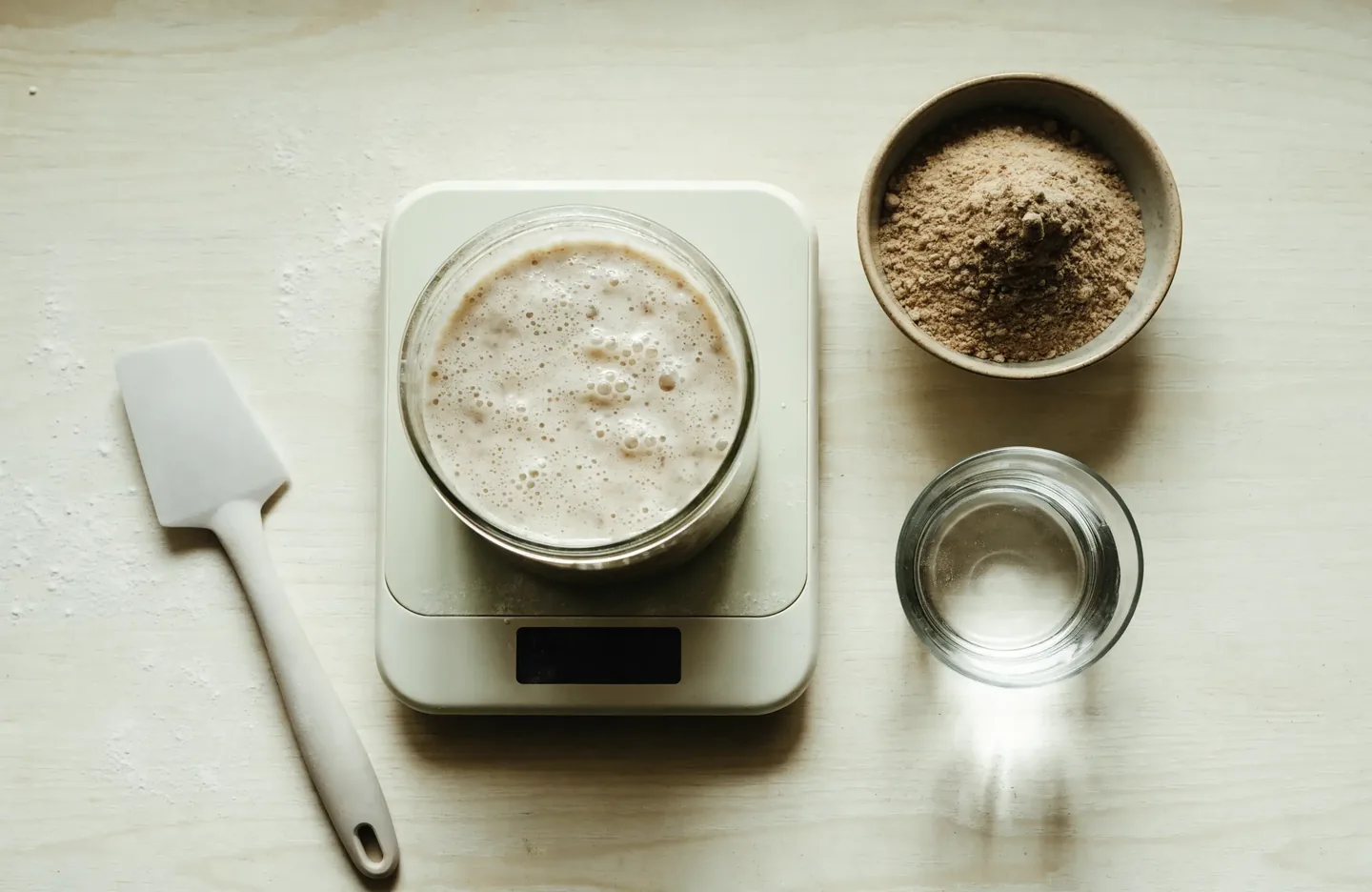
What to feed it once it is established
Here is the part most guides bury: once the culture is stable, the flour question gets much less interesting. King Arthur's own recommendation for routine feeding is plain all-purpose flour, with bread flour offering no real advantage to a starter because you are not building a gluten network in a jar (King Arthur Baking).
A good default is white flour with 10 to 20% wholegrain rye or wholemeal mixed in. You get the enzyme and mineral top up without the jar going dark, thick and aggressively sour, and without burning through expensive flour.
If your starter is sluggish, that rye percentage is the first dial to turn, before you change ratios or move the jar.
Flours that cause real trouble
Bleached flour. The bleaching agents are there to age flour chemically, and a starter is a slow biological process you would rather not chemically interfere with. Unbleached is the easy call, and in most of Europe it is the only thing on the shelf anyway.
Self-raising flour. It contains baking powder and salt. Salt at that level slows fermentation and the chemical leavening does nothing useful in a jar.
Gluten-free flours. A starter made with rice, buckwheat or sorghum flour will ferment happily, and it is the right answer if you cannot eat gluten. It just will not behave like a wheat starter: the rise is smaller and the readiness signals are different, so judging it by a wheat starter's timings will mislead you.
Very old flour. Flour does not spoil quickly, but the wholegrain kind goes rancid faster because the germ carries oil. If it smells like old nuts or crayons, it will not kill your starter, but it will taste like that in your bread.
Switching flour without stalling the jar
Change one variable at a time, and give the culture two or three feeds to settle before you judge the result. A starter that has been on rye for a month and gets moved to white flour overnight will usually go quiet for a day or two. That quiet is adaptation, not damage.
The practical routine: swap in the new flour at half the feed for two feeds, then go to the full amount. If you are moving from white to wholegrain, expect the opposite problem, a jar that suddenly rises faster and peaks earlier, which means you now need to feed sooner or use a bigger ratio.
| What you see | Likely flour cause | What to change |
|---|---|---|
| Very slow to start in week one | White flour only | Switch to wholegrain rye or wholemeal |
| Peaks and collapses in 3 hours | High wholegrain proportion | Cut the wholegrain, or feed 1:2:2 |
| Thick, gluey, hard to stir | Rye at a high percentage | Add water, or move to a wheat blend |
| Suddenly sluggish after a change | Adaptation to new flour | Wait two or three feeds |
| Sharp, harsh sourness | Too much bran, feeding too little | More white flour, larger feed ratio |
One thing worth knowing if you push the rye up: amylase works best around pH 5 to 5.5, and as a rye jar acidifies past that its enzyme activity gets progressively inhibited (IREKS Compendium). A very acidic rye jar throttles its own enzyme supply, which is one of the ways a neglected rye starter gets stuck. Feeding it more often fixes that faster than feeding it more.
Frequently asked questions
Can I make a sourdough starter with plain all-purpose flour only? Yes. It usually takes a few days longer to get going, and day 4 tends to feel more dead than it does in a rye jar. Everything in the seven day schedule still applies, just stretched.
Do I need bread flour for my starter? No. The high protein in bread flour exists to build gluten in a dough, and you are not building gluten in a jar. Save it for the loaf.
Is rye really better, or is that a myth? It is real, but usually explained wrongly. The wild yeast on the bran is part of it, and the enzyme activity is the larger part: rye hands the culture fermentable sugar much sooner. Both effects point the same way, which is why the advice survives even when the reasoning is off.
Can I use whole wheat instead of rye? Yes, and it is the more common choice outside Northern Europe. It behaves the same way, just slightly less emphatically.
Should I feed my starter the same flour I bake with? It helps, but it is not a rule. Keeping a white flour starter and baking wholegrain bread works fine. What matters more is that the feed is consistent enough that you learn to read your own jar's timings.
Does organic or stoneground flour make a difference? Stoneground often does, because the milling leaves more of the germ and bran in. Organic on its own is not the variable, the extraction level is.
My starter went sluggish when I changed brands. Same flour type, different bag. That happens, and it is not your imagination. Ash content, enzyme activity and how finely the bran is ground all vary between mills, even within the same labelled type. Give it three feeds before you change anything else.
Once you have settled on a flour and the jar is doubling predictably, the next thing worth getting right is knowing when it has hit its peak, because using a starter two hours late costs you more rise than any flour choice will.
Where I checked
Keep reading
 Guide
Guide
Bagel Dough: Why It Is So Firm, and How to Knead It
Bagel dough feels stiff and dry on purpose. Here is why it runs at 50 to 60% water and high protein flour, how to knead it, and the windowpane to aim for.
6 min read Guide
Guide
Bagel Recipe: New York Style, Step by Step
A weight-based New York bagel recipe, step by step: the firm 58% dough, an overnight cold retard, how long to boil, and the oven heat that sets a glossy crust.
6 min read Complete guide
Bagels: The Complete Guide
Make a real bagel at home: the firm 58% dough, why bagels are boiled before baking, New York vs Montreal, sourdough and gluten free, and how to fix flat ones.
18 min read