Guide
Levain vs Sourdough Starter: The Difference That Matters
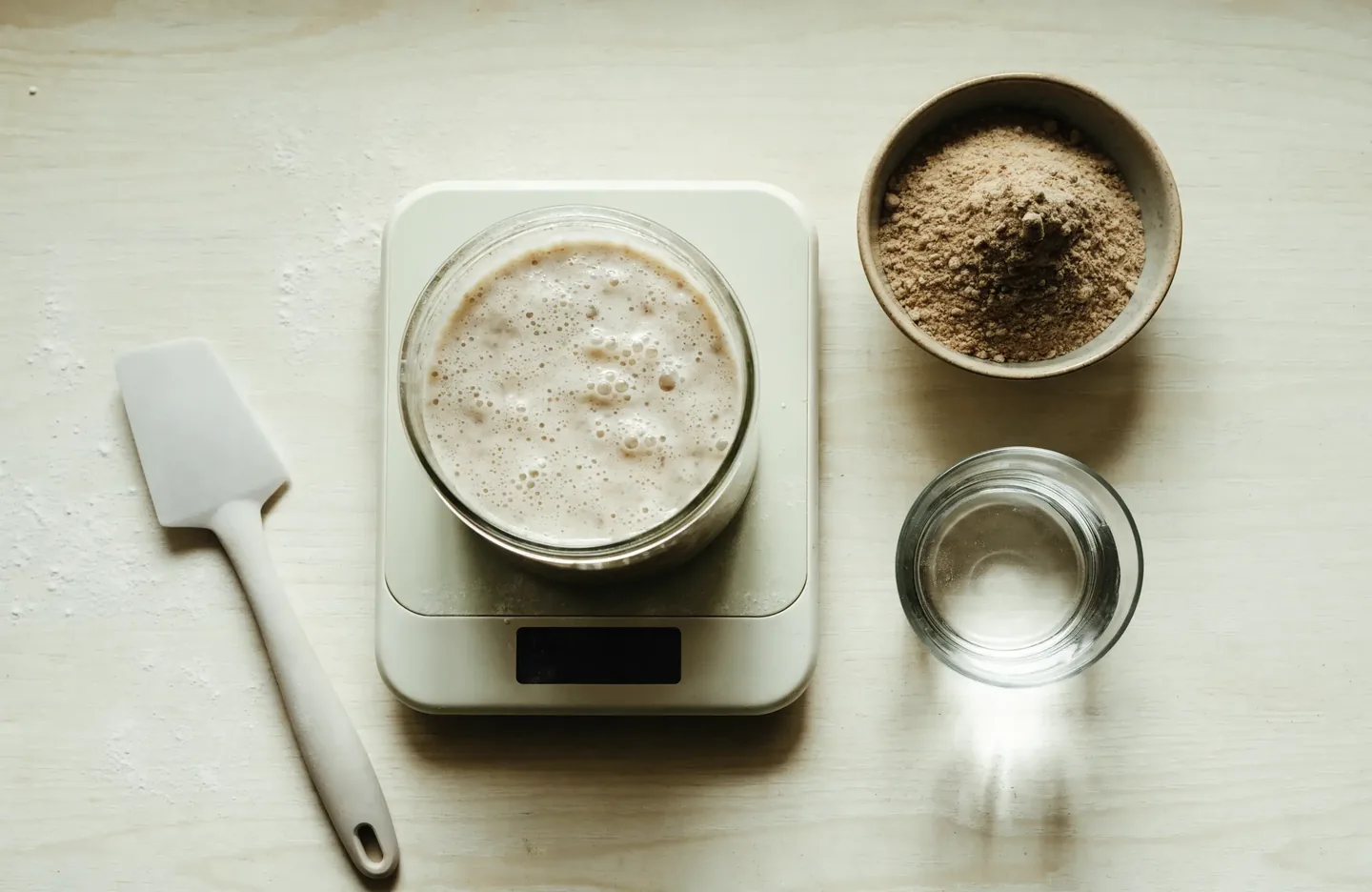
The starter is the culture you keep. The levain is the portion you build for one bake and use up entirely. Same organisms, different job. That is the whole distinction, and it is not a matter of one being better than the other.
The reason it matters is not vocabulary. It is that a levain is disposable, and disposable means you can build it at whatever hydration, flour and ratio that particular bread wants, without touching the rhythm of the jar you maintain.
| Sourdough starter | Levain | |
|---|---|---|
| Lifespan | Indefinite, kept going | One bake, then gone |
| How much you use | Part of it, always leave some | All of it |
| What it is for | Keeping the culture alive | Leavening one specific dough |
| Hydration and flour | Whatever suits your routine | Whatever suits that bread |
| Built when | On a schedule | Hours before you mix |
This is one section of the complete guide to sourdough starters, which covers feeding, storage and troubleshooting the jar itself.
Nobody agrees on the words, and that is fine
Before anything practical, the honest part: this terminology is convention, not law. The Perfect Loaf says it plainly, that what you call your starter, mother dough, chef or levain is up to you and much of it is cultural (The Perfect Loaf).
You will meet all of these for the thing you keep: starter, mother, chef, primary levain, storage leaven. And these for the thing you build: levain, leaven, starter sponge. In French kitchens levain is simply the culture itself, so a French baker saying "levain" and an American baker saying "levain" may be pointing at two different bowls.
So when a recipe uses a word, read what it asks you to do with it. The instruction is unambiguous even when the noun is not: if you use all of it, it is a levain.
Why bother building one at all
If you can bake straight from the jar, and you can, why the extra bowl?
Because the levain is where you tune the bread, and the jar is where you keep the culture alive. Those are two different goals and they pull in different directions.
Your maintained starter probably runs on white flour at 100% hydration, because that is easy to keep and easy to read. But the loaf you want on Sunday might be better with a stiff, mild levain, or a rye one, or one built twelve hours ahead so it is ready when you get up. Build that as a separate bowl and your jar carries on exactly as it was.
Because it scales. A recipe needing 300 g of ripe preferment does not require you to keep 300 g of starter fed all week. Keep 30 g, build 300 g the night before.
Because it is cheaper. A small maintained jar throws away almost nothing. The volume gets built only when you are actually going to bake it.
How to build a levain
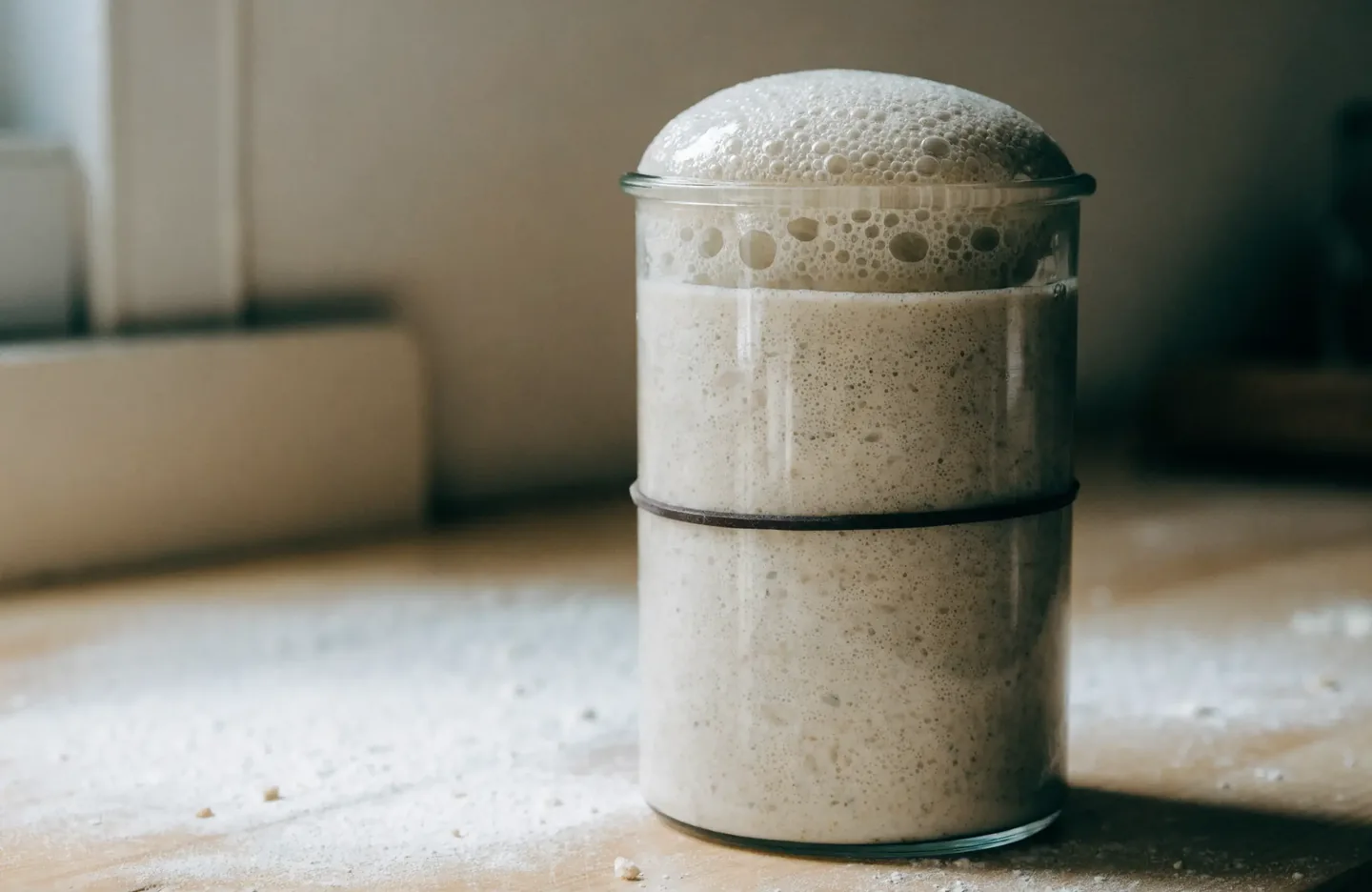
Take a little ripe starter, add flour and water, wait for it to ripen, use all of it.
The fast version, when you want to bake the same day, is a 1:1:1 build: equal weights of ripe starter, flour and water. The Perfect Loaf gives that as the emergency build, ripening in 3 to 4 hours at 78 to 80 °F (25 to 26 °C) (The Perfect Loaf).
For an overnight levain you use much less seed starter, the same way a smaller inoculation stretches the climb in the jar. A spoonful of starter into a bowl of flour and water before bed is ready by morning.
| What you want | Seed starter | Roughly ready in |
|---|---|---|
| Bake this afternoon | 1:1:1 | 3 to 4 h at 25 to 26 °C |
| Bake this evening | 1:2:2 | 6 to 8 h at room temperature |
| Ready by morning | 1:5:5 or less | Overnight |
Those are planning ranges, and the same rule from the jar applies: temperature moves every one of them, often by more than people expect, which is why King Arthur's bakers treat the thermostat as a scheduling tool rather than chasing a correct number (King Arthur Baking).
You judge a levain ripe the same way you judge the jar: the domed surface goes flat. Not by the clock alone, and not by the float test.
How much levain goes in the dough
This is where the vocabulary actually costs people bread. Recipes express it two ways and they are not interchangeable.
The Perfect Loaf's formulas run 6% to 30% levain in the final dough, as a percentage of the flour weight (The Perfect Loaf). That is a wide range on purpose.
| Levain percentage | Effect | Suits |
|---|---|---|
| Around 5 to 10% | Long, slow fermentation, mild flavour | Overnight bulk, warm kitchens |
| Around 15 to 20% | The common middle | Most everyday loaves |
| Around 25 to 30% | Fast, more acidic | Same day bakes, cold kitchens |
So: less levain is not weaker bread, it is slower bread. If your loaf ferments too fast in a hot kitchen, dropping the percentage is a better lever than fighting the clock, and it is exactly the adjustment a separate levain build makes easy.
Reading a recipe that says "100 g of active starter"
Many recipes skip the levain entirely and just call for ripe starter straight from the jar. That works. But it quietly assumes your jar is at 100% hydration, fed on white flour, and at peak when you mix.
If yours is a stiff starter, or a rye one, that same 100 g brings different water and different flour into the dough. Two practical fixes:
- Build a levain to the hydration the recipe assumes. If it wants 100 g of 100% hydration starter, build 50 g flour plus 50 g water plus a little seed and use that.
- Or adjust the dough water. A 50% hydration levain carries less water, so the dough needs a little more.
Neither is complicated. What causes trouble is doing neither and wondering why the dough felt different this time.
Levain and the other preferments
A levain is one member of a family, and the others come up constantly in bread recipes.
| Preferment | Leavened by | Typical texture |
|---|---|---|
| Levain | Wild culture from your starter | Anything from stiff to liquid |
| Poolish | Commercial yeast | Very loose, roughly equal flour and water |
| Biga | Commercial yeast | Stiff, low hydration |
| Pâte fermentée | Saved piece of a previous dough | Dough, includes salt |
The line that matters here: poolish and biga are yeast preferments, a levain is a sourdough one. A recipe asking for poolish is not asking for your starter, and swapping them changes both the timing and the flavour.
Frequently asked questions
Is levain just a fancy word for sourdough starter? In many kitchens, yes, and in French it literally is the starter. In most English language recipes it means the offshoot built for one bake. Read the instruction rather than the noun.
Can I skip the levain and use my starter directly? Yes, and plenty of good bread is made that way. The levain earns its place when you want a hydration, flour or timing that does not match how you keep your jar.
Does using a levain make better bread? Not by itself. It gives you control you would not otherwise have, and control is what makes better bread over time.
Can I keep leftover levain? You can feed it and it becomes a starter, since it is the same culture. But the point of a levain is that you build the amount you need, so leftovers usually mean you built too much.
How do I know when the levain is ready? Same signals as the jar: the surface stops doming and goes flat, and the texture is a dense web of small bubbles. If it has sunk in the middle you are late, and the bread will be more acidic and rise less.
What is a stiff levain for? Lower hydration levains, around 50%, hold their structure well and are usually kept mild, which is why they turn up in enriched and festive breads like panettone. How sour any levain tastes depends more on how you manage the fermentation than on its hydration.
My recipe says "leaven". Is that different? No. Leaven is the English word that levain came from. Same thing.
If you are still deciding how to keep the jar that feeds all this, the two questions worth settling first are what flour to use and what ratio suits your week. Everything else, including every levain you ever build, follows from those two.
Where I checked
Keep reading
 Guide
Guide
Bagel Dough: Why It Is So Firm, and How to Knead It
Bagel dough feels stiff and dry on purpose. Here is why it runs at 50 to 60% water and high protein flour, how to knead it, and the windowpane to aim for.
6 min read Guide
Guide
Bagel Recipe: New York Style, Step by Step
A weight-based New York bagel recipe, step by step: the firm 58% dough, an overnight cold retard, how long to boil, and the oven heat that sets a glossy crust.
6 min read Complete guide
Bagels: The Complete Guide
Make a real bagel at home: the firm 58% dough, why bagels are boiled before baking, New York vs Montreal, sourdough and gluten free, and how to fix flat ones.
18 min read