Guide
Sourdough Starter Mold: When to Bin It and When It Is Fine
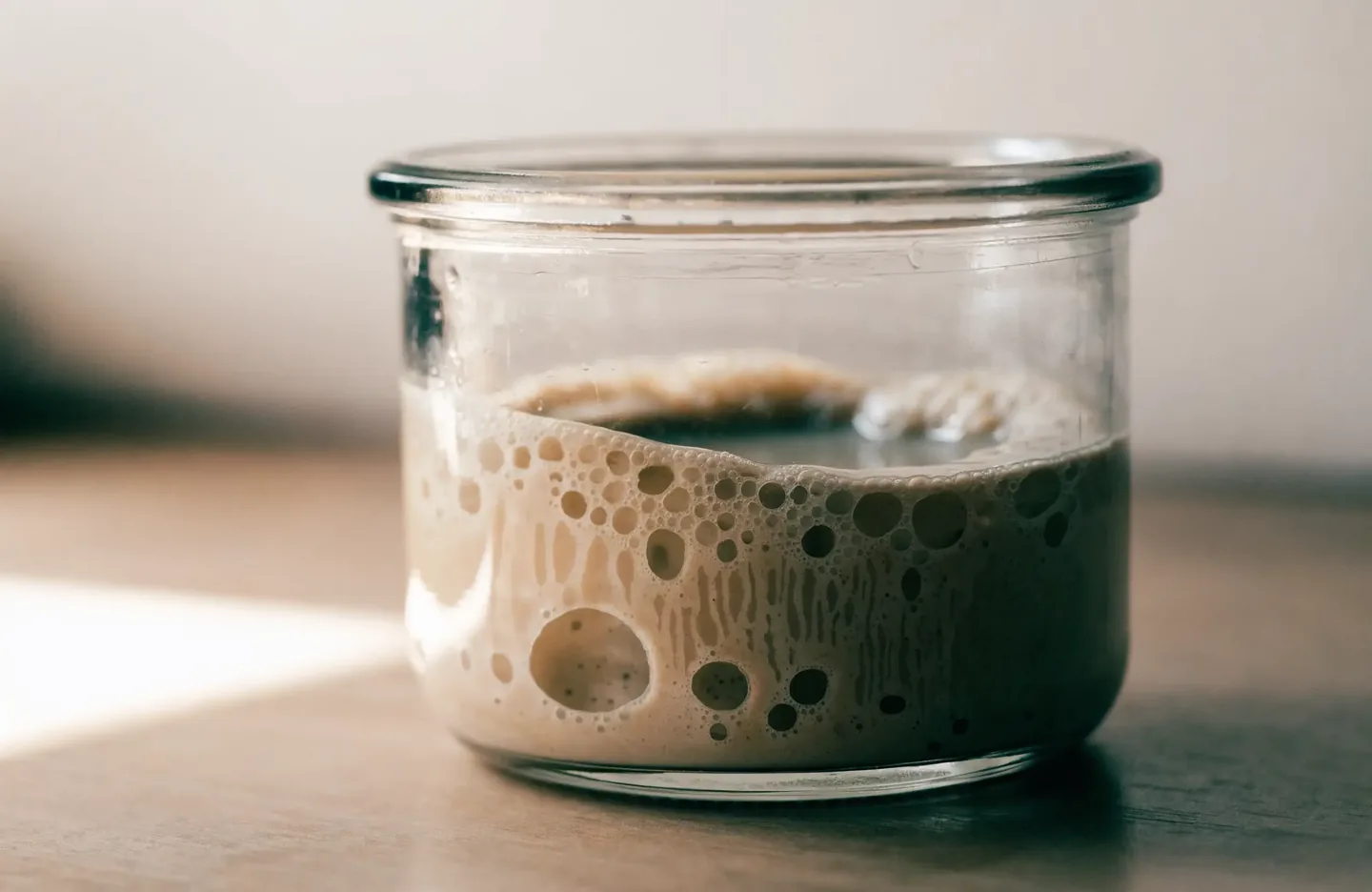
If it is fuzzy, or if it is pink or orange, the jar goes in the bin. All of it, contents and jar, and you start again. Do not scrape, do not rinse the top layer off, do not save a spoonful from the bottom.
If it is a layer of dark liquid, a grey tint or a sunken surface, nothing is wrong. That is a hungry starter and it needs feeding, not throwing away. Most jars binned for "mould" are this.
| What you see | What it is | What to do |
|---|---|---|
| Fuzzy patches, any colour | Mould | Bin everything, start again |
| Pink, orange or red streaks | Not the sourdough microbiome | Bin everything, start again |
| Dark or grey liquid on top | Hooch. Normal, means hungry | Stir in or pour off, then feed |
| Grey or dull beige colour | Normal for an unfed starter | Feed it |
| Sunken, wet, slack surface | Well past peak | Feed it |
| Sharp acetone or nail polish smell | Very hungry | Feed more often, or bigger ratio |
This is one section of the complete guide to sourdough starters, which covers feeding, reading the jar and everything that happens before it gets to this point.
Why scraping it off is not an option
The instinct is reasonable: the fuzz is on top, the rest looks fine, why waste it? The answer is that you are not looking at the whole mould.
The USDA's guidance is direct about this. You only see part of the mould on the surface of a food, and where growth is heavy, "root" threads have invaded it deeply. In dangerous moulds the poisonous substances are often in and around those threads, and in some cases they have spread throughout the food (USDA Food Safety and Inspection Service).
Those poisonous substances are mycotoxins, and the reason they matter here is what the same guidance says about them: they are not visible to the naked eye, have no distinctive taste or odour, and can make you seriously ill. There is no sniff test that gets you past this.
The USDA does allow trimming, but only for hard foods, where the threads cannot travel: hard cheese, firm fruit and vegetables, cutting at least an inch around the growth. The discard-entirely list is the soft, wet category, and it explicitly includes cooked grains, baked goods, jams, yogurt and soft fruit and vegetables, because high moisture content means contamination below the surface.
A sourdough starter is a soft, wet, high moisture food. It is squarely in the discard category and nowhere near the trimming one. That is the whole argument, and it does not depend on anybody's baking opinion.
The bin includes the jar
Wash the jar in hot soapy water, or use a different one. Spores are not tidy and the point of starting again is starting clean.
If you have a backup, this is what it was for. A jar of dried flakes turns rebuilding from scratch into a job of a few days, which is the entire reason to keep one.
What causes it, so it does not happen twice
Mould needs three things a starter can accidentally provide: moisture, air and time without competition. A healthy, regularly fed starter is acidic and crowded, and that is genuinely hostile territory. The failures are almost always about neglect or contamination.
| Cause | What actually happens | Prevention |
|---|---|---|
| Left unfed too long | Acidity and competition drop off | Feed it, or refrigerate it |
| Dried crust on the jar walls | Dry residue above the starter is unprotected | Scrape the sides down at every feed |
| Dirty utensils or hands | Spores introduced from outside | Clean spoon, clean jar |
| Sealed airtight for a long time | Condensation on the lid drips back in | Loose lid or cloth |
| Fruit, honey or juice added | Sugar feeds things that are not your culture | Flour and water only |
| Warm and neglected | Everything above, but faster | Fridge if you are away |
The dried crust one is worth dwelling on because it is the most common and the least discussed. The smear of starter left up the side of the jar dries out, sits above the acidic mass, and is the easiest place in the whole jar for something else to take hold. Ten seconds with a spatula at each feed removes the problem entirely.
The things that look like mould and are not
This is where most perfectly good starters die, so it is worth being as clear about this half as about the other one.
Hooch. A layer of liquid on top, anywhere from clear to grey to almost black. It is alcohol and acid produced by a hungry culture. It is normal, and its colour tells you nothing except that the jar has been sitting. Stir it in for a more sour result, pour it off for a milder one, then feed.
Grey or dull colour. An unfed starter loses the creamy look. That is oxidation and hunger, not spoilage.
A skin on top. A dry film forms when a jar sits uncovered in dry air. Not mould, just dehydration, and it does not spread.
Big irregular bubbles and a slack, wet texture. Well past peak. It works, it is just acidic and tired.
A smell of acetone, vinegar or alcohol. Hunger, every time. A mouldy jar does not generally announce itself by smell, which is exactly why smell is not the test.
The line that actually decides it: normal starter lives in the beige to grey range and is smooth or bubbly. Anything fuzzy, and anything brightly coloured, is not your starter.
What about the first week?
New jars in their first days smell strange and behave oddly, and that is normal. What is not normal is fuzz or pink, and the rule does not soften because the starter is young. If a seven day jar grows mould, bin it and start again with a clean jar.
Related, and worth saying because it comes up constantly: discard from a starter you are still building does not go into recipes. King Arthur's guidance is to wait until you have a healthy, active starter before keeping discard from routine feedings (King Arthur Baking). That is a separate question from mould, but it lands in the same place: the early jar is not food yet.
Frequently asked questions
Can I just scrape the mould off my sourdough starter? No. In soft, wet foods the mould threads travel below what you can see, and the toxins that some moulds produce are invisible and tasteless. Trimming is guidance for hard foods, and a starter is not one.
My starter has pink streaks but no fuzz. Is that mould? Treat it the same way. Pink and orange are outside the colour range of a normal sourdough culture, whatever is causing them, and this is not a case where a close call is worth taking.
Does baking kill mould in a starter? It kills the mould and not the problem. The French food safety agency describes mycotoxins as generally thermostable and not destroyed by ordinary cooking and sterilisation processes (Anses), and Spain's food safety agency puts it more bluntly still: once they are present in a food it can no longer be decontaminated, and they survive drying, milling and processing (AESAN). The oven is not a fix.
I found mould only on the lid. Is the starter safe? Use a clean jar and a clean lid, and be honest about how long the lid has been like that. If there is any growth touching the starter itself, bin it.
How do I know if it is mould or kahm yeast? Kahm is typically a flat, white or cream film with no fuzz. It is more common in ferments than in starters. The practical answer is that a starter with anything growing on the surface is one you can replace in a week, so the cautious call costs you very little.
Can I use a mouldy starter for compost? Yes, that is a fine end for it. It is only food safety that is at stake, not the flour.
How do I stop it happening again? Scrape the sides at every feed, keep the jar loosely covered rather than sealed, feed on a rhythm you can keep, and put it in the fridge when you cannot. And dry a backup, so that next time this is a small problem.
If your jar turned out to be hungry rather than spoiled, the fix is upstream: getting the feeding rhythm and peak timing to match your week, so it is never left sitting long enough for this question to come up.
Where I checked
Keep reading
 Guide
Guide
Bagel Dough: Why It Is So Firm, and How to Knead It
Bagel dough feels stiff and dry on purpose. Here is why it runs at 50 to 60% water and high protein flour, how to knead it, and the windowpane to aim for.
6 min read Guide
Guide
Bagel Recipe: New York Style, Step by Step
A weight-based New York bagel recipe, step by step: the firm 58% dough, an overnight cold retard, how long to boil, and the oven heat that sets a glossy crust.
6 min read Complete guide
Bagels: The Complete Guide
Make a real bagel at home: the firm 58% dough, why bagels are boiled before baking, New York vs Montreal, sourdough and gluten free, and how to fix flat ones.
18 min read