Guide
Storing Sourdough Starter in the Fridge
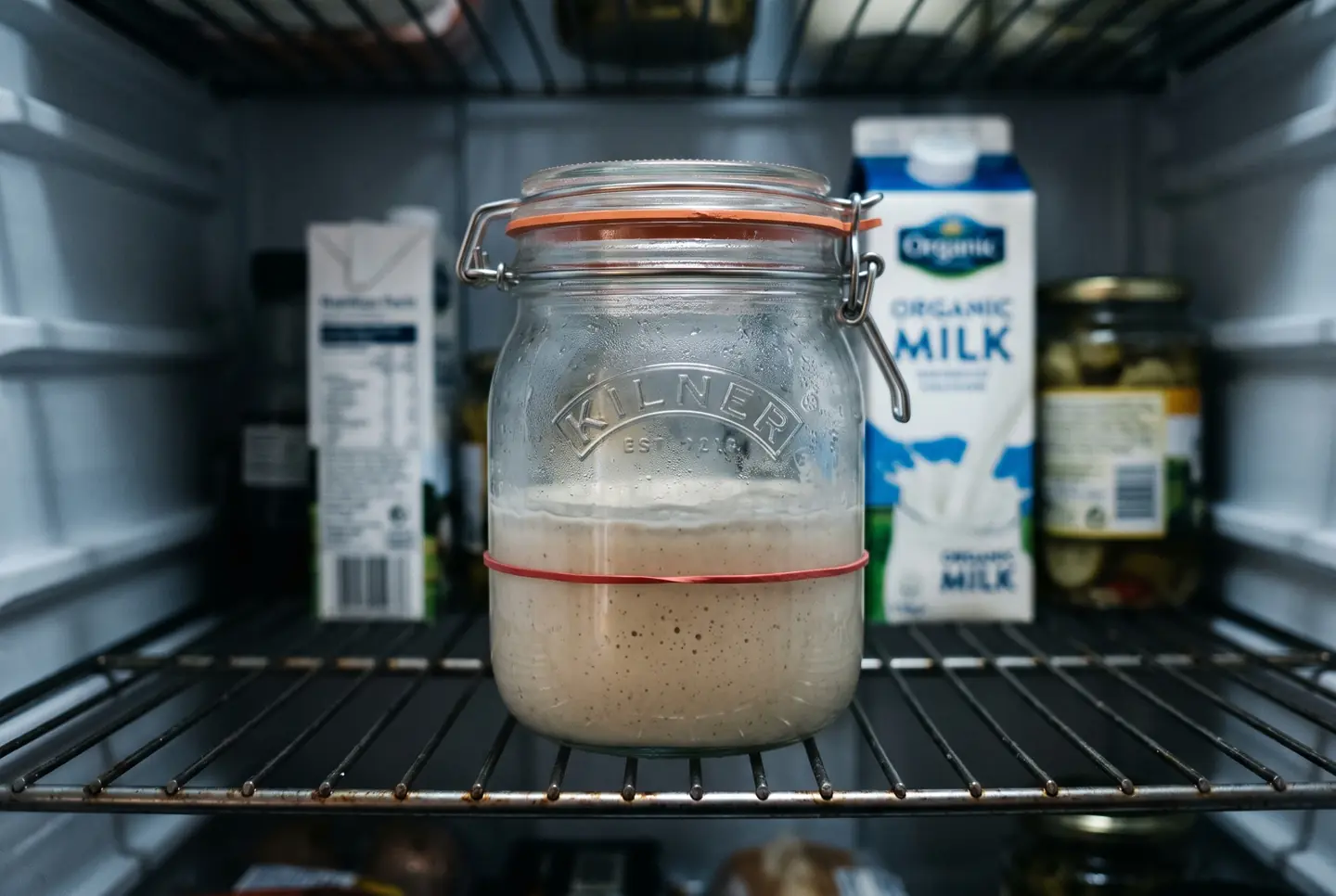
To store a sourdough starter in the fridge, feed it, leave it at room temperature for about an hour so fermentation gets going, then refrigerate it. It will keep a week without any attention, and two to three weeks is still fine. Cold does not kill the culture, it just puts it in low-power mode.
The fridge is the single best thing that ever happened to the home baker who does not bake every day. It turns a daily chore into a weekly one. This page is one section of the complete guide to sourdough starters; here we go deep on the cold-storage part, including the timing detail that most people get slightly wrong.
Why the fridge works
Fermentation is a biological rate, and cold slows it to a crawl. At room temperature your culture burns through its food in hours; at fridge temperature, around 4 °C (39 °F), it stretches the same meal across days. The yeast and bacteria are not dead, they are dormant. King Arthur's whole maintenance model for occasional bakers is built on this: a starter fed and refrigerated needs attention only about once a week (King Arthur Baking).
So the fridge is not a compromise. For anyone who bakes on weekends rather than daily, it is the correct home for a starter between bakes.
The right way to put it away: feed, wait, then chill
Here is the detail worth getting right, because both ways of getting it wrong are common.
Feed the starter first. Discard down to a small amount and feed at a generous ratio like 1:5:5, which gives the culture a full larder to live on while it sleeps.
Then wait about an hour at room temperature before it goes in. This is the part people skip. The Perfect Loaf's guidance is to let the jar sit out for roughly an hour so fermentation is under way, and only then refrigerate (The Perfect Loaf).
Why that window matters:
- Chill it straight after feeding and the culture gets almost nothing done before the cold shuts it down. It goes in hungry and comes out weak.
- Chill it at full peak and it has already eaten most of its food. It goes in spent and produces hooch and acid faster in the cold.
- Chill it about an hour in, just as it is climbing, and it banks a head start, then coasts for days.
You are timing it to go into the cold actively fermenting but nowhere near finished. That single hour is the difference between a starter that revives in one feed and one that needs three.
How long it really keeps
A refrigerated starter is far more forgiving than its reputation. The honest ranges:
| Time in the fridge | What to expect | Revival effort |
|---|---|---|
| Up to 1 week | Barely changed, maybe a little hooch | Often 1 feed |
| 1 to 3 weeks | Hooch on top, sharper smell, all normal | 2 to 3 feeds |
| 3 to 6 weeks | Alive but sluggish, more hooch | 3 or more feeds |
| Months, unfed | Usually recoverable, no guarantee | Several feeds, be patient |
The Perfect Loaf suggests not pushing much past three weeks without a feed, simply because revival takes proportionally longer the longer it sits, not because the culture suddenly dies (The Perfect Loaf). If you know you will be away longer than that, feed it once mid-way if you can, or dry a backup.
Hooch: the liquid on top is not a problem
Open the jar after a week or two and you may find a layer of grey or brown liquid. That is hooch, a mild alcohol the culture produces when it runs low on food. It looks alarming and means nothing bad.
Stir it back in for a slightly tangier starter, or pour it off for a milder one. Either is fine. A dark hooch is a message, not an emergency: it says the jar is hungry and it is time for a feed. The only thing on top of a starter you should ever worry about is fuzzy mould or a pink or orange streak, which is contamination and belongs in the bin, not hooch, which is just fermentation.
Bringing it back to life
This is where most fridge starters get wrongly declared dead, so read the warning first: never judge a refrigerated starter by its first feed. The first cycle out of the cold is almost always sluggish, and that is expected, not a death sentence. It is the single most common false alarm in sourdough.
The routine:
- Take it out and discard down to your small maintenance amount, hooch and all.
- Feed it at your usual ratio, 1:5:5 works well, and leave it at warm room temperature.
- Give it 2 to 3 consecutive feeds before you trust it. The Perfect Loaf's own rule is at least two, preferably three, regular feeds before building a levain from it (The Perfect Loaf).
- Warmth speeds this up. Somewhere around 25 to 28 °C (78 to 82 °F) wakes a cold starter noticeably faster than a chilly countertop (The Perfect Loaf).
By the second or third feed it should be doubling on schedule again, and now it is bake-ready. If you plan ahead, take it out a day or two before you want to bake and you will never be caught short.
A weekly rhythm for the occasional baker
Put the pieces together and the low-effort cycle looks like this.
| When | What you do |
|---|---|
| Once a week (say Sunday) | Take out, discard, feed 1:5:5, wait an hour, back in the fridge |
| A day or two before baking | Take out and start the 2 to 3 wake-up feeds |
| Bake day | Use it at peak, feed the small amount you keep, chill again |
That is the entire maintenance load for a weekend baker: one feed a week, plus a short wake-up run before you bake. Far less flour, far less discard, and a starter that is ready when you are.
Frequently asked questions
Should I feed my starter before or after refrigerating? Before. Feed it, let it ferment at room temperature for about an hour so it is actively working, then refrigerate. Storing it unfed sends a hungry culture into the cold, which makes revival slower.
How long can a sourdough starter stay in the fridge without feeding? A week is effortless, two to three weeks is routine, and it will usually survive much longer, just with a slower comeback. Past about three weeks the revival takes proportionally more feeds.
My fridge starter has liquid on top. Is it ruined? No, that is hooch, a normal sign it is hungry. Stir it in for more tang or pour it off for less, then feed. Only fuzzy mould or a pink or orange streak means it is spoiled and has to go.
Why is my starter slow after coming out of the fridge? Because it is still half-asleep. The first feed out of cold storage is meant to be sluggish. Give it two or three feeds in a warm spot before deciding anything. This is the most common false alarm in sourdough.
Can I bake straight from a cold starter? Better not to. Wake it with a feed or two first so it is doubling reliably. A dough built on a cold, sluggish starter tends to underproof. Take it out a day ahead instead.
Do I have to bring it to room temperature before feeding? No, you can feed it straight from the fridge. It will just take longer to peak because it starts cold, so keep it somewhere warm for that first wake-up feed.
Once your starter lives happily in the fridge, the last skill worth having is knowing exactly when a fed jar has hit its stride, so you can tell when it is active and ready to use instead of guessing.
Where I checked
Keep reading
 Guide
Guide
Bagel Dough: Why It Is So Firm, and How to Knead It
Bagel dough feels stiff and dry on purpose. Here is why it runs at 50 to 60% water and high protein flour, how to knead it, and the windowpane to aim for.
6 min read Guide
Guide
Bagel Recipe: New York Style, Step by Step
A weight-based New York bagel recipe, step by step: the firm 58% dough, an overnight cold retard, how long to boil, and the oven heat that sets a glossy crust.
6 min read Complete guide
Bagels: The Complete Guide
Make a real bagel at home: the firm 58% dough, why bagels are boiled before baking, New York vs Montreal, sourdough and gluten free, and how to fix flat ones.
18 min read