Guide
How Long Does It Take to Make a Sourdough Starter?
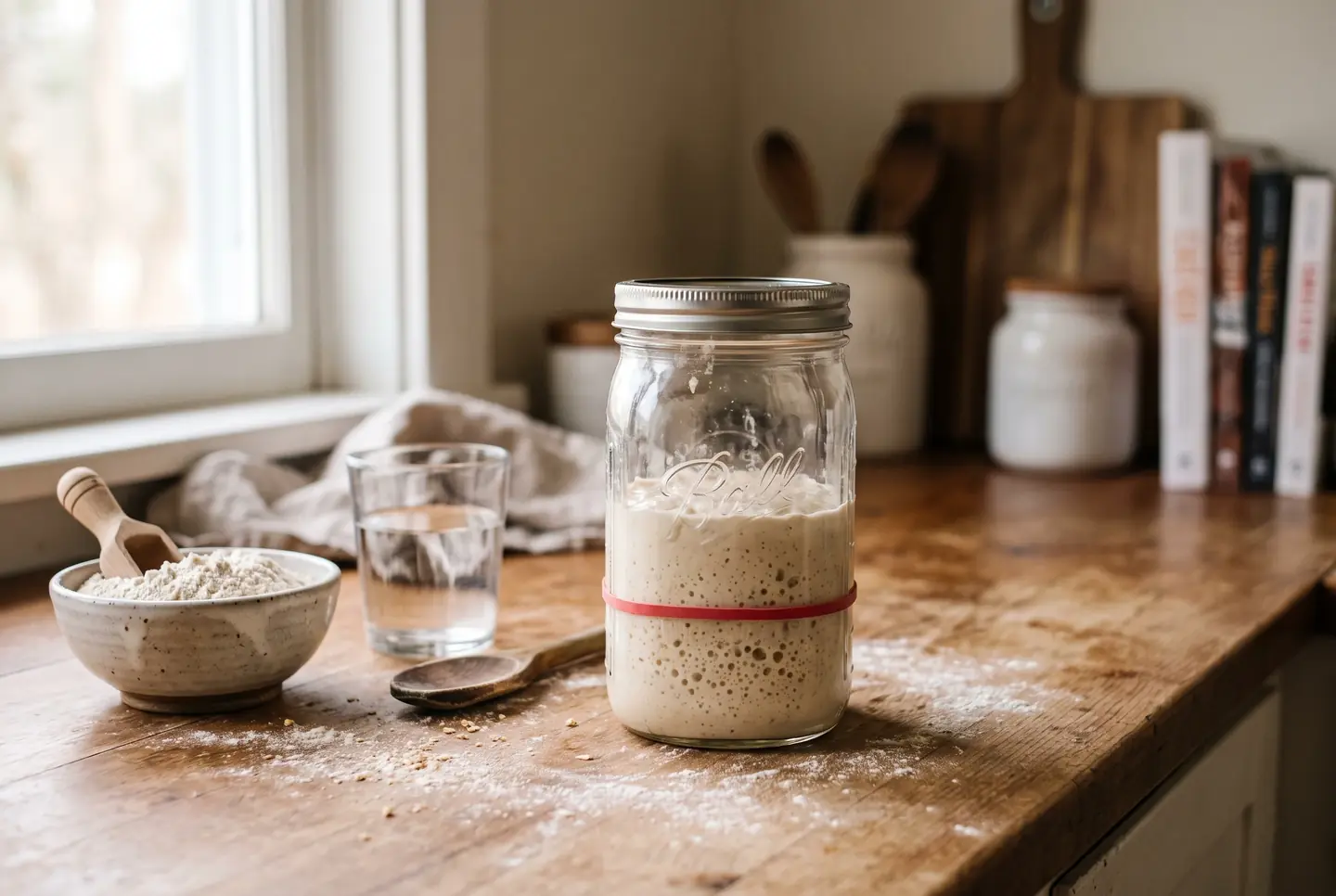
A sourdough starter usually shows its first real signs of life in 5 to 10 days, but it is not strong enough to raise a loaf on its own until roughly 3 to 6 weeks. Those are two different questions, and treating them as one is why so many first loaves come out dense.
The short answer people want is "about two weeks." That is fair for alive and bubbling. It is optimistic for strong enough to bake bread that actually rises. This page is one section of the complete guide to sourdough starters; here we separate the two clocks so you know exactly which one you are watching.
Alive is not the same as ready
Ask "how long does it take" and you are really asking two things at once.
Is it alive? Usually 5 to 10 days. You see bubbles, you smell fermentation, the jar climbs a little. The culture has established.
Is it strong enough to raise a loaf by itself? Often 3 to 6 weeks. The jar now doubles on schedule, feed after feed, with enough force to lift a heavy dough through bulk fermentation.
The gap between those two is where most disappointment lives. A one-week-old starter that bubbles looks finished, so people bake with it, and the loaf barely moves. Nothing was wrong with the starter. It was alive, but it was not yet an engine.
The test that actually tells you it is ready
Readiness is not a date on the calendar, it is a pattern you can see. Your starter is ready to bake when it doubles reliably, in a predictable window, three feedings in a row.
Reliability is the whole point. A jar that doubles once and then sulks the next day is still establishing. The one you can bake with does the same thing every time, so you can plan a dough around it. The Sourdough Journey puts the bar at roughly doubling in 4 to 7 hours after a feed at about 74 °F (23 °C), and holding that rhythm (The Sourdough Journey).
| What the jar does | What it means | Ready to bake? |
|---|---|---|
| Bubbles, no real rise | Alive, weak | No |
| Doubles once, then irregular | Establishing | Not yet |
| Doubles in 4 to 7 h, three feeds running | Stable and strong | Yes |
| Doubles in under 3 h every time | Very vigorous | Yes, and use it earlier |
The float test, where a spoonful of starter is dropped in water to see if it floats, is not on that list on purpose. It gives false positives on stiff starters and false negatives on wet or wholegrain ones. Watch the rise and the clock instead.
What the first week looks like, day by day
The early days follow a fairly consistent arc, and knowing it stops you from panicking on day 4, which is when almost everyone thinks they have failed.
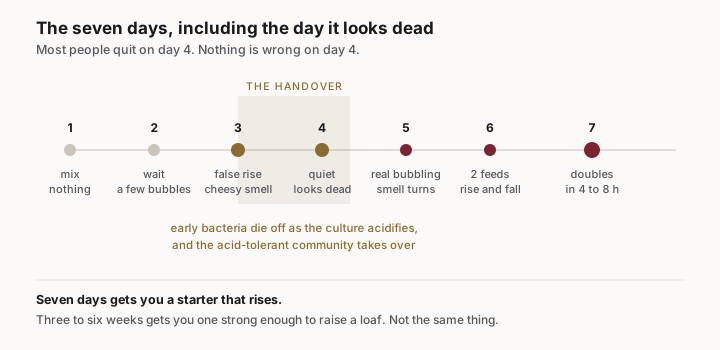
- Days 1 to 3: the false rise. The jar often bubbles dramatically and may even double. This is usually bacteria, not the wild yeast you actually want, and it fades. Do not trust it, and do not bake with it (The Sourdough Journey).
- Days 4 to 6: the quiet. Activity drops, sometimes to nothing. The culture is shifting from those early bacteria toward the stable community of yeast and lactic acid bacteria. This lull is normal and temporary. Patience with day 4 is the single most useful thing a beginner can practise.
- Days 7 to 10: the real climb. Consistent rising returns, this time driven by the yeast that will leaven your bread. Now you start counting doublings, not days.
King Arthur's starter guide runs on the same shape: about a week of daily feeding to establish the culture, with maturity and dependable strength arriving later (King Arthur Baking).
What speeds it up, and what slows it down
Every timeline you read assumes a warm-ish kitchen and a helpful flour. Change either and the numbers move.
Temperature is the big lever. Fermentation is a biological rate: warmer is faster, cooler is slower, and the effect is larger than it feels. As a rule of thumb, every 15 °F (8 °C) roughly doubles or halves the speed, so a jar that doubles in 4 hours at 70 °F (21 °C) needs about 8 at 55 °F (13 °C). The comfortable range for building a starter is around 75 to 80 °F (24 to 28 °C) (The Sourdough Journey).
Flour is the second lever. A jar built on some wholegrain flour, rye or whole wheat, gets going noticeably faster than one on white flour alone, because the whole grain carries more of the wild yeast and the minerals the culture feeds on. A common trick is to start with wholegrain and taper toward white once it is lively.
| Condition | Effect on the timeline |
|---|---|
| Kitchen 75 to 80 °F (24 to 28 °C) | Fastest establishment |
| Kitchen below 65 °F (18 °C) | Slower, first rise may take longer |
| Some rye or whole wheat in the mix | Quicker to wake up |
| 100% white flour | Established, but slower to strengthen |
| Chlorinated tap water | Can stall early activity |
None of these break a starter. They only move the calendar. A cold-kitchen starter on white flour is not failing, it is just running the same film in slow motion.
The honest shortcut while you wait
If you are impatient, there is a workaround that is not cheating: bake a loaf that uses a little commercial yeast alongside your young starter. The starter contributes flavour and acidity, the packet yeast guarantees the rise. This is a normal bakery technique, and it beats forcing a weak three-week-old jar to do a job it is not ready for and getting a brick.
The starter keeps maturing in the meantime. Somewhere in weeks three to six it will start carrying doughs on its own, and you will feel it: the same recipe suddenly rises higher and faster. That is your signal to drop the training wheels.
Frequently asked questions
How long does it take to make a sourdough starter from scratch? Plan on 5 to 10 days to a lively, bubbling starter, and 3 to 6 weeks before it is strong enough to raise a loaf on its own. Warm kitchens and a little wholegrain flour push those numbers to the short end.
Why did my starter bubble on day 2 and then go quiet? That early burst is usually bacteria, not the yeast you want, and it fades around days 4 to 6 while the culture shifts. The quiet stretch is expected. Keep feeding on schedule and real, yeast-driven rising returns around day 7 to 10.
Can I bake with a one-week-old starter? It might be alive, but it is rarely strong enough alone. If you want to bake that early, add a little commercial yeast to the dough for insurance. For a pure sourdough loaf, wait until the jar doubles reliably over three consecutive feeds.
How can I speed up a slow starter? Move it somewhere warmer, around 75 to 80 °F (24 to 28 °C), and feed with a little rye or whole wheat. Both bring the timeline in. What you should not do is bake before it doubles on a dependable schedule.
Is a starter ever truly finished maturing? Not really. A starter keeps getting more stable and more flavourful for months, and an old starter often outperforms a young one. "Ready" just means it clears the reliability bar, not that it has stopped improving.
Once your jar doubles on schedule, the next thing worth learning is how to read that peak by eye, so you can tell exactly when it is active and ready to use rather than guessing from the clock alone.
Where I checked
Keep reading
 Guide
Guide
Bagel Dough: Why It Is So Firm, and How to Knead It
Bagel dough feels stiff and dry on purpose. Here is why it runs at 50 to 60% water and high protein flour, how to knead it, and the windowpane to aim for.
6 min read Guide
Guide
Bagel Recipe: New York Style, Step by Step
A weight-based New York bagel recipe, step by step: the firm 58% dough, an overnight cold retard, how long to boil, and the oven heat that sets a glossy crust.
6 min read Complete guide
Bagels: The Complete Guide
Make a real bagel at home: the firm 58% dough, why bagels are boiled before baking, New York vs Montreal, sourdough and gluten free, and how to fix flat ones.
18 min read