Guide
Whole Wheat Bagels: Blend, Water and Chew
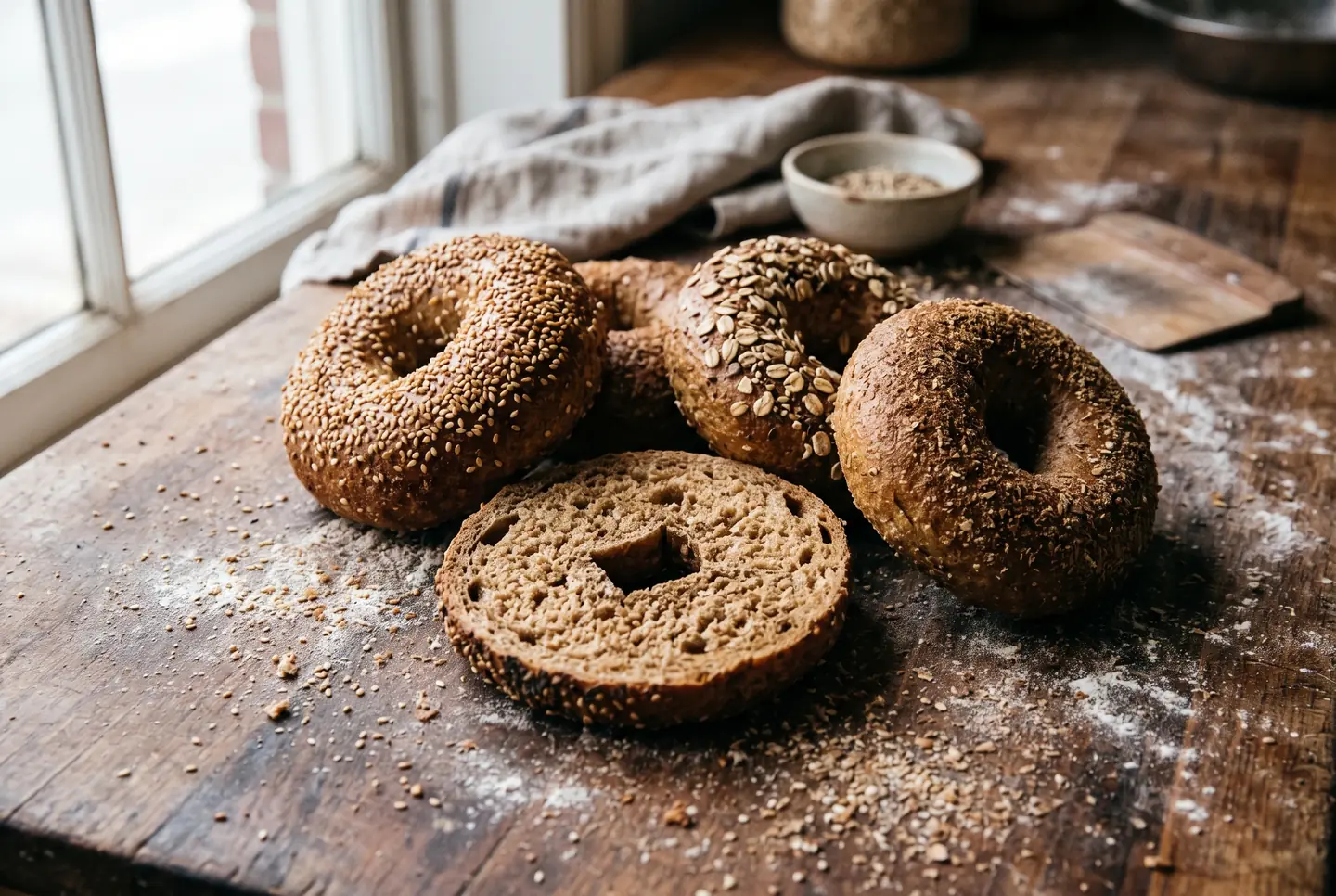
A whole wheat bagel is the easiest variation to want and the easiest to ruin, and it fails the same way almost every time: the dough turns out dry and tight, the ring closes up in the boil, and the crumb bakes dense instead of chewy. Two things cause all of that, and both come from the bran. Bran drinks water like a sponge, and its hard flecks cut through the gluten strands the bagel depends on to hold its shape.
So here is the fix, up front. Do not go fully whole grain on your first try: mix roughly half whole wheat and half bread flour, which keeps most of the flavour and colour while leaving enough clean gluten to hold the ring. And add water, because whole grain flour absorbs more than white, so a dough that would be firm with white flour wants a few points more to feel the same. Everything else, the shaping, the boil, the bake, comes straight from the complete bagel method. This guide is only about the flour swap.
Why whole wheat fights the bagel
A bagel is defined by a firm, low hydration dough with a strong gluten network, the exact thing bran works against. King Arthur builds its whole wheat bagel on a near even split, 360g bread flour to 340g whole wheat, and that is not timidity. It is the ratio that keeps a bagel a bagel.
The bran is the problem twice over. First it competes for water: the germ and bran of whole grain flour pull moisture away from the starch and protein, which is why the same dough feels drier. Second, the sharp bran particles physically interrupt gluten as it forms, so the network never gets as strong or as stretchy as it does with white flour. A guide to baking with whole wheat makes the same point for bread in general: whole wheat needs more water and more patience than the white flour version of the same recipe, and the dough will always feel a little rougher.
For most breads that roughness is fine. For a bagel, where the whole appeal is a tight, chewy, ring holding structure, it is exactly what you have to manage.
The blend is the real decision
| Approach | Flavour and colour | Structure | Who it is for |
|---|---|---|---|
| Roughly half whole wheat, half bread flour | most of it | holds the ring cleanly | your first whole wheat bagel |
| Mostly whole wheat, a quarter bread flour | strong, nutty | firmer, needs care | once the blend works |
| 100% whole wheat | full, assertive | dense, must soak the bran | a deliberate, denser bagel |
Start at the top of that table and work down. A half-and-half blend gives you a bagel that tastes clearly of wheat and browns a shade darker, while still behaving like the dough you already know. As you push the whole wheat fraction up, you get more flavour and a denser, chewier result, and you have to work harder for the ring.
Bread flour, not all purpose, is the partner you want. The extra protein in bread flour is what offsets the gluten the bran cuts away, and it is the reason a blend can stay firm and chewy where straight whole wheat goes crumbly. The flour itself is worth understanding on its own terms: how it is milled, how much water it drinks, and why it behaves the way it does.
Add water, then add a little more
The single number to change is hydration, and the direction is always up. Because the bran absorbs more, a whole wheat blend that reads the same on paper will feel tighter in the hand, so you compensate with water. King Arthur gives a concrete version of this: for every cup of whole wheat flour you swap in, add about two teaspoons of extra liquid to start. Over a whole blend that works out to roughly five to ten percent more water than the white flour version, and the higher the whole wheat fraction, the bigger the bump.
That said, a bagel is still a firm dough. You are not chasing a slack, sticky ball. You are adding enough water that the dough feels the same firmness it would with white flour, no softer, because a wet bagel dough will not hold its hole through proofing and the boil. Add the water gradually and stop when the firmness matches, not when the dough goes soft.
Soak the bran before you fight it
Here is the step that turns a dense, stubborn 100% whole wheat dough into something workable: give the flour time with the water before you demand structure from it. Whether you call it an autolyse or just a soak, letting the whole wheat flour and water sit together for a stretch before kneading lets the bran soften and hydrate fully. Soft, saturated bran cuts less, and a flour that has already drunk its fill will not keep stealing water from the dough as you work.
For a half-and-half blend you can often skip this and just knead a little longer. For a mostly or fully whole wheat bagel it is close to essential: without it, the dough tightens and tears instead of stretching, and the bran stays sharp. The soak costs nothing but time, and it is the difference between a heavy hockey puck and a dense but pleasant bagel.
What does not change
Once the dough is mixed, a whole wheat bagel is just a bagel, and the rest of the method carries over unchanged. You still shape a tight ring, you still give it the same cold overnight rest if you use one, and you still boil it before baking for the same reason and roughly the same time. King Arthur boils its whole wheat bagels one to one and a half minutes, until they float and rise, then bakes them around 450 °F (230 °C) for fifteen to twenty minutes, the same window a white bagel takes.
The one honest caveat is expectation. A whole wheat bagel will be a touch denser and less airy than an all white one, because the bran that gives it flavour also weighs the crumb down. That is the trade, not a fault. Aim for a bagel that is clearly whole wheat and clearly still a bagel, and let the blend, not a single stubborn ideal, decide where you land.
Frequently asked questions
Can you make bagels with 100% whole wheat flour? Yes, but it is the hardest version and not where to start. A fully whole wheat bagel is denser and more assertive, and it really wants a soak or autolyse to soften the bran before shaping. Begin with a half-and-half blend and raise the whole wheat fraction once that works.
Why are my whole wheat bagels so dense and dry? Almost always too little water, too much bran, or both. Whole grain flour absorbs more, so a dough mixed to a white flour hydration comes out tight and dry. Add water until the firmness matches a white dough, and blend in bread flour so there is enough gluten to hold the chew.
How much whole wheat flour should I use in bagels? For a first attempt, roughly half. King Arthur uses a near even split of bread flour and whole wheat, which keeps the flavour while holding the ring. You can push higher for more wheat character, but each step up makes the dough firmer and the crumb denser.
Do whole wheat bagels need more water? Yes. The bran and germ pull water away from the dough, so a whole wheat blend needs several percent more water than the same recipe in white flour to reach the same feel. Add it gradually and stop when the dough is firm, not soft.
Do I still boil whole wheat bagels? Yes, exactly as you would any bagel. The boil sets the crust and gives the bagel its shine and chew, and the flour has nothing to do with it. Boil about one to one and a half minutes, until the rings float, then bake.
A whole wheat bagel is not a health project, it is a flavour choice. Get the blend right and give the bran its water, and you get the nuttier, browner bagel without giving up the ring.
Where I checked
Keep reading
 Guide
Guide
Bagel Dough: Why It Is So Firm, and How to Knead It
Bagel dough feels stiff and dry on purpose. Here is why it runs at 50 to 60% water and high protein flour, how to knead it, and the windowpane to aim for.
6 min read Guide
Guide
Bagel Recipe: New York Style, Step by Step
A weight-based New York bagel recipe, step by step: the firm 58% dough, an overnight cold retard, how long to boil, and the oven heat that sets a glossy crust.
6 min read Complete guide
Bagels: The Complete Guide
Make a real bagel at home: the firm 58% dough, why bagels are boiled before baking, New York vs Montreal, sourdough and gluten free, and how to fix flat ones.
18 min read