Guide
Detroit vs Deep Dish: What Actually Differs
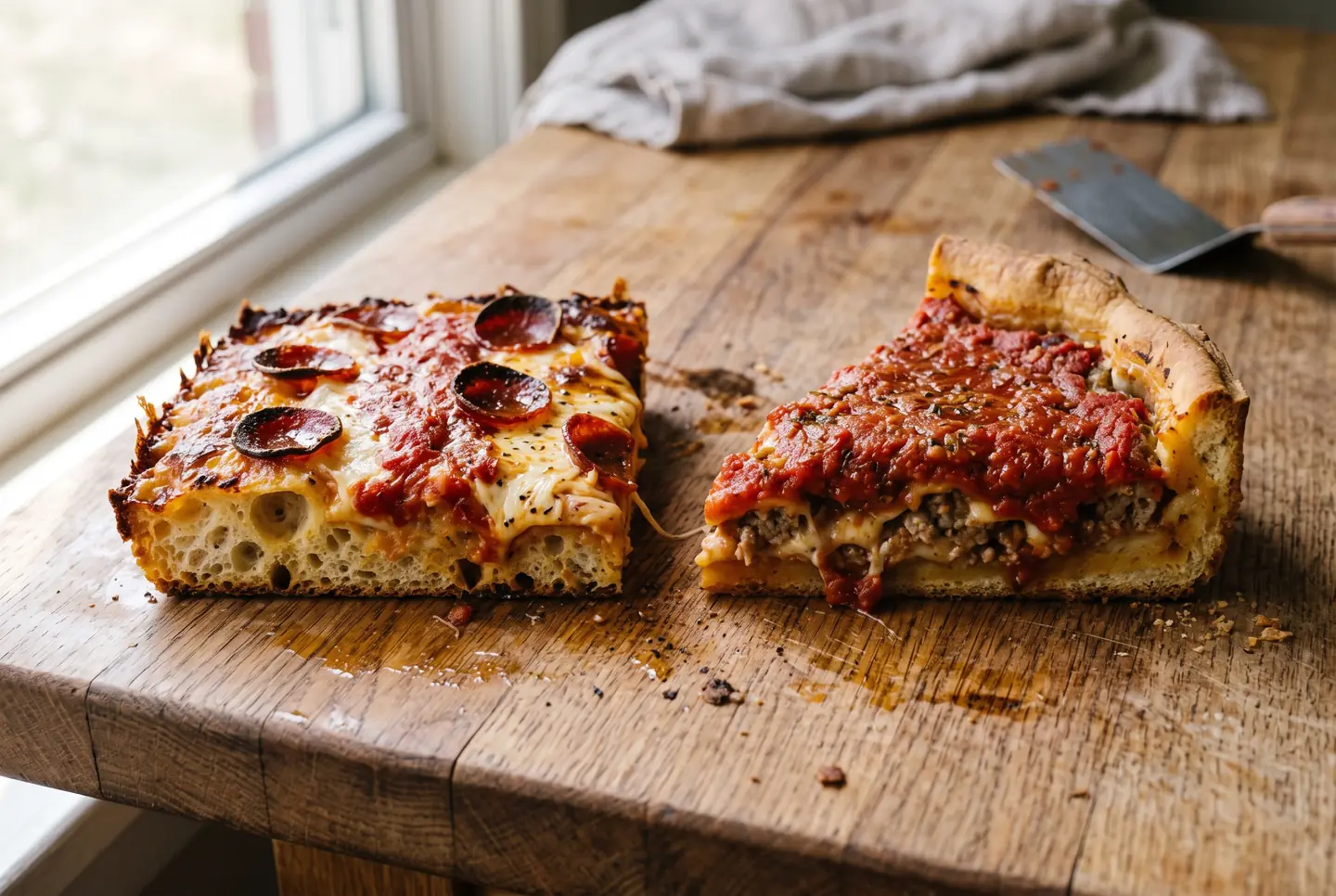
They get lumped together because both are thick, both bake in a pan, and both come out of the American Midwest. But a Detroit-style pizza and a Chicago deep dish are almost opposites in how they are built. The short version: a deep dish is a tall, savory pie you eat with a fork, and a Detroit is an airy, crunchy rectangle you pick up with your hands. They share a pan and a thickness, and not much else.
If you are deciding which one to make at home, or just want to know why your "deep dish" recipe keeps coming out crisp and light instead of dense and rich, this page lays the two side by side. It is the deep version of the comparison in the complete Detroit-style pizza guide.
The one table that settles it
| Detroit-style | Chicago deep dish | |
|---|---|---|
| Shape | Rectangular, sharp square corners | Round |
| Crust | Light, airy, fried-crisp bottom | Dense, tall, pastry-like wall |
| Crust height | Medium, focaccia-like | Very tall, built up the sides |
| Cheese | On top, pushed to the pan edge for frico | On the bottom, against the crust |
| Sauce | On top, in stripes ("red top") | On top, as a thick ladled layer |
| Classic cheese | Wisconsin brick cheese | Low-moisture mozzarella |
| Eating feel | Crisp and light for its height | Heavy, knife-and-fork rich |
| Bake time | Shorter, hot oven | Longer, to cook the deep filling through |
Everything downstream comes from those choices. Let us walk the ones that actually change how the pizza tastes.
The crust: airy versus structural
Detroit dough runs wet, around 70% hydration, which gives it an open, focaccia-like crumb that stays light even though the slice is thick (Wikipedia). The pan and the oil fry the bottom crisp while steam keeps the inside soft. It is a bread you happen to top with cheese.
Chicago deep dish is the opposite job. Its crust is a firmer, sometimes buttery or cornmeal-laced shell, pressed up the sides of a round pan to make a wall (Wikipedia). That wall has to hold a deep load of cheese, toppings and sauce without collapsing, so it is built to be structural, not airy. One dough wants to puff, the other wants to stand up.
Where the cheese goes, and why it matters
This is the difference you can see in a cross-section. On a Detroit, the cheese goes on top of the dough and is pushed all the way to the metal edge, so it melts, then caramelizes against the hot pan wall into the crunchy, lacy border called frico. The cheese is the point of the edge.
On a deep dish, the cheese goes on the bottom, laid directly on the crust before the toppings. There is a shared reason both styles then put sauce last: with a long bake, sauce sitting directly on dough would steam it soggy, so the cheese acts as a barrier and the sauce rides on top (Food Republic). Same instinct, opposite stack.
The sauce: stripes versus a ladle
A Detroit wears its sauce in a few bold stripes across the top after baking, or right before, which is where the nickname "red top" comes from. It is a finishing accent on a cheese-forward pizza.
Deep dish treats sauce as a main layer: a thick, often chunky tomato blanket ladled over the cheese, generous enough to be one of the defining flavors of each bite. On a Detroit the cheese and the frico lead; on a deep dish the sauce is a full partner.
The pans tell the whole story
If you ever wonder why these two look so different, look at what they are baked in. A Detroit is baked in a rectangular pan with sharp square corners, a shape that traces back to the blue steel utility trays a Detroit kitchen borrowed from the local car industry in the 1940s (Wikipedia). Those trays gave the pizza its corners and its fried base. A deep dish is baked in a round, straight-sided pan closer to a cake tin, which is why it comes out as a tall circle you slice like a pie.
The pan is not a detail, it is the cause. Rectangular and shallow-ish with an oiled base gives you frico corners and a crisp bottom; round and deep gives you a wall to hold a heavy filling. Change the pan and you change the pizza, which is exactly why you cannot make a real Detroit in a round tin or a proper deep dish in a flat sheet.
So which should you bake at home?
For most home cooks, Detroit is the easier and more forgiving of the two, and it is why this whole guide is built around it. You press a wet dough into an oiled rectangular pan instead of building and blind-supporting a tall pastry wall, and a shorter, hotter bake means less to go wrong in the middle.
| If you want... | Bake... |
|---|---|
| Crisp, airy, cheese-edge, weeknight-friendly | Detroit-style |
| A rich, forky, sauce-heavy centerpiece | Chicago deep dish |
| Your first-ever pan pizza | Detroit-style, it is the gentler learning curve |
If Detroit is the way you are leaning, the complete guide has the full build, and the step-by-step recipe gets you from bowl to table.
Frequently asked questions
Is Detroit-style pizza the same as deep dish? No. Both are thick and pan-baked, but a deep dish is round with a tall, dense crust and cheese on the bottom under a thick sauce, while a Detroit is rectangular with a light, airy crust, cheese pushed to the edge for a crunchy frico, and sauce in stripes on top.
Which has a thicker crust, Detroit or deep dish? Chicago deep dish is taller overall, with a crust built up the sides of the pan to hold a deep filling. A Detroit is thick but lighter and airier for its height, closer to a focaccia than to a pie shell.
Why is the cheese on the bottom of a deep dish? The cheese sits between the crust and the sauce so that during the long bake the wet sauce does not soak into the dough and make it soggy. A Detroit solves the same problem differently, by putting the sauce on top of the cheese at the end.
Which is easier to make at home? Detroit-style, for most people. You press a wet dough into an oiled rectangular pan and bake hot and fast, rather than building and supporting a tall round crust wall for a long bake.
What cheese does each one use? The classic Detroit cheese is Wisconsin brick cheese, high in fat and built for that caramelized edge, though low-moisture mozzarella is a common stand-in. Chicago deep dish leans on low-moisture mozzarella laid on the base.
Do both really put the sauce on last? Yes, and for the same reason: keeping wet sauce off the dough during a long or hot bake protects the crust from going soggy. The difference is amount and placement, stripes on top for Detroit versus a thick ladled layer for deep dish.
Two great pan pizzas, built on opposite instincts. If you like a crisp, airy slice with a cheese edge you can hear, you are a Detroit person, and the full guide is waiting.
Where I checked
Keep reading
 Guide
Bagel Dough: Why It Is So Firm, and How to Knead It
Bagel dough feels stiff and dry on purpose. Here is why it runs at 50 to 60% water and high protein flour, how to knead it, and the windowpane to aim for.
6 min read Guide
Bagel Recipe: New York Style, Step by Step
A weight-based New York bagel recipe, step by step: the firm 58% dough, an overnight cold retard, how long to boil, and the oven heat that sets a glossy crust.
6 min read Complete guide
Bagels: The Complete Guide
Make a real bagel at home: the firm 58% dough, why bagels are boiled before baking, New York vs Montreal, sourdough and gluten free, and how to fix flat ones.
18 min read