Guide
Bao Flour: Which Flour Makes Snow-White, Fluffy Buns
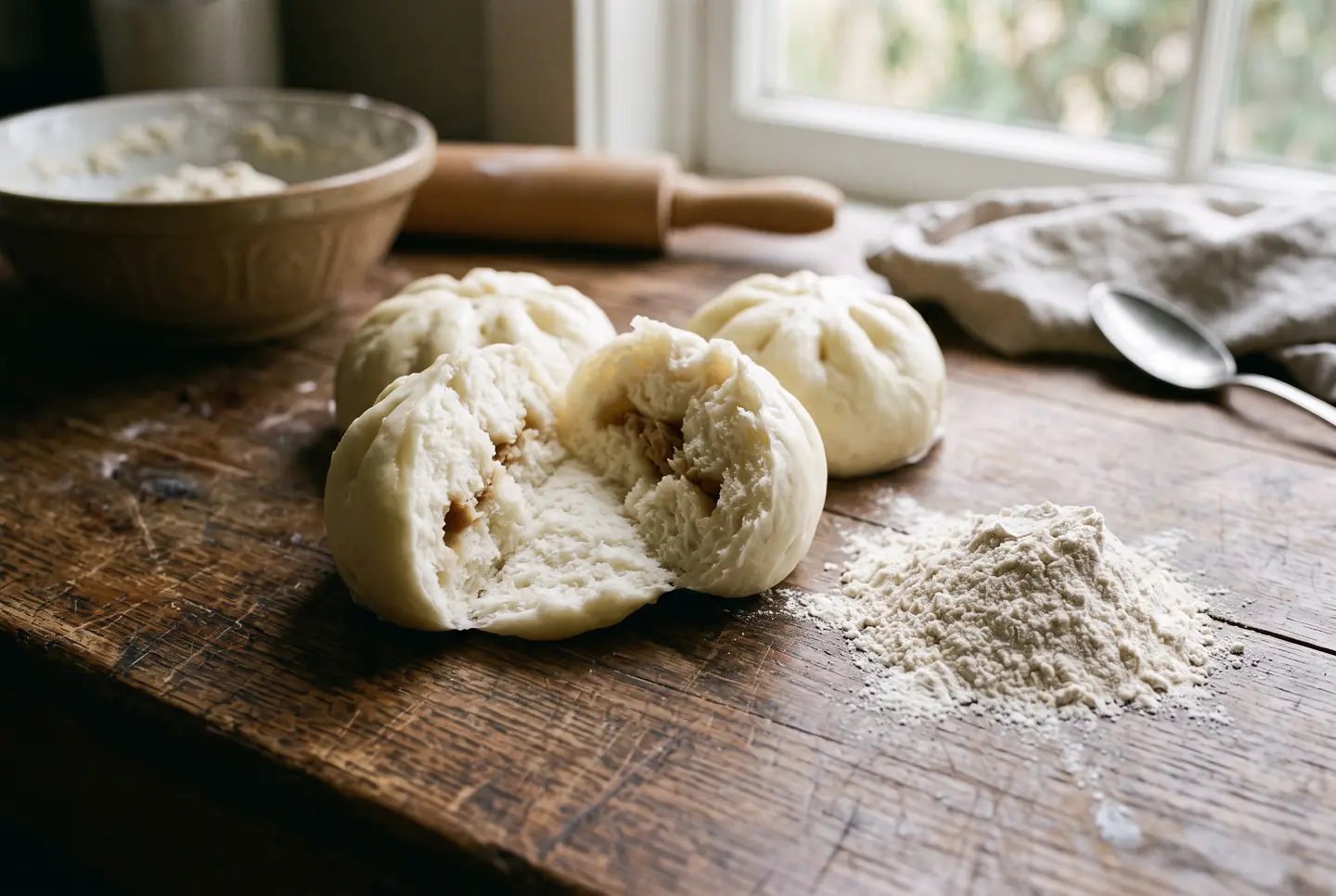
If your homemade bao comes out tan and chewy next to a shop one, the flour is almost always the reason. Colour and chew both come from protein, and a bao wants very little of it. Reach for a low-protein flour, under about 11 percent, and the bun turns pale, soft and tender; reach for a strong bread flour and it turns dense, elastic and slightly gray. That single choice does more visible work than anything else in the dough.
This is the deep version of the flour lever from the complete bao buns guide, where the flour is one of three decisions that make a good bao. Here we stay on the flour: what protein does, which bags to buy, and how to rescue a too-strong flour you already own.
Why protein is the whole story
Protein is what forms gluten when flour meets water, and gluten is what makes a dough strong, stretchy and chewy. That is wonderful in a sourdough and wrong in a bao. A bao should be soft and yielding, not springy, so you want a flour that builds as little gluten as possible.
Red House Spice, one of the most careful Chinese cooking references online, puts the target plainly: for a fluffy, less chewy bun the flour should sit under 11 grams of protein per 100 grams (Red House Spice). Below that line the dough stays tender; above it the bun starts to fight back.
| Flour | Protein (per 100 g) | Bao result |
|---|---|---|
| Cake flour | about 8 to 9% | Softest, palest, most tender |
| Bao or Hong Kong flour | roughly 7 to 9%, often bleached | Whitest of all, the shop look |
| All purpose (lower end) | about 10 to 11% | Good, slightly more chew |
| All purpose (higher end) | 13% or more | Denser, needs the cornstarch fix below |
| Bread flour | 12 to 14% | Too chewy and grayish for bao |
The clearest everyday choice is cake flour, at around 8 to 9 percent protein: it gives the softest, palest, most tender result and it is easy to find. It is a soft-wheat flour built for exactly this kind of tender crumb, and it is worth knowing when to reach for it beyond bao.
Hong Kong flour, and what the bleaching really does
The whitest buns of all use a dedicated bao flour, often sold as Hong Kong flour. It is low in protein and usually bleached, and the bleaching is the shortcut to that snow-white colour: it whitens the flour and softens the gluten further. In side-by-side tests, a proper Hong Kong flour gives "shockingly white" buns that ordinary supermarket all purpose cannot match (Asian Dumpling Tips).
Here is the part worth knowing before you hunt one down: the colour is largely cosmetic. An unbleached low-protein flour makes a bun every bit as soft, just a shade creamier rather than paper-white. Not all bao have to be super white to be delicious, and overdone bleaching actually costs the flour a little flavour (Asian Dumpling Tips). So chase Hong Kong flour if the shop-white look matters to you, and do not feel you are missing anything real if you only have a plain low-protein flour.
One myth to drop while we are here: adding vinegar, to the dough or to the steaming water, does not whiten bao, despite showing up in a number of recipes. The colour comes from the flour, not from an acid.
The cornstarch fix for strong flour
Say the only flour in your cupboard is a strong all purpose, at 13 percent protein or more. You do not need to shop; you can lower the effective protein at home. Replace about one fifth of the flour by weight with cornstarch, sift the two together well, and the mix drops back into bao territory (Red House Spice). Cornstarch is pure starch with no protein, so cutting a fifth of the flour with it dilutes the gluten across the whole dough.
| Your flour | What to do |
|---|---|
| Cake flour (8 to 9%) | Use as is, the softest result |
| Low all purpose (10 to 11%) | Use as is, a touch more chew |
| Strong all purpose (13%+) | Swap one fifth of the weight for cornstarch |
| Bread flour (12 to 14%) | Best avoided; if forced, use the cornstarch swap |
For a 300 gram dough, that means about 240 grams of the strong flour and 60 grams of cornstarch. It is not quite as tender as true cake flour, but it is close, and it turns a bag you already have into workable bao flour.
What to buy, by what is on the shelf
You will not always find a bag labelled "bao flour," so here is how to shop by what is actually stocked. Look for the lowest-protein wheat flour available: cake flour first, then a soft or low-protein all purpose, then Hong Kong or "steamed bun" flour at an Asian grocer if you want the whitest look. Avoid anything labelled bread, strong or high-gluten. Check the nutrition panel if you are unsure: protein per 100 grams is printed there, and under 11 grams is your green light.
Frequently asked questions
What is bao flour? It is a low-protein wheat flour used for steamed buns, often sold as Hong Kong flour and frequently bleached for a whiter colour. Any flour under about 11 percent protein behaves like bao flour, whether or not it carries the name.
Can I use all purpose flour for bao? Yes, especially a lower-protein all purpose around 10 to 11 percent. The buns will be a touch chewier and slightly less white than with cake or Hong Kong flour, but still good. A strong all purpose above 13 percent needs the cornstarch swap.
Is cake flour good for bao? Very. At about 8 to 9 percent protein it gives the softest, palest, most tender crumb and it is easy to find, which makes it the most practical choice for most home cooks.
What is Hong Kong flour? A low-protein, usually bleached wheat flour milled for pale, soft Chinese steamed buns and pastries. It gives the whitest bao, though the extreme whiteness is cosmetic rather than a matter of taste or softness.
How do I make bao whiter? Use a lower-protein, bleached flour such as Hong Kong flour, and steam gently so nothing browns. Skip the vinegar tricks; they do not work. Remember that a creamier, unbleached bun is just as soft and just as good.
Can I use bread flour for bao? It is the worst fit: at 12 to 14 percent protein it builds too much gluten, giving a dense, chewy, grayish bun. If it is genuinely all you have, cut a fifth of its weight with cornstarch to bring the protein down.
Where I checked
Keep reading
 Guide
Guide
Bagel Dough: Why It Is So Firm, and How to Knead It
Bagel dough feels stiff and dry on purpose. Here is why it runs at 50 to 60% water and high protein flour, how to knead it, and the windowpane to aim for.
6 min read Guide
Guide
Bagel Recipe: New York Style, Step by Step
A weight-based New York bagel recipe, step by step: the firm 58% dough, an overnight cold retard, how long to boil, and the oven heat that sets a glossy crust.
6 min read Complete guide
Bagels: The Complete Guide
Make a real bagel at home: the firm 58% dough, why bagels are boiled before baking, New York vs Montreal, sourdough and gluten free, and how to fix flat ones.
18 min read