Guide
Focaccia Sandwich: The One That Holds a Filling
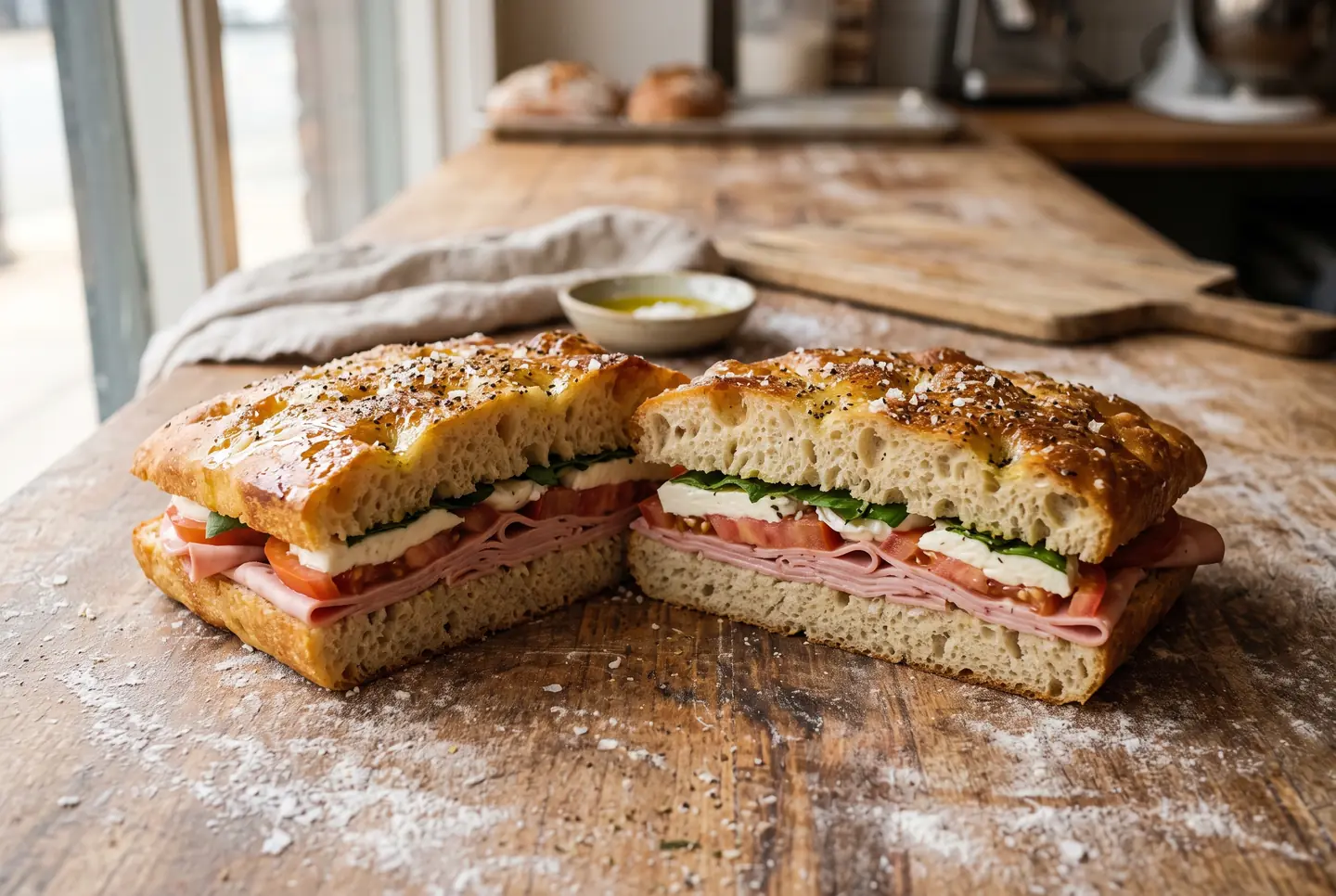
The short answer is that the focaccia you photograph and the focaccia you build a sandwich on are not the same bread. A very wet, big-holed slab tears the moment you fill it and lets the oil and juices run straight through. The sandwich version is baked a little drier and a little more evenly, with a closer crumb, so it splits cleanly and carries mortadella, or tomato and mozzarella, without collapsing or soaking through.
So if your sandwich focaccia keeps falling apart, the fix is not a better filling or a sharper knife: it is the dough itself. Bring the water down from the show-off 80 percent to something nearer 70, bake it a touch thicker in a smaller pan, and you get a crumb tight enough to hold together and soft enough to still taste like focaccia. This page sits under the complete focaccia guide, which covers the styles and where each one shines, and it borrows its dough from the full focaccia recipe.
Why the airy slab makes a bad sandwich
Everything that makes a high-hydration focaccia beautiful works against it as a sandwich base. The large irregular holes that people chase are exactly the gaps a filling falls into and a sauce runs out of. The very soft, custardy crumb that comes from water at 80 percent or more compresses to nothing the moment you press down on a filled sandwich.
The high-hydration dough is the one to make when the bread is the star and you tear it at the table. For a sandwich you want the opposite: a crumb with enough wall between the holes to act like structure.
| Trait | Show-off pan focaccia | Sandwich focaccia |
|---|---|---|
| Hydration | ~80 percent or higher | ~68 to 72 percent |
| Crumb | Big, open, irregular holes | Even, medium, closed enough to slice |
| Height | Tall and dramatic | Moderate, so a filled half stays a comfortable bite |
| Best use | Torn and dipped in oil | Split, filled, pressed |
The dough change: drier, and baked more evenly
Take a standard focaccia and pull the water back. Where the wet version runs about 560 grams of water to 700 grams of flour, which is 80 percent (Baking Steel), a sandwich focaccia is happier around 490 grams to the same 700, roughly 70 percent. That single change gives you a crumb you can slice.
The rest of the method stays familiar: mix until there is no dry flour, a few sets of stretch-and-folds instead of kneading, a full bulk ferment, then into a well-oiled pan. Two differences matter for the sandwich:
- Use a smaller or deeper pan for the same weight of dough. More dough per square centimetre means a taller slab you can split into two real halves rather than one thin sheet.
- Dimple more gently. Deep dimpling is what gives the airy version its craggy top and oil pools. For a sandwich you want a flatter, more even top so the two halves meet cleanly, so press lightly and keep the surface level.
Baking it for a sandwich
Bake it the way you bake any focaccia, hot and with plenty of oil under it, but let it go a minute or two longer so the crumb sets firm rather than staying custardy in the middle. Oven around 450 F (232 C), and figure on 20 to 30 minutes depending on thickness (ThermoWorks). If you own an instant-read thermometer, the inside is done at 190 to 210 F (88 to 99 C); a sandwich focaccia benefits from landing at the top of that range so it is fully set. The full baking guide covers oven position and the preheated surface that browns the base.
That oil crust is not just flavour here. The fried, sealed bottom acts as a moisture shield: it slows a wet filling from soaking into the crumb, which is a large part of why focaccia holds up as a sandwich where a soft sliced loaf turns to mush.
Splitting and filling without a mess
Let it cool completely before you cut it. Warm focaccia squashes and tears; cool focaccia slices.
- Cut a square or rectangle the size you want, then lay a hand flat on top and split it horizontally through the middle with a serrated knife, sawing gently, the way you would open a large roll (Bon Appeteach).
- Build on the cut faces, not the crust. Spread anything moist (pesto, mayo, tapenade) on the inside so the crust stays intact and the sandwich holds.
- Keep juicy things contained. Tomato and fresh mozzarella go between drier layers, or on a leaf of lettuce that keeps the liquid off the bread.
A trick worth stealing: press or briefly grill the assembled sandwich. King Arthur's grilled focaccia sandwich toasts the outside and warms the filling so the whole thing holds together and the crust crisps again. A weighted pan for a couple of minutes a side does the same at home.
| Problem | Cause | Fix |
|---|---|---|
| Sandwich falls apart | Crumb too open and wet | Drop hydration to ~70 percent, bake a bit longer |
| Bread goes soggy | Wet filling against a cut crumb face | Spread a fat layer first; drier fillings; toast it |
| Halves uneven, hard to fill | Split while warm or top too craggy | Cool fully, dimple flatter, use a serrated knife |
| Too tall to bite | Very deep pan, too much dough | Thinner slab, or trim the crumb side down |
Can you use leftover focaccia?
Yes, and it is one of the best uses for day-old focaccia. Bread that has firmed up overnight actually slices more neatly than fresh, and a quick warm-up in the oven or a press in a pan brings the crust back. Skip the microwave, which turns the crumb rubbery.
FAQ
What is the best focaccia for sandwiches? One baked a little drier than the classic airy slab, around 70 percent hydration, thick enough to split into two halves with a closed, even crumb. The very high-hydration, big-holed style looks great but tears and leaks as a sandwich.
How do you cut focaccia for a sandwich? Cool it completely, cut the size you want, then split it horizontally through the middle with a serrated knife, keeping one hand flat on top, so you get a top and bottom half like a roll.
Why does my focaccia sandwich get soggy? The cut crumb soaks up moisture from wet fillings. Spread a fat layer (pesto, mayo, tapenade) on the cut faces first, keep juicy ingredients between drier ones, and toast or press the finished sandwich.
Do I need a different recipe for sandwich focaccia? Not a different recipe, a small change to the same one: less water (about 70 percent instead of 80), a slightly thicker bake, and gentler dimpling for a flatter top.
Can focaccia be made ahead for sandwiches? Yes. Day-old focaccia slices better than fresh. Store it wrapped at room temperature, and reheat in a hot oven for a few minutes to bring back the crust before filling.
A sandwich is where a focaccia stops being a showpiece and becomes lunch, and honestly that is when most of us eat it best. Get the dough a little drier, split it clean, and it will carry whatever you can pile on.
Where I checked
Keep reading
 Guide
Guide
Bagel Dough: Why It Is So Firm, and How to Knead It
Bagel dough feels stiff and dry on purpose. Here is why it runs at 50 to 60% water and high protein flour, how to knead it, and the windowpane to aim for.
6 min read Guide
Guide
Bagel Recipe: New York Style, Step by Step
A weight-based New York bagel recipe, step by step: the firm 58% dough, an overnight cold retard, how long to boil, and the oven heat that sets a glossy crust.
6 min read Complete guide
Bagels: The Complete Guide
Make a real bagel at home: the firm 58% dough, why bagels are boiled before baking, New York vs Montreal, sourdough and gluten free, and how to fix flat ones.
18 min read