Guide
High-Hydration Focaccia: The Wet Dough, Made Easy
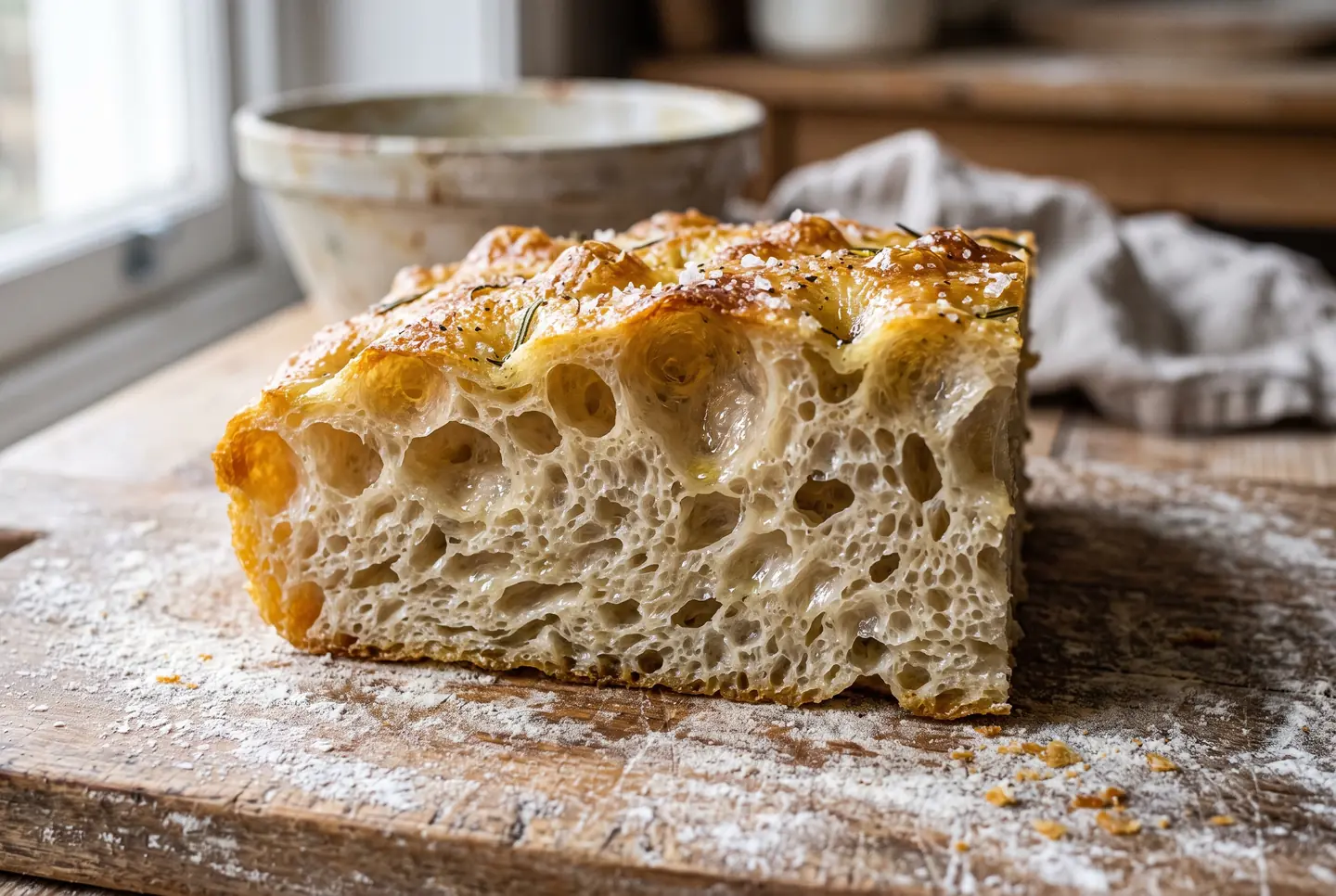
High-hydration focaccia means a dough with water at around 80 percent of the flour weight, roughly 560 grams of water to 700 grams of flour, and that extra water is exactly what gives the tall, open, hole-filled crumb people want from a modern pan focaccia. The catch is that a dough this wet is slack and sticky and cannot be kneaded by hand in the usual way. You do not fight it: you fold it, you give it time, and you handle it with wet or oiled hands. Get those three habits right and an 80 percent dough is no harder than a stiff one, just different.
The reason to bother is structure. A wetter dough traps more gas and stays extensible, so it puffs into an airy crumb instead of a tight one. For the exact ingredient weights and the salamoia brine, the full focaccia recipe has the formula; this page is about how to actually manage the wet dough it produces. It sits under the complete focaccia guide, which covers the styles and the common failures.
Why 80 percent, and what it costs
Most everyday breads sit around 65 to 70 percent hydration. Focaccia goes higher, to about 80 percent, and some bakers push to 82 or beyond, as documented in threads like this 80 percent overnight bake on The Fresh Loaf. The payoff and the price both come from the same water.
| More water gives you | More water costs you |
|---|---|
| A taller, more open crumb | A slack dough that spreads |
| A softer, moister interior | Stickiness that needs wet hands |
| Better gas retention over a long ferment | A longer, gentler process |
If a very wet dough feels like too much on the first attempt, drop to 70 percent, get comfortable, and climb. The method is identical; only the handling gets easier at the lower number.
Folds, not kneading
You build strength in a wet dough with stretch-and-folds instead of kneading. During the first hour or two of the rise, reach under one side of the dough with a wet hand, stretch it up and fold it over the middle, then turn the bowl and repeat three or four times. Baking Steel and King Arthur both build their focaccia this way.
A common, reliable pattern is three rounds of folds spaced about 30 minutes apart. Each round tightens the dough noticeably: it goes from a shaggy puddle to something that holds a loose ball for a moment before relaxing. That change is the gluten network forming. You are done folding when the dough feels smoother and stronger than when you started, usually after the third round.
Time is the other half
A barely-yeasted, very wet dough needs a long, gentle fermentation to develop flavour and strength on its own. There are two ways to give it that time.
- Long room-temperature bulk. Leave the dough out until it is doubled and full of bubbles, which can take several hours depending on how warm the kitchen is.
- Overnight in the fridge. The approach popularised by Alexandra's Kitchen rests the dough cold for roughly 8 to 12 hours, and up to a day or two, which deepens flavour and, just as usefully, lets you mix at night and bake the next day.
The cold ferment also makes a wet dough easier to handle: chilled dough is firmer and less sticky, so turning it into the pan is far less of a wrestling match than with a warm one.
Bowl to pan without the mess
This is the moment people dread, and it is simple once you stop rushing it. Pour a good film of olive oil into the pan. With oiled hands or a wet dough scraper, ease the dough out of the bowl in one piece and let it fall into the oil. Do not try to shape it. Let it rest and relax for 30 minutes to an hour, and it will spread toward the corners on its own. Only then do you dimple: press oiled fingertips straight down to the bottom of the pan, all over, and pour the salamoia into the wells before it bakes.
If the dough springs back and refuses to reach the corners, it is not ready. Cover it, wait another 15 or 20 minutes, and it will relax. Forcing a tight dough tears it and knocks out the gas you spent all that time building.
When the dough is still too wet to move
Sometimes, even after the folds and the ferment, a dough feels too loose to lift cleanly. Before you add flour, which throws off the hydration you worked to reach, try the two cheaper fixes first. Chill it: 30 to 60 minutes in the fridge firms the fat and the dough enough to move it in one piece. And oil everything, generously, your hands, the scraper and the bowl, because a wet dough sticks to dry surfaces and slides off oiled ones. Only if it is genuinely unworkable after that should you fold in a small amount of extra flour, and then accept a slightly less open crumb as the trade.
Flour choice matters here too. A strong bread flour, with more protein, holds a very wet dough together far better than a weaker all-purpose, so if you routinely struggle at 80 percent it may be the flour and not the technique. This is the same lesson the complete guide draws between a thin genovese and a tall pan focaccia: the water sets the ceiling, but the flour decides whether the dough can reach it.
A schedule that works
| Step | Timing |
|---|---|
| Mix | 5 minutes |
| Folds (3 rounds) | over the first 1 to 1.5 hours |
| Bulk ferment | several hours warm, or 8 to 12 hours cold |
| Pan and relax | 30 to 60 minutes |
| Dimple, brine, bake | ~25 minutes at 230°C / 450°F |
The overnight-fridge path splits this cleanly across two days: mix and fold in the evening, then pan, dimple and bake the next morning or afternoon.
Frequently asked questions
What hydration is high-hydration focaccia? Around 80 percent, meaning water at 80 percent of the flour weight, with some bakers going to 82 percent or higher. Everyday breads sit closer to 65 to 70 percent, so focaccia is deliberately wetter for its open crumb.
How do I handle sticky focaccia dough? Wet or oil your hands and any tool that touches it, fold it in the bowl instead of kneading on a counter, and let a cold ferment firm it up before you move it. A chilled 80 percent dough is much easier to handle than a warm one.
Do I have to knead high-hydration dough? No. Wet focaccia dough is built with stretch-and-folds, typically three rounds about 30 minutes apart, which develop the gluten without kneading.
Can I do a same-day high-hydration focaccia? Yes, with a warm rise and a bit more yeast, but the overnight fridge method gives more flavour and a dough that is easier to handle the next day.
Why is my high-hydration focaccia flat and not tall? Usually the dough was deflated when it went into the pan, or it was underproofed. Handle it gently, let it relax and fill the pan on its own, and make sure it is properly risen before baking.
Can I use all-purpose flour at 80 percent hydration? You can, but a strong bread flour holds a very wet, long-fermented dough better. All-purpose gives a softer, slightly less airy result at high hydration.
Where I checked
Keep reading
 Guide
Guide
Bagel Dough: Why It Is So Firm, and How to Knead It
Bagel dough feels stiff and dry on purpose. Here is why it runs at 50 to 60% water and high protein flour, how to knead it, and the windowpane to aim for.
6 min read Guide
Guide
Bagel Recipe: New York Style, Step by Step
A weight-based New York bagel recipe, step by step: the firm 58% dough, an overnight cold retard, how long to boil, and the oven heat that sets a glossy crust.
6 min read Complete guide
Bagels: The Complete Guide
Make a real bagel at home: the firm 58% dough, why bagels are boiled before baking, New York vs Montreal, sourdough and gluten free, and how to fix flat ones.
18 min read