Guide
Focaccia Recipe: The Dough and the Brine, in Weights
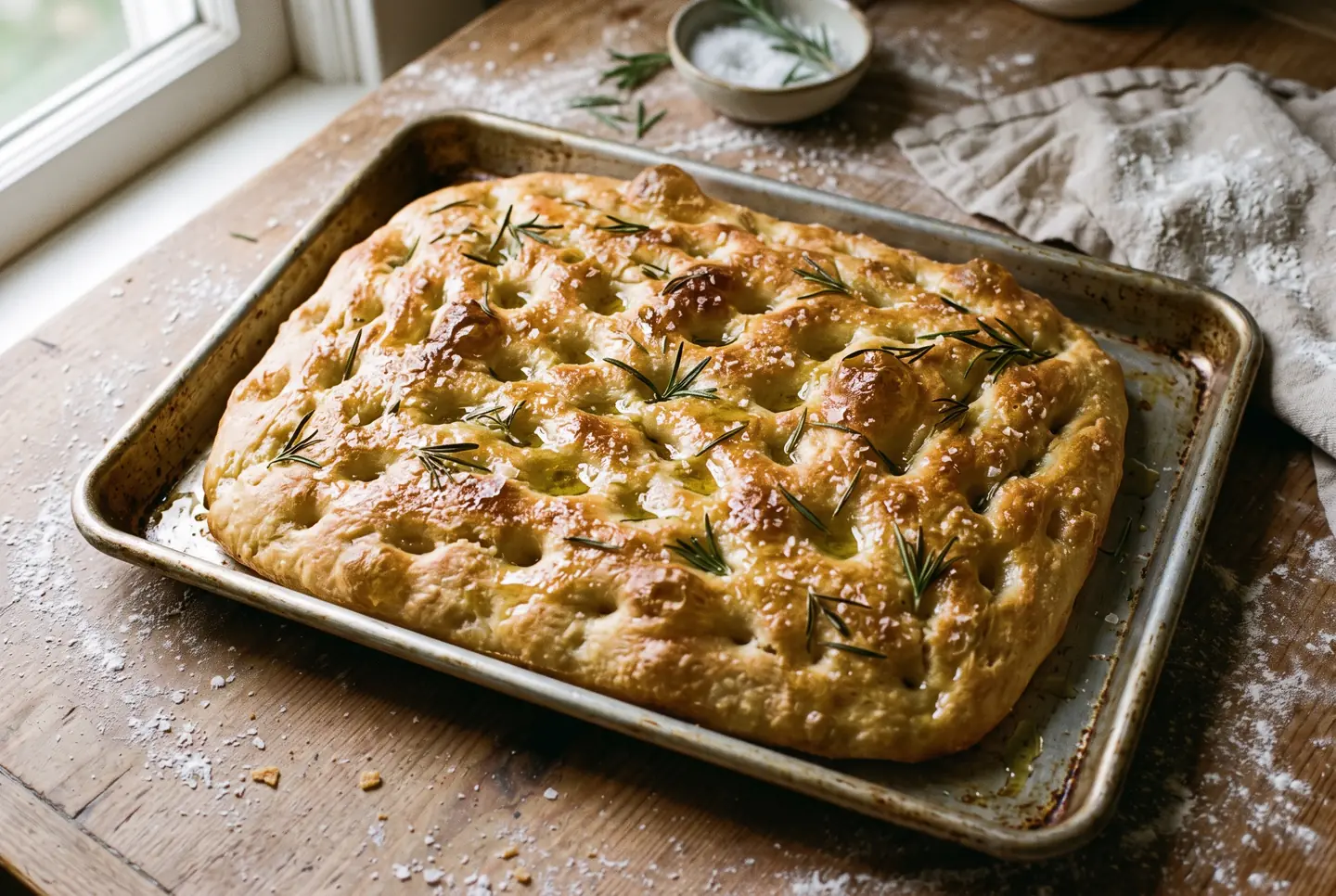
A dependable focaccia is five ingredients in a fixed relationship: flour at 100 percent, water at 70 to 80 percent of the flour weight, salt at about 2 percent, a small dose of yeast, and olive oil both in the pan and on top. Write it that way, in baker's percentages, and you can make one pan or three without redoing any arithmetic. For a standard half sheet pan, a reliable batch is 700 grams of flour, 560 grams of water, 14 grams of salt and 2 grams of active dry yeast, which is the 80 percent dough documented by Baking Steel.
The second half of the recipe, the part most home versions skip, is the salamoia: a brine of water and olive oil that gets poured over the dimpled dough before it bakes. That brine is why a real focaccia comes out golden and glossy instead of pale and dry. This page stays on the formula and the method; for how the styles differ and where a focaccia goes wrong, the complete focaccia guide is the place to start.
The base formula, in weights
Here is the workhorse pan focaccia, written both as baker's percentages and as grams for one half sheet pan. Scale the grams by changing only the flour weight: every other line is a share of it.
| Ingredient | Baker's % | Half sheet pan |
|---|---|---|
| Strong bread flour | 100% | 700 g |
| Water | 80% | 560 g |
| Salt | 2% | 14 g |
| Active dry yeast | ~0.3% | 2 g |
| Olive oil (pan + top) | generous | 40 to 60 g |
To turn any percentage into a weight, multiply the flour weight by the percentage and divide by 100: salt at 2 percent on 700 grams of flour is 700 times 2 divided by 100, which is 14 grams. That is the only calculation in the whole system, and it is why serious recipes are written in percentages rather than cups.
The 80 percent figure is a choice, not a law. A wetter dough gives the tall, open crumb of a modern pan focaccia; a drier one, closer to 55 percent, gives the thin, crisp focaccia genovese. If a very wet dough feels intimidating the first time, the high-hydration focaccia method covers how to handle it without a mess.
The salamoia: the brine that makes it golden
The salamoia is the step that separates a focaccia from an oily flatbread. In the classic Genoese version documented by the Italian Recipe Book, it is simply equal parts lukewarm water and extra virgin olive oil, beaten together and poured over the dough so it collects in the dimples before the final rise and the bake.
| Salamoia (for one pan) | Amount |
|---|---|
| Lukewarm water | 3 tablespoons (about 45 ml) |
| Extra virgin olive oil | 3 tablespoons (about 45 ml) |
| Coarse or flaky salt | scattered on top after |
The emulsion does two things. The water keeps the surface from drying out and helps the crust stay tender, and the oil pools in the wells and, because oil holds far more heat than air, fries the dough around each dimple into little crisp golden craters. Skip the brine and you get the same dough, baked pale and flat.
Method, step by step
- Mix. Stir the yeast into the water, add the flour and salt, and mix just until no dry flour remains. This is a no-knead dough, so you are not developing gluten by hand; time will do it.
- Fold. Over the first hour or two, give the dough 3 to 4 gentle stretch-and-folds right in the bowl, spaced about 30 minutes apart, to build strength. King Arthur and Baking Steel both lean on folds rather than kneading for wet doughs.
- Ferment. Let it rise until roughly doubled and full of bubbles. A long room-temperature rise works; an overnight rest in the fridge works better for flavour and is easier to schedule.
- Pan and rest. Oil the pan generously, turn the dough out, and let it relax and spread for 30 minutes to an hour so it fills the corners without fighting you.
- Dimple and brine. Press your oiled fingertips straight down to the pan to make deep wells, then pour the salamoia over the top so it fills them.
- Bake. Into a hot oven, around 450°F (230°C), for about 25 minutes, until the top is deep gold and the base is crisp. Scatter flaky salt on partway through so it stays visible.
Bake by style
The recipe is one dough, but the bake changes with how thick you spread it.
| Style | Hydration | Oven | Time |
|---|---|---|---|
| Pan focaccia (tall) | ~80% | 230°C / 450°F | ~25 min |
| Genovese (thin) | ~55% | 230°C / 450°F, low rack | 15 to 20 min |
The thin genovese bakes hot and fast because there is less dough to dry out, and it goes low in the oven so the base crisps. The tall pan version needs a few minutes more to set the deeper crumb. Either way, a metal pan on a preheated surface browns the bottom far better than glass or ceramic, which is the single most common fix for a pale, soft base.
A word on the olive oil
Focaccia is one of the few breads where the fat is a headline ingredient, not a footnote, so the oil is worth choosing on purpose. Use an extra virgin olive oil you would happily taste on its own, because in focaccia you will taste it directly: in the pan under the dough, in the salamoia, and drizzled on at the end. The oil in the pan is also structural, not just flavour, since it is what fries the base to a crisp shell rather than letting it steam soft against dry metal. Be generous with it. A dough that comes out austere and dry is almost always a dough that was underoiled, in the pan or on top or both, and the fix is more oil rather than more time.
Scaling to any pan
Because the recipe is in percentages, a different pan is just a different flour weight. A quarter sheet takes about half the batch, two quarter sheets take the full one. Pick your flour weight, then read every other ingredient off the percentage column. The dough does not know what pan it is going into; only the flour weight changes.
One practical limit is the depth of the crumb: the same weight of dough spread over a larger pan bakes thinner and crisper, and packed into a smaller one bakes taller and softer. So the pan is really a fourth style lever, alongside hydration, the brine and the bake. If you want a specific thickness, keep the dough-to-pan ratio in mind rather than only the flour weight.
Frequently asked questions
What is the best flour for focaccia? A strong bread flour is the reliable default, because the higher protein holds the gas of a wet, long-fermented dough. All-purpose works for a softer, lower crumb. Italian 00 gives a finer texture but is not required.
How much water should focaccia dough have? Between 70 and 80 percent of the flour weight for a tall, open pan focaccia, and closer to 55 percent for a thin, crisp genovese. Higher hydration means a wetter, harder-to-handle dough and a more open crumb.
What is salamoia and can I skip it? Salamoia is a brine of equal parts water and olive oil poured over the dimpled dough before baking. You can skip it, but it is what makes focaccia golden and glossy rather than pale, so it is worth the extra minute.
Can I make focaccia the same day? Yes, with a slightly larger dose of yeast and a warm rise, though an overnight fridge ferment gives more flavour and is easier to fit around a day.
Why is my focaccia dense and not airy? Usually too little water, too short a fermentation, or a dough deflated during shaping. A wetter dough, a longer rise and gentle handling fix most dense focaccia.
How deep should the dimples be? Press all the way to the bottom of the pan. Shallow dimples close up as the dough rises; deep ones hold the oil and brine that fry the crust and give focaccia its signature craters.
Where I checked
Keep reading
 Guide
Guide
Bagel Dough: Why It Is So Firm, and How to Knead It
Bagel dough feels stiff and dry on purpose. Here is why it runs at 50 to 60% water and high protein flour, how to knead it, and the windowpane to aim for.
6 min read Guide
Guide
Bagel Recipe: New York Style, Step by Step
A weight-based New York bagel recipe, step by step: the firm 58% dough, an overnight cold retard, how long to boil, and the oven heat that sets a glossy crust.
6 min read Complete guide
Bagels: The Complete Guide
Make a real bagel at home: the firm 58% dough, why bagels are boiled before baking, New York vs Montreal, sourdough and gluten free, and how to fix flat ones.
18 min read