Guide
Roti Troubleshooting: Why It Won't Puff and Other Fixes
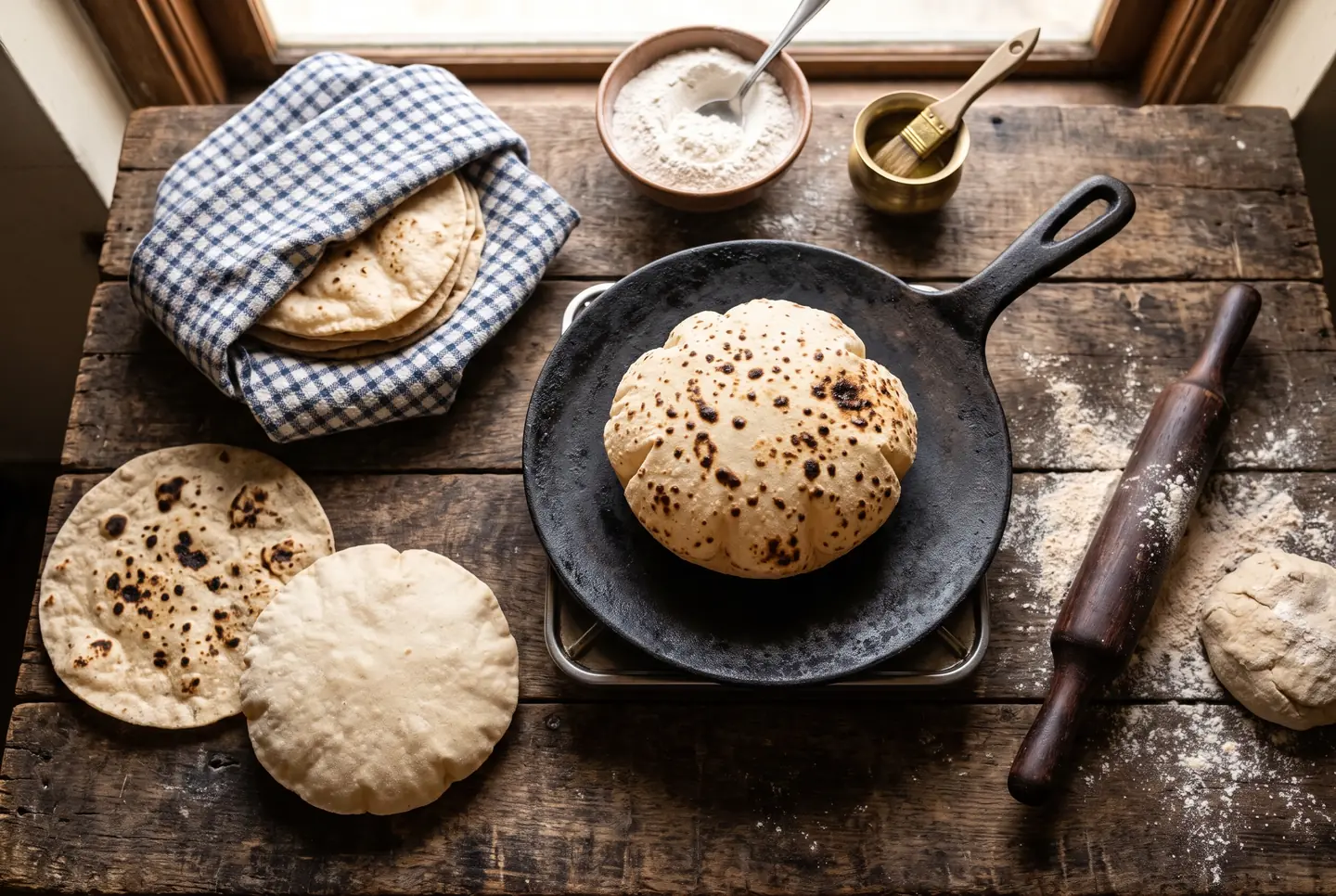
Nearly every roti problem comes from one of four things: the dough, the rolling, the rest or the heat. A roti that won't puff usually means the pan is not hot enough or the round is uneven. A hard roti usually means a dry dough or too long on the heat. A raw middle means too thick or too cool, and a burnt but pale one means too much heat and too much loose flour.
The quick way to use this page: find your symptom in the table, read the matching section, then run the order of checks at the end. If you want the full picture of the bread first, the complete roti guide covers all of it, and this article goes deeper on the things that go wrong.
What are the most common roti problems at a glance?
| Symptom | Likely cause | The fix |
|---|---|---|
| Won't puff | Pan too cool or too hot, uneven rolling, oil in the dough | Adjust the heat, roll evenly, keep the dough oil free |
| Hard, tough, chewy | Dry dough, extra flour, overcooking | Add water not flour, dust lightly, pull it as soon as it is done |
| Raw, doughy middle | Rolled too thick, heat too low | Roll thinner, raise the heat a little |
| Burnt spots but pale | Heat too high, too much dry flour on the surface | Lower the heat, brush off loose flour |
| Cracks or tears when rolling | Dough too dry or too tight | Softer dough, a proper rest |
| Stiff after cooling | Left uncovered, dough too dry | Stack and cover right away, brush with ghee |
Why won't my roti puff?
This is the most common complaint, and it is almost always about steam. A roti puffs because steam builds up inside and has nowhere to go, so anything that lets steam escape, or stops it forming, keeps the roti flat.
Heat is the first suspect. Foodess recommends a pan that is hot but not smoking, around medium high. Too hot and the outside sets too quickly, so the roti cannot expand. Too cool and there is not enough steam to lift it. Sources disagree on the exact setting, so treat it as a range and adjust to your own stove.
The pan itself matters too. Pots and Pans points out that a non-stick pan may not reach the high, steady heat that puffing needs. If you have a cast iron or traditional tawa, use it for rotis.
Then look at the roll. Uneven thickness makes a roti puff unevenly or only in spots, because steam escapes through the thin areas. Roll a smooth, even round, and see how to shape roti for the rolling itself.
Two smaller things are worth knowing. Pressing or puncturing the roti with tongs lets steam out, so be gentle when you flip. And Foodess, as one author's view, says oil in the dough inhibits puffing and makes rotis heavier, so if yours never puff, try a dough with no oil.
Why is my roti hard, tough or chewy?
Hard rotis come from three places: a dry dough, extra flour or too much time on the heat.
The dough should be soft and pliable but not sticky, in Foodess's words. If it feels stiff, add a little water rather than more flour. The roti dough page shows what the right feel is in your hands.
Flour on the board and rolling pin counts too. Foodess warns that extra flour while kneading or rolling makes the roti dry and hard. Use just enough dusting to stop sticking and no more.
Finally, overcooking makes a roti hard and chewy. Once it has puffed and shows some brown spots on both sides, take it off. Staying on the pan to look more golden is how a soft roti turns into a leathery one.
Why is the middle of my roti raw or doughy?
A pale, doughy centre with a cooked edge points to two causes. Either the round was rolled too thick in the middle, or the pan was too cool to cook it through before the surface dried.
Check the thickness first. A thick middle is common when you roll from the centre outward without turning the dough, so turn the round as you roll and keep the middle as thin as the edge. If the thickness looks right, raise the heat a little. The goal is the same hot, steady pan that makes puffing work, which is also why the how to bake roti page puts so much weight on heat control.
A dough that has not rested can also behave oddly. Foodess suggests resting at least 30 minutes, and its recipe card says 1 to 2 hours. The roti proofing page explains what the rest is doing.
Why is my roti burnt in spots but still pale?
Dark patches next to pale areas mean uneven contact with the heat, and there are two common reasons.
The first is a pan or flame that is too hot. Foodess notes that a charred underside means the stove is too hot. It also suggests turning the flame off between rotis if you are finishing on an open flame, because otherwise the grate itself can char the roti.
The second is uneven rolling. Foodess warns that uneven rolling leaves parts of the roti undercooked or burnt, so roll to an even thickness. Excess flour also dries the bread out, so keep your dusting light.
Why does my roti crack or tear when I roll it?
Cracks at the edge and tears mid-roll mean the dough is not ready. Usually it is too dry or too tight.
Add a little water rather than more flour, as Foodess advises, and knead until the dough is smooth. Then rest it. A rested dough relaxes and stretches instead of springing back and splitting, which is the single biggest fix for tearing.
If you are working with a flour that has no gluten, tearing is a different story, because there is nothing to hold the dough together. The gluten free roti page covers the flours and the fixes for that case.
Why does my roti go stiff after it cools?
A roti is softest straight from the pan, and it dries out fast in the open air. The fix is steam. Foodess says to stack cooked rotis in a covered bowl right away, so they trap their own steam. Brushing with melted butter or ghee keeps them softer still.
If your rotis are stiff even when covered, go back to the dough. A dry dough makes a roti that cools into leather no matter how well you wrap it. For longer keeping, storage deserves its own care, and a guide to storing roti is coming soon.
In what order should I check things?
When a roti goes wrong and you are not sure why, work through these in order, because the early ones are the cheapest to fix.
- Heat. Is the pan hot but not smoking? Adjust before you touch anything else.
- Dough feel. Soft, pliable, not sticky? If dry, add water, not flour.
- Rest. Did the dough rest at least 30 minutes?
- Thickness. Is the round even all the way across?
- Flour. Have you used only a light dusting, and brushed off the extra?
- Timing. Are you pulling the roti off as soon as it puffs and browns?
- Covering. Do the cooked rotis go straight into a covered bowl?
Change one thing at a time. If you change the heat, the dough and the rolling all at once, you will never know which one fixed it. The roti recipe is a good baseline to return to when you want to start clean.
Questions
Why won't my roti puff up?
Most often the pan is too cool or too hot, or the round was rolled unevenly. Too hot sets the outside before the roti can expand, and too cool does not make enough steam. Oil in the dough, one author notes, can also stop puffing.
Why is my roti hard and chewy?
Usually the dough was too dry, there was too much extra flour while rolling, or the roti stayed on the heat too long. Add a little water instead of flour, and take the roti off as soon as it has puffed and browned.
Why is my roti raw in the middle?
It was likely rolled too thick, or the pan was too cool to cook it through. Roll evenly and thinner, and bring the heat up a little.
Can I use a non-stick pan for roti?
You can cook on one, but it may not reach the high, steady heat that puffing needs, so rotis may come out flatter. A cast iron or traditional tawa tends to work better. Sources disagree on exact heat, so adjust to your own stove.
How do I keep roti soft?
Stack the cooked rotis in a covered bowl right away so they trap their own steam, and brush them with melted butter or ghee if you like.
Why does my roti tear when I roll it?
The dough is probably too dry or has not rested. Add a little water, knead until smooth and let it rest, and it will roll without splitting.
Every cook has a stack of flat rotis somewhere in their past. Change one thing at a time, keep the pan hot and the dough soft, and the puffed ones will start to outnumber the rest.
Where I checked
Keep reading
 Guide
Bagel Dough: Why It Is So Firm, and How to Knead It
Bagel dough feels stiff and dry on purpose. Here is why it runs at 50 to 60% water and high protein flour, how to knead it, and the windowpane to aim for.
6 min read Guide
Bagel Recipe: New York Style, Step by Step
A weight-based New York bagel recipe, step by step: the firm 58% dough, an overnight cold retard, how long to boil, and the oven heat that sets a glossy crust.
6 min read Complete guide
Bagels: The Complete Guide
Make a real bagel at home: the firm 58% dough, why bagels are boiled before baking, New York vs Montreal, sourdough and gluten free, and how to fix flat ones.
18 min read