Guide
How to Shape Roti: A Round, Even Disc Every Time
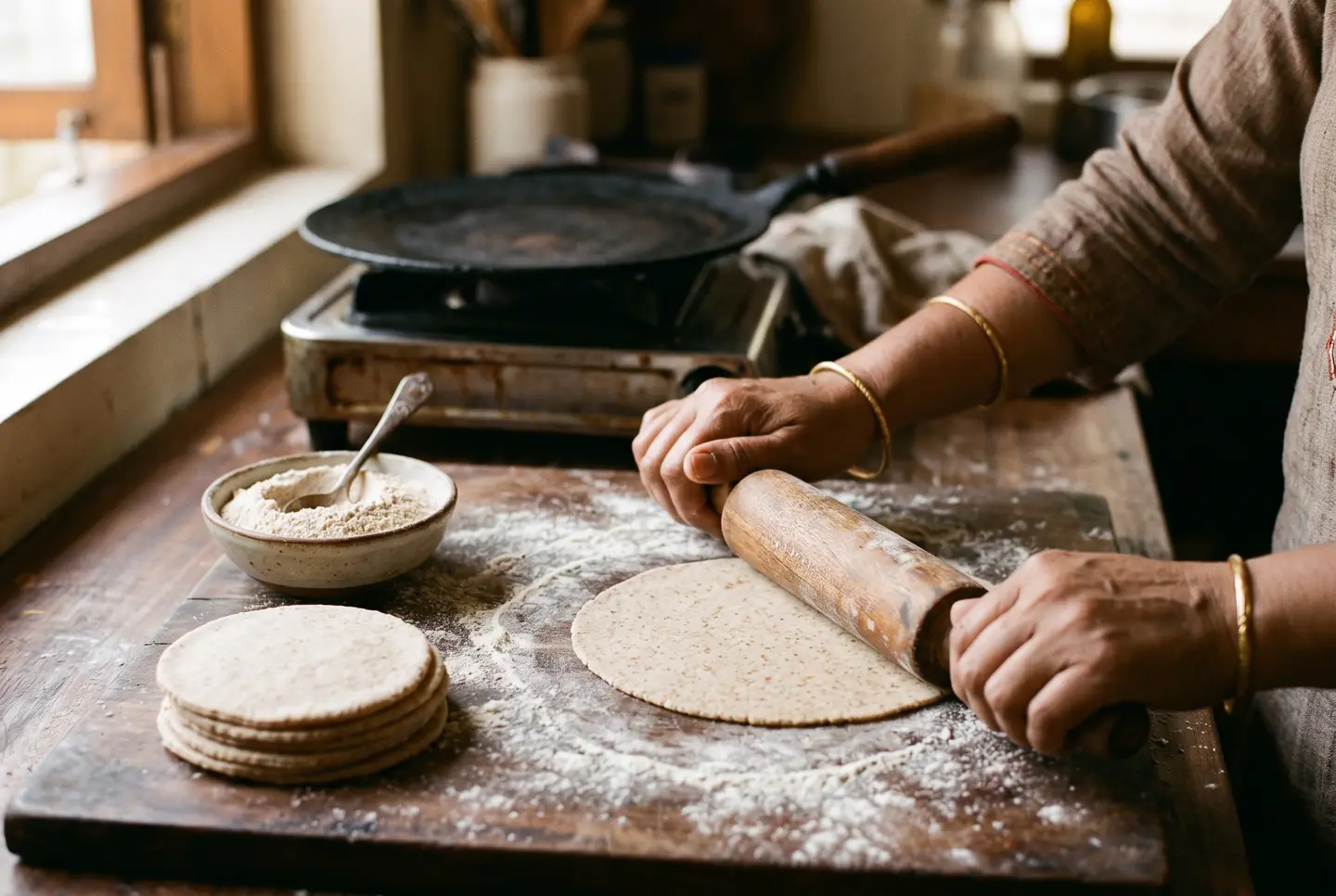
To shape roti, divide the rested dough into equal pieces, roll each into a smooth, crack-free ball between your palms, press it flat, coat both sides in dry atta, then roll it out while giving it a small turn after every pass. Aim for a disc about 13 to 20 cm across, depending on the recipe, and the same thickness from edge to edge.
That last part matters more than the outline. A roti that is a little oval but even all the way across will cook and puff far better than a perfect circle with a thick middle and thin rim. The sections below walk through each move, from the knife to the rolling pin, and what to do when the dough misbehaves. If you want the whole bread from flour to flame, start with the complete roti guide.
How big should each piece be?
The first decision is how many pieces to cut. Two popular recipes make quite different sizes, and both work. The size you pick decides how big the finished roti is and how much rolling you have ahead of you.
| Source | Pieces | Weight of each | Target disc |
|---|---|---|---|
| Cook with Manali | 12 | about 35 to 37 g | 5 to 6 inches (13 to 15 cm) |
| The Curious Chickpea | 8 | about 60 to 67 g (our calculation from the recipe's ingredients) | 7 to 8 inches (18 to 20 cm) |
| America's Test Kitchen | 12 | not stated | about 6 inches (15 cm) |
Centimetre figures here are straight conversions from the inches the recipes print. If you are new to this, take the smaller piece: a little ball of dough is easier to roll even, and a small roti is the easier one to carry from board to pan. Go bigger once your rounds come out reliably.
If you are working from scratch, the dough itself is covered in how to make roti dough, and the full sequence with cooking is in the roti recipe.
Dividing the dough
Turn the rested dough out and roll it into a thick log, then cut it into equal pieces. Equal matters because the pieces roll to the same size and cook in the same time, so a kitchen scale helps the first few times. After that your eye gets good fast.
Keep the pieces you are not working on covered with a cloth or a bowl. The Curious Chickpea flattens each ball with the palm while the others stay covered, which stops the cut faces from forming a dry skin. Dry bits of skin end up as hard flecks in the finished roti.
Rolling a smooth ball
Cook with Manali says to press each piece between your fingers and then roll it between your palms until it becomes a ball with no cracks. This is the step people rush, and it pays off later.
- Tuck the cut edges underneath as you roll, so the surface is smooth and the seam is hidden.
- Use light, circular pressure. You are shaping, not kneading again.
- A ball with cracks will crack again under the pin, and the tear usually starts at that weak spot.
If the ball cracks every time, the dough is probably dry or underrested. Rest it a little longer, or wet your hands slightly and knead it again. The fix for that is in roti dough.
Flattening and flouring
Press the ball into a thick, round disc with your palm before you reach for the pin. America's Test Kitchen has you form each piece into a ball and then flatten it into a thick, rounded disc before rolling, which gives the pin a head start and a round shape to follow.
Then dust it. Cook with Manali sets out about 1/4 cup of dry atta on a plate and turns the flattened ball in it so both sides are coated. The Curious Chickpea goes lighter: it uses flour only if you need it, and otherwise says not to flour the surface. If the dough sticks, it dips it in atta or sprinkles some underneath.
Both are good advice, and they fit together. A well-rested dough at the right softness may need almost no flour. A slightly sticky one needs a coat. Either way, flour little and often rather than a lot at once, and brush off the extra before the roti goes to the pan, because loose flour burns (The Curious Chickpea makes the same point).
Rolling out: the turn after every pass
This is the technique that makes a round disc without any geometry. Roll in one direction, lift or turn the dough, roll again.
Cook with Manali describes it as rolling lengthwise with gentle pressure, then rotating the dough by hand, rolling a little, rotating again. A well-rolled dough almost turns itself. The Curious Chickpea rolls "directly away from you" and gives the disc a turn of one eighth to one quarter after each pass.
| Move | What it does |
|---|---|
| Roll away from you, from the centre outward | Pushes dough evenly toward the edge |
| Turn the disc one eighth to one quarter | Spreads the pressure around the whole circle |
| Lift the dough after a pass and re-dust underneath if it sticks | Stops it gluing itself to the board |
| Roll the pin across the whole disc, edge to edge | Opens it evenly instead of making a thin patch |
Think of it as a loop: roll, turn, roll, turn. Eight or so passes later you have a circle, and you never had to measure one.
How thin and how even
The goal is thin and the same thickness all the way round. America's Test Kitchen asks for even thickness from edge to edge, and Cook with Manali asks for even thickness around the whole disc. The Curious Chickpea adds that you do not need an exact thickness, only a thin disc.
No source gives a number for thickness, so judge it by feel: thin enough to bend easily and see through the flour dust, not so thin that it tears when you lift it.
One more detail from Cook with Manali: a roti that is rolled a little thinner at the rim and slightly thicker in the centre can stay flat and refuse to inflate. So keep the rim and middle the same, which is mostly a matter of rolling the pin across the whole disc each time.
Step by step: from ball to disc
- Cut the rested dough into equal pieces (12 of about 35 to 37 g for a smaller roti, or 8 of about 60 to 67 g for a bigger one).
- Cover the pieces you are not using.
- Press a piece between your fingers, then roll it between your palms into a smooth ball with no cracks.
- Flatten the ball with your palm into a thick round disc.
- Coat both sides in dry atta, shaking off the excess.
- Roll away from you from the centre outward with gentle pressure, then turn the disc one eighth to one quarter.
- Repeat the roll and turn, lifting the dough to flour underneath whenever it sticks.
- Stop at 13 to 15 cm for the smaller roti, or 18 to 20 cm for the larger one, with the thickness the same across the disc.
- Brush off loose flour and carry it to the pan.
Roti not round? Common shape problems
| Problem | Likely cause | Fix |
|---|---|---|
| Oval or oblong disc | Rolling in one direction without turning | The Curious Chickpea's answer: keep turning the dough |
| Thick middle, thin rim | Pressure only at the edges | Roll across the whole disc, centre included |
| Cracks at the edge | Dry ball or underrested dough | Smooth the ball again, or rest the dough longer |
| Sticks to board or pin | Dough a bit wet, too little flour | Dust underneath and on top, lift after each pass |
| Shrinks back after rolling | Dough too tense | Cover and rest it, then roll again |
| Tears when lifted | Rolled too thin in places | Roll evenly and stop sooner |
An uneven disc is not a failed roti. Krish Ashok, quoted by America's Test Kitchen, advises not wasting too much time on geometry, and recipes in general agree that an even thickness matters more than a perfect circle.
Shaping for phulka versus paratha
Phulka and plain roti are shaped exactly as above: a thin, even disc. Paratha begins from the same dough, but fat is worked in as it is folded and rolled, so the shaping involves folding rather than just rolling out. That is a different method, and the dough is the same one. Everything about the ball and the turning still applies.
Questions
What size should a roti be?
It depends on the recipe. Cook with Manali rolls 5 to 6 inch rounds (about 13 to 15 cm), America's Test Kitchen about 6 inches (15 cm), and The Curious Chickpea 7 to 8 inches (about 18 to 20 cm). Pick the size your pan and your hands handle comfortably.
How do I get a round roti?
Turn the dough a little after every pass of the pin, between one eighth and one quarter of a turn. Roll away from you, turn, roll again. The turning evens out the pressure and the circle forms on its own.
Do I need flour on the board?
Only as much as stops sticking. Cook with Manali coats the dough in dry atta on both sides, while The Curious Chickpea uses flour only if the dough sticks. Brush off the extra before cooking so it doesn't burn.
Why won't my roti roll out evenly?
Usually the pressure is landing in one place, or the dough is tense. Roll across the whole disc, turn it after each pass, and rest the dough for a few minutes if it keeps springing back.
Does roti have to be perfectly round?
No. Even thickness matters more than the outline. A slightly oval roti that is even all the way across will cook and puff as well as a perfect circle.
Is paratha shaped the same way?
Not quite. The ball and the rolling are the same, but paratha dough is folded with fat before it is rolled out again, which is what gives it layers.
Your first batch will probably come out in a few interesting shapes. Cook them anyway: they all taste the same, and by the tenth one your hands will have worked out the turn.
Where I checked
Keep reading
 Guide
Bagel Dough: Why It Is So Firm, and How to Knead It
Bagel dough feels stiff and dry on purpose. Here is why it runs at 50 to 60% water and high protein flour, how to knead it, and the windowpane to aim for.
6 min read Guide
Bagel Recipe: New York Style, Step by Step
A weight-based New York bagel recipe, step by step: the firm 58% dough, an overnight cold retard, how long to boil, and the oven heat that sets a glossy crust.
6 min read Complete guide
Bagels: The Complete Guide
Make a real bagel at home: the firm 58% dough, why bagels are boiled before baking, New York vs Montreal, sourdough and gluten free, and how to fix flat ones.
18 min read