Complete guide
Crumpets: The Complete Guide to Holes, Batter and Griddle
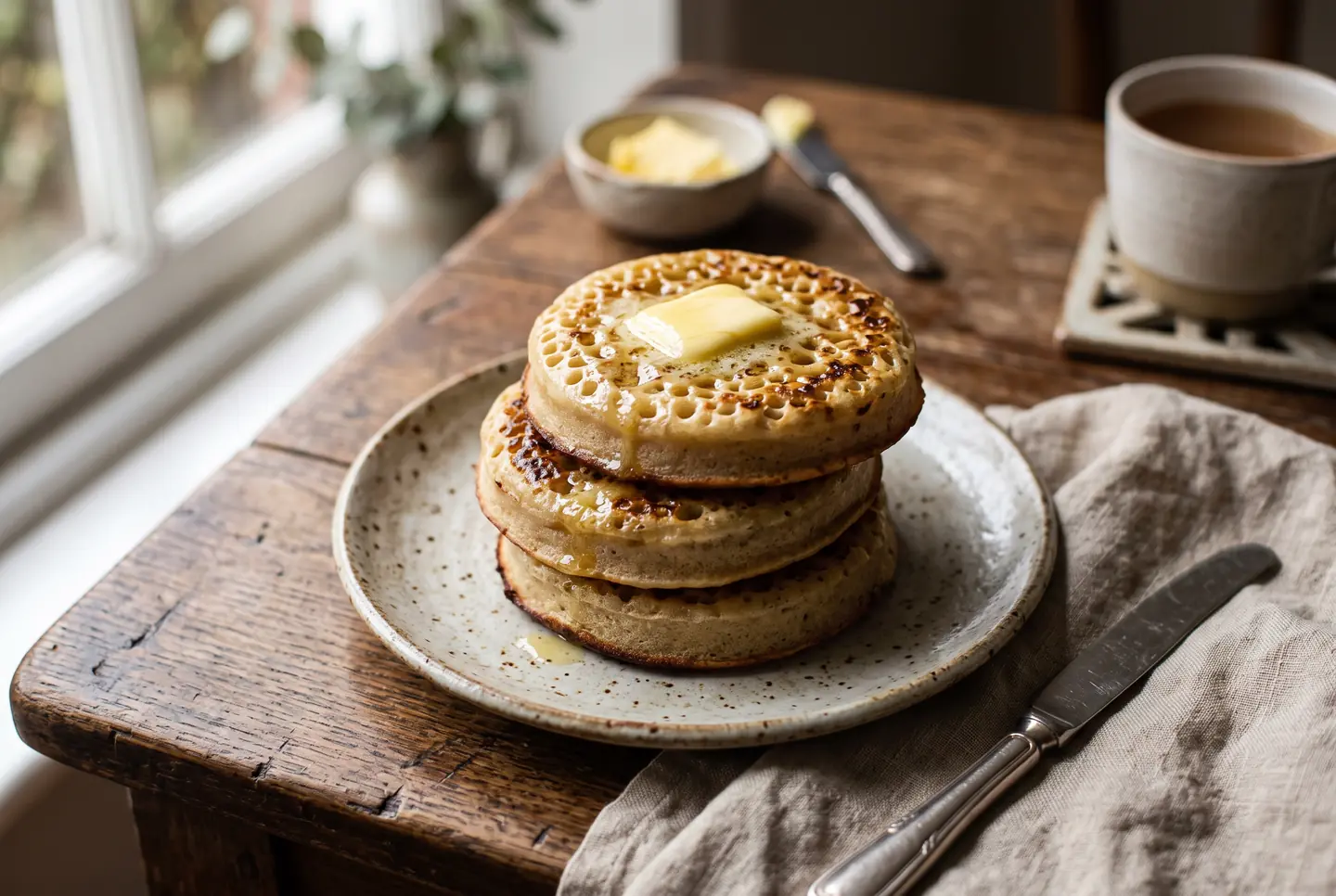
A crumpet is a soft round of griddle bread with a flat, golden-brown base and a top pierced with small holes. You toast it, you put butter on it, and the butter sinks into every one of those holes. That is the whole point of the design. A crumpet is a bread made to be a sponge for something rich, and the holes are not a decoration or a lucky accident. They are the product.
Here is what surprises most people the first time they make them: a crumpet is not a dough at all. It is a batter, closer to a thick pancake mix than to anything you would knead, and it is poured into a ring and cooked on one side almost the whole way through. There is no shaping by hand, no oven and no scoring. What you control is how wet the batter is, how much gas it carries, and how hot the pan is in the first minute. Get those three right and the holes arrive by themselves. Get them wrong and you have a thick, pale pancake with a smooth top, which is edible but is not a crumpet.
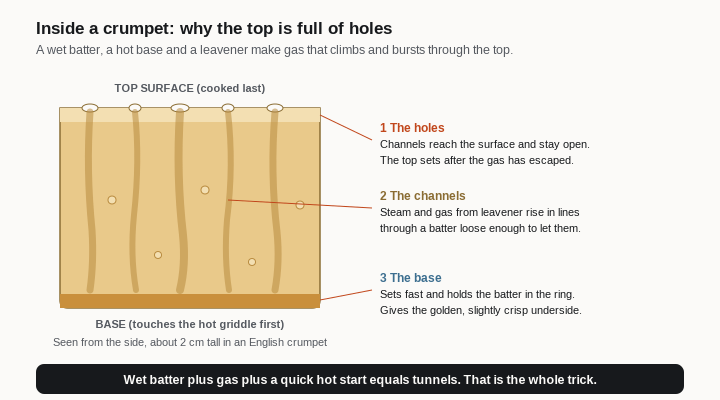
This guide walks the whole thing: the base recipe, the batter and what it should feel like, the rings, the proof, the griddle, then sourdough, gluten free and the regional cousins. After that come the fixes for when it goes wrong, how to keep and freeze them, where they came from and what to put on them. The picture below is the one to keep in your head the whole way through, because every tip in this guide is really about protecting those channels.
Crumpet: the base recipe, step by step
A crumpet is a yeasted batter with a little chemical leavener, poured into rings on a lightly greased griddle and cooked mostly on the first side. From a standing start you can have warm crumpets in about two hours, and most of that is waiting for the batter to turn bubbly. The full method is its own step-by-step crumpet recipe, but here is the shape of it, built on two published recipes that agree on the broad outline.
King Arthur Baking makes 20 crumpets from 420 g of all-purpose flour, 340 g of lukewarm water, 227 g of lukewarm milk, 28 g of melted butter, 2 1/2 teaspoons of instant yeast, 1 teaspoon of baking powder and 8 g of table salt. RecipeTin Eats makes 6 from 150 g of flour, 200 ml of warm water, a teaspoon of yeast, a teaspoon of baking powder, a little salt and sugar, with 2 tablespoons of melted butter or oil for greasing. Different volumes, same logic.
| Step | What you do | Why |
|---|---|---|
| Mix | Flour, liquid, yeast, baking powder and salt, beaten hard for about 2 minutes (King Arthur) | Combines the batter evenly |
| Rest the batter | 1 hour at room temperature (King Arthur) or 15 to 30 minutes somewhere very warm (RecipeTin Eats) | The batter expands and turns bubbly (King Arthur) or foamy (RecipeTin Eats) |
| Heat the griddle | Medium-low, about 325°F for King Arthur, with greased rings in place | Ready for the first pour |
| Pour | Roughly a scant 1/4 cup of batter per 3 3/4 inch ring (King Arthur) | One crumpet per ring |
| Cook | About 10 minutes on the first side, until the top is covered with small holes and the edges look slightly dry (King Arthur) | The holes open and the top sets |
| Flip | About 5 more minutes (King Arthur), or only 20 to 30 seconds for color (RecipeTin Eats) | King Arthur sets the inside and gently browns the top; RecipeTin Eats only tints it |
The two recipes disagree on the second side. King Arthur flips for about 5 minutes to set the inside and gently brown the top (it calls the browning optional and not traditional). RecipeTin Eats flips only for 20 to 30 seconds, for a light blush of color.
On leavening, RecipeTin Eats is blunt: use both baking powder and yeast. "Just one doesn't cut it," it says, and baking soda does not work as well.
The crumpet batter: hydration and the right feel
If you only fix one thing, fix the batter. A crumpet batter is far wetter than any bread dough. Work out the liquid against the flour in the two recipes above and you land close together: King Arthur's 567 g of water and milk against 420 g of flour is about 135 percent, and RecipeTin Eats' 200 g of water against 150 g of flour is about 133 percent. King Arthur calls it "sticky batter" that you pour into the rings.
The holes come from gas and steam rising through that wet batter, and the diagram near the top of this guide shows the channels. America's Test Kitchen rests its batter until doubled (about 40 minutes) and then adds a second splash of water just before cooking. Because the flour has had less time to absorb that late water, it gives the steam the extra push needed to form tunnels.
During the rest the batter changes. King Arthur says it expands and becomes bubbly after an hour at room temperature, and RecipeTin Eats looks for a foamy surface after 15 to 30 minutes somewhere very warm, noting that the batter rises only about 10 to 15 percent.
A word on flour. All-purpose flour is what the recipes above use. RecipeTin Eats says not to use self-raising or wholemeal flour. America's Test Kitchen reports that replacing a portion of the all-purpose flour with cake flour helps the surface set faster. That is a small tweak worth trying once you have the basic crumpet down.
Shaping crumpets without losing the round (rings)
There is no shaping in the hand sense. What you are doing is containing a runny batter long enough for it to set into a neat, tall disc. The ring does that job. King Arthur uses well-greased 3 3/4 inch English muffin rings and RecipeTin Eats uses rings about 9 cm wide. RecipeTin Eats adds that any metal round shape works, including egg rings, biscuit cutters and cleaned tuna cans. The usual English crumpet ends up around 8 cm across and 2 cm thick, according to Wikipedia.
Grease the inside of the ring well, and grease the griddle too: King Arthur places the greased rings on the lightly greased griddle before pouring. After about 4 minutes it lifts the rings off with tongs, and RecipeTin Eats loosens them with a knife if needed.
| Batter per ring | Ring width | Result |
|---|---|---|
| Scant 1/4 cup (King Arthur) | 3 3/4 inch | A classic crumpet, 20 from the full batch |
| 1/4 cup, about 65 ml (RecipeTin Eats) | About 9 cm | About 1 cm of batter that rises to roughly 1.7 cm |
| A heaped 1/4 cup (RecipeTin Eats) | About 9 cm | A thicker crumpet, about 2.2 cm, with fewer holes |
| About a third of the batter, no ring (America's Test Kitchen) | 8 inch skillet | One large, rustic crumpet, three to a batch |
The depth matters. RecipeTin Eats pours about 1 cm of batter per ring. The thicker RecipeTin Eats version has fewer holes. If you do not own rings at all, America's Test Kitchen found they are not needed: it cooked large crumpets in a lightly greased 8 inch nonstick skillet, three to a batch. King Arthur likewise says rings are optional, and that without them the crumpets are less round and less tidy-looking.
Proofing and knowing when to cook
The crumpet batter is rested rather than proofed in the loaf sense. The target is a batter that has visibly risen and is covered in small bubbles. King Arthur calls for a full hour at room temperature, until the batter expands and turns bubbly. RecipeTin Eats gets there in 15 to 30 minutes in a very warm place. America's Test Kitchen rests its batter until doubled, about 40 minutes.
The times differ by source, so use the clock as a rough guide and the look of the batter (expanded, bubbly or foamy) as the check.
Cooking crumpets: pan, heat and time
This is the part where the sources differ most, and one of them overturns a common idea. America's Test Kitchen notes that older recipes called for long, gentle cooking of about 12 minutes, but the food science it found points the other way: a quick, high-heat start. It reports that roughly 75 percent of the structure is established within the first 30 seconds. An initial blast of high heat rapidly converts the water in the batter to steam, which helps form the holes, and it then reduced the heat to medium-low after the first 45 seconds.
RecipeTin Eats arrives at a very similar place from the home-cook side. It starts on medium high and tests the pan with a dab of batter on a butter knife, which should sizzle without smoke. Then it steps down in stages: 1 1/2 minutes on medium high until bubbles appear, 1 minute on medium until bubbles pop at the edges, and 2 1/2 to 4 minutes on medium low until the surface is set. Only then does it lift the rings and flip for 20 to 30 seconds. King Arthur takes the gentler route, a steady medium-low around 325°F for about 10 minutes on the first side (it says to keep a frying pan cooler than for pancakes).
| Approach | Heat plan | Time on first side | Note |
|---|---|---|---|
| King Arthur | Steady medium-low, about 325°F | About 10 minutes | Rings lifted off after about 4 minutes |
| RecipeTin Eats | Medium high, then medium, then medium low | About 5 to 6 1/2 minutes in stages | Reduce the heat if your stove runs strong |
| America's Test Kitchen | High, then medium-low after about 45 seconds | Quick, high-heat start | Based on food science, not a conventional recipe |
Which should you use? The sources do not rank them, so pick one and adjust to your stove. RecipeTin Eats says that heat is the main factor and that a strong stove calls for lower heat.
Know the signs. King Arthur looks for tops covered with small bubbles and holes, edges that look slightly dry and bottoms that are mottled light golden brown, and RecipeTin Eats waits until the surface is set and no more bubbles pop. That is the signal to lift off the ring. America's Test Kitchen has a trick for the moment before flipping: lay a spatula on the surface and pull up sharply to remove the thin layer of raw batter on top so the holes stay open, then flip to dry the surface. Cook the second side briefly for color, then cool the crumpets on a wire rack.
RecipeTin Eats cooks in a non-stick skillet lightly brushed with melted butter, and King Arthur lightly greases its griddle or pan.
Sourdough crumpets
The sources consulted for this guide (King Arthur, RecipeTin Eats, America's Test Kitchen and Wikipedia) do not cover a sourdough version, and the recipes above are all yeasted. So there is no tested sourdough formula here. If you want to work with a starter, the site's sourdough starter guide explains how to build and keep one.
Gluten free crumpets that work
RecipeTin Eats reports that its recipe fails with gluten free flour, though a commenter had success with one specific gluten free flour. The other sources consulted do not cover a gluten free version, so there is no tested formula here. Treat it as an experiment, not a guaranteed result.
The regional types of crumpet (pikelets, Scottish, etc.)
The word crumpet covers more ground than it seems to, and so does its near-relation, the pikelet. Knowing the family helps when you see the name on a menu or in an old recipe. Wikipedia lays out the main branches, and the table below sticks to what it says.
| Type | Where | What sets it apart |
|---|---|---|
| English crumpet | England | Yeasted batter, ring-cooked, about 8 cm across and 2 cm thick, holes on top |
| Pikelet (Staffordshire, Yorkshire) | Parts of England | No yeast, thinner batter, cooked without a ring, so flatter |
| Pikelet (Australia, New Zealand) | Australasia | A small pancake, eaten warm or cold, nothing like a crumpet |
| Scottish crumpet | Scotland | About 18 cm across and 8 mm thick, same batter as a Scotch pancake, cooked on one side, sometimes with raisins |
| Irish crumpet | Ireland | No yeast, cooked on both sides, made by Boland's Bakery in Dublin for much of the 19th and 20th centuries |
| Welsh relatives | Wales | Bara planc (griddle bread) and crempog (pancake) sit in the same family tree |
The confusing one is the pikelet. In some places the word simply means a crumpet. In Staffordshire and Yorkshire it means something different: a thinner, yeast-free batter cooked without a ring, flatter and closer to a pancake. Wikipedia mentions a 1932 Staffordshire recipe by May Byron that used flour and buttermilk with bicarbonate of soda as the raising agent, and suggested cooking in bacon fat. In Australia and New Zealand the word shifts again and refers to a small pancake. So when someone offers you a pikelet, ask which one.
The Scottish crumpet is the biggest surprise to anyone raised on the English kind. It is wide and thin and made from the same ingredients as a Scotch pancake, with a leavening agent that is usually baking powder, and it browns on one side only. Wikipedia also notes that mass production by large bakeries has eroded some regional differences, and that freshly home-made crumpets are less heavy and doughy in texture than the premade commercial ones.
For this guide, crumpet means the English kind, the yeasted, ring-cooked one.
Where crumpets go wrong, and how to fix them
The full troubleshooting guide goes case by case. Here are the common problems, as far as the sources consulted cover them.
| Symptom | Main cause | The fix |
|---|---|---|
| No holes | Pan too cool at the start, or only one leavener used (RecipeTin Eats) | Stronger initial heat, batter should sizzle on contact; use both baking powder and yeast |
| Scorched base | Heat too high (RecipeTin Eats) | Reduce the heat for the later stages |
| Doughy inside | Often just too fresh (RecipeTin Eats) | Cool completely before eating |
RecipeTin Eats gives good specific advice on the two most common complaints. On no holes: the batter should sizzle on contact with the pan, so the pan may be too cool, and stronger initial heat helps the bubbles form, and it uses both baking powder and yeast because one alone does not cut it. On a scorched base: the heat is likely too high, so reduce it for the later stages, and if smoke builds, pull the pan off the heat to cool. The same source adds a note worth remembering: a crumpet that is doughy inside is often just too fresh, and cooling it completely before you eat it fixes the texture.
How to store and freeze crumpets
Cool them completely first. RecipeTin Eats warns that crumpets stored before they are fully cool are "kind of moist and doughy" inside.
King Arthur says to cool them completely, wrap in plastic and keep them at room temperature, then warm them in a toaster before eating (it gives no storage time). RecipeTin Eats is more specific: store in an airtight container in the fridge for 4 days, or freeze for up to 3 months. It also says next-day crumpets are closer to store-bought, and that the author kept some 5 days in the fridge and they were still good once toasted.
| Storage | How | How long |
|---|---|---|
| Room temperature | Cooled, wrapped in plastic (King Arthur) | No time given |
| Fridge | Airtight container (RecipeTin Eats) | 4 days |
| Freezer | Cooled first (RecipeTin Eats) | Up to 3 months |
| Reheat | Toast (both sources); from frozen, thaw first (RecipeTin Eats) | Toast until the base is crispy |
The history of crumpets
Crumpets are old, and the story of how they got their name is honestly uncertain. Wikipedia says the origin of the name is unclear and lists the candidates: a crumpled or curled cake from the Old English crompeht ("crumpled"), the Welsh crempog or crempot (a type of pancake), the French crompâte, or the metal "cramp" ring used to hold the batter, which a correspondent to Manchester Notes and Queries in 1883 claimed as the source. Crumpets have been variously described as originating in Wales or as part of the Anglo-Saxon diet, based on those proposed etymologies, and bara planc (griddle bread) was part of the everyday Welsh diet until the 19th century.
The earliest reference it cites is an isolated 14th-century mention of a "crompid cake". In the early 17th century the lexicographer Randle Cotgrave described "popelins" as made like Welsh "barrapycleds". In 1769 Elizabeth Raffald published the first recognizable crumpet-type recipe in The Experienced English Housekeeper, calling the product a "picklet".
The change came in the 19th century. From then on bicarbonate of soda was usually added to the batter, and Wikipedia contrasts the early crumpets, which were hard pancakes cooked on a griddle, with the soft and spongy, yeast-made crumpets of the Victorian era. In the 1950s Dorothy Hartley noted wide regional variation and linked the small, thick, spongy type to the Midlands.
Wikipedia observes that mass production by large commercial bakeries has eroded some of those regional differences.
What to serve with crumpets and how to build a plate
The sources keep this simple. King Arthur serves crumpets warm with butter, or with butter and jam, and warms them in a toaster if they have been stored. RecipeTin Eats toasts them until the base is crispy, then butters them generously and adds a spread, with honey as the author's favourite.
| Topping | Source |
|---|---|
| Butter | King Arthur, RecipeTin Eats |
| Butter and jam | King Arthur |
| Butter and honey | RecipeTin Eats |
Frequently asked questions
What are crumpets made of? King Arthur's crumpets are made from flour, water, milk, melted butter, instant yeast, baking powder and salt. RecipeTin Eats uses flour, water, salt, sugar, yeast and baking powder. The mixture is a loose batter rather than a dough, and it is cooked in rings on a griddle.
Why do crumpets have holes? The holes come from gas and steam rising through the wet batter. America's Test Kitchen reports that an initial blast of high heat rapidly converts water in the batter to steam, which helps form the holes, and that roughly 75 percent of the structure is established within the first 30 seconds of cooking.
Why are my crumpets not making holes? RecipeTin Eats says the batter should sizzle when it touches the pan, that stronger initial heat helps the bubbles form, and that you need both baking powder and yeast. King Arthur adds that homemade crumpets probably will not be as full of holes as store-bought ones, and that is fine.
What is the difference between a crumpet and an English muffin? A crumpet is made from a pourable batter, cooked in a ring, and has a holey top. RecipeTin Eats describes a crumpet as a cross between an English muffin and pancakes. The sources consulted do not compare the two further.
Can I make crumpets without rings? Yes. America's Test Kitchen found that rings are not needed and made large, free-form crumpets in a lightly greased 8 inch nonstick skillet. King Arthur also says rings are optional. For round ones, RecipeTin Eats says any metal round shape works, including egg rings, biscuit cutters and cleaned tuna cans.
What is the difference between a crumpet and a pikelet? In some regions the two words mean the same thing. In Staffordshire and Yorkshire, a pikelet is flatter, made from a thinner batter with no yeast and cooked without a ring. In Australia and New Zealand, a pikelet is a small pancake.
How long do homemade crumpets keep? RecipeTin Eats says 4 days in an airtight container in the fridge and up to 3 months in the freezer, and that next-day crumpets are closer to store-bought. Toast them before serving.
Wet batter, a hot start, and butter on top. The holes take care of the rest.
Where I checked
Keep reading
 Guide
Bagel Dough: Why It Is So Firm, and How to Knead It
Bagel dough feels stiff and dry on purpose. Here is why it runs at 50 to 60% water and high protein flour, how to knead it, and the windowpane to aim for.
6 min read Guide
Bagel Recipe: New York Style, Step by Step
A weight-based New York bagel recipe, step by step: the firm 58% dough, an overnight cold retard, how long to boil, and the oven heat that sets a glossy crust.
6 min read Complete guide
Bagels: The Complete Guide
Make a real bagel at home: the firm 58% dough, why bagels are boiled before baking, New York vs Montreal, sourdough and gluten free, and how to fix flat ones.
18 min read