Guide
How to Bake Roti: Pan, Flame and Oven Compared
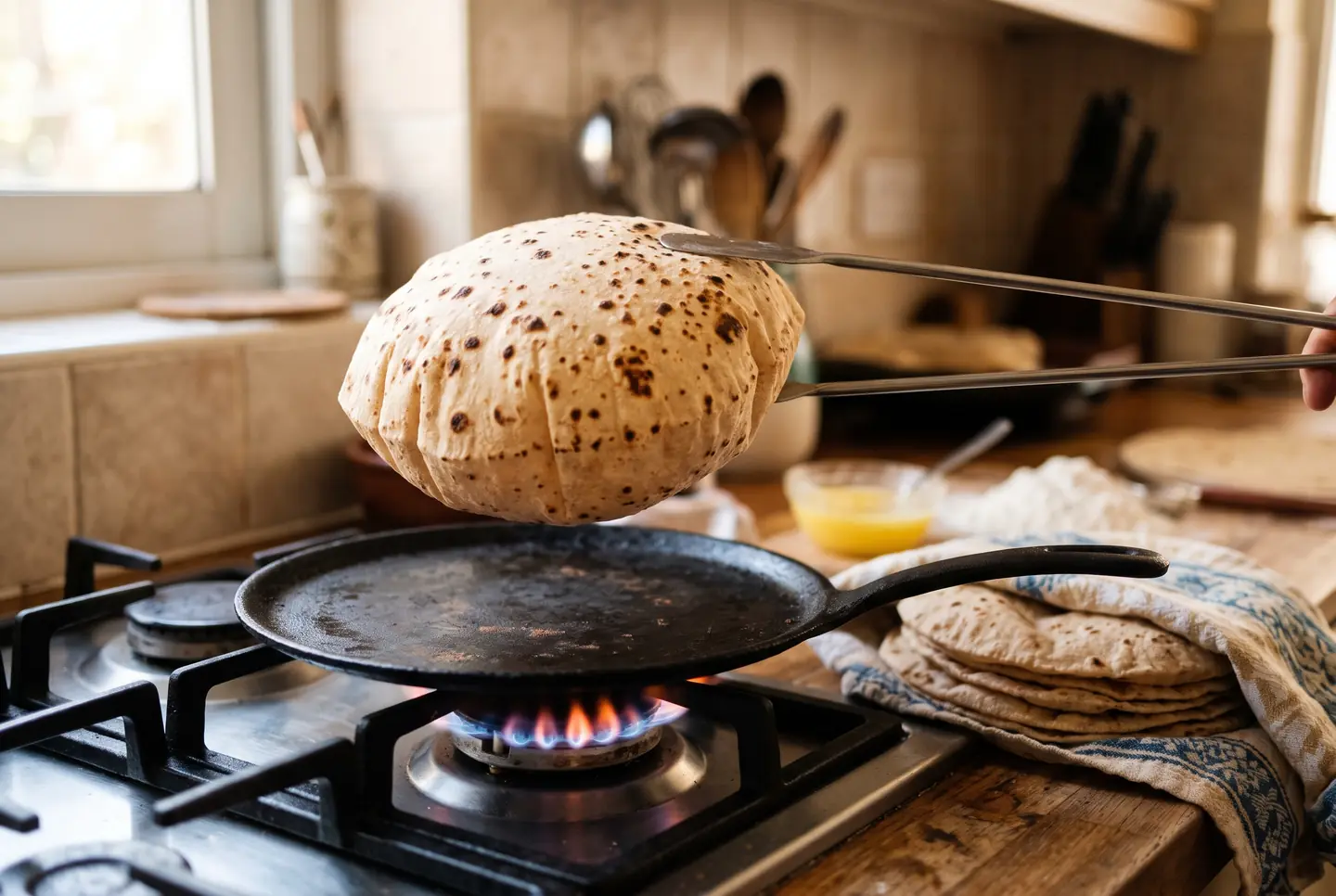
If you searched "how to bake roti", you probably pictured a tray and an oven door. Here is the good news and the small correction in one breath: classic roti is not baked at all. It is cooked on a dry, very hot pan, and the famous puff comes from steam, not from an oven. The oven has a role, but for a different bread.
This page sorts out what you actually want when you type that search: the pan, the heat, the flame, the trick for electric and induction stoves, and the oven version that people call tandoori roti. For the whole bread from flour to plate, start with the complete roti guide, then come back here for the cooking itself.
Can you really bake roti?
Not in the sense you bake a loaf. Roti is an unleavened whole wheat round, rolled thin, and it is cooked on a flat griddle called a tawa. There is no long, slow heat that sets a crumb, because there is no crumb to set. The bread is thin enough that it is done in under a minute per side, and what you want is quick, hard heat on a dry surface.
So when people say "bake", they usually mean one of three things:
- Cook it on the pan, which is the real roti method and the one this page spends the most time on.
- Puff it over a flame, which is the last step of the pan method for anyone with a gas hob.
- Use the oven, which is the tandoori roti route, a related bread with a different dough.
Keep those three apart and most of the confusion disappears. If you want the base dough and the full sequence first, the roti recipe walks it step by step.
What do you need on the stove? The pan and its heat
You need a flat pan that holds heat. A tawa is the traditional choice, flat or very slightly concave, often cast iron or carbon steel. Many kitchens already have a heavy frying pan or a cast iron skillet that does the job.
You can find a tawa in any Indian or South Asian grocery, in many Asian supermarkets, and online. It is cheap, and one heavy pan is all you need. Atta, the fine whole wheat flour that makes the soft roti, is sold in the same shops, and you will see it in bags labeled atta or chapati flour.
Cook with Manali heats the tawa over medium-high and lets it get properly hot before the first roti goes on. That order matters: a pan that is still warming up cooks the roti slowly, and a slow roti turns dry and flat instead of soft and puffed.
The cue that counts comes from Cook with Manali: the tawa must be hot before the roti goes on, on medium-high heat. On a pan that is still warming up, the roti takes longer to cook and ends up hard.
The sequence on the tawa, side by side
Once the pan is hot, the clock is short. These are the cues from Cook with Manali, in the order you will meet them.
| Step | What you do | How long | What to look for |
|---|---|---|---|
| First side | Lay the roti on the hot tawa | 15 to 30 seconds | Bubbles appear on top |
| Flip | Turn it with tongs | About 30 seconds on the second side, a little longer than the first | Brown spots, which you can check with tongs |
| Puff | Move it to the direct flame, least cooked side down | A few seconds | It balloons if evenly rolled |
| Finish | Turn it once with tongs | Short | Brown spots, none burnt |
Two things to take from that table. The second side runs longer than the first, because the first side is only there to set the surface. And the brown spots are your signal, not the clock: they say "done", and a pale roti with no spots is not.
Brush it with ghee or butter the moment it comes off, if you like. It is optional, but it keeps the surface soft and tastes wonderful.
How to puff roti over a gas flame
On a gas hob, the flame does the dramatic part. After the two sides on the tawa, Cook with Manali moves the roti onto the direct flame with the less cooked side facing down. If the roti was rolled in an even layer, it inflates. You turn it with tongs, and it is ready when brown spots show without burning.
Why it works: the surface has already set on the pan, so when the roti meets the open flame, the steam inside has nowhere to go and lifts the whole round into a ball. That is also why uneven rolling stops it. Thin edges and a thick middle let the steam leak out at the edges.
Use tongs, not fingers, and keep the roti moving.
Electric and induction: how to puff without a flame
Many kitchens cook on an electric coil, a glass ceramic hob or induction, with no open flame. You just swap the flame for a gentle press.
Cook with Manali gives the no-flame route:
- Cook the first side for about 30 seconds, until bubbles show.
- Flip and cook the second side until brown spots appear.
- Flip again, with the first side back on the pan.
- Press gently with a clean cloth or a spatula so the roti inflates.
- Flip one last time.
The press does what the flame does: it holds the steam in and pushes it into one pocket. It will not always puff as round as it does on gas, and that is fine. A roti that is soft, spotted and only half puffed still makes a good dinner.
What you have at home: how to puff it
This is the decision most pages skip. Match your equipment to the method and you are done.
| What you have | How to puff it | What to watch |
|---|---|---|
| Gas hob and a tawa | Cook both sides, then finish over the direct flame with tongs | Keep the roti moving so the flame does not burn it |
| Electric hob and a heavy pan | No flame: second side, flip back, press with a cloth or spatula, flip once more | Let the pan get properly hot before the first roti |
| Induction and a compatible flat pan | Same pressing method as the electric hob | Check that your pan works on induction, and use a heavy flat base |
| Oven only, no hob | Tandoori-style roti, a different dough, baked on a tray | It is another bread: see the next section |
If you have a gas hob, you get the most dramatic result. If you do not, you still get a very good roti: the pressing method is reliable. The oven row is the only one that changes the recipe.
The oven version: tandoori-style roti
Here is the thing to be clear about. When a recipe says "bake" and uses an oven, it is almost always tandoori roti, which is a different bread from the everyday roti. The Spices N Flavors tandoori roti is a good example. Its dough includes baking powder, baking soda, yogurt and ghee, so it is leavened and richer than basic roti. The everyday roti has none of those.
The method, as that recipe gives it:
- Preheat the oven to 230 °C.
- Bake for 8 to 10 minutes on a baking tray.
- Do 4 to 5 rotis at a time.
That is the cooking time for that specific dough, and it should not be applied to a plain atta roti. If you put a plain, unleavened roti dough into a very hot oven, you will get something dry and cracker-like, not the soft bread you wanted. Treat tandoori roti as a separate recipe, with its own dough, and enjoy it for what it is: a lovely oven bread with the smoky, tandoor feel of restaurant roti.
| Everyday roti | Tandoori-style roti (oven) | |
|---|---|---|
| Cooked on | Dry hot tawa, then flame or press | Baking tray in a hot oven |
| Dough | Atta and water | Includes baking powder, baking soda, yogurt and ghee |
| Heat | Medium-high pan | Oven preheated to 230 °C |
| Time | Under a minute per side, by cues | 8 to 10 minutes, 4 to 5 at a time |
| Feel | Soft, thin, spotted | Richer, leavened |
What goes wrong, and how to fix it
Almost every problem on the stove comes back to two things: how the dough was rolled and how hot the pan was.
It does not puff. The main cause, according to Cook with Manali, is uneven rolling: thin edges and a thick center. If the dough is too stiff, that also stops the puff. Roll to an even disc, and see how to shape roti for the rolling itself. A softer dough helps too, and how to make roti dough covers the water balance.
It comes out dry or leathery. Usually the pan was not hot enough when the roti went on, or the roti stayed on the pan after the brown spots appeared. Heat the pan properly, and pull the roti once it spots.
It burns in dark patches. The heat is too aggressive or the roti sat still. Keep it moving and take it off when the spots are brown, not black.
It tears when you lift it. Often an unrested dough: see roti proofing.
Keeping rotis soft after cooking
Rotis are best eaten right away, but they keep well if you handle them gently. Cook with Manali stacks them in foil, with a paper towel and the rotis inside, which keeps them from drying out. To warm them again, wrap one in a damp cloth and microwave it for 30 seconds.
To freeze, put parchment paper between the rotis so they do not stick together, then wrap the stack. They come back to life on a hot pan or in the microwave.
Questions
Can you bake roti in the oven?
You can bake a related bread, tandoori-style roti, in the oven. That dough has baking powder, baking soda, yogurt and ghee in it, so it is not the plain atta roti. Classic roti is cooked on a dry hot pan, not baked.
What temperature do you bake tandoori roti at?
One tandoori roti recipe preheats the oven to 230 °C and bakes for 8 to 10 minutes, 4 to 5 rotis at a time on a tray. That applies to that leavened dough, not to everyday roti.
How do I puff roti without a gas flame?
Cook the first side for about 30 seconds until bubbles form, flip, and cook the second side until brown spots appear. Flip again with the first side down, press gently with a cloth or spatula to inflate it, and flip one last time.
Why is my roti not puffing up?
Usually it is rolled unevenly, with thin edges and a thick center, so the steam escapes. A dough that is too stiff also stops the puff. Roll evenly, keep the dough soft, and make sure the pan is hot.
How do I know the tawa is hot enough?
Heat it over medium-high until it is properly hot before the first roti goes on. Cook with Manali warns that a roti placed on a pan that is not hot enough takes longer to cook and turns out hard and overcooked.
Heat the pan, keep the tongs close, and wait for the little puff. It is a small bit of kitchen magic that never gets old.
Where I checked
Keep reading
 Guide
Bagel Dough: Why It Is So Firm, and How to Knead It
Bagel dough feels stiff and dry on purpose. Here is why it runs at 50 to 60% water and high protein flour, how to knead it, and the windowpane to aim for.
6 min read Guide
Bagel Recipe: New York Style, Step by Step
A weight-based New York bagel recipe, step by step: the firm 58% dough, an overnight cold retard, how long to boil, and the oven heat that sets a glossy crust.
6 min read Complete guide
Bagels: The Complete Guide
Make a real bagel at home: the firm 58% dough, why bagels are boiled before baking, New York vs Montreal, sourdough and gluten free, and how to fix flat ones.
18 min read