Guide
Gluten Free Roti: Soft Flatbread Without Wheat
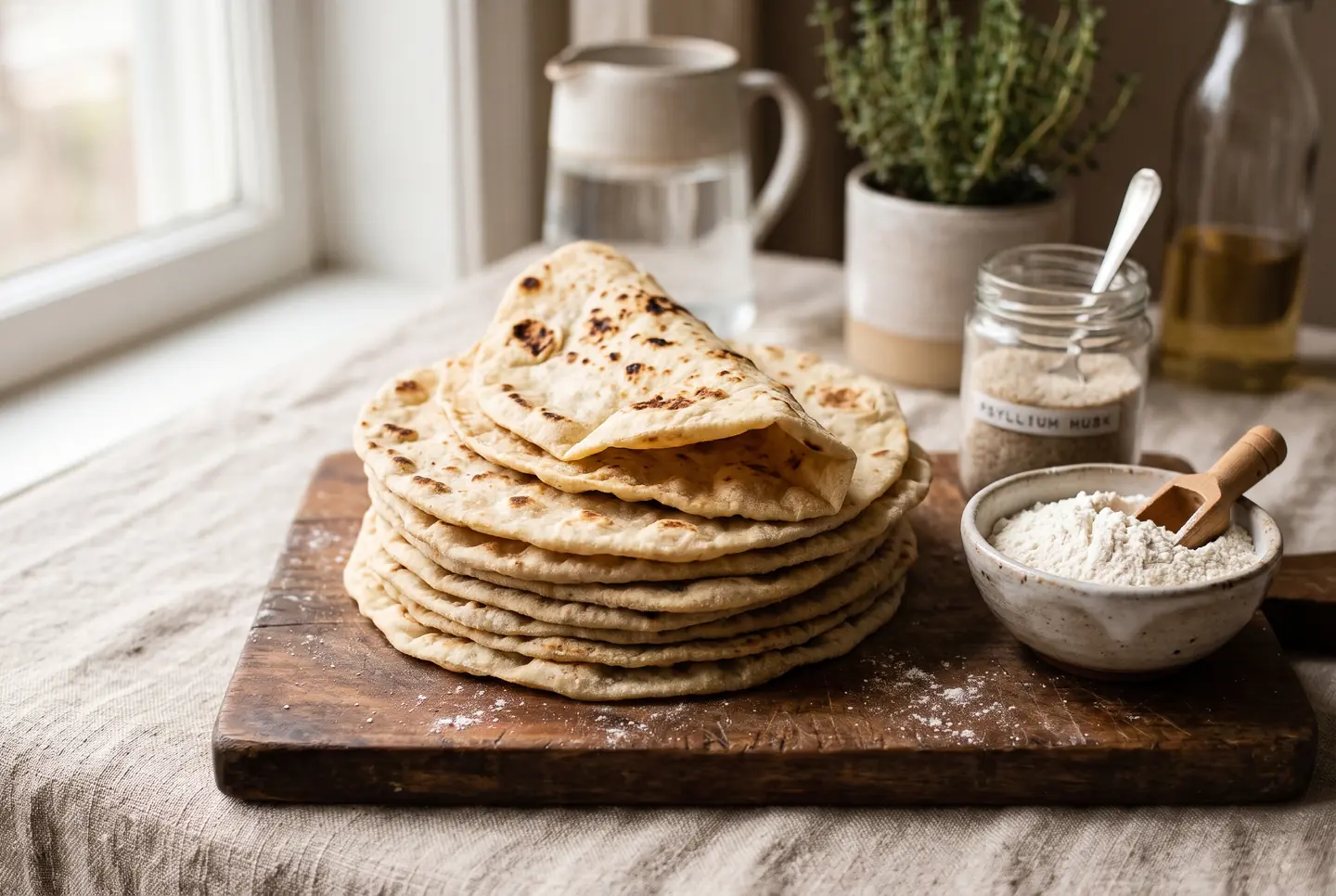
A roti without wheat sounds like a contradiction. The whole charm of the bread is that it stretches thin, puffs on the pan and folds around a curry, and that is exactly what gluten does. Take the gluten away and the dough wants to crack, crumble and tear the moment you look at it.
It can be done, and done well, if you stop trying to imitate wheat and start using the right helpers instead: a sticky binder, very hot water and a gentle hand. This page walks through two reliable routes, a cassava blend and a sorghum one, plus the mistakes that ruin most first batches. If you want the bigger picture of the bread first, the complete roti guide covers the classic wheat version and where gluten free fits in.
Why is gluten free roti so hard to get right?
In a wheat roti, gluten forms a stretchy web that traps steam, so the roti balloons on the pan and settles into a soft disc. Sorghum, rice and cassava have starch and fiber but nothing that stretches. So gluten free roti borrows structure from psyllium husk, which turns into a thick gel in water, and from very hot water, which swells the starch. The dough is stickier and more delicate than atta dough, and it behaves best when you handle it less.
Is atta gluten free? And what about celiac disease?
No. Atta is whole wheat flour, and it is full of gluten. Chapati flour, whole wheat flour and anything labeled atta are all out for a gluten free diet, and so is any pre-made roti or paratha that does not say gluten free on the pack.
If you are cooking for someone with celiac disease, the flour you pick matters as much as the recipe. Sorghum, rice, cassava, tapioca and corn are naturally free of gluten, but flours can pick up wheat during milling, packing or storage. Look for a label that says gluten free, read the allergen statement, and check for any cross contamination warning on the bag. If the packaging is vague, treat the flour as unsafe and pick another brand.
The same goes for your kitchen: use a clean tawa, board and pin.
What flours make a good gluten free roti?
There are two dependable routes, and one shortcut. The first is a cassava based blend, which gives the softest, most wheat-like roti. The second is sorghum (jowar) with psyllium, which is a traditional Indian approach and has a nutty flavor. The shortcut is a store-bought gluten free blend.
| Base | What goes with it | What it gives you | Watch out for |
|---|---|---|---|
| Cassava flour blend (cassava, tapioca starch, brown rice flour, psyllium, baking powder) | Boiling water, a little olive oil | Pliable, soft, closest to a wheat roti | Cassava flour is not tapioca starch, so do not swap one for the other |
| Jowar (sorghum) flour with psyllium | Room temperature water turned into a gel | Nutty, traditional, mildly sticky dough | Psyllium is essential, so do not leave it out or substitute |
| Store-bought gluten free blend | Check the label, ideally xanthan gum already in the mix | Most forgiving and easiest to find | Blends vary a lot, so follow the pack and add psyllium only if there is no binder |
Cornmeal makki roti and bajra (pearl millet) roti are also naturally gluten free, but they are patted out by hand and behave differently. If you want to go down the bajra road, one tip from Natasha's Home is worth keeping: pearl millet can taste bitter if the flour is rancid, so smell it before you start.
How do you make cassava gluten free roti?
This blend and method come from That Girl Cooks Healthy. It makes 4 to 6 rotis, and it is the one that most resembles a wheat roti once it is cooked.
For the dry mix, you need:
- 1 cup (120 g) cassava flour, the whole root flour, not the starch
- 1/4 cup (30 g) tapioca starch
- 1/3 cup (52 g) brown rice flour (sorghum or amaranth flour also work)
- 1 teaspoon (5 g) psyllium husk, whole or powdered (the same amount of xanthan gum works too)
- 2 teaspoons (8 g) baking powder
- 1/2 teaspoon salt
You also need 1 tablespoon (15 ml) of olive oil and up to 2.5 cups (590 ml) of boiling water. The water is added gradually, and you may not use all of it.
- Mix the dry ingredients. Whisk everything in a large bowl so the psyllium and baking powder are evenly spread.
- Add the oil and boiling water. The water must be boiling, not just warm. Pour it in a little at a time and stir with a spoon, since it is too hot to touch. Stop when you have a soft dough that holds together, and adjust the water by feel.
- Divide. Make 4 balls and keep them covered with a damp cloth so they do not dry out.
- Roll. Roll each ball as thin as you can between sheets of parchment paper, dusted with cassava flour. Too thin and it tears. Too thick and it will not puff as well. If rolling frustrates you, the principles in how to shape roti still apply, with a lighter touch.
- Cook. Heat a tawa or skillet to its highest setting, then lower it a little. Cook the roti for about 1 minute, until bubbles appear and the underside turns golden.
- Flip and finish. Flip it, then flip it back, turn the heat low and press gently with a damp cloth to encourage it to puff. About 30 seconds is enough.
- Brush and stack. Brush with butter and stack the rotis under a damp cloth so they stay soft.
One honest note from the same source: puffing is not guaranteed on every roti, and that is normal. A flat but soft roti is still a good roti.
How do you make jowar roti with psyllium?
Sorghum flour is the traditional gluten free flour for flatbread, and the method from Natasha's Home is simple and uses very few ingredients. The trick is to make the psyllium gel first, so it can do its work before the flour goes in.
| Ingredient | Amount |
|---|---|
| Water, room temperature | 240 g |
| Psyllium husk, whole | 15 g (13 g if using powder) |
| Jowar (sorghum) flour | 170 g |
| Salt | 1 teaspoon |
| Oil or ghee | For rolling and finishing |
- Make the gel. Stir the psyllium into the water and let it thicken for 2 to 3 minutes.
- Add flour and salt. Mix until it forms a dough. It should be slightly sticky, and that is right.
- Divide. Shape 4 balls.
- Roll thin. Use a little oil or ghee on the board and the pin so the dough does not tear.
- Cook dry. Place it on a medium-high tawa with no oil and cook for about 2 minutes, until bubbles form.
- Flip and finish. Flip and cook for 1 to 2 minutes, until golden spots appear. Brush with ghee and cover with a cloth.
The recipe is firm on one point: psyllium is what holds this dough together, so do not swap it for something else. If you only have powder, use the lower amount.
Why does gluten free roti tear, and how do you fix it?
Tearing is the number one complaint, and it usually comes down to one of four things.
The dough is too dry. Gluten free flours soak up water slowly, so a dough that feels right straight after mixing can be dry a few minutes later. Add a spoonful of hot water (cassava) or a little more gel water (jowar) and work it in.
The roti is rolled too thin. Without gluten, a paper-thin disc cannot support itself. Roll just thick enough to lift in one piece. The cassava recipe warns that too thin tears and too thick puffs less, so aim for the middle.
You are rolling on a bare board. Roll between two sheets of parchment, or use a lightly oiled surface for the jowar dough. Peel one sheet off, flip the roti onto the pan, then peel the other.
You are handling it too much. Every extra pass dries and stresses the dough. Shape it, roll it, cook it.
If a roti tears anyway, patch it with a pinch of dough, or just cook it. Torn rotis taste the same.
Why is my gluten free roti dry or hard?
Dry, stiff rotis usually come from one of three problems: the pan was too cool, the roti stayed on too long, or the dough was never moist enough.
A cool pan dries the roti out slowly instead of cooking it fast. Heat the tawa until it is properly hot, as in the cassava method, then adjust. Cooking times are short, around a minute a side, so stay with the pan.
Dryness also comes from storage. Brush the roti with butter or ghee as soon as it leaves the pan and stack it covered with a damp cloth. For more on getting the pan and flame right, how to bake roti explains stovetop methods in detail.
One more point from the cassava recipe: do not refrigerate the dough, because it stiffens. Mix it fresh and cook it right away.
Why will my gluten free roti not puff?
Sometimes it simply will not, and the recipes say so openly. A flat gluten free roti is not a failure. Still, a few things raise your chances.
- Use boiling water for the cassava dough. It is not optional. Warm water will not do: the source says the dough must be made with hot water.
- Keep the thickness even. A thin spot lets steam escape and the whole roti stays flat.
- Press with a damp cloth. After the second flip, turn the heat down and press gently on the roti with a damp cloth. This pushes the steam into one pocket.
- Work on a good surface. On an electric or induction stove, the cassava recipe suggests cooking for 1 minute in a skillet and then moving the roti to a roti grill to puff.
Do not change the flours or ratios to chase a bigger puff. The cassava recipe is specific that cassava flour and tapioca starch are different ingredients and should not be swapped.
How do you store and reheat gluten free roti?
Gluten free rotis are best on the day you make them, still warm and soft. Make the dough fresh too: the cassava recipe says chilled dough goes hard, and to make two separate batches rather than doubling one. The basics of roti dough and the standard roti recipe are good references for the wheat version.
- Same day. Stack them covered with a damp cloth, with butter or ghee brushed on each one.
- A day or two. Natasha's Home says jowar rotis keep for 1 to 2 days under a cloth.
- Freezer. Jowar rotis freeze for 2 to 3 months. For cassava rotis, let them cool, wrap each one in parchment paper and then aluminum foil, and freeze for up to 1 month.
- Reheating. Warm the cassava rotis wrapped in foil in the oven for a few minutes, or heat a roti briefly on a hot pan until soft again.
Questions
Is roti gluten free?
Traditional wheat roti is not. Roti made with atta, which is wheat flour, contains gluten. Rotis made from sorghum (jowar), pearl millet (bajra), corn or a cassava blend can be gluten free, as long as the flour is labeled gluten free.
What is the best flour for gluten free roti?
For a soft roti that is closest to the wheat version, a cassava blend with tapioca starch, brown rice flour and psyllium works well. For a traditional approach, jowar (sorghum) flour with psyllium is a reliable choice. A store-bought gluten free blend is the easiest option.
Can I use atta for gluten free roti?
No. Atta is whole wheat flour and contains gluten. It is not suitable for a gluten free diet, and it cannot be mixed with other flours to make it safe.
Why does my gluten free roti crack and tear?
Usually the dough is too dry, the roti is rolled too thin or the board is bare. Add a little water, roll to a slightly thicker disc between parchment sheets and handle the dough as little as possible.
Do I really need psyllium?
For jowar roti, yes. The recipe calls psyllium essential and says not to substitute it. For the cassava blend, xanthan gum can replace it in the same amount.
How long does gluten free roti keep?
Best the same day. Jowar roti keeps 1 to 2 days under a cloth and 2 to 3 months in the freezer. Cassava roti freezes for up to 1 month, wrapped in parchment and foil.
Give the jowar version a go first, since it needs only a few ingredients and one bowl. Once the dough feels familiar in your hands, the cassava blend is a lovely next step, and a warm stack of rotis on the table feels like dinner no matter what flour you used.
Where I checked
Keep reading
 Guide
Bagel Dough: Why It Is So Firm, and How to Knead It
Bagel dough feels stiff and dry on purpose. Here is why it runs at 50 to 60% water and high protein flour, how to knead it, and the windowpane to aim for.
6 min read Guide
Bagel Recipe: New York Style, Step by Step
A weight-based New York bagel recipe, step by step: the firm 58% dough, an overnight cold retard, how long to boil, and the oven heat that sets a glossy crust.
6 min read Complete guide
Bagels: The Complete Guide
Make a real bagel at home: the firm 58% dough, why bagels are boiled before baking, New York vs Montreal, sourdough and gluten free, and how to fix flat ones.
18 min read