Guide
Sourdough Bread Recipe: The Base Formula in Weights
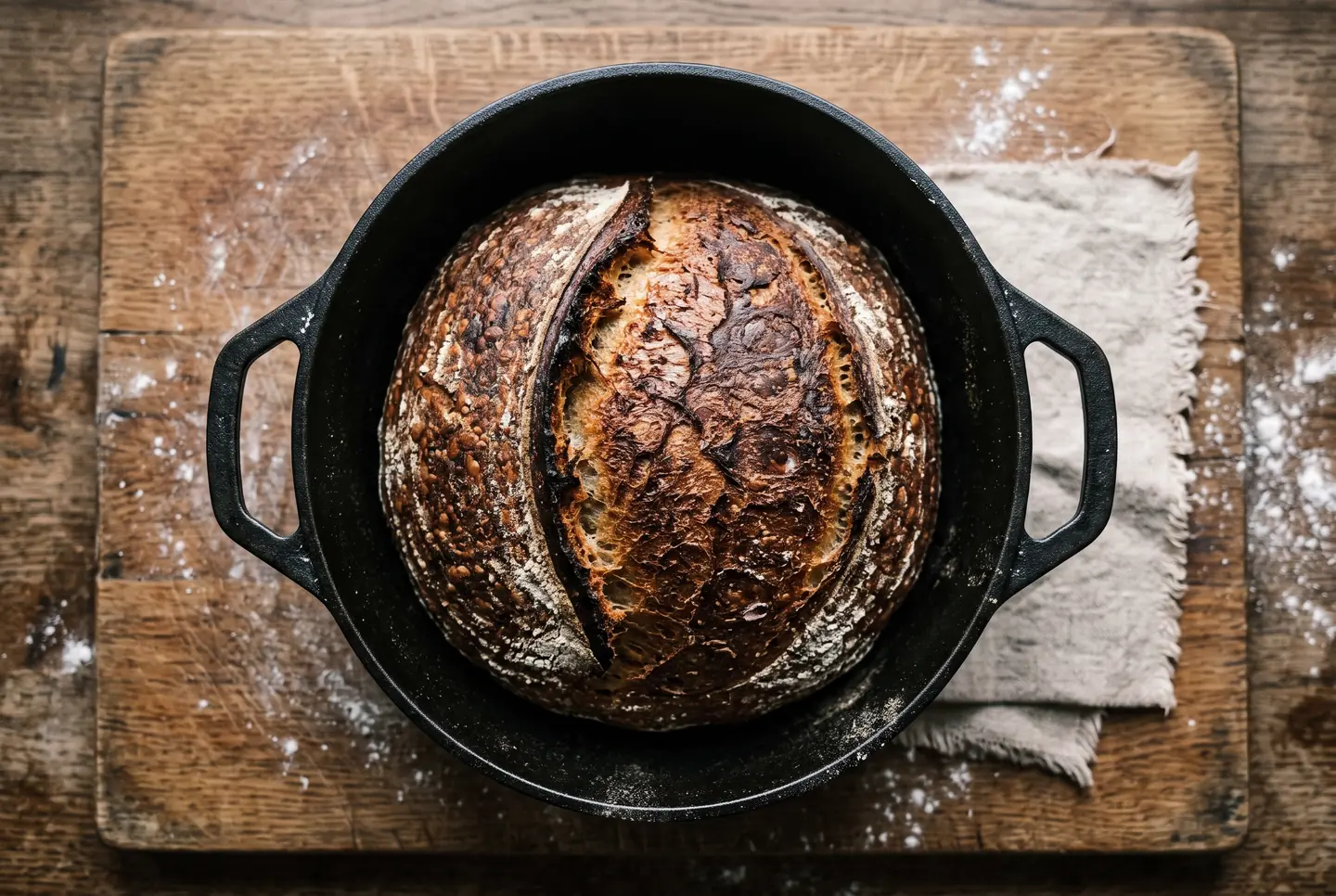
Here is the short answer, in the units that actually let you repeat the loaf: 500 g bread flour, 360 g water, 90 g active starter and 10 g salt. That is a 72 percent hydration dough with an 18 percent dose of starter, a simple beginner formula pitched at the same hydration The Perfect Loaf uses for its beginner's loaf, and it makes one generous boule. Everything below is the timeline that turns those four weights into bread, and the reason we write it in percentages rather than cups is so you can double it, halve it or swap the flour without redoing any maths. For the wider picture of why each step matters, this recipe sits inside the complete sourdough bread guide.
The recipe assumes you already have a starter that is lively and at its peak. If yours is new or sluggish, stop here and fix that first, because a weak starter is behind most dense, flat loaves. Our guide to keeping a sourdough starter alive and knowing when it is ready to bake covers it.
The formula, in baker's percentages
In baker's percentages the flour is always 100 percent and every other ingredient is a share of that flour weight. Read the recipe this way once and you can scale it to any size by picking a new flour weight and multiplying.
| Ingredient | Baker's % | One loaf |
|---|---|---|
| Bread flour | 100% | 500 g |
| Water | 72% | 360 g |
| Active starter | 18% | 90 g |
| Salt | 2% | 10 g |
Water is the one number worth changing on purpose. The same flour and schedule give three different loaves at 65, 72 and 80 percent hydration: drier dough is firmer and easier to shape, wetter dough buys a more open crumb and charges for it in stickiness (flourwise). If this is an early loaf, stay at 72 percent. Which flour you reach for changes the water too, and the best flour for sourdough bread is worth reading before you scale up.
The timeline
The clock times below are a guide for a kitchen around 23 to 24 C (73 to 75 F). Read the dough, not the timer: a warmer room runs faster, a cooler one slower.
| Step | Time | What you are looking for |
|---|---|---|
| Mix flour and water (autolyse) | 30 to 60 min | Shaggy, no dry flour left |
| Add starter and salt | mix in | Dough comes together |
| Bulk fermentation | about 4 h | Roughly 30 to 50% risen, domed, jiggly |
| Stretch and folds | 3 to 4 sets in the first 2 h | Dough tightens and holds shape |
| Pre-shape and rest | 20 to 30 min | Relaxed round, no fight |
| Final shape | into a banneton | Taut skin, seam down or up per method |
| Cold retard | about 16 h at 3 to 4 C | Firm, holds a slow dimple |
| Bake | see below | Deep crust, hollow tap |
1. Autolyse
Mix the flour and water until no dry patches remain, then cover and rest 30 to 60 minutes. This head start on gluten makes the dough easier to work later and asks nothing of you but time.
2. Add starter and salt
Work in the active starter and the salt until fully combined. The dough will feel rough now; the folds fix that.
3. Bulk fermentation and folds
This is the step that decides the loaf. Over about four hours the dough ferments and gains strength, and you help it with three to four sets of stretch and folds in the first two hours, roughly 30 minutes apart. It is ready when it has risen by something like a third to a half, looks domed and slightly jiggly, and shows a bubble or two at the edges. Judge it by the dough, because a warm kitchen can reach this in well under four hours.
4. Shape and cold retard
Pre-shape into a loose round, rest 20 to 30 minutes, then do a final shape into a floured banneton. Cover and refrigerate about 16 hours at 3 to 4 C (The Perfect Loaf). The cold retard develops flavour and firms the dough so it scores cleanly straight from the fridge.
5. Bake
Preheat a Dutch oven inside the oven to 232 C (450 F). Turn the cold dough out, score it once, and bake covered for about 20 minutes so the trapped steam lets it spring, then uncovered for roughly 30 minutes more to set and colour the crust. The loaf is done at an internal temperature of about 97 C (208 F) and sounds hollow tapped on the base. Cool it fully, at least an hour, before slicing, or the crumb turns gummy.
Scaling the recipe
Because the formula is in percentages, a bigger or smaller loaf is one multiplication. Pick your flour weight and take 72 percent of it for water, 18 percent for starter and 2 percent for salt.
| Flour | Water (72%) | Starter (18%) | Salt (2%) |
|---|---|---|---|
| 350 g | 252 g | 63 g | 7 g |
| 500 g | 360 g | 90 g | 10 g |
| 1000 g | 720 g | 180 g | 20 g |
Frequently asked questions
How much starter do I need for one loaf? About 90 g, which is 18 percent of a 500 g flour weight. More starter ferments the dough faster, not necessarily better.
Can I bake it the same day instead of the cold retard? Yes, you can proof at room temperature until the dough passes a gentle poke test and bake without the fridge, but the cold retard develops more flavour and makes scoring easier, so it is worth the wait when you can spare it.
What if I do not have a Dutch oven? Approximate the steam with a preheated tray and a pan of water in a hot oven, though a covered pot is the more reliable route to a bakery crust.
Why is my loaf dense? Most often an under-ripe starter or under-fermented bulk. Make sure the starter is at its peak and let the dough tell you when bulk is done rather than the clock.
Where I checked
Keep reading
 Guide
Guide
Bagel Dough: Why It Is So Firm, and How to Knead It
Bagel dough feels stiff and dry on purpose. Here is why it runs at 50 to 60% water and high protein flour, how to knead it, and the windowpane to aim for.
6 min read Guide
Guide
Bagel Recipe: New York Style, Step by Step
A weight-based New York bagel recipe, step by step: the firm 58% dough, an overnight cold retard, how long to boil, and the oven heat that sets a glossy crust.
6 min read Complete guide
Bagels: The Complete Guide
Make a real bagel at home: the firm 58% dough, why bagels are boiled before baking, New York vs Montreal, sourdough and gluten free, and how to fix flat ones.
18 min read