Guide
Open Crumb Sourdough: What Actually Controls the Holes
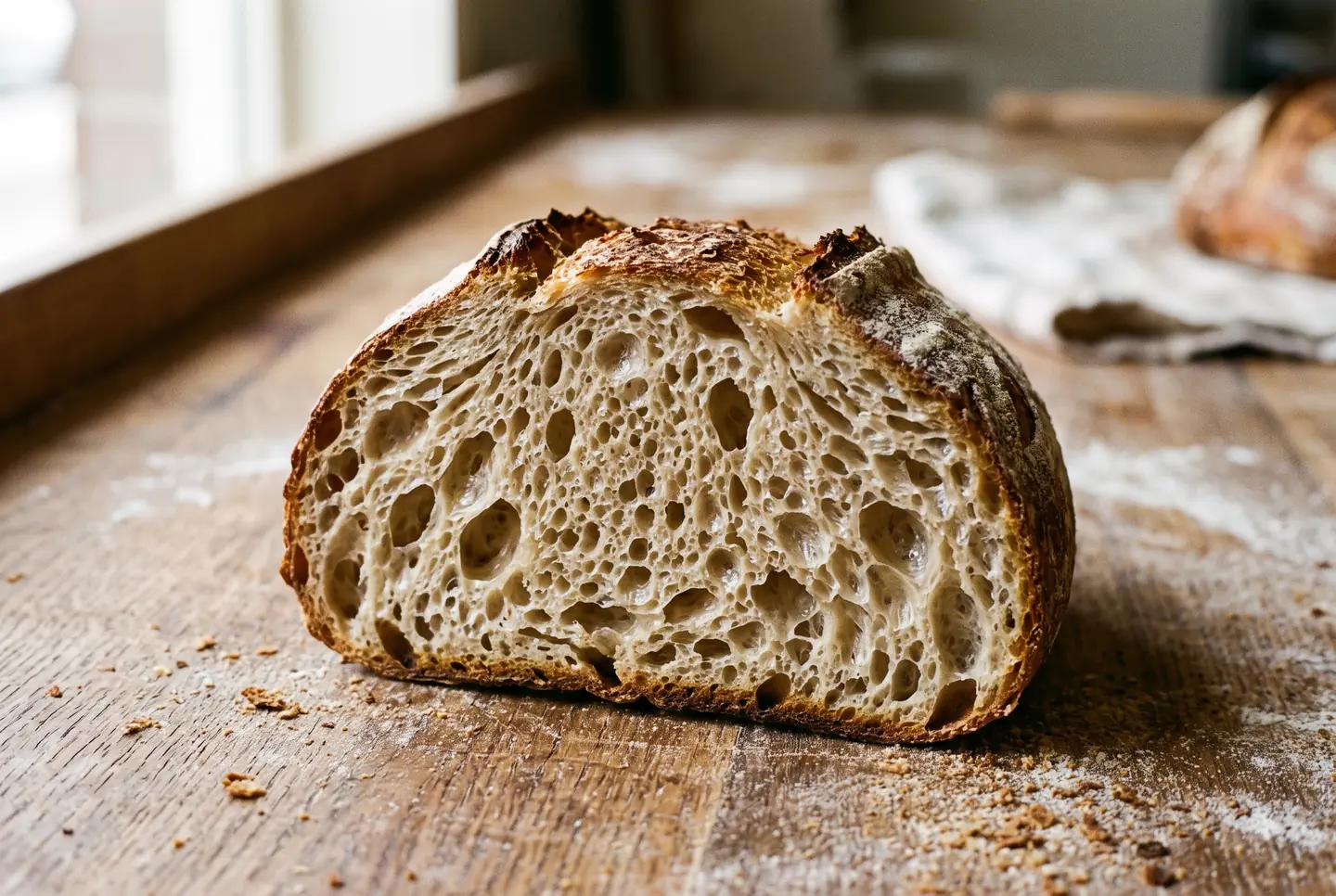
The wide, glossy, irregular holes people chase in a sourdough crumb are not the product of one secret. There is no single lever you pull, no magic hydration number, no fold that unlocks it. An open crumb is the sum of several things going right at the same time, and the reason so many bakers fail at it is that they fix the loud, visible one, water, and ignore the quiet one that matters more, fermentation. Get the bulk right first and a modest loaf opens up. Pour in water while the fermentation is off and you get a wet, flat brick with a gummy line near the base.
So if you want the short answer before the detail: nail your bulk fermentation first, use a strong white flour, handle the dough gently, and only then reach for higher hydration. This guide sits inside the complete sourdough bread method, which walks the whole bake start to finish; here we are only untangling the one question of why some loaves open and others do not, and in what order the factors actually count.
The levers, ranked by how much they matter
Most open-crumb advice throws every variable at you at once, as if they were equal. They are not. Here is the honest ranking, heaviest hitter first.
| Factor | How much it moves the crumb | The common mistake |
|---|---|---|
| Fermentation (bulk) | The most, by far | Ending the bulk too early, so the dough is too tight to open |
| Gluten strength | A lot | Not enough folds, so big bubbles collapse |
| Flour choice | A lot | Low-protein or heavy whole grain flour that cannot hold gas |
| Hydration | Some | Chasing it first and blaming the water for a fermentation problem |
| Shaping and bake | Some | Rough shaping that knocks the gas out, or a weak oven spring |
The trap is reading that list top to bottom and still starting at the bottom, because water is the easiest thing to change. Resist it. A dough fermented to the right point at 70 percent hydration will open more than an under-fermented one at 80.
Fermentation is the biggest lever
This is the part almost every beginner underweights. The bubbles you see in the finished crumb are mostly built during the bulk, so if the bulk is short, the crumb is tight no matter what else you do. An under-fermented dough simply has not generated and trapped enough gas to open, and it also lacks the extensibility to stretch around big bubbles. An over-fermented one has the opposite problem: the gluten has been eaten down by the acids and enzymes, so it can no longer hold the gas it made, and the loaf spreads and flattens.
The window between those two is where an open crumb lives. Read the bulk by feel, not by the clock: look for a rise of roughly 30 to 50 percent, a domed and jiggly surface, and bubbles gathering at the edges of the container. There is one more piece of timing that helps here, upstream of the dough itself. Feed your starter so you use it when it has just turned ripe, before it becomes too acidic, because an over-acidic starter carries protease enzymes that weaken the gluten before you have even mixed (The Perfect Loaf).
Strength: the folds that let big bubbles survive
Fermentation makes the gas. Strength is what lets the dough hold a large bubble without tearing and letting it escape. A weak, under-developed dough can be fermenting beautifully and still bake tight, because the walls between the bubbles keep collapsing into each other.
You build that strength without a mixer, through a series of stretch and folds across the first part of the bulk. Each set aligns and tightens the gluten a little more, until the dough goes from shaggy and slack to smooth, elastic and able to hold a shape. The feel you are after is a dough that stretches thin without ripping and springs back slowly. Get there and the structure can carry the open crumb the fermentation is trying to give it.
Flour and water, in that order
Flour is the raw material for everything above, and it is arguably the single ingredient choice that most affects whether an open crumb is even possible. Reach for a strong white bread flour with a higher protein content, because protein is gluten potential, and gluten is what holds the holes. Whole grain flour, by contrast, works against an open crumb: the bran physically cuts the gluten network, which is why a heavily whole grain loaf eats denser (that trade-off is its own guide, whole grain sourdough, and the best flour for sourdough covers the choice in full).
Only once flour and fermentation are handled does hydration earn its reputation. More water makes a more extensible dough that stretches around bigger bubbles, and it turns to steam in the oven to help push the crumb open. But higher hydration is not mandatory for an open crumb, and it demands more skill to develop strength in a wetter dough (The Perfect Loaf). A sensible range for a mostly white flour is around 70 to 80 percent, and a high-protein flour can carry the top of that while a softer flour struggles. Start lower, master the loaf, then climb.
Gentle hands and a strong bake finish it
You can do everything above right and still flatten the crumb in the last two steps. When you shape the loaf, build tension with light, confident moves rather than hard degassing, because every bubble you knock out now is one that will not be in the slice. And the bake has to deliver real oven spring: a properly preheated Dutch oven traps the steam that lets the loaf leap in the first ten minutes, setting the open structure before the crust locks. A limp bake with no spring closes a crumb that was ready to open.
Frequently asked questions
How do I get an open crumb in sourdough? There is no single trick. An open crumb is fermentation, gluten strength, flour and hydration all landing together. The heaviest lever is bulk fermentation, so fix that first: end the bulk at a 30 to 50 percent rise, not too early and not too late. Then make sure the dough is strong from enough folds, use a strong white flour, and only then raise the water. Gentle shaping and a strong bake finish the job.
Does high hydration guarantee an open crumb? No. Higher hydration makes an open crumb easier, because a wetter dough stretches around bigger bubbles, but it is not mandatory and it is not enough on its own. A well-fermented 70 percent dough will open more than an under-fermented 80 percent one. Water without correct fermentation just gives you a wet, flat loaf.
Why is my sourdough crumb so tight and dense? The most common cause is under-fermentation: the bulk ended too early, so the dough never made or trapped enough gas. After that, look at strength (too few folds), flour (too weak or too much whole grain), and rough shaping that knocked the gas out. Work through them in that order.
What hydration should I use for an open crumb? For a mostly white flour, somewhere around 70 to 80 percent is a sensible working range. A high-protein bread flour can handle the upper end, while a softer flour may struggle above 75. Start at the lower end while you learn the dough, then climb once the loaf is reliable.
Does the flour matter for open crumb? A lot. A strong white flour with higher protein gives the gluten needed to hold big bubbles, while whole grain flour cuts the gluten network with its bran and bakes denser. If an open crumb is the goal, start with a strong white bread flour.
Can an over-fermented dough still have an open crumb? No. Over-fermentation is the other failure. The acids and enzymes break down the gluten until it can no longer hold the gas it made, so the loaf spreads and flattens instead of standing tall with open holes. The open crumb lives in the window between under and over.
Where I checked
Keep reading
 Guide
Guide
Bagel Dough: Why It Is So Firm, and How to Knead It
Bagel dough feels stiff and dry on purpose. Here is why it runs at 50 to 60% water and high protein flour, how to knead it, and the windowpane to aim for.
6 min read Guide
Guide
Bagel Recipe: New York Style, Step by Step
A weight-based New York bagel recipe, step by step: the firm 58% dough, an overnight cold retard, how long to boil, and the oven heat that sets a glossy crust.
6 min read Complete guide
Bagels: The Complete Guide
Make a real bagel at home: the firm 58% dough, why bagels are boiled before baking, New York vs Montreal, sourdough and gluten free, and how to fix flat ones.
18 min read