Guide
What to Serve with Roti: Build a Plate That Works
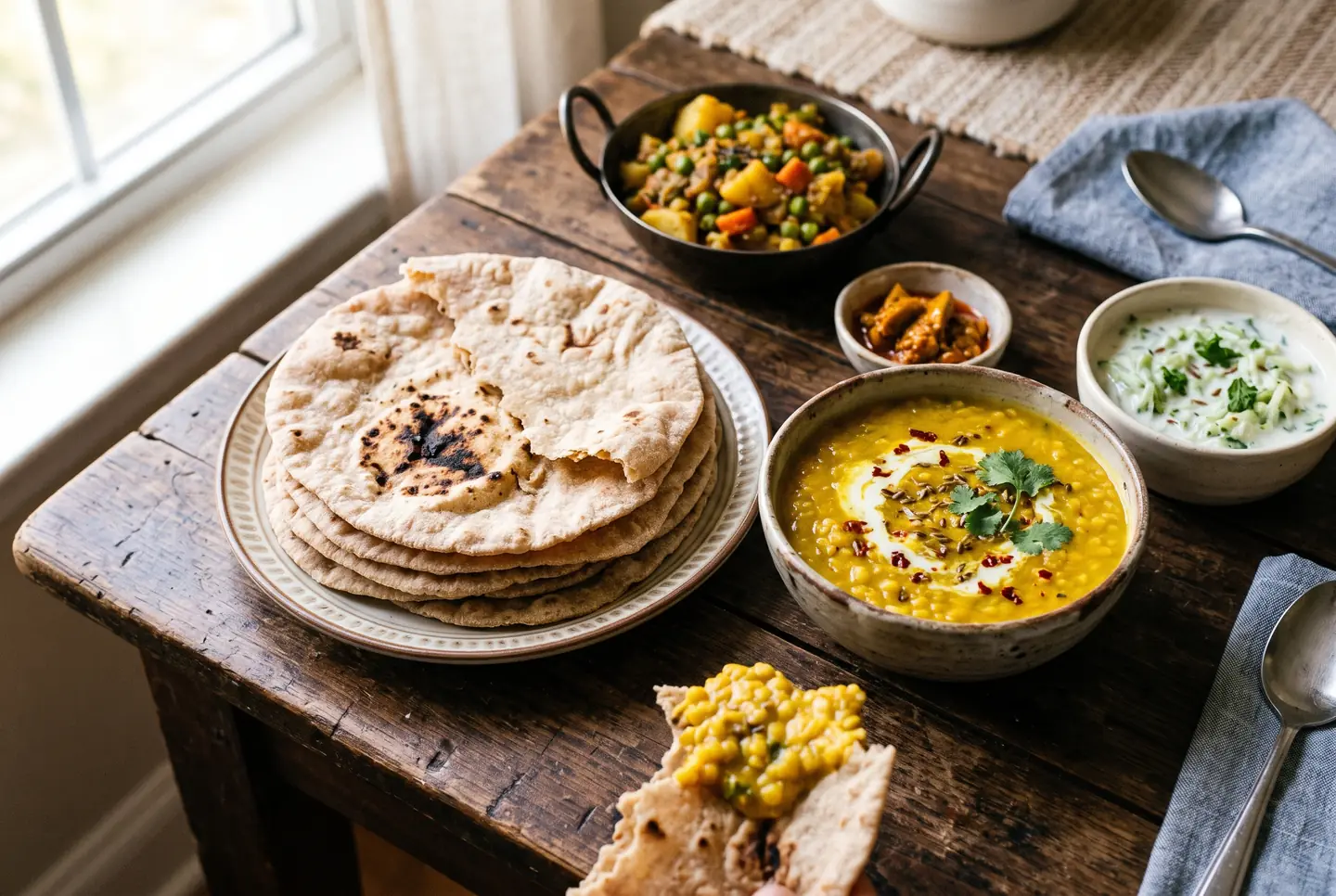
The short answer: serve roti with something wet, something dry and something sharp. A dal or a curry gives you the wet part, a vegetable sabzi or a kebab gives you texture, and a chutney adds a sharp or sweet note. Add a little butter or ghee on the bread and you have a full plate. This is the author's way of thinking about the plate, not a rule.
That is the whole logic, and it works whether you cook from a tradition or from whatever is in the fridge. This page goes deeper than the short serving section in the complete guide to roti: how to balance a plate and how to eat it, with the traditional pairings described on Wikipedia.
What is the simplest way to think about a roti plate?
Think in layers. Each one does a job, and when one is missing the plate feels flat.
| Layer | Job on the plate | Examples |
|---|---|---|
| Wet base | Gives the bread something to carry | Dal, vegetable curry, meat curry, stew |
| Dry element | Adds bite and a change of texture | A vegetable dish (sabzi), a kebab |
| Fresh or sharp | Resets your mouth between bites | Chutney |
| Fat | Rounds off the bread itself | Butter or ghee on the hot roti |
| The roti | Spoon, fork and wrap in one | Torn by hand |
You do not need all five every night. Wet base plus roti is dinner. Add one of the others and it starts to feel like a plate someone planned.
Does dal really go with roti?
Yes, and it is the pairing to start with. Wikipedia notes that in Indian and Sri Lankan cooking, chapati is commonly eaten with dal. In the author's view, the dal supplies the soft, savory part of the plate and the roti carries it.
One practical preference: a dal thick enough to cling to a torn piece of bread is easier to eat with roti than one that runs off.
What curries go with roti?
Almost any of them. According to Wikipedia, chapati is commonly paired with curries, vegetable dishes (such as sabzi), stews or chutneys.
Vegetable curries. Wikipedia names vegetable curry, along with dal, as the usual partner in an Indian tiffin (lunch box).
Kebabs. In Afghan and Pakistani cuisine, chapati is served with kebabs, which swaps the gravy for something grilled.
Stews. Stews are on the traditional list too, so a pot of stew with a stack of roti is a fair meal.
Why add a dry sabzi?
In the author's opinion, a plate of only wet dishes gets monotonous. Sabzi (vegetable dishes) is among the traditional partners for chapati on Wikipedia, and a drier one next to a dal or curry gives the plate a change of texture.
Where do butter, ghee and chutney fit in?
They are the finishing touches.
Butter or ghee. Wikipedia says chapatis are often topped with butter or ghee for flavor and softness. Whether to add it depends on how rich the rest of the plate is, and that is your call.
Chutney. Chutneys appear in the traditional list of things to eat with chapati. A small spoonful beside the dal or sabzi is an easy way to add a sharp or sweet note.
What do people eat with roti for breakfast?
Often something simple. Wikipedia lists several breakfast habits: among the Luo of Kenya, chapati is eaten with tea, and in Uganda it is also taken with tea, especially in Kampala. Similar breakfast habits appear in coastal Andhra, Zanzibar, Oman and among Indo-Malaysians. In Pakistan, chapati may be served with halwa in the morning.
So breakfast roti is the opposite of the curry plate: no sauce, just a warm bread and a hot drink, or a sweet dish on the side. If you have leftover rotis, a cup of tea and a bit of butter is a perfectly respectable start to the day.
How do you pack roti for lunch?
In India, according to Wikipedia, roti is the most common tiffin (lunch box) food, usually with dal or a vegetable curry. As a matter of opinion, a thick filling suits a lunch box better than a thin one. The how to store roti page covers keeping rotis fresh.
Can you wrap roti like a sandwich?
Yes. Wikipedia describes several wraps built on chapati.
| Where | What it is |
|---|---|
| Uganda | The rolex: an omelet rolled in chapati |
| Uganda | The kikomando: chapati with cooked beans |
| Kenya | Street vendors serve chapati wraps |
For other filled breads, see the types of roti page. For a home version, an omelet or cooked beans rolled in a roti follows the Ugandan examples above.
How do you eat roti with your hands?
The method is simple: tear a piece of bread and use it to pick up the food. Wikipedia describes exactly this, tearing the bread and taking the accompaniment with it, or dipping it into soup.
In practice:
- Tear off a piece of roti by hand.
- Use it to pick up the dal, sabzi or other dish.
- With a soup, dip the roti into it, as Wikipedia describes.
How do you keep roti warm while you cook?
Wikipedia says chapatis may be stacked in a container until consumption. It gives no further serving advice, so stack them as they come off the pan and serve. If you need ideas for cooking the rotis themselves, the roti recipe and how to bake roti are the places to start.
What can go wrong with a roti plate?
These are the author's opinions, not sourced facts.
| Issue | Suggestion |
|---|---|
| All wet dishes, no dry one | Add a sabzi or kebab |
| Nothing sharp or sweet | Add a chutney |
| Hard, tough bread | See where roti goes wrong |
Questions
What is the best thing to eat with roti?
Dal is the classic answer, especially in India and Sri Lanka. Add a vegetable dish or a chutney and it is a fuller plate.
Can I eat roti with just butter or ghee?
Yes. Chapati is often served hot with butter or ghee, and it works well as a quick breakfast or snack.
What goes with roti for breakfast?
Tea is common in Kenya and Uganda, and in Pakistan chapati may be served with halwa. A little butter and a hot drink is enough.
What vegetables go with roti?
Wikipedia lists vegetable dishes such as sabzi, and curries, among the usual partners.
How do I keep roti soft until dinner?
Wikipedia only says chapatis may be stacked in a container until consumption, so that is the sourced answer.
Do you eat roti with a fork?
Traditionally no. Per Wikipedia, you tear off a piece by hand to pick up the food, or dip the chapati into soup.
A good roti plate is not complicated: something wet, something dry, a bread to carry it all, and people to share it with.
Where I checked
Keep reading
 Guide
Bagel Dough: Why It Is So Firm, and How to Knead It
Bagel dough feels stiff and dry on purpose. Here is why it runs at 50 to 60% water and high protein flour, how to knead it, and the windowpane to aim for.
6 min read Guide
Bagel Recipe: New York Style, Step by Step
A weight-based New York bagel recipe, step by step: the firm 58% dough, an overnight cold retard, how long to boil, and the oven heat that sets a glossy crust.
6 min read Complete guide
Bagels: The Complete Guide
Make a real bagel at home: the firm 58% dough, why bagels are boiled before baking, New York vs Montreal, sourdough and gluten free, and how to fix flat ones.
18 min read