Guide
Sourdough Roti: Soft Flatbread From Discard
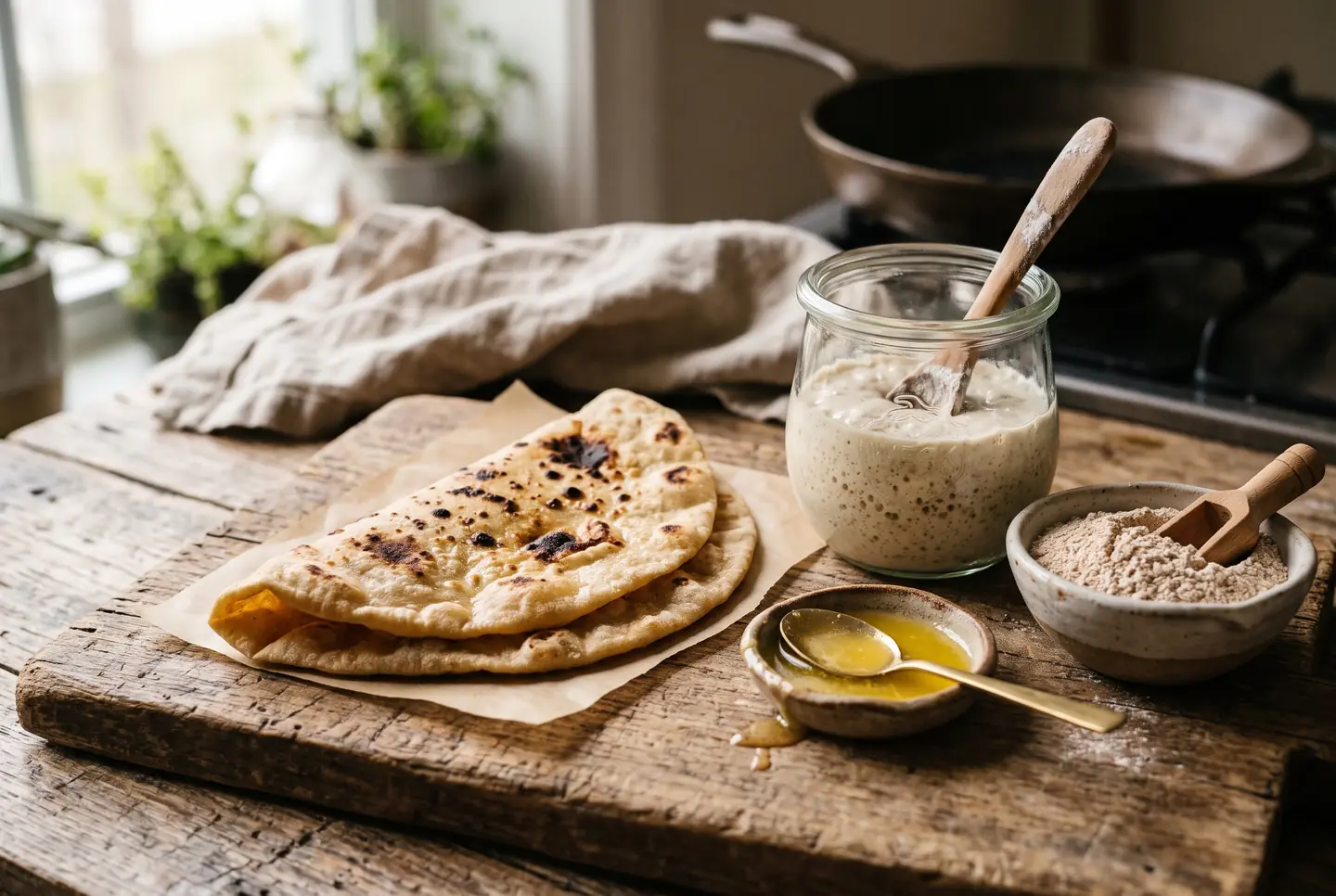
If you keep a sourdough starter, you know the jar of discard that sits in the fridge looking at you. Sourdough roti is one of the easiest answers. You stir a little discard into a plain whole wheat dough, give it a short rest, and cook it on a hot pan like any roti. The result is soft, a touch tangy and a little more tender than the plain version.
One thing to settle first: this is not a bread that rises. Classic roti is unleavened, and the sourdough here is there for flavor and softness, not lift. If you want the whole bread from flour to plate, the complete roti guide has it. This page is about what the starter changes and how to use it without overdoing it.
What does sourdough do to roti?
Not much, and that is the charm. Plain roti is atta and water. Sourdough roti is atta, a little discard, a little water and optionally salt. The method does not change at all: knead, rest, roll, cook on a hot pan.
What changes is the taste and the feel. Cooking From Heart describes the flavor as slightly sour, and says that for some people it is an acquired taste. If you like the tang of a good sourdough loaf, you will probably like it. If you want a roti that tastes only of wheat, use less discard or skip the idea.
The texture is the other gain. The roti stays soft and bends instead of cracking, which is exactly what you want when you tear off a piece to scoop up a curry. And because you are not waiting for a rise, you are not adding hours to your evening.
What do you need for sourdough roti?
The base quantities come from Cooking From Heart, and they make 6 rotis:
- 1.5 cups of atta, the fine whole wheat flour used for roti
- 4 tablespoons of sourdough discard
- 1/2 teaspoon of salt, which is optional
- Warm water, added a little at a time
- A few drops of oil for the dough
- Ghee for brushing at the end, if you like
Atta is sold in South Asian grocery stores, many Asian supermarkets and online, often labeled atta or chapati flour. For the plain version of the dough, with all the water details, see how to make roti dough.
Flour is not the same from bag to bag, so treat the salt and the water as a starting point. Add the water slowly and stop when the dough is firm but still soft.
How much discard should you use?
This is the question that decides whether you love the bread or find it too sour. The discard does two jobs: it adds tang and it softens the dough. More discard pushes both further.
Cooking From Heart suggests starting with about 2 tablespoons of discard and working up to about 1/2 cup as you get used to the taste. The recipe above sits at 4 tablespoons, a comfortable middle.
Two pieces of advice from the same source help here. Older discard, the jar that has sat for days, is more acidic, so use less of it. And if there is liquid on top of your discard (the hooch), you can stir it in as long as it smells fruity and not funky.
| Discard amount | What you will notice | Good for |
|---|---|---|
| About 2 tablespoons (the starting point) | A faint tang, mostly wheat flavor, a slightly softer roti | First try, or a household that is not sure about sour |
| 4 tablespoons (the recipe above) | A clear but gentle tang, tender bend | Everyday sourdough roti |
| Working up toward 1/2 cup | A stronger sour note, a very soft dough | Sourdough fans who want the flavor front and center |
One rule of thumb works for all three rows: if the discard is older and more sour, move one row down the table, not up.
Discard or active starter: does it matter?
The source recipe is written for discard, and it does not test active starter, so the table below is cautious. Discard is the unfed, leftover part of the starter. Active starter is fed and bubbly. In a roti you are not relying on a rise, which is why discard is such a natural fit.
| What you add | How much | What it does | When the flavor shows up |
|---|---|---|---|
| Fresh discard, a day or two old | The recipe amount, 4 tablespoons | Mild tang, softer dough | In the cooked roti |
| Older discard, several days | Less than the recipe amount | More acidic, so use less | In the cooked roti |
| Active, bubbly starter | Not tested in the source recipe, so start with the same amount and taste | Not documented | See the note below |
For a first batch, the simplest path is the one that uses what you already have. Use the discard you were going to throw away, and use the recipe amount.
How do you make sourdough roti, step by step?
This follows the Cooking From Heart method, with the cooking cues from Cook with Manali for the pan.
- Mix. Put the atta, the discard and the salt (if using) in a bowl. Add warm water a little at a time and bring it together.
- Knead. Work it into a firm but soft dough. If it feels stiff, add a splash of water. If it sticks, add a little flour. The flour varies, so go by feel.
- Oil and rest. Rub a few drops of oil over the dough and let it rest for 15 to 20 minutes. This is the short rest. There is no long fermentation in this version.
- Divide. Make 6 balls.
- Roll. Roll each ball into a regular circle. Do not roll it too thin: a slightly thicker roti turns out softer and puffs more. For the rolling itself, see how to shape roti.
- Cook. Put it on a hot griddle over medium heat. Bubbles show up within seconds. Flip it and cook until you see dark golden spots.
- Finish. For the classic puff, hold it for about 10 seconds a side over a direct flame with no oil, using tongs. This is optional. Then brush with ghee.
Notice what is missing: no proofing time beyond the rest, no shaping tricks, no special equipment. If you want a deeper look at the rest step, roti proofing covers why dough benefits from a pause. And for the whole sequence with plain dough, the roti recipe is the place to start.
Can you ferment the dough longer?
Yes, and this is where sourdough roti gets interesting. The recipe above is the quick, reliable version. The slower way is to give the dough more time with the starter, so the sourdough flavor develops further.
There is no fixed timing for this part. The recipe rests the dough for only 15 to 20 minutes, and anything beyond that is extrapolation from how sourdough behaves, so treat it as an experiment, not a recipe.
If you want to try it, these are the general ideas:
- Use a bit more starter, so there is more going on in the dough.
- Let the dough sit longer in a covered bowl, keeping an eye on how it smells and feels.
- Expect a more sour flavor, since more time generally means more acidity.
- Roll and cook exactly the same way as before.
The danger is in over-doing it. A dough left too long, or with too much old discard, will taste sharp and may feel slack and hard to roll. If that happens, a little extra flour on the board helps, and next time you can shorten the wait. Start with the quick version until you know what you like, then push it.
How do you cook sourdough roti on the pan?
Exactly like regular roti. The pan matters more than the dough: it should be properly hot before the first roti goes on. Cook with Manali heats the tawa over medium-high, and warns that a roti placed on a pan that is not hot enough takes longer and turns hard. Cooking From Heart uses medium heat and sees bubbles within seconds.
Use whichever one suits your stove, but make sure the pan is hot, and watch the roti, not the clock. Bubbles tell you when to flip, and the dark golden spots tell you it is done.
If you have a gas hob, the 10 seconds a side over the flame gives you the full puff. If you cook on electric or induction, the pressing method in how to bake roti does the same job. Either way, brush with ghee as soon as the roti comes off the pan.
What goes wrong with sourdough roti?
Most problems are the usual roti problems, with one extra variable.
Too sour. You used too much discard, or the discard was old. Next time, start with about 2 tablespoons and work up from there. Older discard is more acidic, so use less of it.
The dough is sticky or slack. The discard adds moisture. Go easy on the water, and adjust to the flour you have. The dough should end up firm but soft.
It does not puff. This is usually about rolling, not about the sourdough. Roll an even circle, and remember that a slightly thicker roti puffs more.
It is dry or hard. The pan was not hot enough, or the roti stayed on too long. Heat the pan first, and take the roti off as soon as it spots.
How do you store and freeze sourdough roti?
Cooking From Heart suggests wrapping the cooked rotis in aluminum foil or a clean cloth, where they stay soft for a few hours. That is enough for a dinner with leftovers for the next lunch.
For longer storage, the same source says to freeze them after pre-cooking. The idea is to cook each roti partway, cool them, and freeze, so you can finish them on a hot pan when you want one. It is handy when you have a lot of discard to use up and a freezer to put the results in.
Questions
Is sourdough roti really sourdough if it is not leavened?
It uses sourdough, but it is not leavened by it. Classic roti is unleavened, and here the starter adds flavor and softness rather than rise. Think of it as a roti with a sourdough accent, not a sourdough loaf.
How much sourdough discard should I put in roti?
Start with about 2 tablespoons and work up to about 1/2 cup, depending on how much tang you like. The base recipe uses 4 tablespoons of discard for 1.5 cups of atta. Older discard is more sour, so use less of it.
Do I need to let sourdough roti dough rest?
Yes, but briefly. After kneading, rub on a few drops of oil and let the dough rest for 15 to 20 minutes. There is no long fermentation in the standard recipe.
Can I use discard that has liquid on top?
Yes. The liquid, called hooch, can go in as long as the discard smells fruity and not funky. If it smells off, leave it out.
Does sourdough roti taste sour?
Slightly. Cooking From Heart describes the flavor as slightly sour, and says some people have to get used to it. If you want it milder, use less discard, and avoid very old discard.
Can I freeze sourdough roti?
Yes. Freeze them after pre-cooking, then finish them on a hot pan when you want to eat. For a few hours of storage, wrap the cooked rotis in aluminum foil or a clean cloth.
Keep the jar, save the discard, and give it a try. It is one of those small kitchen moves that makes a good dinner out of what you were about to throw away.
Where I checked
Keep reading
 Guide
Bagel Dough: Why It Is So Firm, and How to Knead It
Bagel dough feels stiff and dry on purpose. Here is why it runs at 50 to 60% water and high protein flour, how to knead it, and the windowpane to aim for.
6 min read Guide
Bagel Recipe: New York Style, Step by Step
A weight-based New York bagel recipe, step by step: the firm 58% dough, an overnight cold retard, how long to boil, and the oven heat that sets a glossy crust.
6 min read Complete guide
Bagels: The Complete Guide
Make a real bagel at home: the firm 58% dough, why bagels are boiled before baking, New York vs Montreal, sourdough and gluten free, and how to fix flat ones.
18 min read