Guide
Roti History: Where Roti Comes From and How It Spread
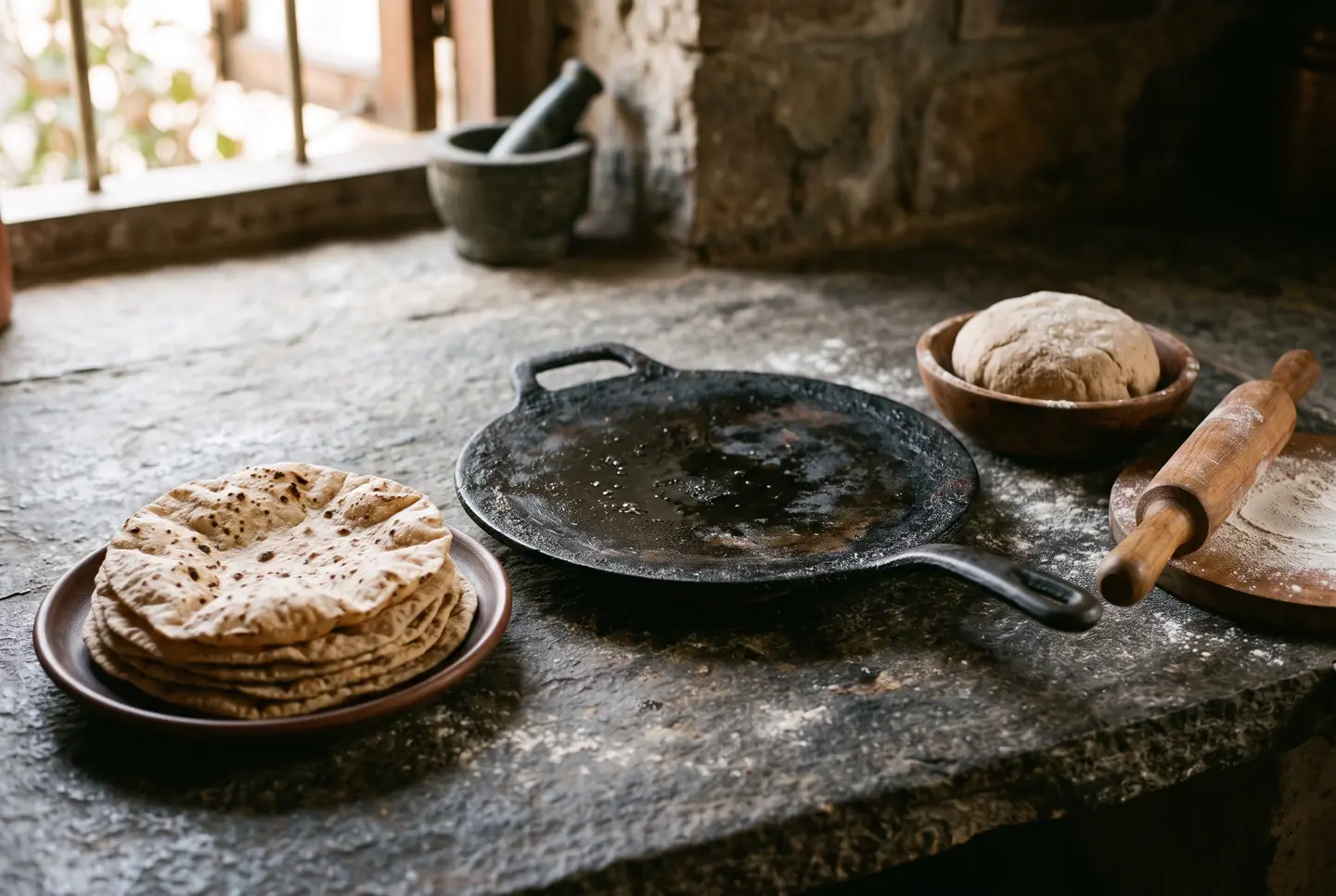
The short answer: roti is the everyday flatbread of the Indian subcontinent, cooked on a hot griddle, and the story of the dish is older than the written record. Bronze Age sites of the Indus Valley Civilization have yielded clay and metal objects that look like griddles, which suggests that something close to roti may have been cooked there. Nobody can date the first roti, and that is part of its charm.
What we can follow is the trail of the word, the mentions in old texts, and the long journey that took roti from a village hearth to Trinidad, Kenya and Malaysia. This page goes further than the history section of the complete guide to roti, one clue at a time.
What does the history of roti look like at a glance?
| Period | What the sources say | Source |
|---|---|---|
| Bronze Age | Griddle-like clay and metal objects found at Indus Valley sites, which hint at flatbread cooking | Wikipedia |
| Old Sanskrit texts | Chapati is mentioned, with no firm date given | Britannica |
| 16th century | The Ain-i-Akbari, a Mughal record by Abu'l-Fazl, mentions it | Wikipedia |
| 17th century | A Portuguese priest, Sebastien Manrique, describes a thin baked bread in Lahore | Wikipedia |
| 1857 | The "chapati movement": chapatis passed from village to village | Wikipedia |
| Late 1800s onward | Indian laborers carry roti to the Caribbean and East Africa | Wikipedia |
Is the Indus Valley really where roti began?
It is the best clue we have, but it is a clue, not a proof. Wikipedia notes that Bronze Age sites of the Indus Valley Civilization contain clay and metal artefacts that look like tavas, the flat griddles still used today. The historian K. T. Achaya also points to cave paintings that show round dough being prepared.
Griddles do not prove bread, so be careful with any page that states a firm date. A griddle can cook many things. What the evidence supports is that the technique, a thin unleavened dough on a hot flat surface, is very old in the region.
There is also a competing story. Britannica reports that some accounts say chapati began in East Africa and was brought to the subcontinent by travelers or merchants. The same source says it appears in old Sanskrit texts. The evidence for the subcontinent is stronger, but it is fair to say the exact origin is debated.
What does the word roti actually mean?
The English word chapati comes from the Hindi chapati, which comes from the Sanskrit carpati, tied to a word for flat. It points to the way the dough is shaped, by slapping it between the hands, according to Wikipedia. English use dates to the early 19th century, and British India wrote it as "chewpatty" or "chowpatty".
Roti is the wider word. It covers breads of the subcontinent in general, and in some regions, Bengal among them, it mostly means chapati. That is why one table in a restaurant can call the same bread roti, chapati or phulka. The types of roti page sorts out which is which.
What do the old records say?
The written trail starts to get clear in the Mughal period. The 16th-century Ain-i-Akbari, written by Abu'l-Fazl ibn Mubarak, vizier to the emperor Akbar, mentions chapati (Wikipedia).
In the 17th century, the Portuguese priest Sebastien Manrique, travelling to Lahore, described it as a thin baked bread eaten by the lower class. That detail is useful because it shows roti as the plain, everyday bread of ordinary people, not a dish for feasts.
Why did chapatis start moving in 1857?
This is the strangest chapter. During the Indian Rebellion of 1857, British officials were alarmed by the "chapati movement": village watchmen carried chapatis from village to village, with instructions to make more and pass them on, and the pattern spread quickly (Wikipedia).
Even the experts do not know what it meant. The same article says the motive was unknown. Food writer Nina Mukerjee Furstenau reads it as a case of bread symbolism, while writer Anita Mannur sees an example of food practices that outsiders find hard to read. Treat any confident explanation with suspicion.
How did roti travel the world?
Roti went wherever people from the subcontinent went, and mostly because of labor migration.
| Place | How it arrived | Source |
|---|---|---|
| The Caribbean | Indian indentured laborers introduced it, which led to regional forms of roti | Wikipedia |
| East Africa | Immigrants brought it, including laborers on British railways in Kenya and Uganda | Wikipedia |
| Kerala | After 1924, Sikh activists ran a free kitchen serving chapati, which popularized it where wheat was not a staple | Wikipedia |
In the 1880s, according to the same article, indentured shipworkers from the North-Western Provinces demanded chapati while others wanted rice, so two separate rations were created. A bread had become a point of identity.
What changed when roti left home?
The bread adapted to each new kitchen. In the Caribbean it grew into a cuisine of its own. In Malaysia, chapati remains a breakfast food among Indo-Malaysians, per Wikipedia. The complete guide covers the modern forms: the wrap roti of Trinidad and the flaky roti canai.
The dough, though, stays recognizable. Whole wheat flour, water, a rest and a hot pan still make the bread at the heart of all these versions. If you want to cook the original idea, start with the roti recipe and the notes on roti dough.
Is roti the same as a tandoor bread?
No, and the difference is old. Roti is cooked on a flat griddle, the tava, rather than baked in a clay oven. Wikipedia describes the Indus Valley finds as griddle-like objects, not ovens, which fits a bread that grew up beside, not inside, the oven tradition. For a closer look at the cooking itself, see how to bake roti.
Why does the history matter in your kitchen?
Because it explains why the bread is so simple. Roti was made to be quick, daily and cheap, by people who cooked it every day. That is why a good roti is about hands and heat, not rare ingredients. If yours is stiff, the answer is usually technique, which where roti goes wrong walks through.
Questions
Where does roti come from?
From the Indian subcontinent. Bronze Age Indus Valley sites contain griddle-like artefacts, and chapati appears in old Sanskrit texts, though the exact origin is debated.
What is the difference between roti and chapati?
Roti is the broad word for breads of the subcontinent. Chapati is a specific kind, and in some regions, including Bengal, roti mostly means chapati.
What does chapati mean?
It comes from the Hindi chapati and the Sanskrit carpati, linked to a word for flat, and it refers to slapping the dough between the hands to shape it.
What was the chapati movement of 1857?
During the Indian Rebellion of 1857, watchmen carried chapatis from village to village with instructions to make more and pass them on. British officials feared a signal, and the motive is still unknown.
How did roti reach the Caribbean and Africa?
Through migration. Indian indentured laborers brought it to the Caribbean, and laborers and immigrants brought it to East Africa, including railway workers in Kenya and Uganda.
Is roti really thousands of years old?
The technique probably is: griddle-like objects date to the Bronze Age Indus Valley. But no one can name a first roti, so be wary of exact dates.
Every roti you puff on the pan today is the latest page of a very long story, and it asks for nothing more than flour, water and a hot surface.
Where I checked
Keep reading
 Guide
Bagel Dough: Why It Is So Firm, and How to Knead It
Bagel dough feels stiff and dry on purpose. Here is why it runs at 50 to 60% water and high protein flour, how to knead it, and the windowpane to aim for.
6 min read Guide
Bagel Recipe: New York Style, Step by Step
A weight-based New York bagel recipe, step by step: the firm 58% dough, an overnight cold retard, how long to boil, and the oven heat that sets a glossy crust.
6 min read Complete guide
Bagels: The Complete Guide
Make a real bagel at home: the firm 58% dough, why bagels are boiled before baking, New York vs Montreal, sourdough and gluten free, and how to fix flat ones.
18 min read