Guide
Pizza Dough Baker's Percentage: The Formula, Scaled
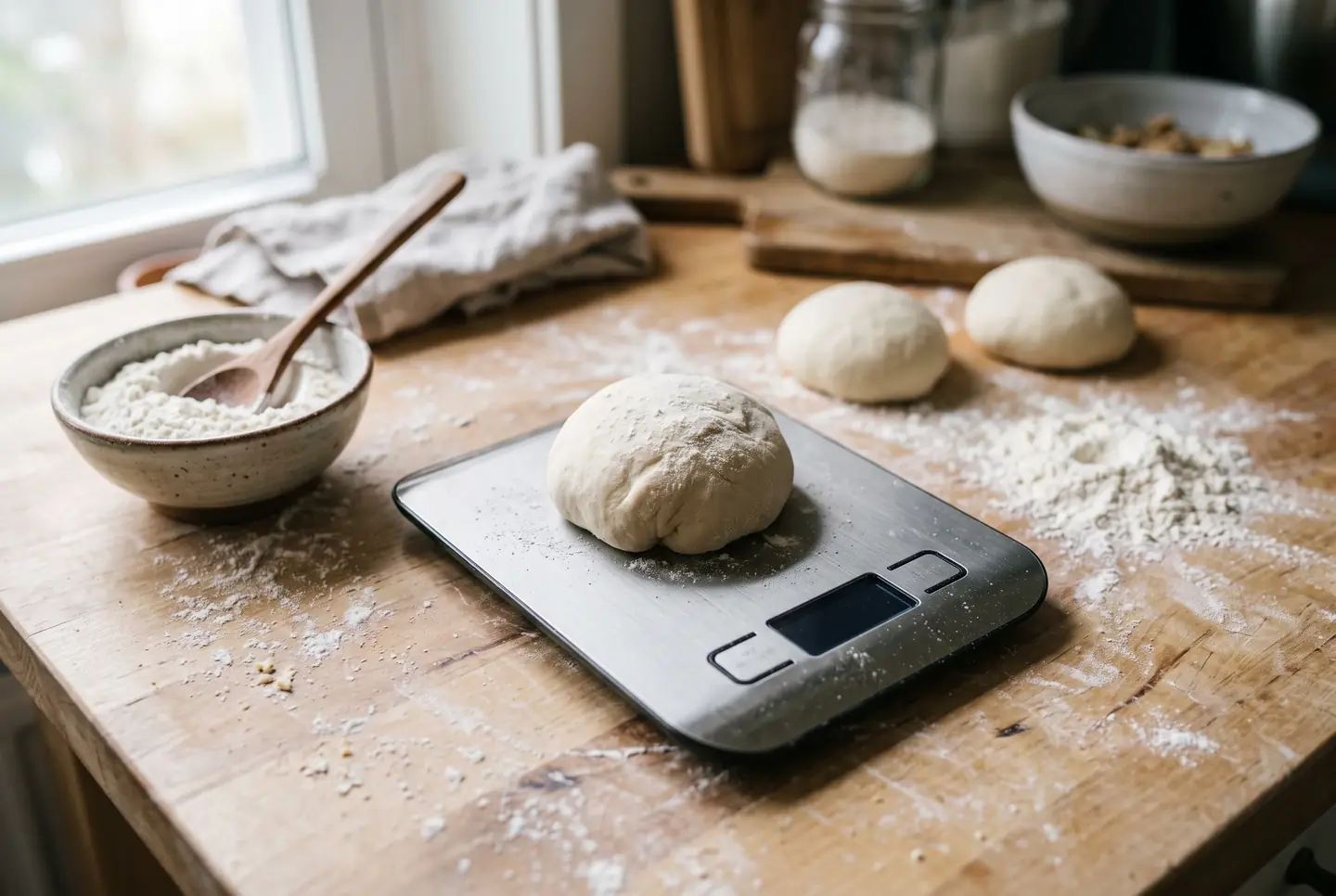
Baker's percentage is a way of writing a dough recipe where flour is always 100 percent and every other ingredient is written as a share of the flour weight. Water at 62 percent means 620 grams of water for every 1,000 grams of flour. Once a recipe is written this way, you can make two pizzas or twelve without redoing any math, and you can compare two doughs at a glance instead of squinting at cups.
That is the whole trick, and it is why every serious pizza recipe is written in percentages rather than in cups. This page is the deep dive on the formula and the arithmetic behind it. For the full method, from mixing through the bake, the complete pizza dough guide is the place to start; here we stay on the numbers.
Why flour is 100 percent
Flour is the anchor because it is the ingredient every other one relates to. Water hydrates the flour, salt is dosed against the flour, yeast is dosed against the flour. So flour gets called 100 percent, and a formula like 100 / 62 / 2 / 0.5 reads as flour, then water, salt and yeast as fractions of it.
To turn a percentage into a weight, multiply the flour weight by the percentage and divide by 100. Salt at 2 percent on 1,000 grams of flour is 1000 times 2 divided by 100, which is 20 grams. Nothing more complicated than that happens anywhere in this system.
The two base formulas
Here are the two workhorse pizza doughs side by side, in percentages. The New York style leans on bread flour and a little oil; the Neapolitan style is barer and wetter and is built to bake much hotter.
| Ingredient | New York style | Neapolitan style |
|---|---|---|
| Flour | 100% | 100% |
| Water | 62% | 55-62% |
| Salt | 2% | 2.5-3% |
| Instant yeast | 0.5% same day, 0.1% cold ferment | 0.1-0.2% |
| Oil | 2-3% | none |
The New York numbers follow a classic home formula: 62 percent hydration, 2 percent salt, 3 percent oil and 0.5 percent instant yeast, built on bread flour of 13 to 14 percent protein (Serious Eats). The Neapolitan column follows the hand-stretched standard, which per the AVPN disciplinary uses no oil, runs 55 to 62 percent hydration, and takes a very small dose of yeast (Associazione Verace Pizza Napoletana).
Reading each number
Each percentage is a lever, and it helps to know which way each one pulls.
- Water (hydration). The share of water to flour. Lower (around 60 percent) gives a firmer, easier dough; higher (68 percent and up) gives a lighter, more open crumb that is also stickier to handle. Most home pizza lives between 60 and 70 percent (Baking Steel).
- Salt. Flavor, but also a brake on fermentation and a tightener of the gluten. Pizza runs high for bread, 2 to 3 percent, and the Neapolitan standard sits at the top of that.
- Yeast. The clock. More yeast means a faster rise; less yeast plus time in the fridge means a slower, tastier one. This is why the same-day and cold-ferment columns above differ by fivefold on yeast alone.
- Oil. Softens the crumb and helps browning in a cooler oven, which is why New York uses it and Neapolitan, baked at 450 C, does not.
Notice that only the yeast changes dramatically between a same-day and an overnight dough. Everything else can stay put. That is the payoff of thinking in percentages: you move one lever and leave the rest alone.
Scaling to any number of balls
To turn a formula into a shopping list, pick a ball weight and a number of balls, multiply to get the total dough, then split that total by the percentages. A generous 12 inch New York ball is about 280 grams; a Neapolitan ball is nearer 250 grams (Serious Eats, AVPN).
The one wrinkle: the percentages add up to more than 100, so the flour is not simply the total divided by the number of ingredients. For the New York formula (62 + 2 + 0.5 + 3 on top of 100) the percentages total 167.5. Flour equals total dough divided by 1.675, and every other ingredient is a percentage of that flour. Here is that math already done for the New York formula, at 280 grams a ball.
| Balls | Total dough | Flour | Water | Salt | Yeast | Oil |
|---|---|---|---|---|---|---|
| 2 | 560 g | 334 g | 207 g | 6.7 g | 1.7 g | 10 g |
| 4 | 1,120 g | 669 g | 415 g | 13 g | 3.3 g | 20 g |
| 6 | 1,680 g | 1,003 g | 622 g | 20 g | 5 g | 30 g |
| 8 | 2,240 g | 1,337 g | 829 g | 27 g | 6.7 g | 40 g |
Read any row as a full ingredient list. Four New York balls need about 669 grams of flour, 415 of water, 13 of salt, 3.3 of yeast and 20 of oil. Change the ball weight and the whole table slides with it, but the percentages never move.
Weigh it, do not measure it
The reason percentages are written against weight and not volume is that a cup of flour is not a fixed amount. Depending on whether you scoop or spoon it, a cup of flour can vary by roughly a third. That swing is enough to move your hydration by ten points without you ever touching the water, which is the difference between a firm dough and a slack one. A cheap kitchen scale removes the entire problem: set the bowl on it, zero it, and add each ingredient to its gram target. Weighing is also what makes the percentages honest, because the moment you switch to cups the ratios stop meaning anything.
A worked example, start to finish
Say you want four Neapolitan style balls of 250 grams, so 1,000 grams of dough. Use 60 percent water, 2.8 percent salt, 0.15 percent yeast, no oil. The percentages total 162.95, so flour is 1000 divided by 1.6295, about 614 grams. Water is 60 percent of that, 368 grams. Salt is 2.8 percent, 17 grams. Yeast is 0.15 percent, about 0.9 grams. That is the entire recipe, derived from four numbers and a target, and it will read the same whether you are making four pizzas or forty.
Turning a recipe you already like into percentages
You do not have to start from a formula. If you have a pizza dough you already trust, written in grams, you can convert it and keep it forever. Take the flour weight and call it 100 percent. Then divide every other ingredient by the flour weight and multiply by 100. A dough with 500 grams of flour, 310 of water, 11 of salt and 2.5 of yeast becomes 62 percent water, 2.2 percent salt and 0.5 percent yeast, which is a textbook New York profile. Once it is in percentages, you can scale it to any number of balls, tweak one lever at a time, and never lose the recipe to a torn page again. If your recipe is in cups, weigh one batch as you make it and write down the grams; that single session of weighing is what frees the recipe from the cup forever.
Frequently asked questions
What is a good hydration for a first pizza dough? Start at 60 to 62 percent. It is firm enough to shape without sticking to everything, and it still bakes into a good crust. Push higher only once handling a wetter dough feels comfortable.
Do the percentages change when I make more dough? No. That is the point of the system. The percentages stay fixed; only the gram weights scale up or down with your batch size.
Why does my flour weight come out odd, like 669 grams? Because the other ingredients add weight too, so flour is the total dough divided by the sum of all percentages (as a decimal), not a round number. Round to the nearest gram or two; the dough will not notice.
Is baker's percentage the same for bread and pizza? The system is identical. Pizza just tends to run leaner and saltier than sandwich bread, and often with far less yeast when it ferments cold overnight.
Can I measure yeast that small accurately? Below about a gram, a standard kitchen scale struggles. Use a 0.1 gram jeweller's scale, or scale your whole batch up so the yeast lands above a gram, or switch to a pinch measured the same way every time and adjust by feel.
A caloroso closing from the kitchen: once the formula lives in your head as four numbers, pizza stops being a recipe you follow and becomes a dough you steer. That is a good place to cook from.
Where I checked
Keep reading
 Guide
Guide
Bagel Dough: Why It Is So Firm, and How to Knead It
Bagel dough feels stiff and dry on purpose. Here is why it runs at 50 to 60% water and high protein flour, how to knead it, and the windowpane to aim for.
6 min read Guide
Guide
Bagel Recipe: New York Style, Step by Step
A weight-based New York bagel recipe, step by step: the firm 58% dough, an overnight cold retard, how long to boil, and the oven heat that sets a glossy crust.
6 min read Complete guide
Bagels: The Complete Guide
Make a real bagel at home: the firm 58% dough, why bagels are boiled before baking, New York vs Montreal, sourdough and gluten free, and how to fix flat ones.
18 min read