Guide
How to Score Sourdough Bread: Depth, Angle and the Ear
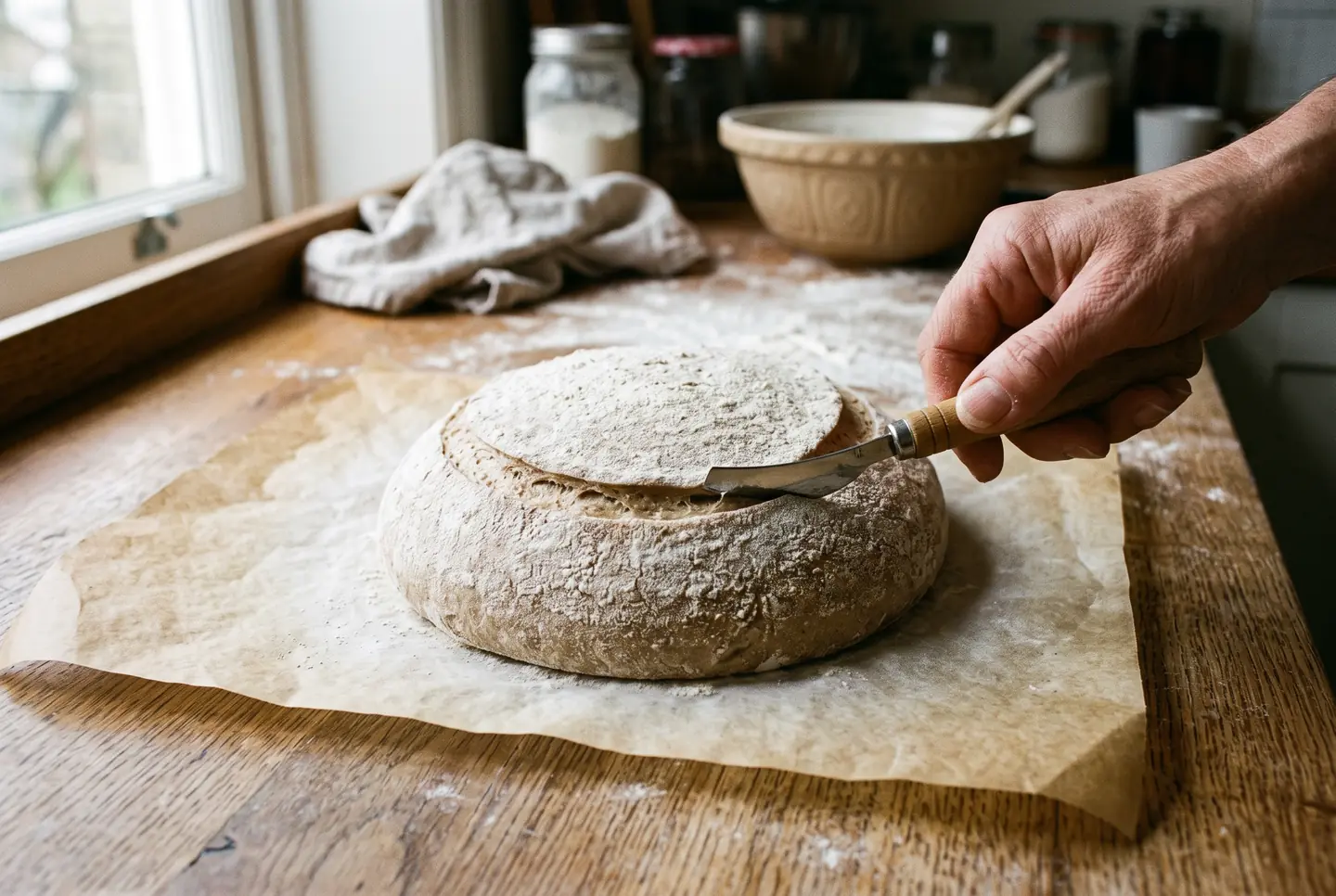
Scoring is the single cut, or set of cuts, you make on the loaf just before it goes in the oven, and it is not decoration. It tells the bread where to open. A loaf trapped in a taut skin has to burst somewhere as it springs, and if you do not give it a deliberate opening it will tear at a random weak point, usually the base, in a ragged blowout. Score it well and it opens exactly where you cut, with a clean lifted flap called the ear. The two things that decide which of those you get are the depth of the cut and the angle of the blade.
This step sits at the very end of the process laid out in the complete sourdough bread guide, right after the loaf comes out of its cold proof and just before it meets the pot. Here we look only at the cut itself: how deep, at what angle, and why the loaf you score should be cold.
Depth and angle are the whole story
Everything about a good score comes down to two variables, and once you can see them separately the mystery falls away. Depth decides whether the cut opens at all; angle decides whether it opens into an ear or just a canyon.
A cut wants to be roughly 1/4 to 1/2 inch, about 0.5 to 1 cm, deep (The Sourdough Journey). Too shallow and the surface seals over before the loaf has finished expanding, so the cut does nothing and the loaf blows out somewhere else. Too deep and you cut through the structure that holds the shape, and the loaf spreads sideways instead of springing up.
The angle is what most people get wrong. Hold the blade nearly flat, at a low 30 to 45 degrees to the surface, and you cut under a thin flap of skin; that flap lifts and curls up as the loaf springs, and that lifted lip is the ear. Hold the blade straight down at 90 degrees and you get an open cut with no flap: useful for decorative patterns, but it will not give you an ear.
| Blade angle | Depth | What you get |
|---|---|---|
| ~30 to 45° (low, blade tilted) | ~0.5 to 1 cm | A lifted flap that curls up: the ear |
| ~90° (straight down) | ~0.5 to 1 cm | A clean open cut, no ear: good for patterns |
| Any angle, too shallow | under ~0.3 cm | Seals over, does nothing, loaf blows out elsewhere |
| Any angle, too deep | over ~1.5 cm | Cuts the structure, loaf spreads flat |
For a first good loaf, aim for one thing: a single decisive slash down the length of a batard, blade low, about a centimetre deep. Master that one cut before you try wheat stalks and leaves.
One confident cut, not many timid ones
The taut surface of a shaped loaf responds to speed and commitment. A slow, careful, sawing motion lets the blade drag, catch and pull the skin into a ragged tear (The Sourdough Journey). One swift, confident stroke parts the skin cleanly and leaves a smooth edge that can lift.
Two practical helps make that easier. Keep the blade genuinely sharp: a bread lame with a fresh razor cuts where a dull knife drags. And if the blade is dragging even so, dipping it in water before the cut lets it glide through a sticky surface. Beyond that, the honest advice is to commit to the movement. Hesitation is what ruins most scores, not lack of skill.
Score it cold, straight from the fridge
The reason the cold retard matters here is that a cold loaf scores in a way a warm one never will. Chilled dough is firm and taut, so the blade parts a clean line; a slack, room-temperature loaf is soft and sticky and tears instead of opening. This is why the standard method is to take the loaf straight from the fridge, turn it out, and score it while it is still cold, before it warms and loosens.
So the sequence is tight: out of the banneton, onto the parchment, one confident cut, and straight into the hot Dutch oven. Do not let a scored loaf sit around warming up, because the open cut will slacken and lose its edge before it ever springs.
When the ear will not form
If you are scoring correctly and still get no ear, the cut is usually not the problem. An ear is a flap of skin lifted by oven spring, so it needs two things the score cannot supply on its own: real surface tension, and real spring left in the dough.
Surface tension comes from shaping. A loaf that was shaped slack has no taut skin to lift, so review how you shaped the boule or batard if the surface feels loose. Spring comes from a dough that is properly, not over, fermented; an over-proofed loaf has spent its rise and will not push a flap open no matter how you cut it. And the cut itself has to be low-angled, as above: a vertical cut simply cannot make an ear. When those three line up, tension, spring and a low cut, the ear appears on its own.
A blowout means the loaf opened somewhere you did not choose
The most common scoring failure is not a bad-looking cut but a loaf that burst at the side or base and left your neat score untouched. That is a blowout, and it is the loaf telling you it opened where it could, because your cut did not give it a better option.
Two causes account for most blowouts. The cut was too shallow, so the surface sealed before the loaf finished expanding and the pressure found a weaker spot. Or the loaf was under-proofed, with so much spring left that a single cut could not release it all. The fix follows the cause: cut a touch deeper and more decisively, or give the dough a little more final proof so it is not straining against its own skin. A well-timed, cleanly cut loaf opens along your line and nowhere else.
Frequently asked questions
How deep should I score sourdough bread? About 1/4 to 1/2 inch, roughly 0.5 to 1 cm. Too shallow seals over before the loaf expands and it blows out elsewhere; too deep cuts the structure and the loaf spreads instead of springing up.
What angle gives you an ear on sourdough? A low angle, around 30 to 45 degrees, with the blade nearly flat to the surface. That cuts under a thin flap of skin which lifts and curls into an ear as the loaf springs. A straight 90-degree cut opens cleanly but makes no ear.
Why does my sourdough tear instead of opening at the score? Usually the loaf is too warm and slack, or was shaped without enough surface tension. Score it cold, straight from the fridge, with a sharp blade and one confident stroke, and make sure the loaf was shaped taut.
Should I score sourdough cold or at room temperature? Cold. A loaf straight from the fridge is firm and taut, so the blade parts a clean line, while a warm loaf is soft and drags into a ragged tear. Cold also holds the shape as it goes into the hot pot.
Why did my loaf blow out at the bottom instead of the score? The cut was too shallow to release the spring, or the dough was under-proofed with too much rise left. The pressure found a weaker point than your cut. Score a little deeper and more decisively, or give the dough slightly more final proof.
Do I need a bread lame, or will a knife work? A lame with a fresh razor is best because it is thin and very sharp, which is what a clean cut needs. A sharp paring knife can work at a pinch, but a dull blade drags and tears no matter how careful you are.
Where I checked
Keep reading
 Guide
Guide
Bagel Dough: Why It Is So Firm, and How to Knead It
Bagel dough feels stiff and dry on purpose. Here is why it runs at 50 to 60% water and high protein flour, how to knead it, and the windowpane to aim for.
6 min read Guide
Guide
Bagel Recipe: New York Style, Step by Step
A weight-based New York bagel recipe, step by step: the firm 58% dough, an overnight cold retard, how long to boil, and the oven heat that sets a glossy crust.
6 min read Complete guide
Bagels: The Complete Guide
Make a real bagel at home: the firm 58% dough, why bagels are boiled before baking, New York vs Montreal, sourdough and gluten free, and how to fix flat ones.
18 min read