Guide
Poolish and Biga for Pizza: More Flavor, Nothing to Buy
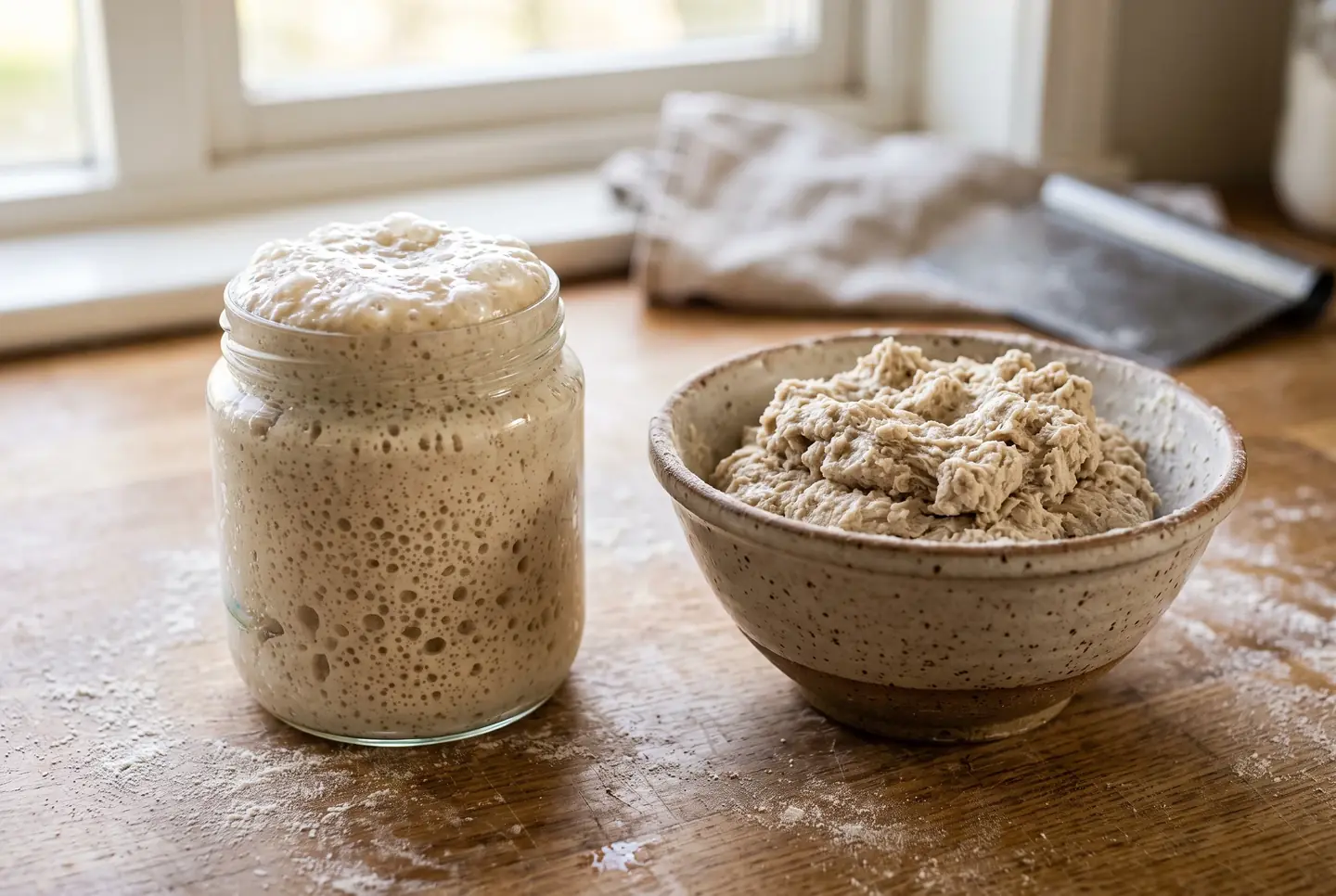
A poolish and a biga are both preferments: a portion of your flour and water, mixed with a pinch of yeast and left to ferment ahead of time, then added to the final dough the next day. Both do the same job, deeper flavor and a lighter, more extensible crust, and they differ mostly in how wet they are. A poolish is a loose batter at 100% hydration, equal parts flour and water. A biga is a stiff, shaggy preferment at roughly 45 to 50% hydration. Neither costs anything you do not already have, which is the whole appeal: better pizza for the price of a little planning.
If you have made a straight dough a few times and want to level up, this is the next step. It sits inside the complete pizza dough guide as one of the ways to build flavor; here we stay on the preferment, so you can build one, ripen it right, and fold it into your recipe without guesswork.
Poolish or biga: which one, and why
The two behave differently in the bowl and in the mouth. A poolish is forgiving and easy to mix, and it tends to give a lighter, airier crumb with buttery, nutty notes, which is why it is the friendlier of the two for a first try (Ooni). A biga is stiffer and a little more work to incorporate, and it leans toward a stronger, chewier structure with a more pronounced tang. A lot of Italian pan and in-teglia pizza is built on biga for exactly that reason.
| Poolish | Biga | |
|---|---|---|
| Hydration | 100% (equal flour and water) | 45 to 50% (stiff, shaggy) |
| Texture of result | Lighter, more open, airy | Stronger, chewier, structured |
| Flavor | Mild, buttery, nutty | Deeper, tangier |
| Ease of use | Easy to mix and fold in | Firmer, harder to incorporate |
| Good first choice | Yes | Once you are comfortable |
Neither is required for a good pizza. But if your straight dough already tastes fine and you want more without changing your flour or buying gadgets, a preferment is the cheapest jump in quality on the table.
How much of the flour to ferment ahead
You do not preferment all of the flour, only a share of it. The rest of the flour, along with the salt and a little more yeast, goes in the next day. A common working range is 20 to 50% of the total recipe flour in the preferment, and the longer you plan to ferment it, the smaller that share should be (pizzablab). A shorter, same-morning poolish can carry more of the flour; a preferment you will leave overnight or longer should carry less, so it does not exhaust itself before you mix.
Start modest. A poolish built from 30% of your total flour is a reliable first ratio: enough to taste the difference, not so much that a slightly over-ripe batter wrecks the batch.
How much yeast, and how long
This is the part people get wrong. A preferment needs only a whisper of yeast, because it has hours to work. The more yeast you add, the faster it ripens, so you dose the yeast to the time you have. The figures below are for fresh yeast, measured against the flour in the preferment itself, at normal room temperature:
| Time to ripe | Fresh yeast (on preferment flour) |
|---|---|
| About 4 hours | ~1.5% |
| About 8 hours | ~0.75% |
| About 12 hours | ~0.2% |
| About 16 to 18 hours | ~0.1% |
These are the standard preferment ranges (pizzablab). If you use instant dry yeast instead of fresh, use roughly a third of these numbers, since instant is about three times stronger by weight. A warm kitchen speeds everything up, so in summer lean toward the lower dose or the shorter end of the time.
How to tell it is ripe
A preferment is ready when it has risen, domed, and covered itself in bubbles, and is just beginning to fall in the center. That slight collapse is the signal: the yeast has hit its peak and the flavor is developed, but the gluten has not yet broken down. A poolish at that moment looks foamy and slack, smells sweet and faintly winey, and shows a dimpled or receding surface. Catch it there.
Do not let it go far past that point, especially with a larger preferment share. An over-ripe preferment loses its strength, the gluten degrades, and you are left with a slack, soupy batter that makes a weak, hard-to-handle dough (Ooni). If life gets in the way and it over-ripens, it is not a disaster for flavor, but expect the final dough to be looser; handle it wetter and bake it sooner.
Building a poolish, step by step
- Mix. In a clear container, combine equal weights of flour and water plus your dose of yeast for the time you want. Stir to a smooth, thick batter. No kneading, there is no gluten to build yet.
- Mark the level. A piece of tape on the container tells you at a glance how much it has risen. You are watching for a rise, a dome, and the first sign of falling.
- Wait at room temperature. Cover loosely and leave it. Depending on your yeast dose and kitchen, this is a matter of hours to overnight.
- Use it at the turn. When it is bubbly, domed, and just starting to sink, it is ready. If you truly cannot mix right away, the fridge slows it down and buys you a few hours.
A biga follows the same idea with less water: mix the flour with just enough water to make a rough, shaggy mass, break it up so it is not one tight lump, and let it ferment the same way. It will not look foamy like a poolish; it swells and softens instead.
Folding it into the dough
The next day, add the ripe preferment to the rest of the flour, the remaining water, the salt, and a small amount of extra yeast, then mix and knead as usual. Two practical notes: hold back a little of the mixing water at first and add it as needed, because a preferment changes how the dough hydrates and you want to judge the feel; and because the preferment already carries active fermentation, the final bulk rise runs faster than a straight dough, so watch the dough, not the clock. From there it is your normal routine, bulk, divide, ball, and proof.
Frequently asked questions
What is the difference between poolish and biga? Hydration, mainly. A poolish is a wet, 100% hydration batter of equal flour and water; a biga is a stiff preferment around 45 to 50% hydration. Poolish gives a lighter, airier crumb and is easier to use; biga gives a stronger, chewier, tangier result.
How much poolish should I use in pizza dough? Preferment 20 to 50% of your total flour, and start near 30%. The longer you plan to ferment the preferment, the smaller the share, so it does not exhaust itself before you mix.
How much yeast goes in a poolish? Only a trace, dosed to time. For fresh yeast on the preferment flour, roughly 1.5% for a 4 hour rise down to about 0.1% for 16 to 18 hours. Use about a third of that if you use instant dry yeast.
How do I know when my poolish is ready? When it is domed, bubbly, and just beginning to fall in the center, with a sweet, faintly winey smell. That slight collapse is the peak. Past it, the preferment weakens and makes a slack dough.
Can I make pizza dough with a biga if I have never used one? Yes, but a poolish is the easier first preferment because it mixes and folds in without fuss. Once you are comfortable, a biga rewards you with more chew and a deeper flavor, which is why so much Italian pan pizza uses it.
Once you have run a preferment through a couple of times, it stops feeling like an extra step and starts feeling like the reason your pizza finally tastes like the good place down the street. Mix a jar tonight, bake tomorrow, and let the time do the work.
Where I checked
Keep reading
 Guide
Guide
Bagel Dough: Why It Is So Firm, and How to Knead It
Bagel dough feels stiff and dry on purpose. Here is why it runs at 50 to 60% water and high protein flour, how to knead it, and the windowpane to aim for.
6 min read Guide
Guide
Bagel Recipe: New York Style, Step by Step
A weight-based New York bagel recipe, step by step: the firm 58% dough, an overnight cold retard, how long to boil, and the oven heat that sets a glossy crust.
6 min read Complete guide
Bagels: The Complete Guide
Make a real bagel at home: the firm 58% dough, why bagels are boiled before baking, New York vs Montreal, sourdough and gluten free, and how to fix flat ones.
18 min read