Guide
Same-Day Pizza Dough: When Time Is Short
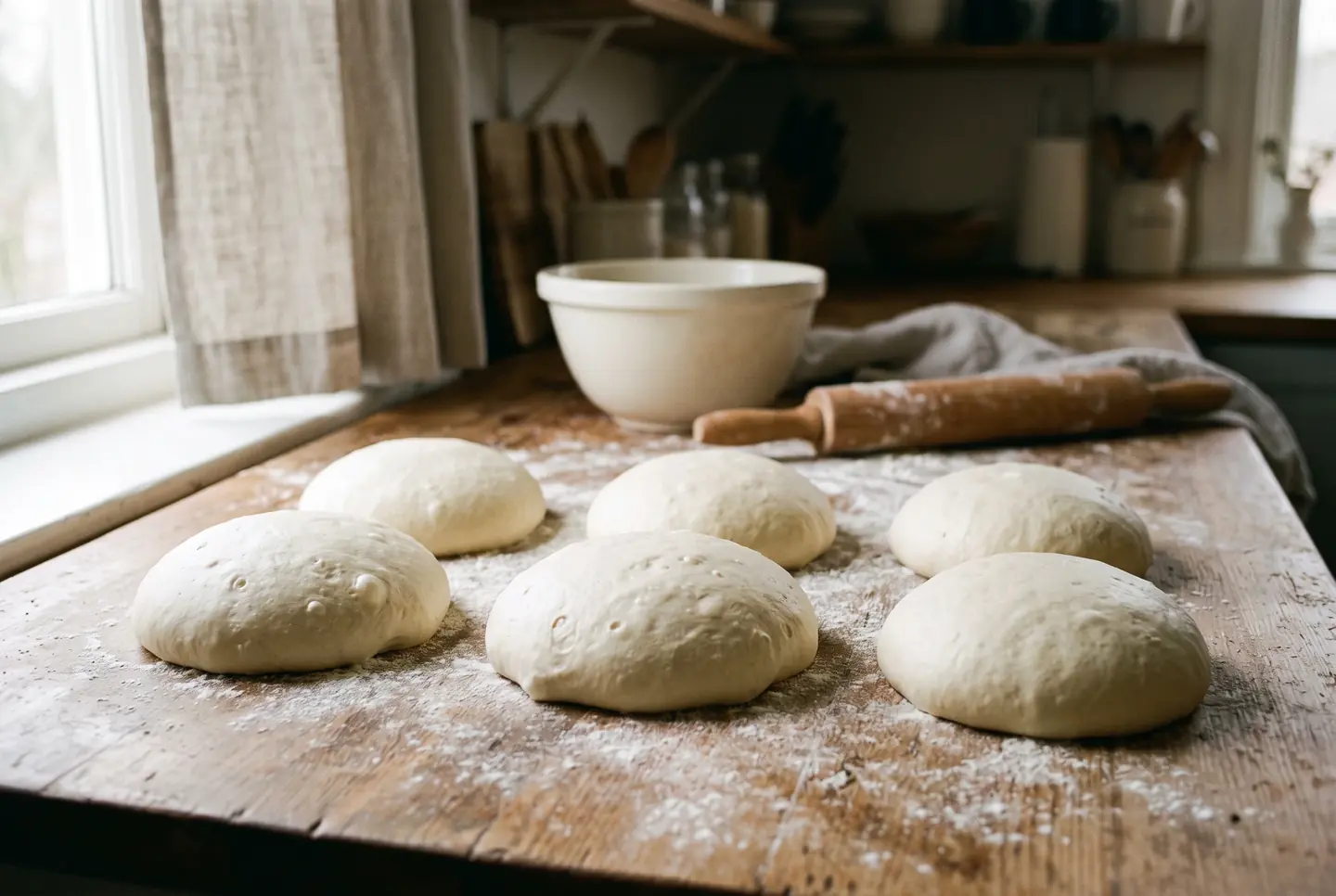
Yes, you can make real pizza dough and eat it the same day. The whole trick is one trade: use more yeast and a warmer room to compress the rise into hours instead of days, and accept a cleaner, simpler flavor in return. Done right, a same-day dough is still soft, still puffs at the edge, and beats any supermarket base by a distance.
It is worth being honest about what you give up, because the internet rarely is. A long cold rise in the fridge builds a deep, faintly tangy flavor that a few hours on the counter cannot match. Baking Steel puts it plainly, calling their same-day dough a "cold beer on a hot day" against the "fine wine" of their 72-hour version. If you have the time, the complete pizza dough guide walks through the slow route, and the cold ferment method is where that flavor comes from. This page is for the evenings when you decided at 4 p.m. that tonight is pizza.
The one lever: more yeast, a warmer room
Fermentation is a clock you can speed up or slow down. Two dials control it: how much yeast you start with, and how warm the dough sits. A three-day dough uses a pinch of yeast and the cold to stretch the rise out. A same-day dough does the opposite.
- More yeast. Baking Steel's same-day recipe uses 2 grams of yeast where their long version uses 1 gram, roughly double, to get the dough moving fast.
- A warm spot. Use room-temperature water, around 21 to 24 °C (70 to 75 °F), and let the dough rise somewhere warm. Above about 24 °C (75 °F) fermentation speeds up; below about 18 °C (65 °F) it drags. An oven with just the light on is a reliable warm box.
That is the entire mechanism. Everything below is choosing how fast you need to go.
Pick a schedule
Same-day covers a wide range, from a rush job in an hour to a relaxed eight-hour rise that gets you closer to real flavor. Longer is better whenever you can spare it, because even a few extra hours deepen the taste.
| You have | Approach | What to expect |
|---|---|---|
| About 1 hour | No-knead dough, quick-rise yeast, warm proof | Fast and functional; flavor is mild, crumb tighter |
| 2 to 3 hours | 4-ingredient no-knead, single room-temp rise | The sweet spot for a weeknight; noticeably better |
| 8 to 10 hours | Double yeast, one long counter rise | Closest a same-day dough gets to slow-ferment flavor |
The one-hour route works: Killing Thyme's no-knead dough is ready in about an hour with quick-rise yeast and a warm proof. But if you can start at lunchtime for a dinner pizza, the longer window pays off. Alexandra's Kitchen's popular four-ingredient dough (flour, water, salt, yeast) is a no-knead mixed by hand and left to rise, no machine and no shaping skill required.
Instant yeast is the shortcut
For same-day dough, instant (quick-rise) yeast earns its place. Unlike active dry yeast, it does not need to be proofed in warm water first, so you can mix it straight into the flour and save that step and its wait. It also starts faster, which is exactly what a short timeline wants. Active dry yeast still works; just dissolve it in the warm water first and give the dough a little more time.
Getting flavor back on a short clock
You cannot fake three days of fermentation, but a few honest moves narrow the gap:
- Let it go as long as you can. Every extra hour on the counter adds flavor. Start early.
- Do not skimp on salt. Salt at about 2% of the flour weight is doing flavor work, not just seasoning. A flat dough is often an under-salted one.
- A little olive oil in the dough gives a tender crumb and a bit of richness that reads as "made from scratch."
- A warm, unhurried rise beats a hot, forced one. Blasting the dough to rise in 30 minutes trades away what little flavor a short ferment can build. Warm, not hot.
If you truly only have an hour
The one-hour route is the most rushed, and it asks the most from your method to make up for the missing time. Killing Thyme's no-knead version gets there with quick-rise yeast, a pinch of sugar to feed it, and a genuinely warm proofing spot, then a single short rise before shaping. It works because every dial is turned toward speed at once: more yeast, warmth, and a touch of extra food for the yeast.
Two things matter more on a one-hour dough than on any other, because the dough itself has less going for it:
- The oven and surface do the heavy lifting. With a young dough, a screaming-hot preheated stone or steel is what saves the crust, giving the base the immediate blast it needs to puff and crisp before it dries. If you skip that on a rushed dough, a pale, bready result is almost guaranteed.
- Do not overwork it. A fast dough has developed little structure, so knead it just enough to bring it together. Over-kneading a barely-fermented dough makes it tight and springy, and it will fight you when you try to open it.
If the dough snaps back every time you stretch it, it needs a rest, not more muscle. Cover it and give it ten to fifteen minutes so the gluten relaxes, then try again. That short wait costs almost nothing and is the difference between a disc that opens and one that keeps shrinking.
A same-day formula to start from
A straightforward same-day dough, in baker's percentages, based on the Baking Steel approach:
| Ingredient | Baker's % | For 500 g flour |
|---|---|---|
| Bread flour | 100% | 500 g |
| Water (room temperature) | 65 to 67% | 325 to 335 g |
| Instant yeast | around 0.4% | about 2 g |
| Salt | 2% | 10 g |
| Olive oil (optional) | 2% | 10 g |
Mix until no dry flour remains, cover, and let it rise at warm room temperature until roughly doubled: about 4 to 6 hours for the eight-hour plan, faster in a warmer kitchen. Divide into balls, rest them a while so they relax and become easy to open, then shape and bake as hot as your oven allows.
Frequently asked questions
Can I make pizza dough and use it the same day? Yes. Use about double the yeast of a slow recipe and let the dough rise in a warm spot. Depending on how much yeast and warmth you use, it is ready in one to eight hours. Longer within that range means better flavor.
How much yeast for same-day pizza dough? More than a slow dough. Where a three-day dough might use around 1 gram of yeast per 500 g of flour, a same-day dough roughly doubles that to about 2 grams to move quickly.
Does same-day pizza dough taste worse than dough left overnight? It tastes simpler, not bad. A long cold ferment builds a deeper, slightly tangy flavor; a same-day dough is cleaner and more straightforward. For a weeknight pizza the difference is small, and a fresh homemade base still beats store-bought easily.
Can I speed up pizza dough with warm water? Warm, not hot. Room-temperature water around 21 to 24 °C (70 to 75 °F) is the sweet spot. Hot water can kill the yeast; cold water slows it down. To go faster, keep the dough somewhere warm rather than heating the water.
Do I have to knead same-day dough? No. Many of the fastest recipes are no-knead: you mix until combined and let time do the work. A short knead or a couple of folds during the rise gives a slightly better structure if you want it, but it is not required.
Where I checked
Keep reading
 Guide
Guide
Bagel Dough: Why It Is So Firm, and How to Knead It
Bagel dough feels stiff and dry on purpose. Here is why it runs at 50 to 60% water and high protein flour, how to knead it, and the windowpane to aim for.
6 min read Guide
Guide
Bagel Recipe: New York Style, Step by Step
A weight-based New York bagel recipe, step by step: the firm 58% dough, an overnight cold retard, how long to boil, and the oven heat that sets a glossy crust.
6 min read Complete guide
Bagels: The Complete Guide
Make a real bagel at home: the firm 58% dough, why bagels are boiled before baking, New York vs Montreal, sourdough and gluten free, and how to fix flat ones.
18 min read