Guide
How to Stretch Pizza Dough by Hand (No Rolling Pin)
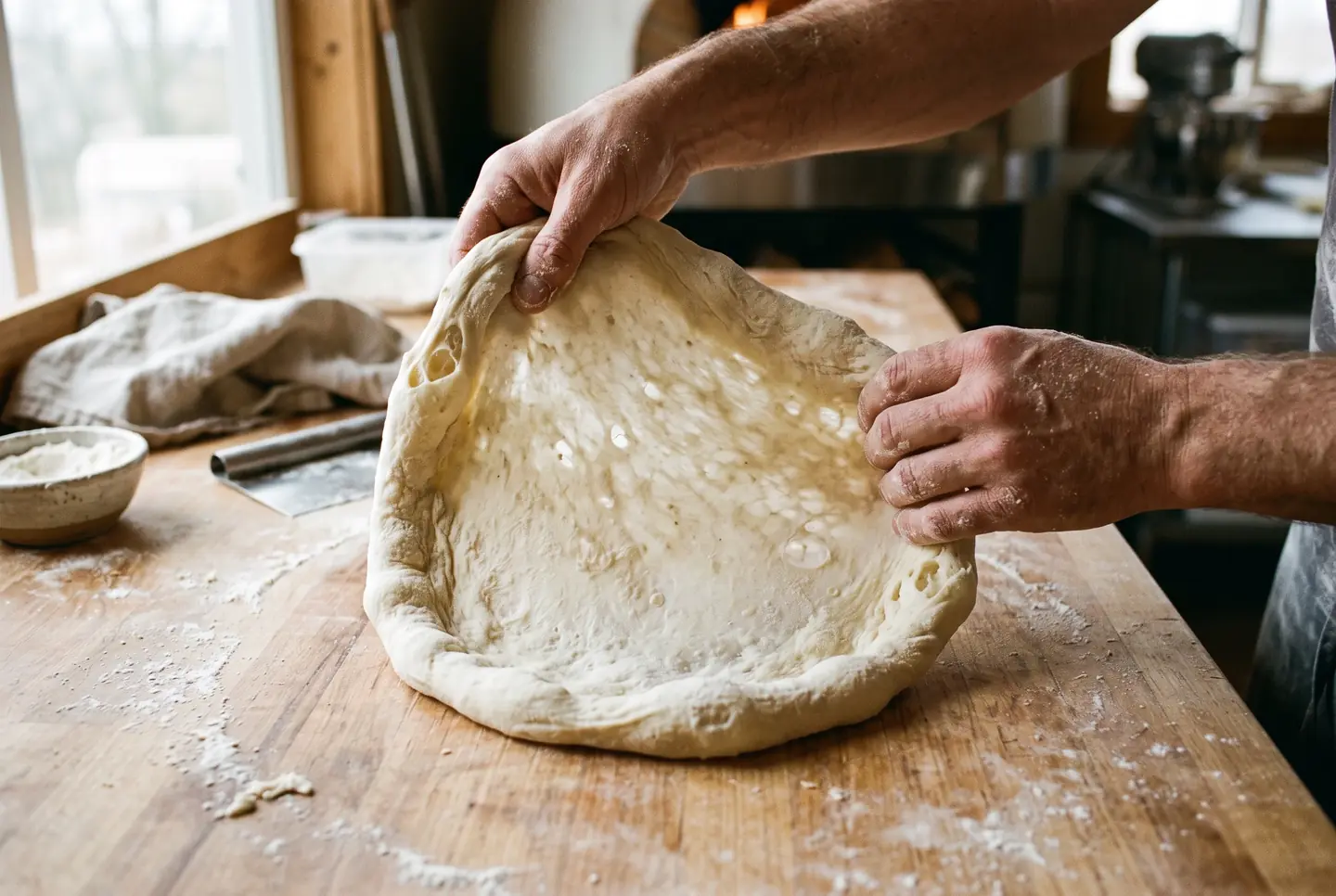
Stretch pizza dough with your hands, never a rolling pin, and start with a dough that has come to room temperature. Warm dough is relaxed and stretches; cold dough is tight and springs back, and forcing it is what tears it. Press a rim into the edge, flatten the center with your fingertips, then drape the disc over the backs of your knuckles and let gravity do the pulling. The moment it stops cooperating and snaps back, put it down, walk away for a minute or two, and come back to a dough that has softened.
That pause is the whole trick, and it is the part almost nobody tells you: the fight is not a skill problem, it is a timing problem. This is one step inside the complete pizza dough guide, where mixing, fermenting, and balling all happen first. Here we pick up at the ball on the counter and take it to a round, thin center with a puffy edge, ready for toppings.
Take the dough out of the fridge first
A ball straight from the fridge is the single most common reason dough will not open. Cold gluten is stiff and elastic, so it pulls back to a small tight disc the instant you let go. Let the balls sit out, covered, until they lose their chill and relax, roughly 30 to 60 minutes depending on your kitchen. They should look slightly puffed and feel soft and slack, not firm.
You cannot rush this with muscle. If you try to stretch a cold ball, you will either tear it or end up with a thick, chewy, undersized round that shrinks back on the peel. Warm it, and the same dough opens almost on its own.
Put the rolling pin away
A rolling pin presses the air out of the dough. The gas your fermentation worked hours to build up gets crushed flat, and with it goes the open, bubbly rim, the cornicione, that separates a real pizza from a cracker. Roll the dough and you bake a dense, uniform disc; stretch it and you keep the bubbles where you want them, pushed out to a light, airy edge.
Hands also feel what a pin cannot: where the dough is thin, where it is thick, where it is about to give. You steer the round as you open it. A pin just flattens everything the same, thin spots and all.
Define the rim, then flatten the center
Start by setting the edge you want to keep. With flat fingertips, press down into the dough about half an inch in from the outer edge, then rotate the ball on the counter and repeat all the way around (The Practical Kitchen). That ring of pressed dough pushes the gas outward into the rim and marks the border you will not thin out.
Now open the middle. Using the pads of your fingers, not the tips, press from the center outward to flatten the inner disc, rotating as you go, until you have a flat round about six to eight inches across and an even thickness (The Kitchn). Keep your hands off the rim you just built. At this stage the dough is still on the counter and still thick; the thinning comes next, in the air.
Let gravity finish it: the knuckle drape
The last stretch happens off the counter. Lift the disc and lay it over the backs of both hands, knuckles loosely together, palms down. Move your fists slowly apart and let the weight of the dough pull the center thinner while you rotate it around your hands (The Kitchn). Gravity does the work; your job is only to turn it and keep the stretch even.
A gentler version, good for a wet or delicate dough: pick the round up by one edge and hold it vertical, letting it hang and stretch downward under its own weight, walking your hands around the rim like a steering wheel (The Practical Kitchen). Either way, go slow. Fast and hard is what makes holes.
When it snaps back, stop and rest it
If the dough shrinks the moment you let go, it is not ready, it is telling you the gluten is still tight. The fix is not more pulling. Lay the round back on the counter, cover it loosely, and give it one to three minutes (The Practical Kitchen). The gluten relaxes while it sits, and when you come back the same dough opens further without a fight. Two or three short rests to open one pizza is completely normal, not a mistake.
This is where warm dough pays off again: a properly rested, room-temperature ball needs fewer of these pauses. A cold or under-rested one needs many, if it opens at all.
When it tears, pinch it shut
Holes happen, especially in the thin center or in a dough that has fermented a little long and turned fragile. Do not stretch through a tear, it only grows. Lay the dough flat, pinch the hole closed with your fingers, press the seam together, and let it rest about thirty seconds before you go on (The Practical Kitchen). Watch for the see-through spots too: if you can read newsprint through the center, ease off there and pull from the thicker areas instead, or the dough will split in the oven and the toppings will weld it to your peel.
Flour, semolina, or oil: what goes on the surface
What you dust the counter and peel with changes how the dough behaves and how the crust bakes. Too much flour dries the surface and makes the crust tough; the right amount just stops it sticking.
| Surface dressing | Best for | Watch out for |
|---|---|---|
| Light flour (00 or bread) | Stretching on the counter | Excess dries the dough and toughens the crust |
| Semolina or fine cornmeal | Dusting the peel so the pizza slides | A gritty bite on the bottom if you use too much |
| A film of olive oil | Pan pizza and stretching in a tray | Too slick to launch off a bare peel |
A practical split: a whisper of flour while you open the round on the counter, then semolina on the peel so it releases cleanly. For pan or grandma-style pizza you skip the peel entirely and oil the tray, stretching the dough right in it, resting and re-stretching as it relaxes.
Fast fixes: symptom, cause, correction
| What you see | Why | What to do |
|---|---|---|
| Dough springs back to a small disc | Cold or under-rested; tight gluten | Warm to room temperature; rest 1 to 3 min and retry |
| Center tears into a hole | Stretched too fast, or over-fermented and fragile | Pinch shut, rest 30 sec, pull more gently |
| A thin, see-through window | Uneven stretch, center overworked | Stop thinning the center, pull from the thicker edges |
| Won't get bigger no matter what | Gluten fully tightened | Cover, walk away 5 min, come back; do not force |
| Thick, bready, undersized round | Never warmed up, or rolled with a pin | Next time warm the ball and stretch by hand |
Frequently asked questions
Why does my pizza dough keep shrinking back when I stretch it? The gluten is too tight, almost always because the dough is cold or has not rested enough. Take it out of the fridge 30 to 60 minutes ahead, and whenever it snaps back mid-stretch, set it down for one to three minutes so the gluten can relax, then continue.
Can I use a rolling pin on pizza dough? You can, but you should not for most pizza. A pin crushes out the gas from fermentation and gives a dense, flat crust with no airy rim. Stretching by hand keeps the bubbles and builds the puffy edge. A pin is only sensible for a deliberately thin, cracker-style base where you do not want a rim.
Should I flour the dough before stretching it? Use a light dusting, no more. Too much flour dries the surface and toughens the crust. Many bakers stretch on a barely floured counter, then move the round to a peel dusted with semolina so it slides off cleanly.
How thin should I stretch pizza dough? Thin the center to an even round, leaving a half-inch rim untouched, until the middle is about an eighth of an inch thick, thinner if you like it crisp. If light shows through and you can read print through it, you have gone too far and it will tear when baked.
How do I stop the dough from tearing? Start warm, go slow, and let gravity stretch it rather than your fingers. If a hole opens, pinch it shut and rest the dough 30 seconds before continuing. Most tearing comes from forcing a cold or over-proofed dough.
Do I need to knead the dough again before stretching? No. Kneading now would tighten the gluten you want relaxed and knock out the gas. By stretching time the dough should already be balled and proofed; you only shape it, gently.
Open one round the slow way and the pattern clicks: warm it, press the rim, drape it, and rest it the moment it argues. Do that and the dough stops being something you fight and turns into something that almost opens itself while you reach for the sauce.
Where I checked
Keep reading
 Guide
Guide
Bagel Dough: Why It Is So Firm, and How to Knead It
Bagel dough feels stiff and dry on purpose. Here is why it runs at 50 to 60% water and high protein flour, how to knead it, and the windowpane to aim for.
6 min read Guide
Guide
Bagel Recipe: New York Style, Step by Step
A weight-based New York bagel recipe, step by step: the firm 58% dough, an overnight cold retard, how long to boil, and the oven heat that sets a glossy crust.
6 min read Complete guide
Bagels: The Complete Guide
Make a real bagel at home: the firm 58% dough, why bagels are boiled before baking, New York vs Montreal, sourdough and gluten free, and how to fix flat ones.
18 min read