Guide
Gluten-Free Pizza Dough That Isn't a Cracker
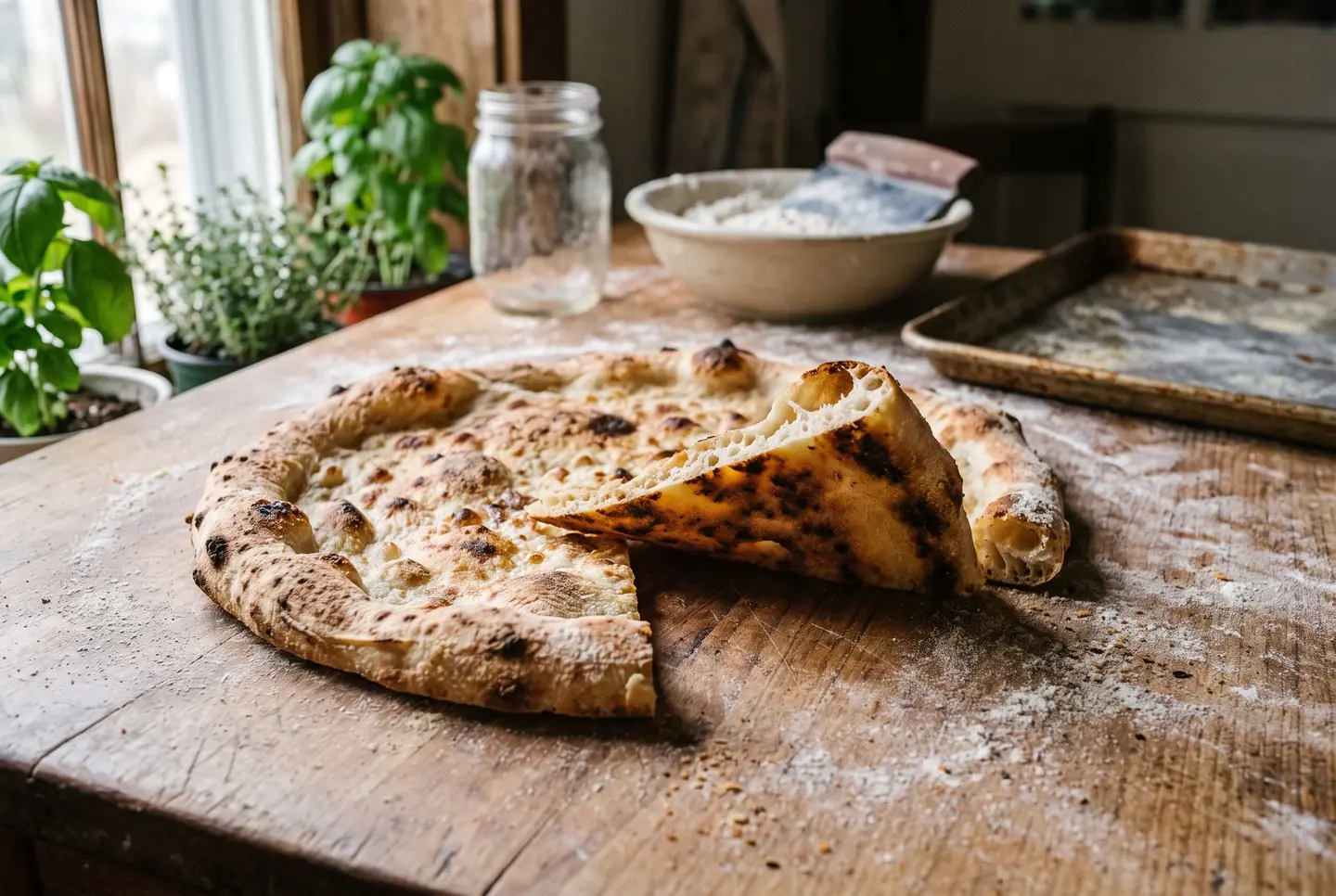
The short answer: gluten-free pizza dough turns into a cracker when it is too dry, under-rested, or over-baked. Fix those three and it bends instead of snapping. A good gluten-free crust is soft enough to fold, with a chewy edge and a base that crisps without drying to a shard.
The reason it goes wrong is structural, not a matter of skill. Wheat dough stretches because gluten builds an elastic web that traps gas and holds a shape. Take the wheat out and that web is simply gone. Nothing you knead into a gluten-free mix will bring it back, which is why gluten-free dough spreads like a thick batter and never behaves like the wheat version. It is a method of its own, and it sits inside the complete pizza dough guide as one branch: here we stay on how to give a flour with no gluten enough structure to carry a slice.
What has to replace gluten
Gluten does three jobs at once: it binds the dough, holds gas so the crust puffs, and gives the chew. In a gluten-free dough each job gets handed to a different ingredient. The single most important one is a binder that forms a gel, and for pizza that binder is almost always psyllium husk.
| Gluten's job | Gluten-free stand-in |
|---|---|
| Binds the dough into one mass | Psyllium husk gel (or, in some recipes, xanthan gum) |
| Holds gas so the crust rises | Yeast plus the psyllium gel trapping the bubbles |
| Gives chew and flex | Psyllium, and often a starch like tapioca |
| Structure and body | A blend flour, plus sometimes almond flour for softness |
Psyllium husk is the piece most home recipes miss. It is a soluble fiber that soaks up water and sets into a stretchy gel, and that gel is what lets a gluten-free crust bend at all. King Arthur, The Loopy Whisk and Gluten Free on a Shoestring all build their pizza crusts around it rather than xanthan alone. Two practical notes from those sources: use finely ground psyllium powder, not whole husks, and treat it as the reason the dough must rest, which is the next section.
Hydration: wetter than you think
A wheat pizza dough sits around 60 to 70% water. A gluten-free dough usually needs more, because the starches and the psyllium both drink heavily, and a dough that looks right by wheat standards will bake dry. The Loopy Whisk describes a workable gluten-free dough as closer to a thick, spreadable paste than a ball you can pick up.
The tell is simple. If the dough cracks at the edges when you spread it, it is too dry and needs more water or more rest, not more flour. Add water a spoonful at a time until it spreads without tearing. It should feel soft and slightly tacky, never stiff.
The rest that makes or breaks it
This is the step people skip, and it is the one that decides cracker versus chewy. Psyllium does not hydrate instantly. It needs time sitting in the wet dough to swell and knit into its gel, and until that happens the dough has no real structure. A rest of at least 30 minutes to an hour at room temperature is common in psyllium-based pizza recipes, on top of whatever proof the yeast needs.
Two things happen in that rest. The psyllium sets, so the dough stops being sandy and starts holding together. And if there is yeast, it works in parallel, giving a little lift and some flavor. Skip the rest and you bake a dry, brittle base no matter how much water you added, because the water is still loose in the dough instead of locked into the gel.
Shaping: spread, don't stretch
You cannot toss or stretch this dough, and trying will only tear it. Wet your hands or use a piece of oiled parchment and press it out from the center, the same motion you would use to spread a thick batter. Aim for an even round; thin spots bake to a crack and thick spots stay gummy.
Because the dough is soft, most reliable methods build it directly on the parchment or on the pan it will bake on, so you never have to transfer a floppy raw round onto a hot surface.
Baking: hot surface, and don't overbake
Heat is where a chewy crust is saved or lost. Two rules carry most of the result.
Bake hot, on a preheated surface. A stone or steel that has soaked up heat gives the base an immediate blast that sets the bottom and crisps it. King Arthur's gluten-free Neapolitan-style crust bakes at 260 °C (500 °F) on a preheated stone or steel for 15 to 18 minutes. Their standard gluten-free crust uses a par-bake instead: 425 °F (about 220 °C) for 8 to 10 minutes just to set the crust before toppings go on.
Do not overbake. This is the cracker trap. Gluten-free crust has no gluten holding moisture, so every extra minute in the oven dries it further toward a shard. Pull it when the base is set and the edge is golden, not deep brown. If you like a crisp bottom without a dry top, the par-bake route is the safer one: set the naked crust first, add toppings, then finish it just until the cheese bubbles.
A base formula to start from
Gluten-free flours vary enough that a blend from one brand behaves differently from another, so treat any formula as a starting point and adjust water by feel. A common shape for a psyllium-bound pizza dough, expressed as baker's percentages against the flour blend:
| Ingredient | Baker's % | Note |
|---|---|---|
| Gluten-free flour blend | 100% | A pizza or bread blend, not plain rice flour |
| Water | 80 to 100% | Higher than wheat dough; adjust by feel |
| Psyllium husk powder | 4 to 8% | The binder; finely ground |
| Olive oil | 4 to 6% | Softness and a tender crumb |
| Salt | 2% | Flavor |
| Instant yeast | around 1% | For lift and flavor |
If your blend already contains xanthan gum, ease off any extra binder so the dough does not turn rubbery. When in doubt, more rest and more water fix a dry dough; more flour almost never does.
Frequently asked questions
Why is my gluten-free pizza crust always hard like a cracker? Three usual causes: the dough was too dry, it did not rest long enough for the psyllium to gel, or it baked too long. Add water until it spreads without cracking, give it a rest of at least 30 to 60 minutes, and pull it from the oven as soon as the base is set.
Do I need psyllium husk, or can I use xanthan gum? Xanthan binds but does not give the same bend. Psyllium husk forms a stretchy gel that lets the crust fold rather than snap, which is why most crusts built for chew use it. If your flour blend already has xanthan, you can still add a little psyllium for flex.
Can I make gluten-free pizza dough ahead of time? Yes. It keeps in the fridge for a day or two, and many bakers find a rest in the cold improves how it handles. Let it come back toward room temperature before you spread it.
Should I par-bake gluten-free pizza crust? It helps. Baking the naked crust first sets the structure and crisps the base, so it does not go soggy under the toppings. King Arthur's standard crust is par-baked at 425 °F for 8 to 10 minutes before topping.
What flour is best for gluten-free pizza? A blend made for bread or pizza, which combines starches with a structure flour, beats any single flour. Plain rice flour alone bakes gritty and dry. Some recipes add almond flour for a softer crumb.
Where I checked
Keep reading
 Guide
Guide
Bagel Dough: Why It Is So Firm, and How to Knead It
Bagel dough feels stiff and dry on purpose. Here is why it runs at 50 to 60% water and high protein flour, how to knead it, and the windowpane to aim for.
6 min read Guide
Guide
Bagel Recipe: New York Style, Step by Step
A weight-based New York bagel recipe, step by step: the firm 58% dough, an overnight cold retard, how long to boil, and the oven heat that sets a glossy crust.
6 min read Complete guide
Bagels: The Complete Guide
Make a real bagel at home: the firm 58% dough, why bagels are boiled before baking, New York vs Montreal, sourdough and gluten free, and how to fix flat ones.
18 min read