Bread
Pumpernickel: the German rye bread that bakes for 16 hours, and how to make it at home
Real pumpernickel has no molasses, no wheat, and it is not ready in an afternoon. It is a Westphalian rye bread that bakes for 16 to 24 hours in a low oven, and the near-black colour comes from heat and time alone.
At a glance
- Origin
- Vestfália, Alemanha
- Created
- not measured
- Hydration
- 80% to 100%
- Flour
- centeio integral, grão triturado grosso (roggenschrot) e grão inteiro
- Leaven
- sauerteig (fermento natural de centeio)
- Total time
- 40 h to 60 h
- Oven
- 120 °C
- Steam
- yes
- Internal temperature
- not measured
- Shape
- pão de fôrma tampada, retangular
- Difficulty
The recipe
Ingredients
| Amount | baker's % | |
|---|---|---|
| Wholemeal rye flour (for the sauerteig) | 100 g | 20% |
| Water (for the sauerteig) | 100 g | 20% |
| Rye sourdough starter | 20 g | 4% |
| Coarse rye meal (roggenschrot) | 300 g | 60% |
| Whole rye berries, soaked overnight | 100 g | 20% |
| Boiling water (for the scald) | 300 g | 60% |
| Stale pumpernickel, crumbled (altbrot) | 50 g | 10% |
| Salt | 10 g | 2% |
Method
- The day before, refresh the sauerteig: mix the 100 g rye flour, the 100 g water and the starter. Cover and leave 12 to 16 hours at 22 to 24 °C, until bubbly and clearly sour. At the same time, put the whole rye berries to soak in cold water.
- Next day, make the scald: pour the 300 g boiling water over the coarse rye meal, stir and cover. Rest 3 to 4 hours. The heat gelatinises the starch and frees the grain's sugars, which deepens the sweetness and the colour.
- In a bowl combine the now warm scald, all the sauerteig, the drained rye berries, the crumbled stale pumpernickel and the salt. Mix with a wet hand or a spoon just until homogeneous. It is a thick, sticky paste, not a dough you knead: do not knead.
- Grease a lidded loaf tin well. Press the paste in without leaving air pockets, smooth the top with a wet spoon and close the lid.
- Rest 2 to 4 hours somewhere warm. The loaf barely rises: readiness shows as fine cracks opening on the surface, not as volume.
- Bake with the lid on, sitting in a deep tray with a couple of centimetres of hot water (a water bath). Start at 150 °C for 1 hour to set, then drop to 120 °C and hold for 16 to 20 hours. Top up the water if it dries out.
- Switch off and let the loaf cool completely in the tin. The colour and flavour go on deepening as it cools.
- Turn out, wrap and wait 24 to 48 hours before cutting. A rye crumb only firms up cold, and this bread asks for even longer: cutting early gives you a gummy slice.
The right flour
This bread asks for rye, and only rye. Authentic pumpernickel is made from coarsely milled wholemeal rye and whole rye grain, with no wheat flour at all: that is the line that separates the German original from the imitation. Rye builds no gluten network the way wheat does, so there is no point chasing strength or a windowpane. The structure comes from pentosans, fibres that soak up a lot of water and form a viscous gel rather than an elastic mesh. That is why the dough is sticky and never gets kneaded. The Rye flour entry in this catalogue explains why the grain behaves this way and what to look for on the label.
The story
Pumpernickel was born in Westphalia, in western Germany, ordinary people's food in a region where rye grew well and wheat was dear: the bread you could make from what you had, and which kept for weeks. It is an old bread, though without a birth certificate: the name itself is only recorded from the 17th century, at first as a nickname for a person, and comes to mean this rye bread in the 18th. The name is a riddle nobody has fully solved. The reading most linguists accept is that pumpernickel joins pumper, a dialect word for the sound of a fart, and Nickel, a pet form of Nikolaus that also stood for the devil (English Old Nick comes from it). It would be the devil's fart, a joke about the bread's reputation for being heavy to digest. There is also the tale that Napoleon said the bread was only good for his horse Nickel, hence bon pour Nickel: a pretty story, invented much later and with no basis.
What defines it
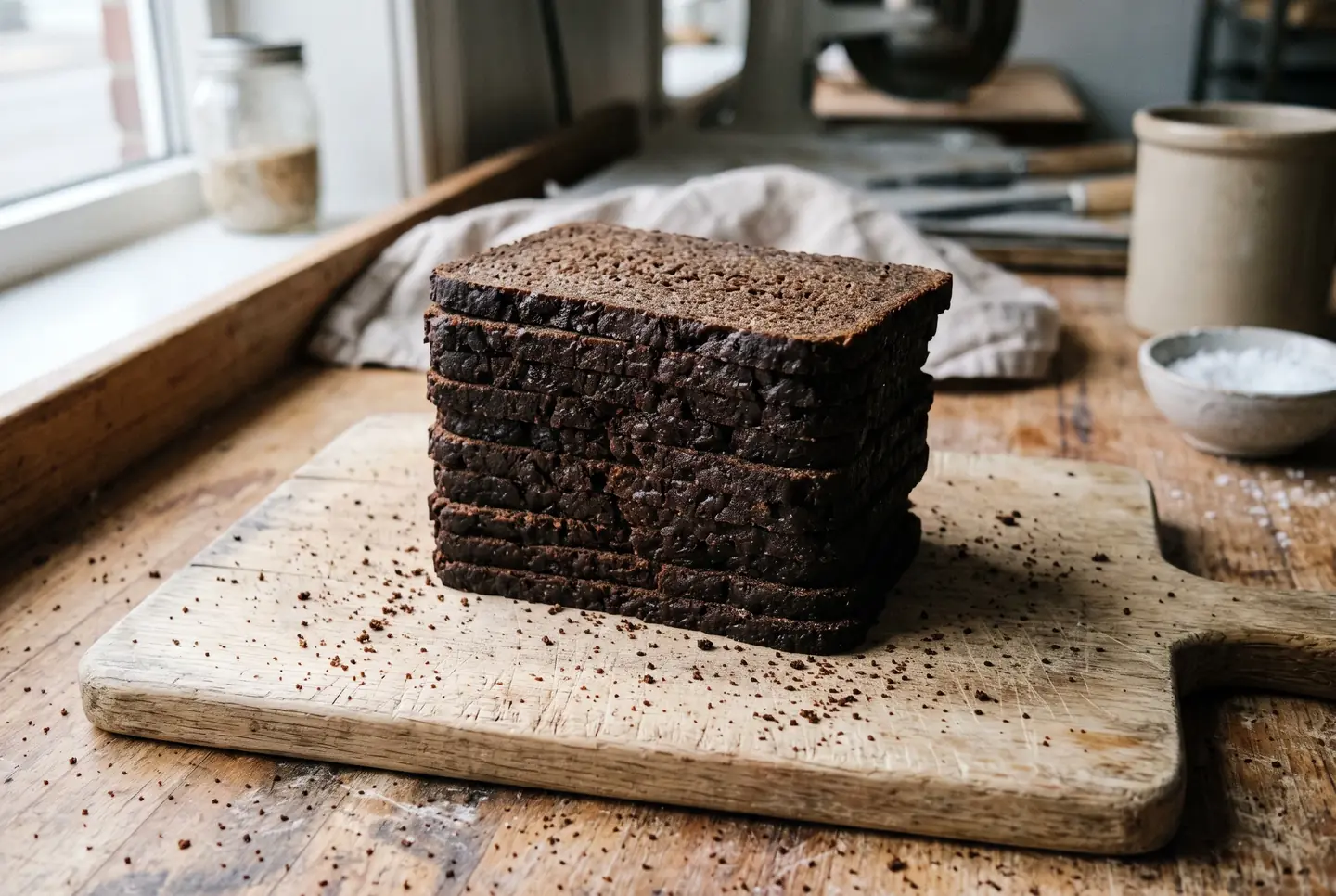
A good pumpernickel is dark, almost black, dense and moist, its slices holding together as thin as paper. There is no crisp crust and no open crumb: the appeal is the opposite of that. The flavour runs deep, somewhere between malt and bitter chocolate, with a background sweetness that comes from no added sugar. That colour and that flavour are born from the Maillard reaction and the caramelisation of rye's own sugars over the many hours of low baking. The German original takes no molasses, cocoa or coffee: if your loaf needed colouring to go dark, it baked too fast. The sign that it worked is a firm, glossy slice that does not crumble.
How the dough behaves
Forget everything you know about kneading. Pumpernickel dough is a thick, sticky paste, closer to a firm porridge than to a bread dough. You mix it with a spoon or a wet hand, only until even, and stop. Before that it pays to scald part of the rye with boiling water: this scald, the German Brühstück, gelatinises the starch and frees the grain's sugar, which deepens sweetness and colour. The sauerteig, the rye sourdough, is not there for flavour alone. Its acidity lowers the pH and holds back rye's alpha-amylase, the enzyme that, left unchecked, would take the starch apart in the oven and leave the crumb soggy. In rye, acidity is structure, not seasoning.
Variations
The protected standard, Westfälischer Pumpernickel, was granted the European geographical indication seal in 2014 and requires a closed oven, at least 20 hours of baking and no less than 90% rye, with water, salt and reused already-baked pumpernickel, the altbrot. Outside Westphalia you meet faster versions, with yeast and fewer hours. The pumpernickel sold in the United States is usually another bread altogether: it carries wheat flour, molasses and cocoa or coffee for the dark colour, and it bakes in normal time. At home, without a bakery oven, the way through is a lidded tin and patience: baking low for many hours in a water bath imitates the industrial oven well.
Where it goes wrong
The mistake that ruins pumpernickel most often is being in a hurry. If you raise the temperature to speed things up, the colour may come, but the flavour stays raw and the slice crumbles. Second mistake: cutting early. A rye crumb only firms up once it is fully cold, and this bread asks for even more, 24 to 48 hours wrapped before the first slice. Cutting it warm gives you a gummy paste. Third: expecting it to rise like a wheat loaf. It does not double, and waiting for that lets the dough turn too sour. Readiness shows on the surface, which opens into fine cracks, not in the volume.
Frequently asked
- Does pumpernickel contain wheat?
- In the authentic German bread, no. Traditional pumpernickel is 100% rye, between whole grain and coarse meal. The version with wheat flour, molasses and cocoa is the American one: same name, different origin.
- Where does the dark colour come from, if there is no colouring?
- From the oven. The many hours at 120 °C set off the Maillard reaction and caramelise rye's sugars. It is the same process that browns any bread's crust, except here it acts on the whole crumb, for long enough to turn it almost black.
- Can I make pumpernickel without a sourdough starter?
- You can, and the purest historical version used no leavening at all, just rye, water and salt, relying on the very long bake. But at home the sauerteig helps: beyond flavour, its acidity controls rye's enzyme and secures a firm crumb rather than a soggy one.
- Do I really need 16 hours in the oven?
- For the classic result, yes: the low, long time is what builds colour and flavour with no colouring added. You can shorten it with a hotter start, but the more you cut, the further the loaf drifts from the original.