Bread
Pita bread: the story, the steam pocket and a recipe that opens at home
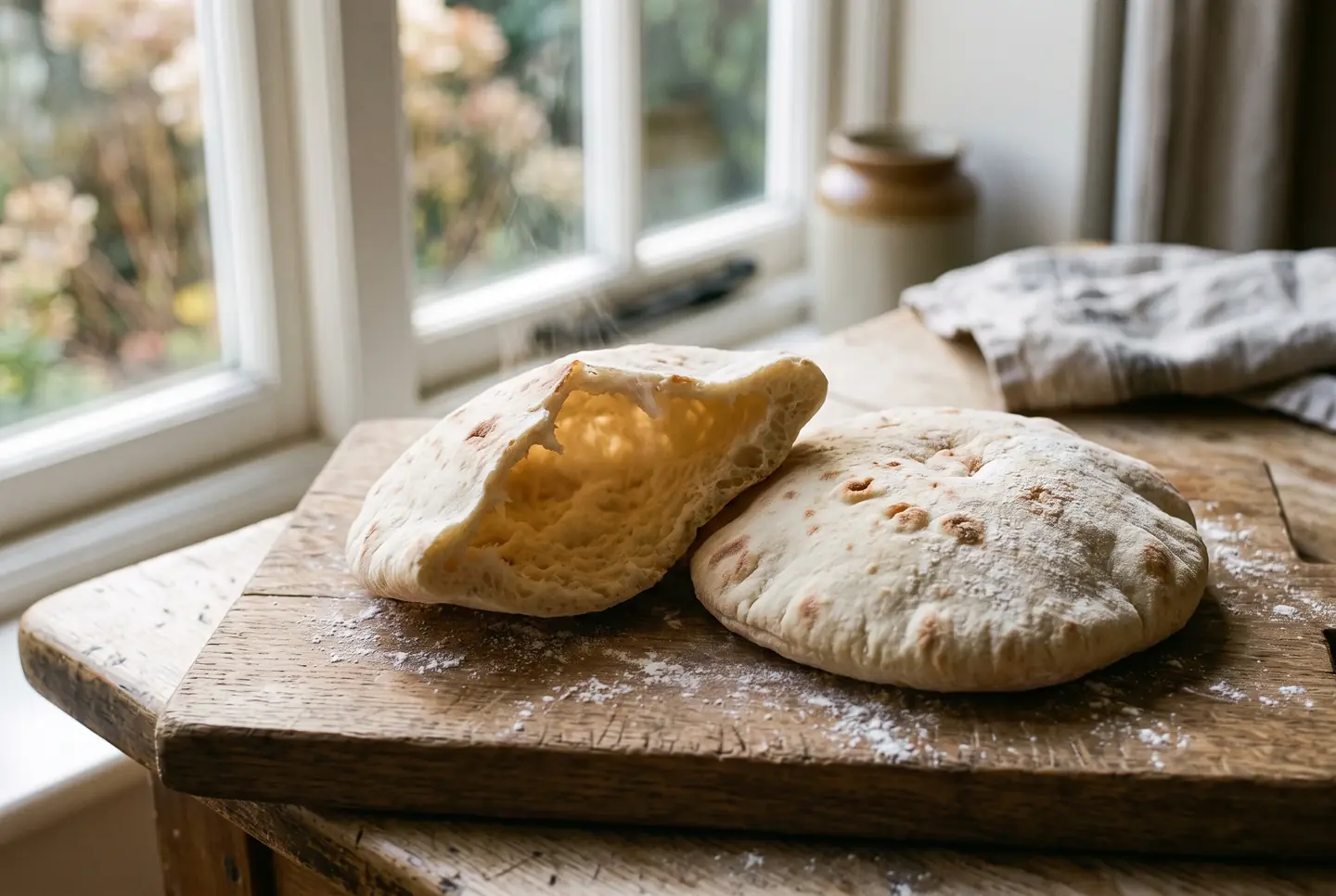
Pita bread is a thin disc that puffs up in the oven and opens a steam pocket inside. It comes from the Levant, in the Middle East, and it is one of the oldest breads we still eat today.
At a glance
- Origin
- Líbano, Síria, Palestina, Jordânia, Levante (Oriente Médio)
- Created
- not measured
- Hydration
- 60% to 68%
- Flour
- trigo de força média (pão)
- Leaven
- biológico
- Total time
- 2 h to 3 h
- Oven
- 250 °C
- Steam
- no
- Internal temperature
- not measured
- Shape
- disco achatado
- Difficulty
The recipe
Ingredients
| Amount | baker's % | |
|---|---|---|
| Bread flour (medium strength) | 500 g | 100% |
| Warm water | 325 g | 65% |
| Salt | 10 g | 2% |
| Instant dry yeast | 5 g | 1% |
| Olive oil | 15 g | 3% |
| Sugar | 8 g | 1.6% |
Method
- Mix the flour, salt, sugar and yeast in a bowl. Add the warm water and the oil and mix until it comes together into a dough.
- Knead 8 to 10 minutes, until the dough is smooth and elastic. Cover and let it ferment 1 to 1 and a half hours, until doubled.
- Divide into 8 equal balls. Round each one, cover and rest 15 minutes: a tight dough will not puff.
- Meanwhile, put a stone or a heavy tray in the oven and preheat as high as it goes, 250 °C or more, for at least 30 minutes.
- Roll each ball into a thin, even disc about 3 to 4 mm thick, with no thick edges. Rest a further 10 minutes.
- Bake one or two discs at a time straight on the hot stone. In 1 to 2 minutes they balloon up. Do not open the oven before that.
- Pull them out as soon as they puff, still pale or with a few golden spots. Stack under a cloth: the trapped steam keeps them soft and the pocket open.
The right flour
Classic pita wants a medium-strength wheat, the kind we call bread flour. It has enough gluten to hold the steam while the disc puffs: that elastic network takes the pressure of the balloon without bursting. All-purpose flour, a little weaker, also makes a good pita, slightly softer, it just puffs with less force. Flour that is too weak, like cake flour, will not hold the pocket and the disc bakes flat. For wholemeal pita, mix some wholemeal into the bread flour, but do not go past a third, because the bran weighs against the balloon and gets in the way of the pocket.
The story
Pita was born in the Levant, the strip of the Middle East that today covers Lebanon, Syria, Palestine and Jordan. It is a very old bread: the family of leavened flatbreads goes back thousands of years, to when the oven was a hot clay wall and the dough stuck to it for a few minutes.
The name pita spread to the West through the Greeks, which is why many people think the bread is Greek. The recipe itself belongs to the Arab world and the eastern Mediterranean, where it never stopped being the everyday bread: the base of shawarma, the edible spoon for hummus, the pouch you stuff with falafel. Wrap, dip or fill it, it is the same pocket disc that has fed the region for millennia.
What defines it
What defines pita is not the flavour or the shape, it is the pocket. It forms from steam: the thin dough, baked in a very hot oven, turns its water into steam inside before the crust sets. The steam has nowhere to go, so it pushes the two faces apart and blows the disc up like a balloon. When it cools, the balloon deflates and the pocket is left, that empty pouch you fill.
That is why pita wants the opposite of ciabatta. No open, holey crumb and thick crust here: you want two thin, soft layers that separate cleanly. Hydration sits in the middle, around 65%, high enough to make steam and low enough to roll a thin disc that will not tear. Thin is the key word: the more even the disc, the more cleanly the steam splits the two faces and the deeper the pocket runs.
How the dough behaves
The secret of pita is not in the dough, it is in the heat shock. The oven has to be at its maximum, 250 °C or more, with a stone or a heavy tray preheated for a good while. That scorching floor is what turns the water to steam all at once and puffs the disc in a minute or two.
After you mix flour, water, salt and a little yeast, the dough rests until it relaxes. You roll each ball very thin, let it rest again (a tight dough will not puff) and drop it straight onto the hot floor. No added steam, unlike what many bread recipes call for: the steam that opens a pita comes from inside the dough itself. Do not open the oven too soon, the disc needs those minutes untouched to inflate. A baker's trick is to lay each disc on the stone with its underside facing up, because the smoother face puffs better. And if your oven will not go past 220 °C, do it on the stovetop: a cast-iron pan over high heat runs hotter than many home ovens.
Variations
White pita is the most common, but the wholemeal version, with part of the flour swapped for wholemeal, is traditional and more aromatic, even if it puffs a little less. There is Greek pita, thicker and pocketless, made to wrap a gyros; and Arabic khubz, wider and thinner than a bakery pita. You can brush it with olive oil and za'atar before baking, or scatter sesame on top. And what goes stale is not thrown out: it becomes the toasted bread of a fattoush, or chips baked with oil and salt to eat with dips. A cousin of pita, Iraqi laffa is larger, thinner and baked stuck to the wall of a taboon oven, pocketless, made to wrap. And pita freezes very well: once baked and cool, seal it in a bag and freeze, then bring it back soft with thirty seconds in a hot oven or a quick pass in the pan.
Where it goes wrong
The mistake that kills the pocket most often is a cold oven. Without a very hot floor the steam builds slowly, the crust sets first and the disc bakes flat. Preheat for real, 30 to 40 minutes with the stone inside.
The second mistake is rolling the dough too thick or leaving thicker edges: the thick part holds the two faces together and the pocket never closes the circle. Roll it thin and even. The third is baking a tight, freshly rounded dough: it shrinks back and resists the steam, so let it rest before it goes in. And do not open the door in the first minutes to peek, the sudden cooling makes the balloon collapse before its time.
Frequently asked
- Why doesn't my pita bread form a pocket?
- Almost always a cold oven or dough rolled too thick. The pocket depends on a very hot floor that flashes the water to steam all at once. Preheat the stone for 30 minutes at the oven's maximum and roll the disc thin and even, with no thick edges.
- Do I need a baking stone?
- It helps a lot, but a heavy tray or a preheated cast-iron pan will do. What you cannot skip is the heat: without a scorching floor the pita bakes flat and never puffs.
- Can I make pita in a pan, without an oven?
- You can. On a very hot cast-iron pan, no oil, each disc puffs in a little over a minute per side. The pocket comes out the same, and that is how pita is made across most of the Middle East.
- Can I use sourdough instead of commercial yeast?
- Yes. A levain pita has more flavour and keeps better, it just needs a longer ferment. What opens the pocket is the hot oven, not the type of leaven, so the baking technique is the same.