Bread
Panettone: what defines the dough and a two-day recipe that works at home
The panettone most people know comes in a bag and lasts for months on the shelf. The classic Milanese one is another thing: a living lievito madre dough, two days of work and a dome that only holds if it cools upside down.
At a glance
- Origin
- Milão, Lombardia, Itália
- Created
- not measured
- Hydration
- 40% to 48%
- Flour
- farinha de força (tipo 0 / Manitoba) · W 350 to 400
- Leaven
- lievito madre
- Total time
- 36 h to 72 h
- Oven
- 160 °C
- Steam
- no
- Internal temperature
- 92 °C to 94 °C
- Shape
- cúpula alta em pirottino de papel
- Difficulty
The recipe
Ingredients
| Amount | baker's % | |
|---|---|---|
| Strong flour (W 350 to 400) | 300 g | 100% |
| Lievito madre (stiff sourdough) | 90 g | 30% |
| Water | 135 g | 45% |
| Sugar | 150 g | 50% |
| Egg yolks | 150 g | 50% |
| Butter, soft | 170 g | 57% |
| Acacia honey | 15 g | 5% |
| Vanilla bean | 3 g | 1% |
| Salt | 4 g | 1.3% |
| Raisins | 150 g | 50% |
| Candied fruit (orange and citron) | 100 g | 33% |
Method
- Refresh the lievito madre three times on the same day, three hours apart, with the same flour as the recipe. It is ready when it triples in about four hours and smells of sweet yoghurt.
- At night, make the primo impasto: mix the flour, the lievito madre, the sugar and the water, and knead until the gluten forms. Add the yolks a little at a time and finally the soft butter, waiting for each addition to disappear. Knead to the windowpane.
- Let the primo impasto triple in volume for 10 to 12 hours at 26 °C, covered.
- Next day, add the remaining flour to the primo impasto and knead until the gluten comes back. Add the sugar, the yolks, the emulsion of honey, vanilla and zest, and the soft butter a little at a time, always waiting for it to incorporate. Add the salt last.
- Fold in the raisins and candied fruit by hand, gently, just until they spread through. Do not knead after this.
- Rest the dough 30 to 60 minutes, then do the pirlatura on a lightly buttered counter, turning the dough until it forms a smooth, tight ball.
- Put it in the pirottino and let it rise 6 to 8 hours at 26 to 28 °C, until the dough reaches 2 cm from the rim.
- Do the scarpatura: cut a cross in the surface, lift the flaps, place a cube of butter in the centre and close it. Bake at 160 °C for 50 to 55 minutes (1 kg mould), until the centre reads 92 to 94 °C.
- Out of the oven, skewer two rods through the base, turn it upside down and let it cool that way for 8 to 12 hours before wrapping.
The right flour
There is no middle ground here: panettone needs strong flour, with a W between 350 and 400. This is Manitoba territory, and it is not a whim. The dough carries more fat and sugar than its own weight in flour, yolks that soften the gluten, and a fermentation that runs past twelve hours. An ordinary W 220 flour gives out along the way: the gluten tears and the dough collapses. The high W builds the elastic web that can hold that much fat and gas for that long. Look for the strength on the label, or protein above 13 g per 100 g.
The story
Panettone is Milanese, and it is old. Medieval Lombardy already baked an enriched bread for the holidays, with honey and raisins. The oldest firm record of pani grossi made with butter, raisins and spices sits in an account book of the Collegio Borromeo in Pavia, dated 1599, and by the eighteenth century the pane grande was well known.
The tall dome is newer. In the 1920s Angelo Motta began fermenting the dough inside a paper mould, the pirottino, and let it climb upward instead of spreading. That change gave panettone its domed shape. In 2005 an Italian decree fixed what may carry the name: natural fermentation from sourdough, at least 16% butter, 4% yolk and 20% between raisins and candied fruit. What fills the supermarket shelf at Christmas is another product, industrial and quickly leavened.
What defines it
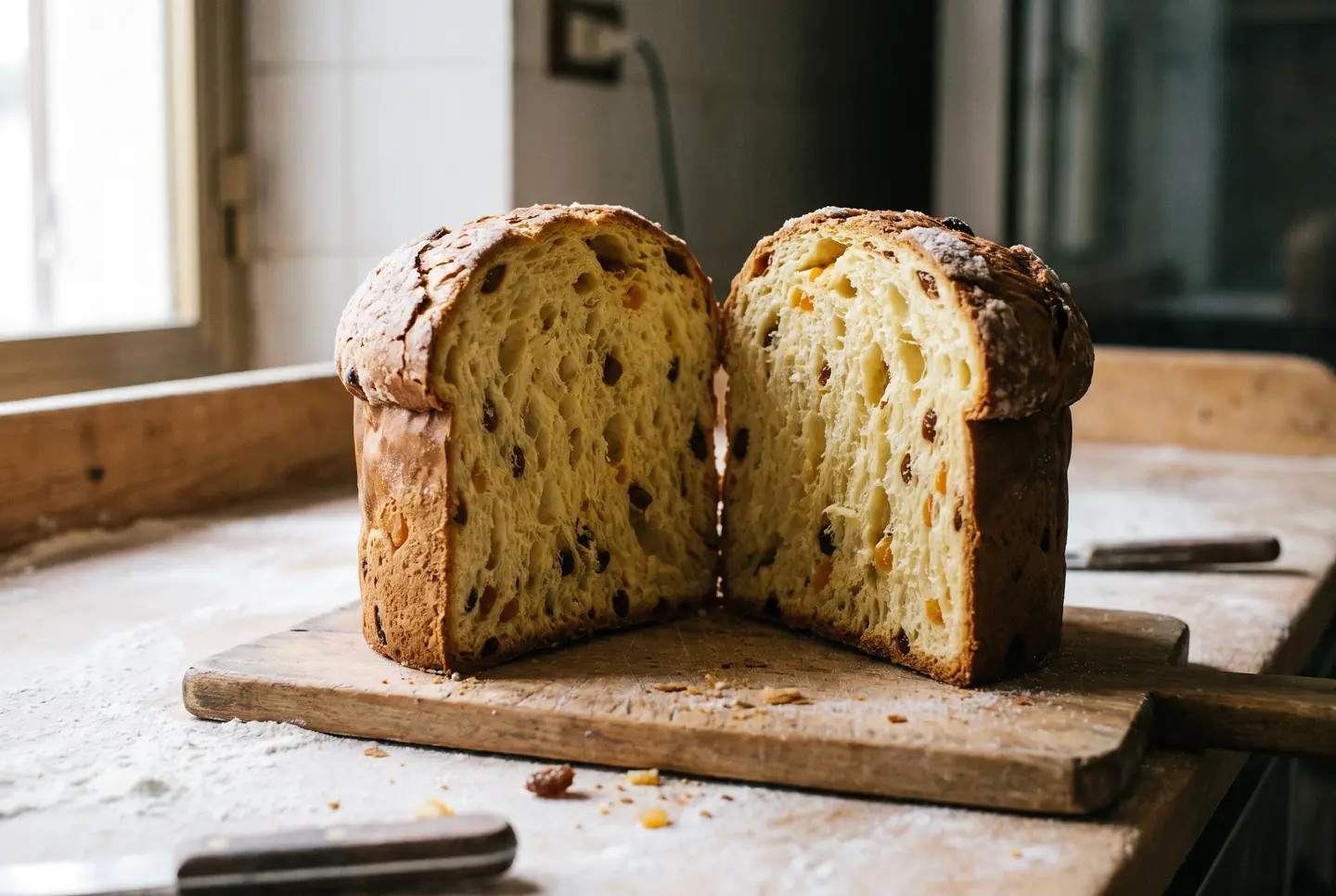
The right panettone shows before you cut it. The dome splits open on top in a cross, the scarpatura, and gives off a scent of butter, vanilla and orange peel. Torn open, the crumb comes away in strands: long yellow filaments of yolk that pull apart rather than crumble, full of irregular holes. It is soft, moist and elastic, never dry. If yours crumbles like cake, the lievito madre was weak or the yeast too fast.
How the dough behaves
Panettone is a two to three day project, and there is no honest shortcut. First comes the lievito madre, a solid sourdough that needs three refreshments on the same day, three hours apart, to wake up and turn sweet. Without a starter at its peak, the dough will not rise.
The primo impasto is made at night: flour, starter, sugar, water, yolks and butter, kneaded to the windowpane and left to triple in about twelve hours near 26 °C. The next day comes the secondo impasto, with the rest, the emulsion of honey, vanilla and zest, and last the raisins and candied fruit. Then comes the pirlatura: on a lightly buttered counter, you turn the dough on itself into a smooth, tight ball, which goes into the pirottino and rises another seven to eight hours.
Variations
The Milanese classic carries raisins and candied peel, but the family is large. The panettone basso, flatter and with an almond crust, is typical of Piedmont. There are versions with only chocolate chips, with cream, and the Veronese pandoro, the cousin without fruit. At home, the biggest adjustment is the oven: without a professional oven's power, bake at 160 °C and shield the dome with foil if it browns too fast.
Leftover panettone has one more life: the crumb, already rich in butter and egg, folds into a gelato base beautifully. We wrote the balanced version at panettone gelato.
Where it goes wrong
The mistake that ruins panettone most is a weak starter. If it does not triple on its own in four hours, it will not lift a dough this heavy. The second is butter going in warm or too fast in the secondo impasto: the emulsion breaks, the dough turns oily and the gluten tears. The third is baking without a thermometer: aim for 92 to 94 °C in the centre, not the clock. And the cruelest, cooling it upright. Straight from the oven the panettone cannot hold its own weight and sinks. It has to cool upside down, skewered at the base, for several hours.
Frequently asked
- Can I make panettone without lievito madre?
- You can make a similar sweet bread with commercial yeast, but it is not panettone. The solid sourdough is what gives the stringy crumb, the weeks of shelf life and the tangy aroma. Without it you have a good Christmas bread that stales in a few days.
- Why does my panettone sink as it cools?
- Almost always the missing upside-down cooling. Fresh from the oven the crumb is hot and cannot hold its own weight. Skewer the base, turn it upside down and leave it that way for six to twelve hours before wrapping.
- How is it different from supermarket panettone?
- The industrial one uses accelerated dough, fast yeast and vegetable fat, and is built to last months. The Milanese classic comes from lievito madre, two doughs and at least 16% butter and 20% fruit, as the 2005 Italian decree requires.
- Can I use baker's yeast instead of a starter?
- You can, and there are good recipes that do, but the result is another product: it rises faster, tastes more neutral and stales sooner. For the silky strands and the keeping quality of the classic, the starter is irreplaceable.