Bread
Pandoro: the story, the technique and a recipe that works at home
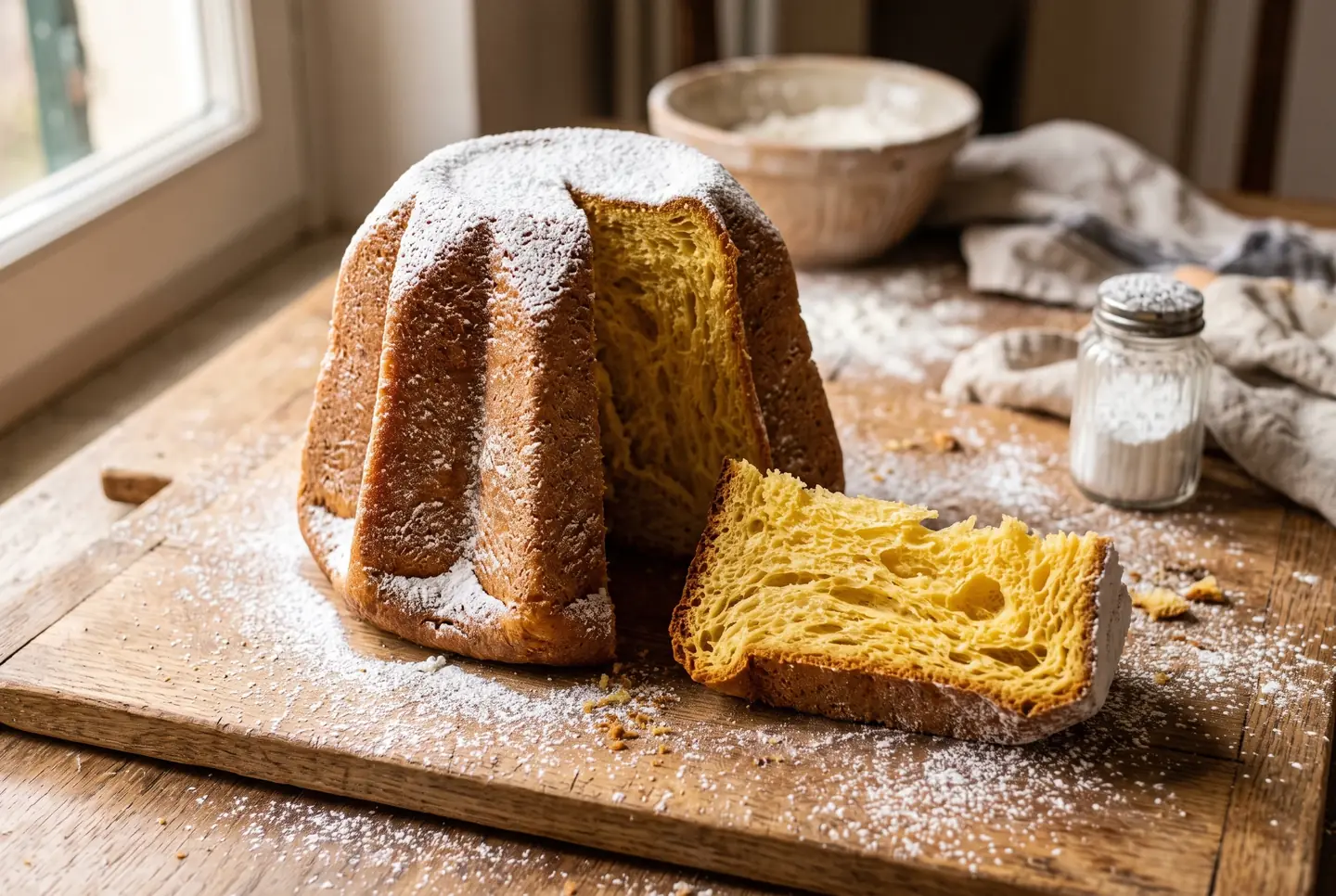
Pandoro is the Christmas cake of Verona: an eight-pointed star, golden with butter and yolk, light as a cloud. It looks simple, but it is one of the hardest sweets there is.
At a glance
- Origin
- Verona, Vêneto, Itália
- Created
- 1894, Domenico Melegatti
- Hydration
- not measured
- Flour
- manitoba · W 350 to 400
- Leaven
- lievito madre
- Total time
- 36 h to 60 h
- Oven
- 160 °C
- Steam
- no
- Internal temperature
- 93 °C to 96 °C
- Shape
- estrela de oito pontas
- Difficulty
The recipe
Ingredients
| Amount | baker's % | |
|---|---|---|
| Manitoba flour (W 350 to 400) | 500 g | 100% |
| Stiff sourdough starter (lievito madre) | 150 g | 30% |
| Egg yolks | 180 g | 36% |
| Sugar | 160 g | 32% |
| Butter (dough) | 150 g | 30% |
| Butter (lamination) | 100 g | 20% |
| Whole egg | 50 g | 10% |
| Water | 80 g | 16% |
| Cocoa butter (optional) | 15 g | 3% |
| Vanilla (pod) | 4 g | |
| Honey | 15 g | 3% |
| Salt | 5 g | 1% |
Method
- Two days ahead, build up the lievito madre with daily feeds until it triples on its own in three to four hours at 28 °C. Without a strong starter the pandoro will never lift the weight of butter and yolk that is coming.
- The night before, make the first dough: dissolve the sugar in part of the water, add half the yolks, the lievito madre and about 70% of the flour. Knead to a smooth, elastic dough, then work in the 150 g of dough butter a little at a time, until it is glossy and clears the bowl.
- Cover and ferment 10 to 12 hours at 26 to 28 °C, until tripled in volume. This long ferment is what gives the aroma and the lightness.
- In the morning, for the second dough, add the rest of the flour to the tripled mass and knead until it builds strength. Add in stages the honey, the remaining yolks, the whole egg, the vanilla and the salt, and only then the melted cocoa butter and the softened butter, always keeping the dough below 26 °C, until it passes the windowpane test.
- Rest the dough, covered, in the fridge for 30 to 40 minutes. It will firm up just enough for the lamination.
- Roll the dough into a rectangle, place the cold slab of lamination butter in the centre and fold it like a book. Roll and fold three times, resting 20 minutes in the fridge between each turn. Those layers are what give the feathery, stringy crumb.
- Shape the dough into a ball, set it seam down in a well buttered 1 kg star mould, and let it rise 8 to 10 hours at 26 to 28 °C, until the dome reaches close to the rim.
- Bake at 170 °C for the first 10 minutes, drop to 160 °C and continue 35 to 45 minutes more, until the centre reads 93 to 96 °C. If the top browns too fast, cover it with foil. Cool it upside down in the mould for at least 2 hours before turning it out, and serve the next day, dusted with icing sugar.
The right flour
Pandoro is the final exam for a flour. It carries almost its own weight in butter, yolk and sugar, and even so the gluten network has to hold all of that and still rise threefold in the oven. For that you need a very strong flour: manitoba, with a W between 350 and 400 and protein near 14% to 15%. See our manitoba reference at /farinhas/manitoba/, which already lists panettone and pandoro as its natural home.
The high W matters because the ferment is long, two to three days, and a weak flour would collapse well before the end. But strength alone is not enough: the dough also needs extensibility, the ability to stretch without tearing. Without it, the lamination breaks and the butter escapes instead of turning into layers. It is that balance, plenty of strength with good elasticity, that makes manitoba the flour of the great leavened cakes.
The story
Pandoro is young for such a traditional sweet. Its birth certificate has a date: 14 October 1894, when Domenico Melegatti, a Verona confectioner, patented the name, the shape and the process. (English Wikipedia gives 30 October; the Italian sources and Melegatti itself keep the 14th.)
But the root is far older. Verona already made nadalin, a dense, low Christmas cake topped with sugar, pine nuts and almonds, documented since the 13th century, in the time of the Della Scala. Melegatti took that heavy cake and lightened it: he removed the topping, added butter and yolk, and let the dough climb upward, tall and airy.
The name comes from the shine. Legend says someone, seeing a slice lit by the sun, cried out pan de oro, golden bread, for the colour the yolk and butter gave the crumb. The eight-pointed star shape was designed by the impressionist painter Angelo Dall'Oca Bianca: a truncated cone with an octagonal section that, seen from above, becomes a star.
What defines it
What defines pandoro is a lightness that should not be possible. It carries almost its own weight in butter and yolk, ingredients that normally weigh any dough down, and still it comes out light, with a yellow crumb full of strands that pull apart in the hand.
That stringy crumb is the signature. It comes from the sfogliatura, the same gesture as a croissant: the butter is laminated in layers inside the dough, and in the oven each layer becomes a wafer-thin sheet. Cut a good pandoro and it does not crumble, it opens into strands.
The second trait is the perfume. Real vanilla, butter and the long ferment of the lievito madre give an aroma no industrial shortcut reaches. And there is the shape: without the eight-pointed star, with icing sugar snowing over the top, it is not pandoro, it is just a tall cake.
How the dough behaves
Pandoro belongs to the family of grandi lievitati, the great Italian leavened cakes, alongside panettone. That means three things that scare anyone coming from ordinary bread: natural leaven is mandatory, there are several doughs, and it takes the patience of two to three days.
Everything starts with the lievito madre, the mother dough. It has to be strong, able to triple in three or four hours, or the heavy buttered dough will never rise. The first dough is made at night and ferments all night until it triples. The next day, the second dough adds the rest of the flour, the sugar, the yolks and, last of all, the softened butter, always keeping the dough below 26 °C so the fat does not melt.
Then comes the lamination: the dough is rolled out, given a slab of cold butter and folded like a book, three times, with a rest in the fridge between each turn. Only then does it go into the buttered mould, where it rises another eight to ten hours until the dome reaches the rim. It is a project, not a Sunday recipe.
Variations
The most famous variation is not in the dough, it is in the filling. Many people cut the pandoro into horizontal slices, spread mascarpone cream between them and rebuild the tree, for a festive dessert. Whipped cream, chocolate spread or zabaglione also show up.
In the dough, the real divide is between pandoro and panettone: same family, similar technique, but panettone carries candied fruit and raisins and has a cylindrical shape, while pandoro is plain, fruit-free, and bets everything on butter and vanilla. People who dislike fruit in a Christmas sweet are almost always on team pandoro.
Then there is nadalin, the Veronese ancestor, which survives as a regional sweet: lower, denser, with the sugar and almond topping Melegatti had removed. It is worth tasting the two side by side to understand what changed in 1894.
If a whole pandoro is more than the table can finish, the plainness that defines it, butter and vanilla with no fruit in the way, makes it an unusually clean flavour to freeze. The balanced recipe is at pandoro gelato.
Where it goes wrong
The mistake that ruins a home pandoro is starting with a weak lievito madre. If your mother dough does not triple on its own in a few hours, it will not lift kilos of butter and yolk: the pandoro comes out low and heavy. Build the starter up over days before you try.
The second mistake is dough temperature. Above 26 °C the butter melts, the emulsion breaks and the crumb looks like soap instead of strands. Work in a cool kitchen, chill the bowl, and stop kneading if the dough warms up.
The third is rushing the final rise. It really does take eight to ten hours, and cutting that short leaves the pandoro dense. And out of the oven, cool it upside down inside the mould: a hot pandoro resting on its base collapses under its own weight.
Frequently asked
- Do I really need lievito madre, or can I use baker's yeast?
- Classic pandoro is made with lievito madre, and that is where the aroma and the softness that last for days come from. You can make a version with baker's yeast and a long preferment, faster and easier, but the result is a different sweet: tasty, yet without that soul of the grandi lievitati.
- Can I make it without the star mould?
- You can, in any tall mould, like a panettone case or even a ring tin, but you lose the signature. The eight-pointed star is not just pretty: the points help such a rich dough bake evenly. Without it, watch the centre more closely so it does not stay raw.
- Why did my crumb come out like cake, not strands?
- Either the lamination was skipped or the butter melted. The strands come from the laminated butter layers; if the fat blends into one mass with the rest, the crumb is plain cake. Keep everything cold while laminating and do not skip the folds.
- How long does pandoro keep?
- Well wrapped, a week or more, which is why the industry sells it boxed all through Christmas. Lievito madre is a natural preservative: its mild acidity holds off staling. Store it in a sealed bag, away from heat, and never in the fridge, which dries it out.