Bread
Croissant: the story, the technique and a recipe that works at home
The croissant sounds French, but it was born in Vienna. Its charm is layered: dozens of paper-thin sheets of dough and butter that shatter when you bite.
At a glance
- Origin
- Paris, França
- Created
- 1905
- Hydration
- 48% to 58%
- Flour
- T45 ou T55 (de força) · W 180 to 280
- Leaven
- biológico
- Total time
- 14 h to 24 h
- Oven
- 200 °C
- Steam
- no
- Internal temperature
- 88 °C to 96 °C
- Shape
- crescente laminado
- Difficulty
The recipe
Ingredients
| Amount | baker's % | |
|---|---|---|
| T45 or T55 flour (strong) | 500 g | 100% |
| Cold whole milk | 140 g | 28% |
| Cold water | 140 g | 28% |
| Sugar | 55 g | 11% |
| Salt | 10 g | 2% |
| Instant dry yeast | 10 g | 2% |
| Soft butter (in the dough) | 40 g | 8% |
| Cold tourage butter (min. 82% fat) | 250 g | 50% |
Method
- Make the détrempe: mix the flour, cold milk and water, sugar, salt, yeast and the 40 g of soft butter just until you have a smooth dough, without kneading hard (too much gluten fights you when you sheet it). Flatten into a rectangle, wrap and chill 1 hour, or overnight.
- Make the butter block: pound the 250 g of cold butter between two sheets of paper into a square of about 18 cm, still cold but pliable. Keep it in the fridge.
- Roll the détrempe into a rectangle twice the size of the block. Set the butter in the centre and fold the dough over it like an envelope, sealing the edges. Butter and dough must be at the same cool, pliable state: if the butter cracks it is too cold; if it smears, chill everything.
- Roll into a long rectangle and give the first single fold (fold in three, like a letter). Wrap and chill 30 to 45 minutes. Repeat twice more, turning 90° each time and chilling between folds. Three single folds in all (or one double and one single).
- After the last fold, chill at least 1 hour, or overnight. The dough must be cold and rested so it sheets without shrinking back.
- Roll the dough to about 3 to 4 mm thick. Cut triangles with a 10 to 12 cm base. Nick the base of each, then roll from base to tip without squeezing, leaving the tip underneath.
- Brush with beaten egg, keeping it off the cut sides (it glues the layers and blocks the rise). Prove 2 to 3 hours at 24 to 26 °C, away from draughts, until almost doubled and jiggly when you shake the tray.
- Brush with egg again and bake at 200 °C in a well preheated oven for 15 to 20 minutes, until deep golden and the centre reads 88 to 96 °C. The layers should show at the cut. Cool on a rack.
The right flour
A croissant asks its flour to do two things at once: be strong enough to hold dozens of layers, and extensible enough to sheet thin without shrinking or tearing. In France that means T45 or T55, ideally the stronger de gruau versions, with a medium to medium-high W.
Outside France, a bread flour of moderate protein does the job well. See our bread flour reference at /farinhas/bread-flour/ to gauge the strength you need. A very strong flour like pure manitoba (/farinhas/manitoba/) fights back when you sheet and makes the dough spring closed; if manitoba is all you have, cut it with plain flour to lower the strength. Flour that is too weak cannot hold the lamination and the croissant collapses.
The story
The croissant has a French accent but a Viennese birth. Its ancestor is the kipferl, a crescent-shaped roll Austria had eaten since the Middle Ages, dense and enriched, with no layers at all.
The turn happened in Paris. In 1838 or 1839 the Austrian August Zang opened the Boulangerie Viennoise on the rue de Richelieu and showed the French the kipferl and the Vienna loaf. Local bakers copied it, renamed it for its crescent shape and, little by little, swapped the brioche dough for a yeasted laminated one.
The modern croissant, light and layered, belongs to the early twentieth century: the oldest known recipe is from 1905, and in 1915 Sylvain Claudius Goy wrote a version of pâte feuilletée levée already close to today's.
What defines it
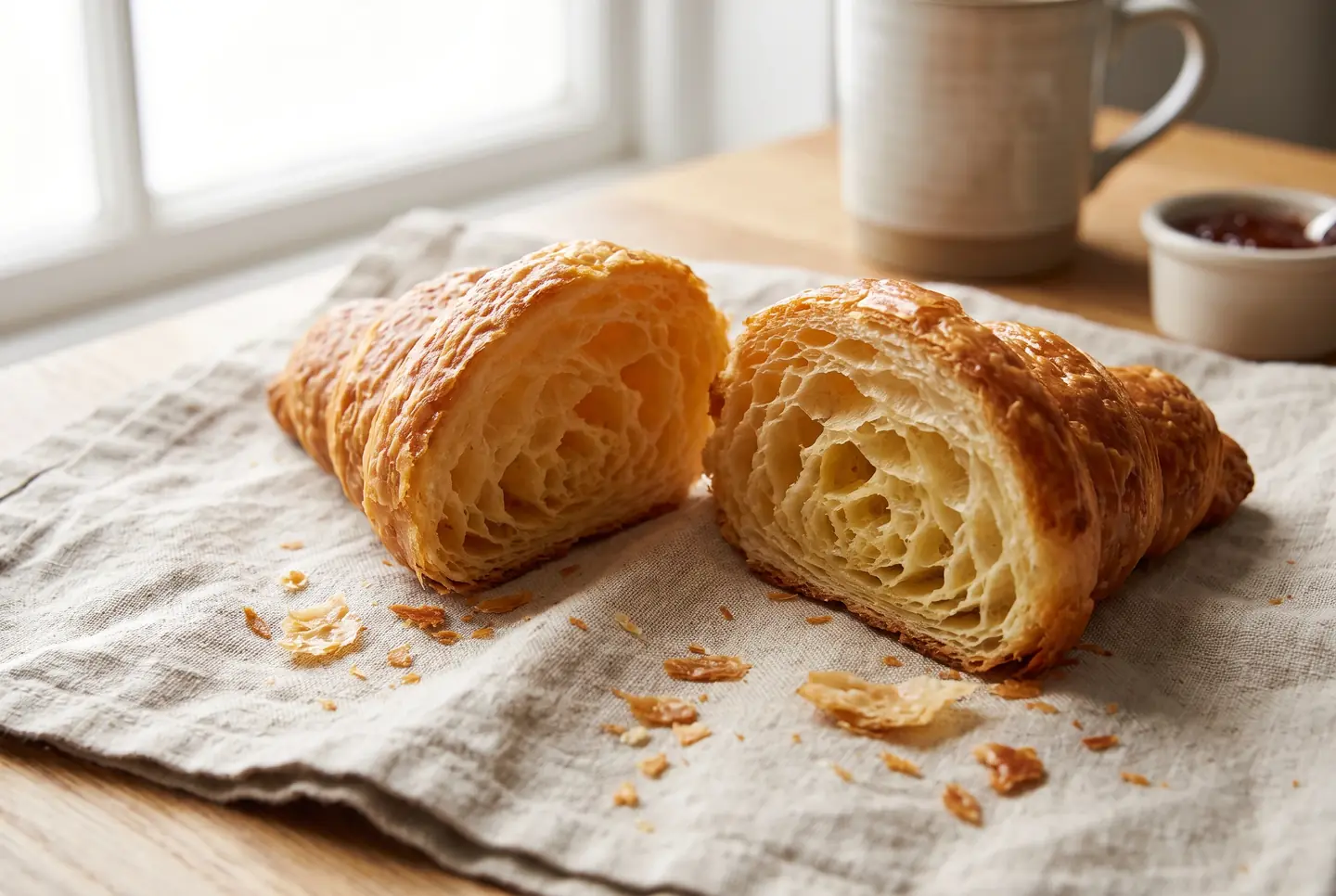
A good croissant gives itself away by sound and by cross-section. The crust cracks and sheds flakes when you bite, and inside the crumb shows a honeycomb of thin layers, not a soft even sponge.
The cut face is the honest portrait of the lamination. You should see the turns: walls of dough separated by gaps where the butter turned to steam and pushed one sheet off the next. A tight, greasy crumb means butter that melted while you sheeted; a bready crumb means too few layers or too little proof.
Outside, an all-butter croissant is straight by French convention (the curved shape usually flags margarine), egg-glossy and hazelnut brown.
How the dough behaves
The technique that defines the croissant is lamination: locking a block of butter inside the dough and rolling and folding it several times, building dozens of alternating layers of dough and fat. Three single folds give 27 layers of butter, enough to flake without becoming puff pastry.
Temperature is the whole game. Dough and butter have to yield together: if the butter is hard it cracks and pierces the sheets; if it softens, it melts into the dough and you lose the separation. That is why you work cold and rest in the fridge between folds.
How much butter to lock in divides bakers: the French rule of thumb is about a quarter of the dough weight, which lands near half the flour weight, while home recipes run from 40% to 56% of the flour. The final proof is the other delicate point: it must stay below the melting point of butter, near 24 to 26 °C.
Variations
The most famous cousin is the pain au chocolat, the same laminated dough rolled around two batons of chocolate, rectangular instead of crescent. The croissant aux amandes fills day-old croissants with almond cream and bakes them again, rescuing what went stale.
There is also the sourdough croissant, with levain instead of commercial yeast, tangier and slightly better keeping.
In Italy the close relative is the cornetto, and it is not the same thing: more sugar and egg, usually less flaky and softer, and almost always filled. Croissant and cornetto share the shape, not the formula.
Where it goes wrong
The mistake that ruins a home croissant most often is butter at the wrong temperature. Too cold and it cracks and vanishes between the sheets; too warm and it melts into the dough and the croissant bakes like a greasy bun. Work fast and go back to the fridge whenever the dough starts to sweat.
The second is sheeting with force and haste, which tears the layers and lets the butter leak. Roll in firm, even strokes, turn the dough, and let it rest if it resists.
The third is proofing too warm in the hope of rushing it. Above 28 °C the butter melts before the oven and you get a puddle on the tray, and the croissant bakes sodden instead of flaky.
Frequently asked
- Can I make croissants in a single day?
- You can, but it is a rush. The détrempe needs at least 1 hour in the fridge, and each fold needs another 30 to 45 minutes of cold rest. Without those breaks the butter warms and melts. Spreading it over two or three days is easier and tastes better.
- What butter should I use?
- A butter with at least 82% fat, ideally the tourage type, which is more plastic and takes rolling without cracking. Ordinary supermarket butter has more water and works less well, but it will do if it is well chilled.
- My croissant leaked butter in the oven. What went wrong?
- Almost always the proof was too warm or too long, and the butter melted before it baked. Prove near 24 to 26 °C and stop when the croissant wobbles like jelly, not when it has doubled in size.
- Why did mine come out bready, with no layers?
- Either the layers glued together (butter that softened and merged into the dough), or you sheeted too hard and pushed the air out. Work cold, with a light hand, and check that you can see the turns on the side before baking.