Bread
Ciabatta: the story, the technique and a recipe that works at home
Ciabatta looks ancient but it is younger than the VCR. It was invented in 1982, in Italy, to fight off the French baguette, and it became the sandwich bread of the entire world.
At a glance
- Origin
- Adria, Polesine, Veneto, Itália
- Created
- 1982, Arnaldo Cavallari
- Hydration
- 75% to 85%
- Flour
- tipo 0 · W 260 to 320
- Leaven
- biga (16 h to 20 h)
- Total time
- 18 h to 24 h
- Oven
- 230 °C
- Steam
- yes
- Internal temperature
- 93 °C to 96 °C
- Shape
- retangular achatado
- Difficulty
The recipe
Ingredients
| Amount | baker's % | |
|---|---|---|
| Bread flour (W 260 to 320) | 500 g | 100% |
| Water | 375 g | 75% |
| Salt | 10 g | 2% |
| Instant dry yeast | 3 g | 0.6% |
Method
- The day before, make the biga: mix 200 g of the flour, 100 g of the water and 1 g of the yeast into a rough, dry dough. Do not knead. Cover and leave 16 to 20 hours somewhere cool, around 18 °C.
- Next day, add the whole biga, the remaining 300 g flour, 250 g water and the rest of the yeast. Mix only until no dry flour is left and rest 30 minutes.
- Add the salt and the last 25 g of water in stages, squeezing the dough by hand until it goes in. It will stay slack and sticky: that is correct.
- Bulk ferment 2 to 3 hours at 24 °C. In the first 90 minutes give it three folds, 30 minutes apart, always with a wet hand.
- Tip the dough onto a well floured counter without pressing, so it keeps its gas. Cut two rectangles with a scraper. Do not shape.
- Move each one onto a floured cloth, cover and leave 45 to 60 minutes.
- Bake at 230 °C with steam for the first 15 minutes, then 10 to 15 minutes more without steam, until the centre reads 93 to 96 °C.
- Cool on a rack for at least an hour before cutting. Cutting it hot ruins the crumb.
The story
In 1982 Arnaldo Cavallari was looking at his own shop window with some irritation. The French baguette had taken over the Italian sandwich market, and he, a miller in Adria in the Polesine and a rally driver on weekends, decided to answer with a bread that was Italian from its shape to its name.
Cavallari called it ciabatta polesana after his region, trademarked it and licensed production. Within a few years the recipe was being made in several countries. Almost nobody eating a ciabatta today knows it has an owner, a birthday and paperwork.
What defines it
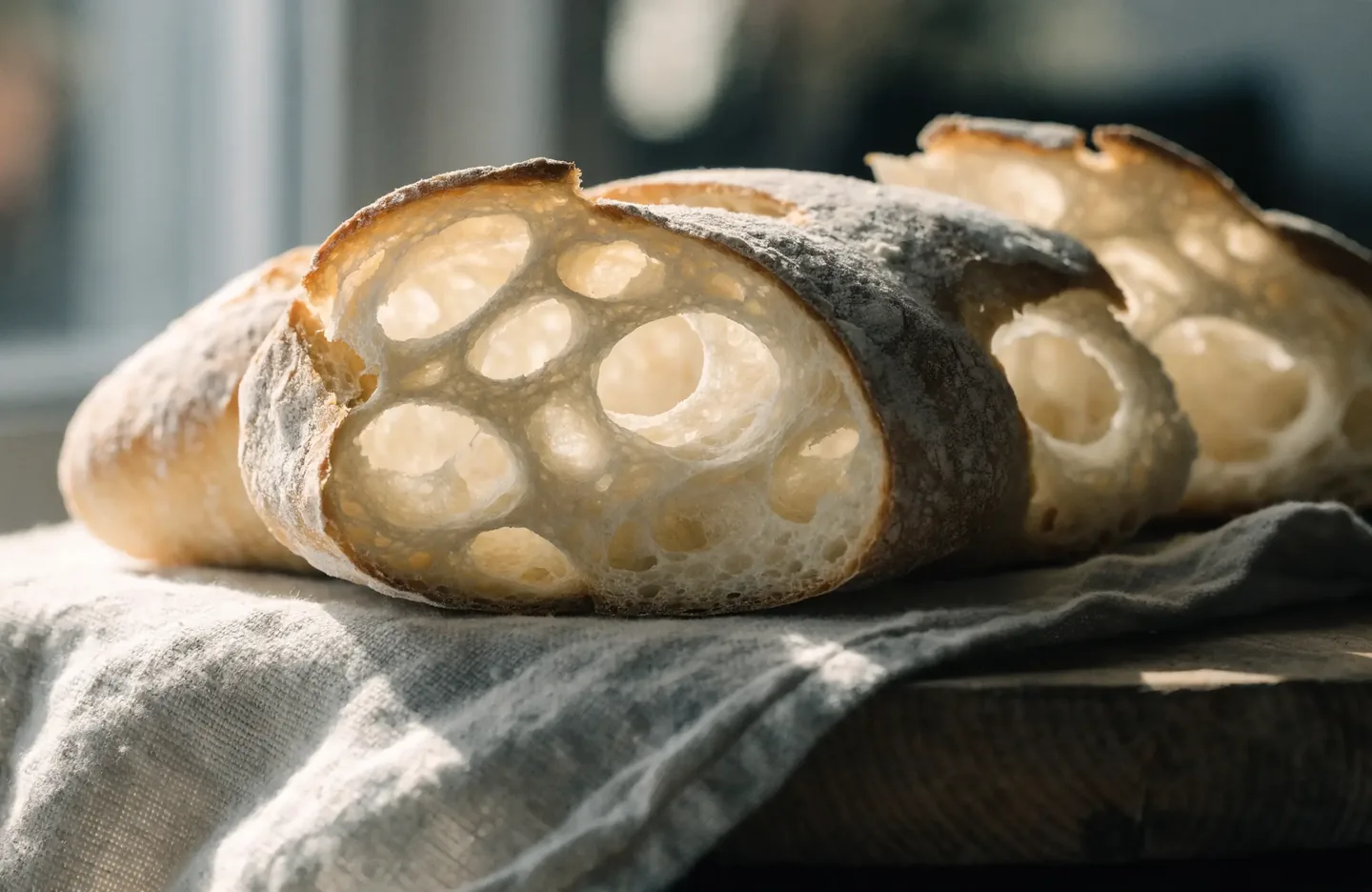
What defines ciabatta is not the shape, it is the water. Above 75% hydration the dough stops holding itself up and spreads, and that spreading is exactly what gives the irregular holes and the paper-thin crust.
The name means slipper. That is not poetry: it is the shape the dough takes on its own when you tip it out and do nothing to it. Ciabatta is the bread defined by what you do not do.
How the dough behaves
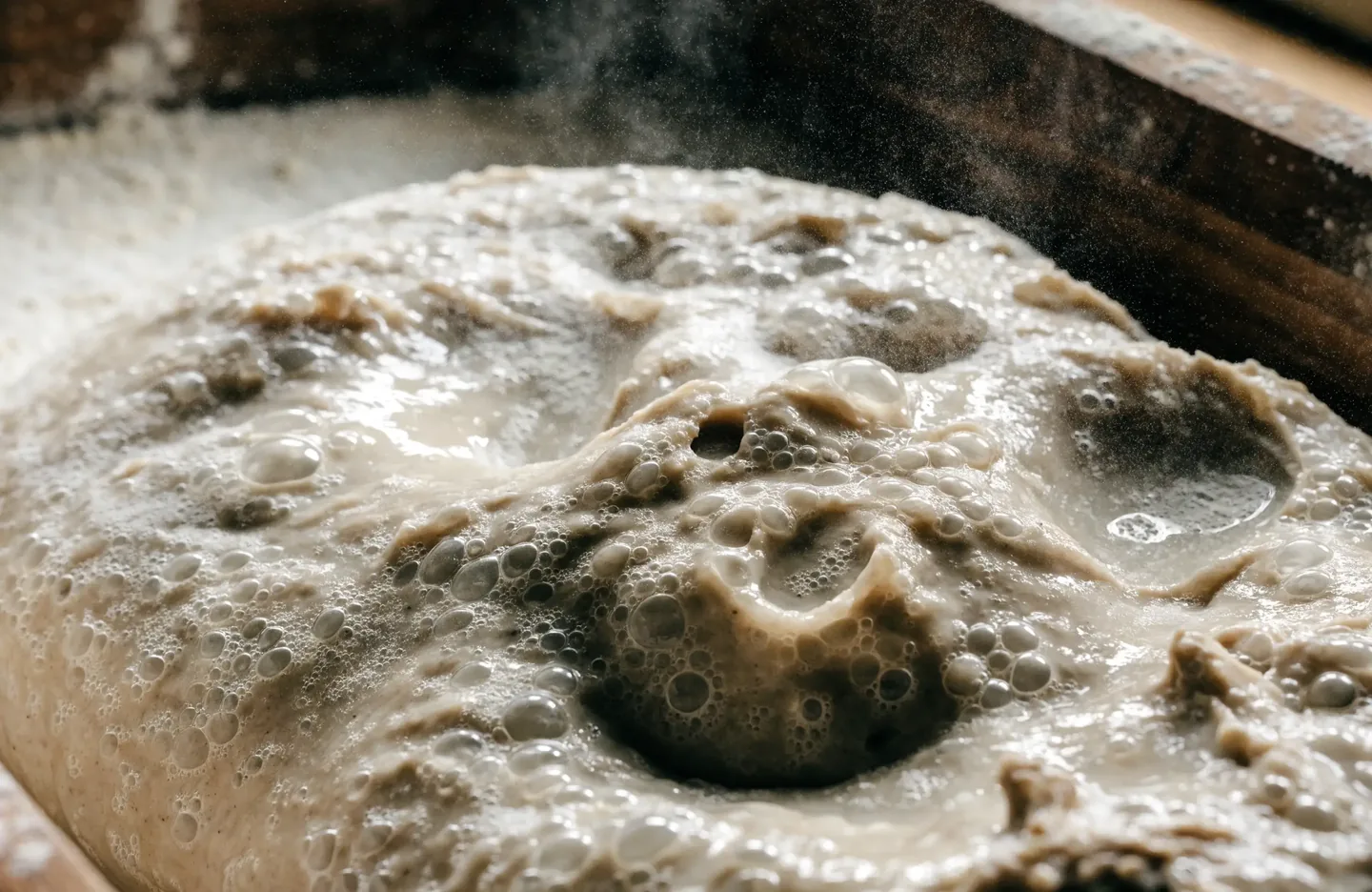
You work it with wet hands and as little handling as possible. Every extra fold closes the crumb, and the crumb is the whole point. Where other breads want kneading until smooth, ciabatta wants the opposite: you want it to keep looking like a dough that never got sorted out.
The overnight biga does most of the flavour. Sixteen to twenty hours with very little yeast, in a dry 50% hydration dough, and that is where the acids and aromas form that the next day's dough would never have time to build.
Variations
Ciabatta integrale swaps 20% to 30% of the white flour for wholemeal and comes out denser and more aromatic. Ciabatta con olive folds chopped olives in during the last folds, never into the mix, or the fruit tears the gluten network. There is also a version with olive oil in the dough, common in the south of Italy, which gives a softer crumb and a less crisp crust.
Where it goes wrong
The champion mistake is kneading it smooth, the way you would a sandwich loaf. Smooth ciabatta does not exist: if your dough is smooth, it is too dry and the crumb will come out closed.
The second is skipping steam. Without moisture in the first minutes the crust sets before the dough has finished rising, and the loaf stays low. The third is cutting it hot, which turns the crumb to rubber.
Frequently asked
- Can I make ciabatta without a biga?
- You can, but it becomes a different bread. Without the long overnight ferment the crumb still opens, but the flavour is shallow and the loaf stales the same day. If time is short, cut the yeast and stretch the bulk instead.
- My dough is impossible to handle. Did I do something wrong?
- Probably not. At 75% hydration the dough genuinely sticks and will not hold a shape. Wet your hands, use a scraper instead of fingers, and resist adding flour: every extra spoonful closes the crumb.
- Do I need a baking stone?
- It helps but it is not required. A heavy tray preheated for 45 minutes gets you most of the way. Steam is the part you cannot skip.
- Why does mine come out flat and wide?
- Almost always a bulk fermentation that ran too long for the kitchen temperature. In a 28 °C kitchen those 3 hours become 90 minutes. Watch the dough, not the clock.