Bread
Chocolate babka: the story, the twist technique and a recipe for home
Babka looks like a French patisserie dessert, but it started humble: it was the leftover challah dough that Eastern European Jewish families rolled with a filling so nothing went to waste. The chocolate that now defines it only arrived later, in New York, in the 20th century.
At a glance
- Origin
- Comunidades judaicas asquenazes (Ucrânia ocidental), Polônia e Ucrânia
- Created
- not measured
- Hydration
- 55% to 60%
- Flour
- farinha de força
- Leaven
- direto
- Total time
- 4 h to 14 h
- Oven
- 175 °C
- Steam
- no
- Internal temperature
- 85 °C to 90 °C
- Shape
- trança enrolada em fôrma
- Difficulty
The recipe
Ingredients
| Amount | baker's % | |
|---|---|---|
| Bread flour (strong, high-protein) | 500 g | 100% |
| Whole milk, warm | 200 g | 40% |
| Eggs (2 medium) | 100 g | 20% |
| Sugar | 60 g | 12% |
| Unsalted butter, softened | 120 g | 24% |
| Instant dry yeast | 8 g | 1.6% |
| Salt | 8 g | 1.6% |
| Dark chocolate, chopped (filling) | 150 g | 30% |
| Butter (filling) | 80 g | 16% |
| Sugar (filling) | 80 g | 16% |
| Cocoa powder (filling) | 30 g | 6% |
| Sugar (syrup) | 80 g | 16% |
| Water (syrup) | 80 g | 16% |
Method
- Dough: warm the milk to about 38 °C, dissolve the yeast and a pinch of the sugar and let it foam. In a bowl, mix the flour, the rest of the sugar, the salt, the eggs and the milk into a dough. Knead 8 to 10 minutes, until smooth.
- Add the softened butter a little at a time, kneading well between additions, until it disappears into the dough and it turns silky and elastic again. It goes through a sticky phase: keep kneading.
- First rise: cover and leave 60 to 90 minutes at about 26 °C, until nearly doubled. To make shaping easier, chill it in the fridge for 1 hour or overnight.
- Filling: melt the chocolate with the butter, add the sugar and cocoa and stir into a smooth paste. Let it cool until spreadable and firm, but not fully set.
- Roll the dough into a rectangle of roughly 40 by 30 cm. Spread the filling, leaving a 1 cm border. Roll it up tightly from the long side into a log and seal the seam well.
- With a sharp knife, cut the log in half lengthwise, leaving about 2 cm joined at one end. With the layers facing up, twist the two halves together, keeping the cut exposed.
- Set the twist in a greased, lined loaf pan. Cover and let it proof 30 to 60 minutes, until visibly risen and puffy to the touch.
- Bake at 175 °C for 40 to 50 minutes, until the centre reads 85 to 90 °C. If the top browns too fast, cover it with foil halfway through.
- Syrup: boil the sugar with the water until dissolved. Brush the hot syrup over the loaf while it is still hot, straight from the oven. Let it cool in the pan before turning out.
The right flour
Babka is an enriched dough, loaded with butter, eggs and sugar, and it is exactly all that fat that gets in the way of the gluten forming. That is why it wants a strong bread flour, with plenty of protein, able to hold the structure despite the butter. A standard bread flour handles it in most kitchens: see our reference at /farinhas/bread-flour/ to learn what to look for on the label.
If you plan to do the long cold ferment in the fridge, or want a tall, fluffy babka, it is worth stepping up to an even stronger flour such as manitoba, which survives hours of fermentation without slackening: we cover it at /farinhas/manitoba/. Flour that is too weak, like cake flour, will not hold the filling and the twist collapses, and the crumb comes out heavy instead of stringy.
The story
Babka started as an exercise in not wasting anything. In the Jewish communities of Poland and western Ukraine, in the early 19th century, there was always leftover challah dough from making the Sabbath loaf. Rather than throw it out, families rolled that scrap out, spread it with fruit jam or cinnamon, coiled it up and baked it alongside the challah. The name probably comes from baba, the Polish Easter cake, and means grandmother.
Chocolate, which now seems like the very essence of babka, was not part of the original recipe: it was expensive and scarce in Eastern Europe. It was only with the migration of Ashkenazi Jews to the United States, in the 20th century, that the chocolate filling became standard, above all in New York. Babka became pop culture in 1994, in a Seinfeld episode built around a fight over the last chocolate babka, and exploded for good in 2013, when the Israeli Breads Bakery opened in New York and turned its version into a phenomenon.
What defines it
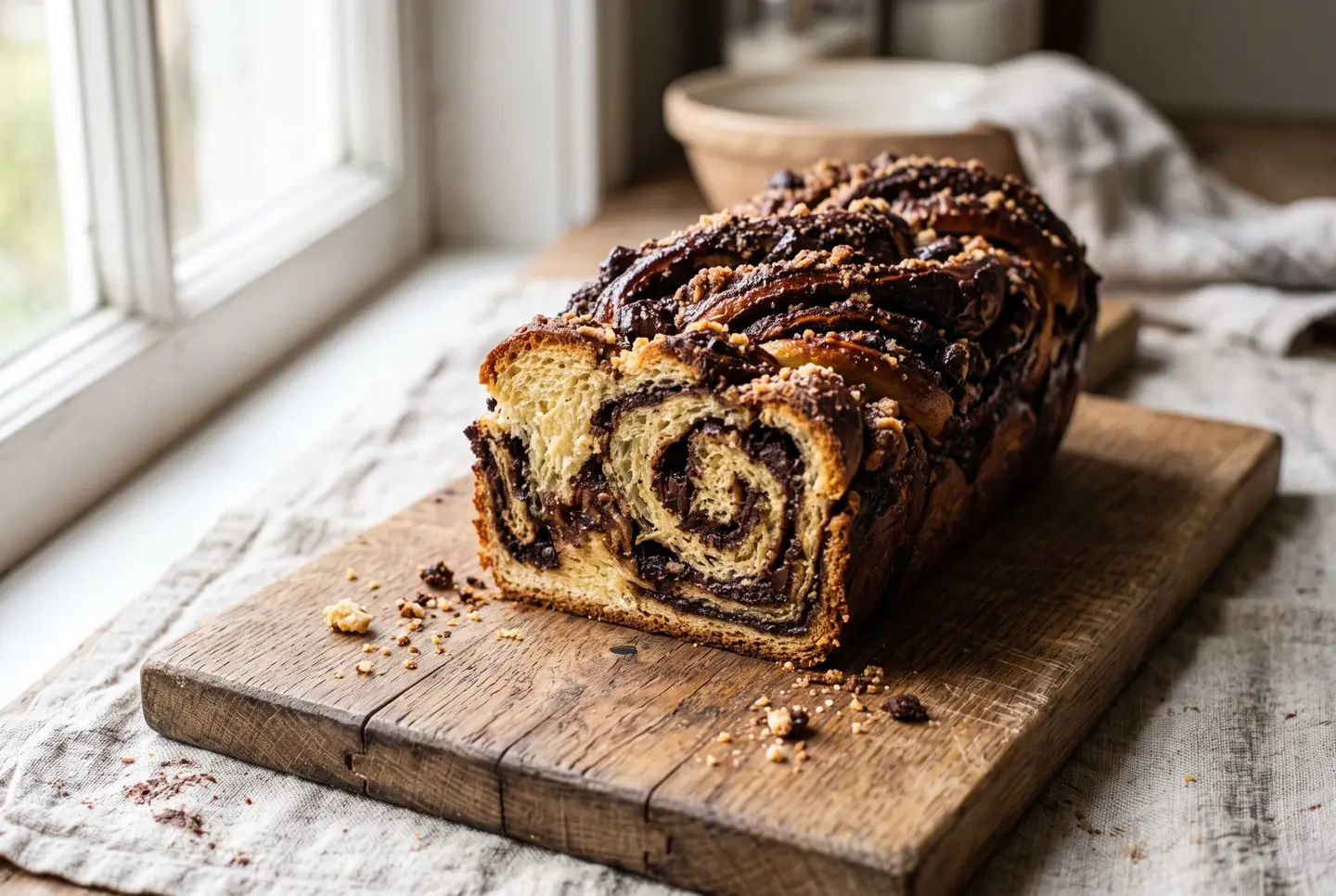
What makes a babka a babka is not the flavour of the filling, it is the pattern inside. Unlike an ordinary filled bread, where the filling hides in the middle, a babka puts its layers on display: you roll the filled dough into a log, cut that log in half lengthwise and twist the two halves together with the cut faces up. The result is a spiral of dough and chocolate that shows up in every slice.
That lamination by twisting is the signature. It is not a buttery laminated pastry like a croissant, and it is not a loaf with chocolate chips: it is an enriched dough, soft and slightly stringy, with dark veins repeating in thin layers. If your babka comes out with the chocolate pooled in one pocket, you made a roll, not a babka.
How the dough behaves
Babka dough is a cousin of brioche: lots of butter, eggs and sugar. That makes it soft and full of flavour, but also harder to knead, because the fat gets in the way of the gluten. The right order is to develop the dough first with just flour, milk and eggs, and only then work in the softened butter a little at a time, kneading until it disappears and the dough turns smooth and silky again. Hydration sits around 55 to 60%, drier than a classic brioche, precisely so the dough can survive being cut and twisted.
After the first rise, many bakers chill the dough for an hour, or even overnight. Cold dough is firm and does not stick, and that changes everything when you roll the rectangle, spread the filling and, above all, cut the log in half without crushing it. The lengthwise cut and the twist with the layers facing up are the decisive moment: that is where the spiral is born.
Variations
The most classic swap is cinnamon babka, made with a paste of brown sugar, butter and cinnamon instead of chocolate, closer to the original Eastern European recipe. The lazy version uses a hazelnut spread like Nutella straight from the jar, already spreadable. In Israel the same idea appears as krantz cake, often with a more generous sugar syrup that leaves the loaf almost sticky.
There are also savoury babkas, filled with cheese, garlic and herbs or za'atar, served as a table bread rather than a sweet. And some bakers pair chocolate with orange zest, tahini or pistachio, three combinations that sit beautifully against the buttery dough.
Where it goes wrong
Mistake number one is a warm, runny filling. If the melted chocolate is loose, it leaks through the dough, glues itself to the counter and the spiral never forms. Let the filling cool into a spreadable paste, firm but not hard.
The second is over-baking. Enriched dough dries out fast, and a babka taken too far turns dry and crumbly the next day. Pull it when the centre reads 85 to 90 °C, not later. The third is failing to seal the seam when you roll the log: if the seam opens, the roll falls apart as you twist. And the fourth is skipping the final proof: an under-proofed babka bakes dense and heavy, without that light, stringy crumb.
Frequently asked
- Do I need a stand mixer to make babka?
- It helps a lot, because the dough is rich in butter and tiring by hand, but you can do it by hand. Knead the base until smooth, add the softened butter in stages and be patient: the dough goes through a sticky phase before it turns silky again.
- Can I leave the dough in the fridge overnight?
- You can, and it is recommended. A long cold ferment deepens the flavour and firms the dough, making it far easier to roll, fill and cut the next day. Take it out of the fridge and work it while still cold.
- Why did my babka come out dry?
- Almost always too hot an oven or too long in it. Chocolate scorches easily, so babka bakes low, around 175 °C, and comes out when the centre reads 85 to 90 °C. Brushing on hot sugar syrup also helps keep it moist.
- What is the sugar syrup at the end for?
- It gives shine, sweetens the crust and, above all, seals in moisture, keeping the loaf soft for an extra day or two. Brush the hot syrup over the bread while it is still hot, straight from the oven, so it soaks in.