Flour
Emmer flour: high protein, weak gluten, and a nutty rustic crumb
Emmer is the middle of Italy's three farro wheats, and it plays a trick on anyone who trusts the protein figure. The number runs high, 12% to 18%, but the gluten behind it is weak, so the dough turns soft and extensible rather than strong. Read what it does at the bench, not the label.
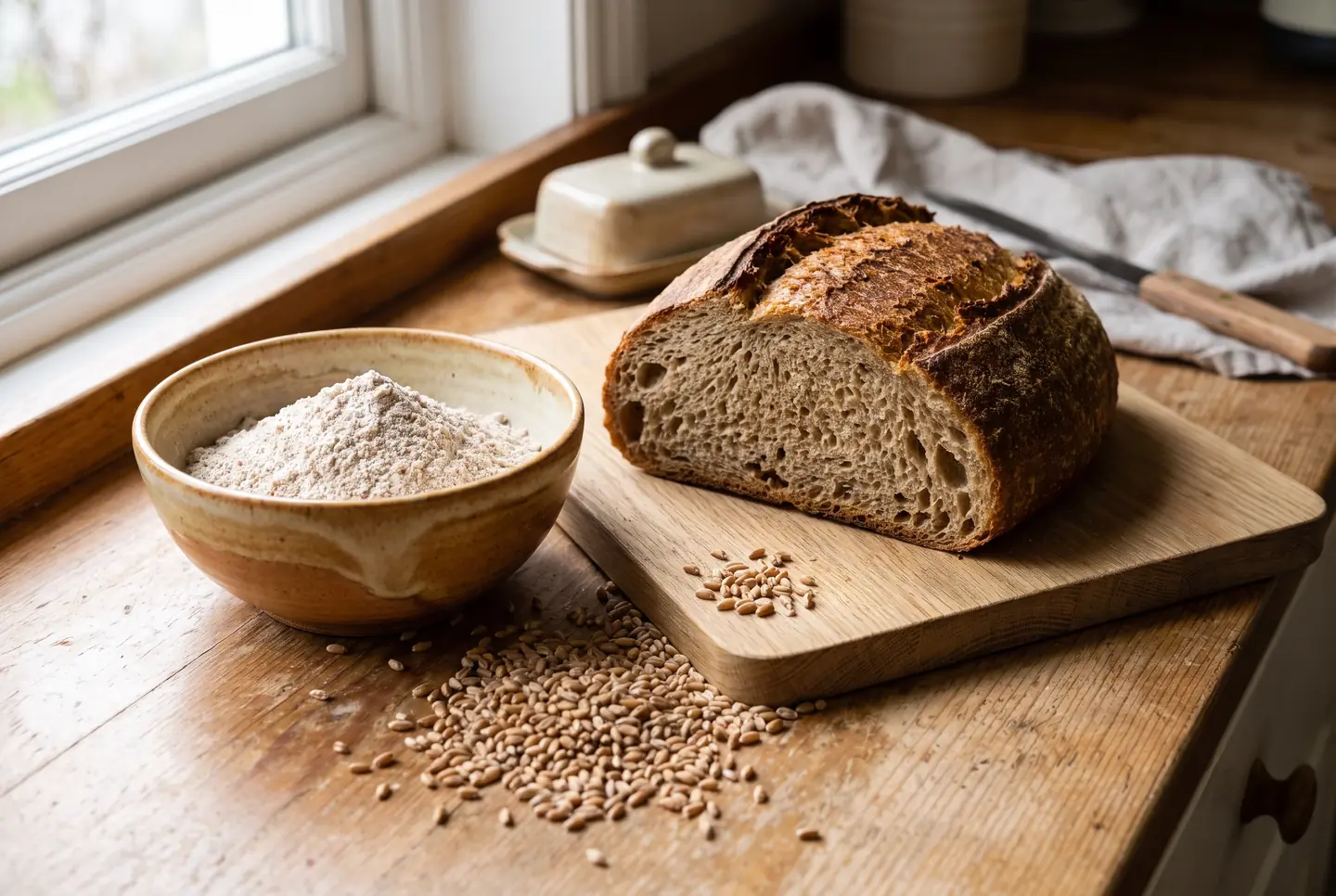
At a glance
- Strength (W)
- not measured
- Protein
- 12% to 18% *
- Water absorption
- not measured
- Stability
- not measured
- Ash
- 1.27% to 1.7%
- Origin
- Crescente Fértil; um dos primeiros cereais domesticados, há cerca de 10.000 anos. Hoje sobretudo na Itália (Garfagnana, Monteleone di Spoleto), com lavoura pequena no resto da Europa
- Grain
- Triticum dicoccum (turgidum subsp. dicoccum), trigo vestido e tetraploide (2n = 4x = 28); é o farro médio da tríade italiana e o ancestral direto do trigo duro
Sources disagree. Emmer runs high on protein, 12% to 18% depending on the cultivar and the study, but high protein is not the same as strong gluten, and here the two pull in opposite directions. The number that decides how the dough behaves is the gliadin-to-glutenin ratio: 4.9 in emmer against 2.5 in common wheat, with the lowest glutenin of the whole panel. So read the behaviour, not the protein: emmer gives a soft, very extensible dough that tears easily, holds gas poorly, and never builds a real windowpane.
What it is called in each country
| Country | Called |
|---|---|
| English | emmer (Reino Unido); nos EUA o rótulo costuma dizer farro, termo que lá cobre os três trigos vestidos |
| Português | trigo emmer, quase sempre pelo nome em inglês; no varejo brasileiro chega como farro importado, de loja italiana ou de produtos naturais |
| Italiano | farro medio / farro dicocco. Na Itália farro sozinho pode ser qualquer um dos três: peça dicoccum. As IGP Farro della Garfagnana e Farro di Monteleone di Spoleto são dicoccum |
| Français | amidonnier. Petit épeautre é einkorn e grand épeautre é a espelta: nenhum dos dois é amidonnier |
| Español | escaña mayor / farro. Não confundir com escanda (espelta, nas Astúrias) nem com escaña menor, que é o einkorn |
What it is for
Emmer earns its place in a blend. Cut 25% to 50% into a good bread flour and you buy the nutty, sweet, faintly rustic flavour and the whole-grain nutrition, the fibre and the minerals, while the bread flour carries the structure the emmer will not. That is the sweet spot for most home loaves, pizza and focaccia.
On its own it makes a dense, close, low loaf, and some days that is exactly what you want: a tight tin bread for cheese and cured meat, a hearth-style pane rustico, flatbreads, crackers, biscuits and shortcrust. Fresh pasta is its other home ground, no surprise given it is durum's ancestor: the dough rolls out silky and takes sauce beautifully.
How to substitute it
Swapping emmer into a recipe you already know is easy if you go by feel, not one for one. Start at 25% emmer and 75% bread flour, hold a little water back, and shorten the mix. Push toward 50% for more flavour and a denser crumb, and expect the dough to feel slacker and stickier at every step.
Its closest relatives make the most natural partners. Semolina (/farinhas/semolina/), milled from emmer's own descendant durum, is the obvious blend for pasta and rustic loaves. Among the farro cousins, spelt (/farinhas/spelt-flour/) brings a touch more strength and einkorn (/farinhas/einkorn-flour/) a touch less, so a common wheat still does the structural work.
When not to use it
Emmer is the wrong flour for anything built on strong, elastic gluten and a big rise. Skip it, or keep it to a small fraction, for open high-crumb breads like an open-crumb baguette or a ciabatta, for laminated doughs like croissant and puff pastry, and for anything that depends on real oven spring. Weak gluten cannot hold the gas those breads need: the crumb collapses tight, the lamination shears instead of stretching, and the loaf stays low.
How to use it
Baking 100% emmer is a change of technique, not just of flour. Keep the hydration on the low side, because a wet emmer dough turns to paste with nothing to hold it. Mix short and gentle: you are not building a strong gluten network, you are trying not to shear the weak one you have, so skip the aggressive folds.
Do not wait for the dough to double, it will slacken and spread before it ever gets there. Shape it into a tin, where the walls carry the loaf the gluten cannot, and bake it while it still has some spring left. A dense, moist, nutty crumb is the goal here, not an airy one.
How to choose one when buying
The word on the bag is the trap. Farro covers all three hulled wheats, so a bag marked only farro could be einkorn, emmer or spelt. Look for dicoccum or emmer printed somewhere, and note the market split: in the US emmer is usually labelled farro, while UK bags tend to say emmer outright.
Watch two more things. Pearled or perlato farro is the whole grain for cooking, the kind you simmer like rice, not the flour, so make sure you are buying it stone-ground into flour. And stone-ground flour keeps the germ, which means it goes rancid: buy small bags and use them fresh.
The story
Emmer is one of the first cereals anybody farmed. It was domesticated in the Fertile Crescent around 10,000 years ago, and it fed ancient Rome as the grain the Romans called far: the same root that gives Italian farina and, further down the line, the English word flour.
Botanically it sits in the middle of Italy's farro trio, the three hulled wheats sold under one confusing name. Farro piccolo is einkorn (Triticum monococcum), farro grande is spelt (Triticum spelta), and farro medio, the one on this page, is emmer (Triticum dicoccum). Emmer is a hulled, tetraploid wheat: 28 chromosomes against einkorn's 14. It is also the direct ancestor of durum, the pasta and semolina wheat, both of them Triticum turgidum.
It faded when free-threshing wheats took over, but it never left Italy. Two protected names still carry it: Farro della Garfagnana in Tuscany and Farro di Monteleone di Spoleto in Umbria, both of them dicoccum.
Frequently asked
- Is emmer the same as spelt or "farro"?
- Not quite. Farro is not one grain, it is the Italian name for three hulled wheats: farro piccolo is einkorn, farro medio is emmer, and farro grande is spelt. Emmer is the middle one, tetraploid with 28 chromosomes. So emmer is a farro, but so are the other two, which is why the bare word farro tells you almost nothing on its own.
- Can I bake 100% emmer bread?
- Yes, but expect a dense, close, low loaf rather than an airy one. Emmer's weak gluten cannot hold much gas, so keep the hydration low, mix short and gentle, bake in a tin, and do not wait for it to double. For a lighter, taller result, blend 25% to 50% emmer into a bread flour and let the stronger wheat do the lifting.
- Does emmer contain gluten? Is it safe for celiacs?
- Emmer contains gluten, so it is not safe for anyone with celiac disease or a gluten intolerance. It is an ancient wheat, not a gluten-free grain, and its weak gluten is a baking trait, not a health pass. If you are avoiding gluten for medical reasons, emmer is off the table.
- How does emmer differ from common wheat in the kitchen?
- Flavour and behaviour. Emmer tastes nuttier and sweeter and brings more whole-grain character, but its dough is softer, stickier and far more extensible, tearing where common wheat would stretch. It also holds gas poorly, so you work faster, wetter is not better, and you lean on a tin or a blend for the structure common wheat gives you for free.