Flour
Buckwheat flour: what it is, what it is for, and the galette it makes
It is not wheat, and not even a grass. That single fact explains the missing gluten, the blank strength figures on the bag, and why every country that adopted it ended up with a batter or a noodle, never a loaf.
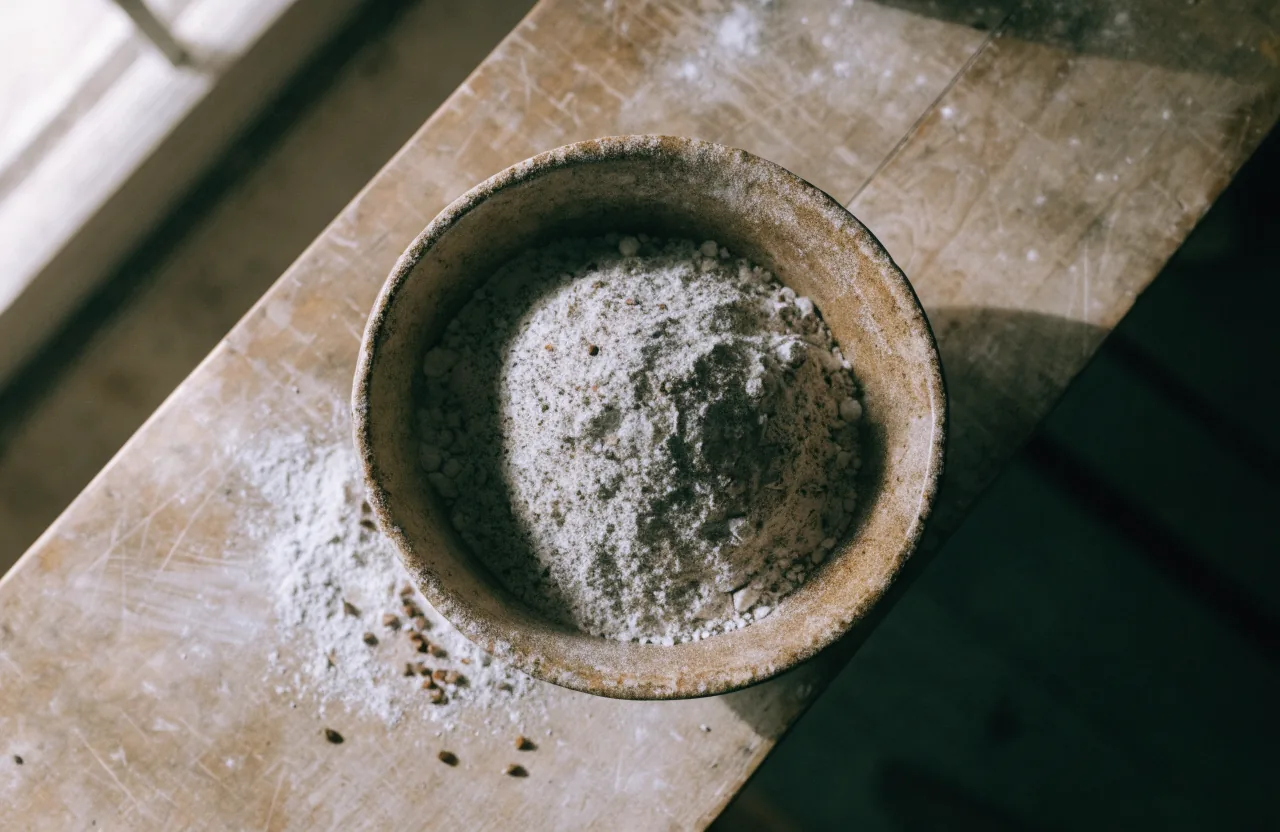
At a glance
- Strength (W)
- not measured
- Protein
- 12% to 12.6%
- Water absorption
- not measured
- Stability
- not measured
- Ash
- not measured
- Origin
- Ásia oriental; na Europa desde o século XIV, documentado na Bretanha desde 1497
- Grain
- não é cereal nem trigo: semente de Fagopyrum esculentum, da família do ruibarbo
What it is called in each country
| Country | Called |
|---|---|
| English | buckwheat flour: light (sifted) ou dark (whole groat) |
| Português | farinha de trigo sarraceno ou trigo mourisco |
| Italiano | farina di grano saraceno (integrale para pizzoccheri e polenta taragna) |
| Français | farine de sarrasin ou blé noir (IGP Farine de blé noir de Bretagne, registrada na UE em 2010) |
| Español | harina de trigo sarraceno o alforfón |
What it is for
Buckwheat is at its best in a batter. Breton galettes, Russian blini, the American breakfast pancake: in all of them the flour is not a substitute for wheat, it is the reason they taste the way they do. It browns fast, it smells of nuts and toasted hay, and it carries ham, cheese and egg the way no wheat pancake quite manages.
It also makes noodles: Japanese soba is buckwheat cut with wheat flour, and the wheat is there only to hold the dough together while you roll and cut it.
And it works as a minority partner: 10% to 20% in a wheat dough gives the speckled crumb and the bitter almond note without costing the rise. Past 20% the crumb starts to tighten and you pay for it in structure.
When not to use it
A loaf made only of buckwheat is the classic disappointment. There is no gluten at all, so nothing traps gas and no oven spring is coming. What you get is dense and gummy the next day, and neither more yeast nor a longer proof fixes it: the problem was never the fermentation.
It is also wrong for anything laminated or delicate. Croissants need extensible gluten, and buckwheat only dilutes what the wheat brought. In a light sponge, past a small proportion the crumb turns heavy and the flavour goes from nutty to frankly bitter.
How to use it
Decide between light and dark first: it matters more than the brand. Dark flour is the whole groat, hull fragments included: grey-brown, speckled, stronger, faintly bitter, and it is what gives a galette its character. Light flour is sifted, paler and milder, easier to like in blini, thin crepes and cakes. If your result tastes harsh, go light. If it tastes of nothing, go dark.
With no gluten to develop, the usual rules invert. You cannot overwork a buckwheat batter, so whisk it as hard as you like, and it takes far more water than a wheat batter would: nothing holds that water in place, so the mix looks thin, and it should. Spread it thin in the pan, too: thickness is what makes a galette rubbery.
In bread, start at 20% of total flour and stop at 30% unless you will trade rise for flavour, with a little extra water, since buckwheat drinks and gives nothing back. Buy small bags, too: it turns rancid faster than wheat flour. And no W will be printed anywhere, because an alveograph measures a gluten network and there is none here.
The story
Buckwheat is not a cereal and not a wheat. It is the seed of Fagopyrum esculentum, a plant in the family of rhubarb and sorrel, which is why it carries no gluten and no botanical relation to the wheat in its name. The name is a translation accident: the Dutch called it boekweit, beech wheat, after the little three-sided seed that looks like a beech nut. The French are blunter: blé noir, black wheat.
It came out of East Asia, reached Europe in the fourteenth century and is documented in Brittany from 1497, for an unglamorous reason: it grows fast, tolerates thin acid soil and asks for no manure, exactly where wheat sulks. It became the crop of people who could not grow wheat, and the galette the daily bread of a region with no bread flour. France recognised a protected geographical indication in 2008, Farine de blé noir de Bretagne, and the European Union registered it in 2010.
Here is the part almost nobody joins up. Japan turned buckwheat into soba, Russia into blini and kasha, Lombardy into pizzoccheri and polenta taragna, the United States into a breakfast pancake. Four cultures with no contact, one conclusion: buckwheat becomes a batter, a porridge or a noodle. Every tradition that adopted it stopped short of the loaf, centuries before anyone had a word for gluten.
Frequently asked
- What is the difference between light and dark buckwheat flour?
- Light flour is sifted, so most of the hull is gone: pale grey, mild, slightly sweet. Dark flour is milled from the whole groat and keeps hull fragments, which makes it speckled, stronger and a little bitter. Dark is the traditional choice for galettes, light the easier one in blini, thin crepes and cakes.
- Is buckwheat flour gluten-free?
- Yes. Despite the name, buckwheat is not wheat and not even a grass: it is the seed of a plant related to rhubarb, and it contains no gluten. If you are coeliac, the risk lies in the mill rather than in the plant, so buy a bag certified gluten-free.
- Can I bake bread with 100% buckwheat flour?
- You can bake something, but not a risen loaf in the usual sense. With no gluten there is nothing to hold gas, so it wants a tin, a binder and modest expectations, and still comes out dense. For bread you can slice, keep buckwheat at 20% to 30% of a wheat dough.
- Why does my buckwheat flour taste bitter?
- Two likely reasons. Either it is the dark grade, whose hull fragments carry a bitterness that is normal and rather the point, or the flour has gone rancid, which happens faster than with wheat. Rancid buckwheat smells faintly of paint, so smell the bag before you mix.