Bread
Stollen: the Dresden Christmas bread that matures for weeks before you cut it
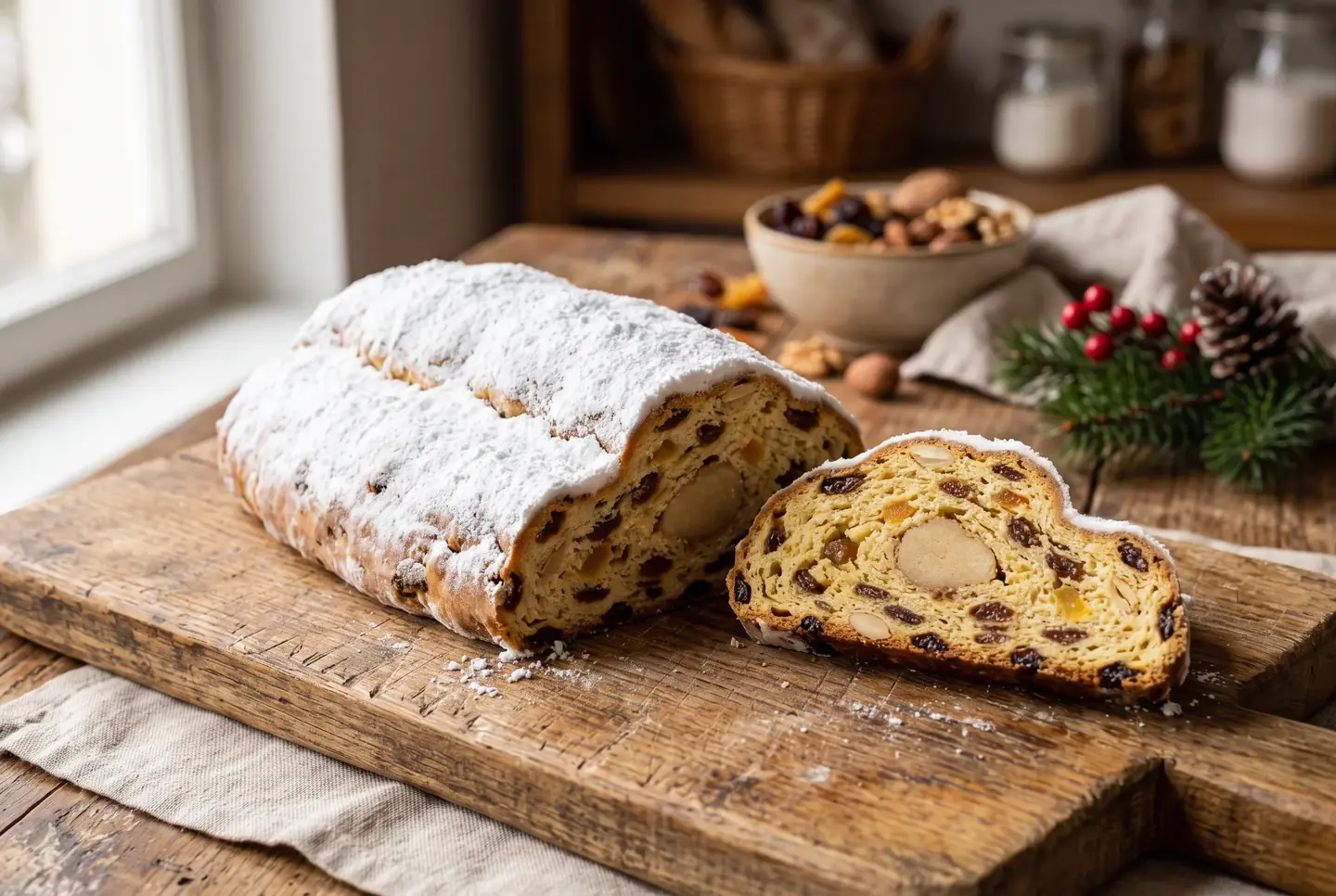
Stollen is the German Christmas bread, and it looks like nothing else. It is heavy, buttery and buried in sugar as if it had snowed, and the strangest part: you do not eat it the day you bake it. It needs weeks of rest to come good.
At a glance
- Origin
- Dresden, Saxônia, Alemanha
- Created
- 1474
- Hydration
- 35% to 50%
- Flour
- trigo forte, W alto (a massa carrega muita manteiga e fruta)
- Leaven
- fermento biológico (levedura fresca)
- Total time
- 6 h to 15 h
- Oven
- 175 °C
- Steam
- no
- Internal temperature
- 90 °C to 94 °C
- Shape
- pão dobrado, formato oval, coberto de manteiga e açúcar de confeiteiro
- Difficulty
The recipe
Ingredients
| Amount | baker's % | |
|---|---|---|
| Strong bread flour | 500 g | 100% |
| Whole milk, warm | 200 g | 40% |
| Fresh yeast | 25 g | 5% |
| Butter, soft | 250 g | 50% |
| Sugar | 60 g | 12% |
| Salt | 8 g | 1.6% |
| Egg | 55 g | 11% |
| Raisins and sultanas | 325 g | 65% |
| Candied peel (orange and lemon) | 100 g | 20% |
| Rum (to soak the fruit) | 50 g | 10% |
| Chopped almonds | 75 g | 15% |
| Ground cardamom | 2 g | 0.4% |
| Mace or nutmeg | 1 g | 0.2% |
| Cinnamon | 2 g | 0.4% |
| Lemon and orange zest | 10 g | 2% |
| Marzipan (optional core) | 200 g | 40% |
| Melted butter (to brush) | 80 g | 16% |
| Icing sugar (to coat) | 80 g | 16% |
Method
- The night before, add the raisins, sultanas and candied peel to the rum and let them soak overnight, stirring now and then. They need to drink the alcohol and swell, or they will bleed water into the dough later.
- Warm the milk, crumble the fresh yeast into it with a pinch of sugar and a spoon of the flour, and let it foam for about 15 minutes.
- Mix the rest of the flour with the sugar, salt, cardamom, mace, cinnamon and zest. Add the foamed milk and the egg and knead until the dough is smooth.
- Add the soft butter a little at a time, waiting for each portion to disappear before the next. The dough turns rich and heavy: knead until it comes off the counter, without expecting a thin windowpane.
- Cover and let it rise 1 to 2 hours somewhere warm. A dough this rich rises slowly, so do not rush it.
- Drain the fruit well and pat it dry. Spread the fruit and almonds over the dough and fold it on itself just until they spread through, without overworking.
- Roll the dough into an oval, place the marzipan log in the centre (if using) and make the classic stollen fold: fold one side over the other so the lower edge shows. Move it to the tray and let it rise another 45 to 60 minutes.
- Bake at 175 °C for 50 to 60 minutes, until the centre reads 90 to 94 °C. While still hot, brush it generously with melted butter and coat it in caster sugar and then icing sugar. Let it cool, wrap it well and let it mature at least 1 to 2 weeks somewhere cool before slicing.
The right flour
Stollen carries more butter and fruit than almost any sweet bread, so it wants a strong bread flour, wheat with plenty of gluten. The Bread flour entry in this catalogue shows what to look for on the label. The dough is heavy on purpose and rises slowly; a weak flour cannot hold that much fat and collapses in the oven. Look for 12 to 13% protein on the label. And do not add water: hydration here is low, between 35 and 50%, because the butter and milk already soften everything and the fruit will still release moisture.
The story
Stollen is from Dresden, in Saxony, and it is old. The name shows up earlier, in 1329, in a document from Naumburg, but it is in Dresden that it becomes an institution: the first record there is from 1474, on an invoice from the Christian Bartholomai hospital. Back then it was an Advent fasting bread, poor by design: only flour, yeast and water. The Church forbade butter and milk during Lent, and the result was hard and plain.
The turning point came in 1491, with the so-called Butterbrief, the butter letter. At the request of the Saxon princes, Pope Innocent VIII allowed butter and milk in stollen, in exchange for a small yearly penance that helped build Freiberg Minster. From then on the bread grew rich and became a festive treat, sold at the Striezelmarkt, one of Germany's oldest Christmas markets. Every year, on the Saturday before the second Sunday of Advent, Dresden holds the Stollenfest, in memory of the giant stollen that Augustus the Strong had baked in 1730. Since 1991 the Schutzverband Dresdner Stollen has protected the name and tested every batch (a minimum of 16 points out of 20), and in 2010 the European Union recognised Dresdner Christstollen as a Protected Geographical Indication.
What defines it
A good stollen is neither cake nor ordinary bread. It is dense, buttery and heavy in the hand, with a crumb darkened by all that fruit and a thick white shell of sugar. The shape has a story: the dough is folded on itself into an oval that, tradition says, recalls the Christ child in swaddling cloths. The butter and sugar outside are not decoration, they are preserve: they seal the bread and make it keep for weeks, sometimes months. Cut open, it is firm and moist, scented with rum, cardamom and citrus peel, and at the centre it may or may not carry a rope of marzipan.
How the dough behaves
Stollen dough is among the richest there is: against the flour, a true Dresdner carries at least half its weight in butter and two thirds in raisins. That makes it heavy and lazy. It rises slowly, never forms a thin windowpane like a lean bread, and it does not need to. The work starts the night before, soaking the fruit in rum until it swells, so it will not bleed water or turn mouldy later.
What makes stollen keep is the finish. Straight from the oven, still hot, it is brushed with plenty of melted butter and rolled in sugar, first caster then icing. That shell seals the moisture in and protects it from without. Then comes the part almost no one has the patience to respect: the maturing. Stollen has to rest wrapped, somewhere cool (between 12 and 15 °C), for at least a week or two. In that time the butter and spices spread through the crumb and the flavour settles. The Dresden certification guarantees at least eight weeks of shelf life, and many people bake theirs back in November to eat at Christmas.
Variations
The stollen family is large. The Dresdner Christstollen is the most regulated: it may only be made in and around Dresden, with no margarine and no artificial flavour. Elsewhere there is the generic Christstollen, the Marzipanstollen (with a marzipan core), the Mohnstollen (with poppy-seed paste) and the Mandelstollen (with almonds). In France, Alsace has its own Christmas stollen, a legacy of the German border, which should not be confused with the Alsatian berawecka, a far denser bread of dried fruit with barely any dough. At home, the biggest adjustment is the oven: without a professional oven's power, bake lower and shield it with foil if the crust browns too fast.
Where it goes wrong
The mistakes that ruin a stollen are specific. The first is drowning the yeast in fat and sugar too early: give it warm milk to wake up before the butter goes in, or the dough will not rise. The second is poorly drained fruit: soggy raisins bleed water, leave the crumb raw and open the door to mould, so drain well and pat dry. The third, and most common, is impatience: cutting the stollen the day you baked it wastes it, because it is still dry with the flavours unmelded. Wait out the maturing weeks. And do not skimp on the butter-and-sugar shell, it is what holds the moisture and makes the bread last.
Frequently asked
- Do I really have to let stollen mature?
- Yes. Fresh from the oven it is dry with the flavours apart. Wrapped somewhere cool, between 12 and 15 °C, the butter spreads, the spices settle and the texture improves. Wait at least one to two weeks, and it keeps for months.
- Does every stollen have marzipan?
- No. The classic may or may not. When it carries a rope of marzipan down the centre it is called Marzipanstollen. It is optional and a matter of taste.
- What makes a stollen a Dresdner Christstollen?
- Being made in and around Dresden, following the association's minimums: at least 50% butter and 65% raisins against the flour, with no margarine and no artificial flavour. Every batch is tested and sealed, and the name is a Protected Geographical Indication in the European Union.
- Can I make it with ordinary yeast?
- Yes, and that is the traditional way. Stollen is a yeasted bread, not a sourdough. Just wake the yeast in warm milk before adding the butter and fruit.