Bread
Baguette: the story, the technique and a recipe that works at home
The baguette feels eternal, but the word only means bread from 1920, and the law that protects it is from 1993. Four ingredients, a crust that sings and an open crumb: you can make it at home.
At a glance
- Origin
- Paris, França
- Created
- 1920
- Hydration
- 65% to 72%
- Flour
- T65 · W 180 to 220
- Leaven
- poolish (12 h to 16 h)
- Total time
- 14 h to 20 h
- Oven
- 240 °C
- Steam
- yes
- Internal temperature
- 96 °C to 98 °C
- Shape
- cilíndrico alongado
- Difficulty
The recipe
Ingredients
| Amount | baker's % | |
|---|---|---|
| T65 flour (or plain bread flour) | 500 g | 100% |
| Water | 350 g | 70% |
| Salt | 10 g | 2% |
| Instant dry yeast | 4 g | 0.8% |
Method
- The night before, make the poolish: mix 150 g of the flour, 150 g of the water and 1 g of the yeast into a smooth batter. Cover and leave 12 to 16 hours at room temperature, around 20 °C, until it is full of bubbles and just starting to sink in the middle.
- Next day, add the whole poolish, the remaining 350 g flour, 200 g water and the last 3 g of yeast. Mix only until no dry flour is left and rest 30 minutes.
- Add the salt and knead or fold until the dough is smooth and has some strength. Unlike ciabatta, here you want structure: the dough should clear the counter and hold a shape.
- Bulk ferment 1.5 to 2 hours at 24 °C, with two or three folds in the first hour.
- Divide into three equal pieces, pre-shape into loose cylinders and let them relax 20 minutes, covered.
- Shape each baguette to about 35 to 40 cm, sealing the seam well. Set them on a well floured linen cloth, seam up, and let them prove 45 to 60 minutes.
- Flip onto the hot tray, score 3 to 5 diagonal cuts with the blade almost flat, and bake at 240 °C with steam for the first 15 minutes.
- Vent the steam and bake 8 to 12 minutes more, until the crust is deep golden and the centre reads 96 to 98 °C. Cool on a rack for at least 30 minutes: the crust will crackle on its own.
The right flour
A baguette needs a medium-strength flour, and in France that flour has a name: T65. It is the flour of the baguette de tradition, with a baking strength (W) of at least 180 and an ash content above 0.75%, enough to trap the gas without turning the dough tough. If you cannot find T65 where you live, reach for a plain bread flour of moderate protein, or a type 0. What you want to avoid is either extreme.
Flour that is too weak will not hold the long shape and the baguette flattens; flour that is too strong gives a rubbery crumb and a thick crust. It pays to understand what strength (W) does to a dough before you buy: see our bread flour reference at /farinhas/bread-flour/ to choose the right one.
The story
The word baguette is only tied to bread in 1920, in a Seine department rule that set a minimum weight of 80 g, a maximum length of 40 cm and even the price. Before that, French bread was large and round; the long thin loaf is a recent chapter, bound up with Paris and its urban ovens.
On 13 September 1993, France published the Décret pain. To be called a baguette de tradition française, the loaf may contain only four things: wheat flour, water, salt and leavening (yeast or levain). No frozen dough, no additives, no preservatives. And it has to be made on the premises where it is sold: a shop that only bakes bread brought in from elsewhere cannot call itself a boulangerie. The price of that purity is a short life: a real baguette goes stale in under 24 hours, which is exactly why in France you buy bread every single day.
What defines it
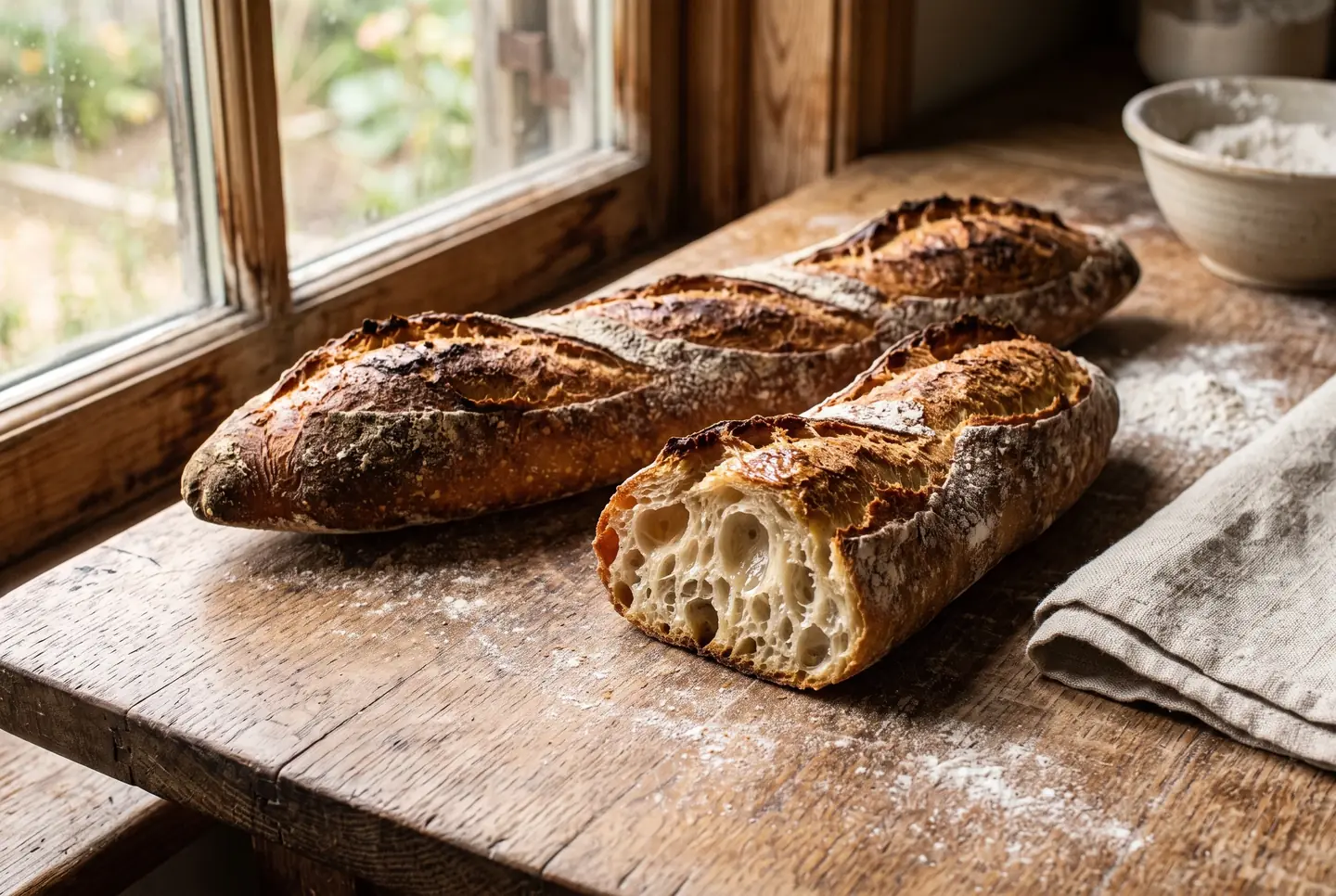
A good baguette shows itself before you bite. The crust is thin and cracks when you press it, so much that it splits on its own as it cools: the French say it sings. Underneath, the crumb is cream-coloured, glossy and full of irregular holes, nothing like the closed cotton wool of factory bread.
The cuts on top are not decoration. The ears (the grignes) that open in the oven are the signature of a baguette made right: they prove the dough had strength and gas at the right moment. If yours comes out smooth on top, with no raised ear, a step went missing. Toasted wheat aroma, a crust that makes noise, an open moist crumb: that is how you know it worked.
How the dough behaves
The baguette is the opposite of ciabatta in one respect: here you need structure. The dough sits around 70% hydration, enough for an open crumb, but you develop the gluten properly, by kneading or folding, because without strength the dough will not hold that long shape.
The overnight poolish makes the flavour. Twelve to sixteen hours with a tiny amount of yeast in equal weights of flour and water, and that is where the nutty, wheaty aromas form that the day's dough would never have time to build. The next day, the delicate work is the shaping: pre-shape, let it relax, then roll it up without squeezing, sealing the seam well. The right surface tension is what opens the ears in the oven.
Variations
The baguette de tradition is the pure four-ingredient version, made on the premises. The ordinary baguette allows industrial shortcuts and for that reason cannot use the word tradition. Outside France, the same dough becomes a ficelle (thinner) or a bâtard (shorter and fatter), both handy for a small oven.
At home, the most honest variation is levain instead of poolish: more acidity, a more rustic crust and slightly better keeping. No couche? Prove between the folds of a well-floured cloth. No lame? Score with a fresh razor blade fixed to a stick.
Where it goes wrong
The mistake that ruins a home baguette most often is a cold, dry oven. Without high heat and steam in the first minutes the crust will not crackle and the loaf will not open at the ears: it comes out pale and soft. Preheat properly, to 240 °C, and make steam with a tray of hot water or a spray bottle.
The second mistake is slack shaping. Without surface tension the dough spreads and the baguette turns into a flat snake. The third is scoring shallow and straight: the cuts must run at an angle, almost lying on the dough, and deep enough to guide the opening. And, like any bread, cutting it too hot leaves the crumb gummy.
Frequently asked
- Can I make a baguette without poolish?
- You can, with a direct ferment and a little more yeast, but the flavour is shallower and the bread stales faster. If you have 12 hours to spare, the poolish is the best return on effort in this whole recipe.
- I have no T65. What do I use?
- A medium-strength flour (type 0, or a bread flour of moderate protein) does the job. Avoid weak cake flour, which will not hold the shape, and very strong flour, which turns the crumb rubbery.
- Why will my baguette not open at the ears?
- Almost always too little tension in the shaping or a score that is too shallow. Roll it up sealing the seam well and cut on the diagonal, blade almost flat, deep enough to guide the split.
- Do I need a couche and a lame?
- They help but they are not required. A well-floured linen cloth stands in for the couche, and a fresh razor blade cuts as cleanly as a baker's lame. Steam is the part you cannot skip.